
On the Denali Park Road, the bus slows for a caribou crossing the gravel while the tundra rolls out toward a mountain that makes its own weather. Near Seward, the ground changes to spruce and moss, and the trail to Exit Glacier ends at a wall of blue-white ice that has been pulling back year after year.
Both are Alaska national parks, and they offer very different trips: one is a long look at wild interior country, the other is a coast of ice and water.
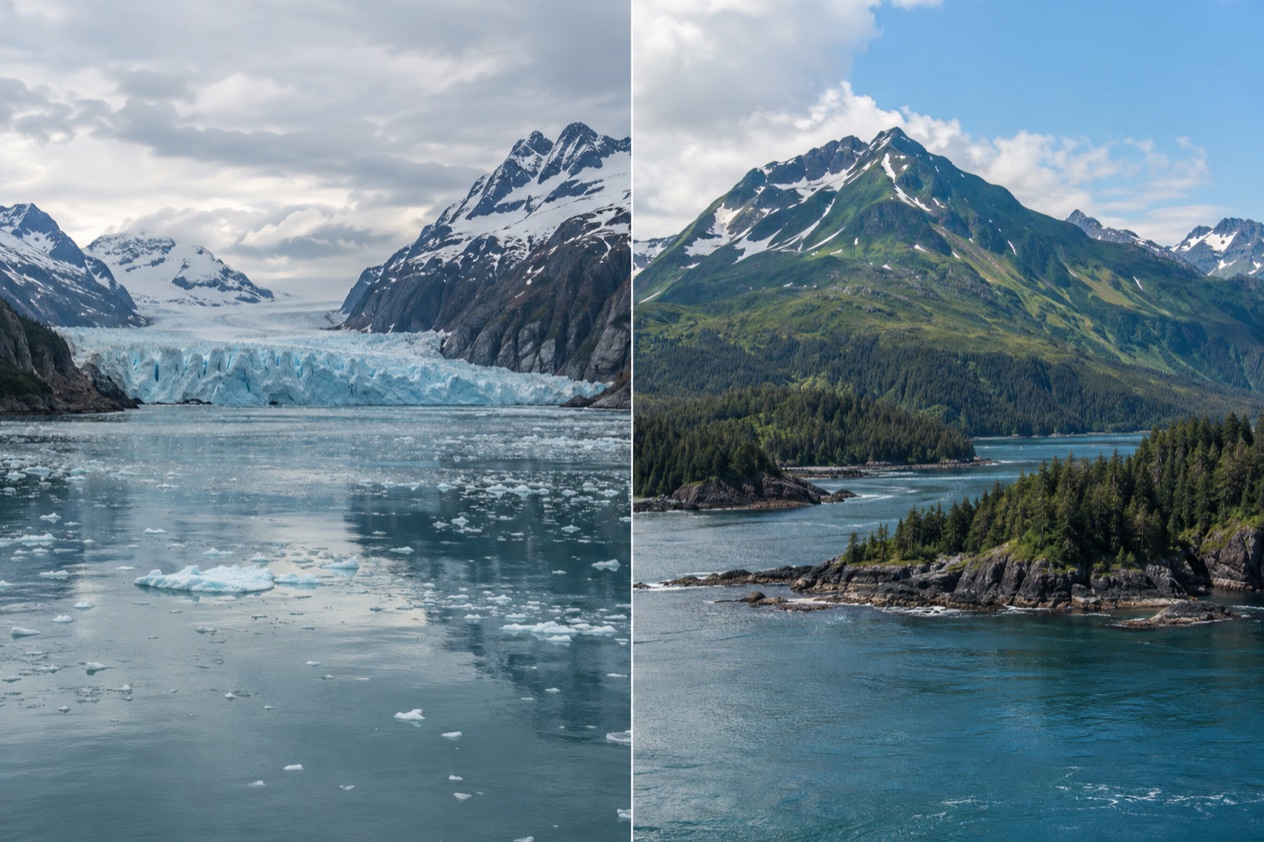
Which is better, Denali or Kenai Fjords?
Denali suits travelers who want big mountain country, a single long road into the wilderness and the chance to watch large animals roam open tundra, while Kenai Fjords suits those who want glaciers, a rugged coastline and the sea air around the town of Seward. Neither is the better park in general. They answer different wishes, and the table sets them out in plain terms.
| Category | Denali | Kenai Fjords |
|---|---|---|
| Scenery | Mount McKinley, tundra and one long park road | Retreating glaciers, Harding Icefield and a fjord coast |
| Vibe | Vast, quiet interior wilderness | Coastal, near a harbor town |
| Things to do | Riding or driving the Denali Park Road, watching for wildlife | Walking to Exit Glacier, exploring the coast |
| Wildlife | Large land animals may appear along the road | Marine and coastal life may appear along the shore |
| Weather | Main summer season from late May to early September | Coastal conditions near Seward |
| Getting there | Park Road starts at the George Parks Highway | Exit Glacier is the only part reached by road |
| Entrance fee | Pass required for most visitors | No entrance fee |
| Best for | Mountain and wildlife seekers | Glacier and coast seekers |
A traveler who wants to spend a day in a landscape without towns or buildings in sight will feel at home in Denali. A traveler who likes the idea of a day that ends with a harbor meal after time among glaciers will probably lean toward Kenai Fjords.
Both parks ask you to accept that nature sets the terms. The animals appear or they do not, the clouds lift or they stay, and a good trip in either place is built around what you see rather than what you expect.
Scenery and wildlife
Denali is built around one mountain. Mount McKinley rises 20,310 feet and is the roof of North America, and on a clear day it dominates the sky above rolling tundra, braided rivers and ridgelines in shades of rust and green.
The mountain often hides in cloud, so seeing it feels like a gift rather than a certainty. When it stays hidden, the wide valleys and the changing light on the tundra still fill the windows.
Wildlife in Denali is about open space. Along the park road you may see caribou, moose, Dall sheep on the slopes and grizzly bears working across the hillsides. These are chances, never promises, and part of the pleasure is scanning the slopes with binoculars and finding a dot that turns out to be an animal. The long summer light stretches the days and gives you time to look.
Kenai Fjords is a landscape of ice meeting the sea. The park holds Harding Icefield, a huge sheet of ice that feeds glaciers flowing toward the coast, and Exit Glacier, the one glacier you can reach by road. The coast itself is cut by fjords, with steep walls, forested shores and cold green water. Mist and rain are part of the scene, and they give the place its moody, ancient look.
Wildlife here is tied to the water and shoreline. On the coast you may see sea otters, sea lions, puffins and other seabirds, and whales are sometimes reported in the waters nearby. As in Denali, none of it is guaranteed, and the fjord scenery carries the day whether or not an animal appears. Many travelers remember the sound of ice cracking more than any single sighting.
For sheer drama of mountains and open land, Denali wins. For close contact with glacier ice and a coastline shaped by it, Kenai Fjords wins. If wildlife is the main draw, Denali offers the wider horizon for spotting big animals, while Kenai Fjords rewards people who like seabirds and marine life.
Things to do
The main activity in Denali is simply moving along the Denali Park Road and watching. The road is the only one in the park, and it runs 92 miles from the George Parks Highway to Kantishna.
In summer, roughly late May through early September, private vehicles may drive the first 15 miles to Savage River. That stretch gives a taste of the landscape, with open views of the valley and a place to stop and look back toward the mountains.
Beyond the road, Denali is a place for walking in tundra, scanning for animals and learning about the park at visitor facilities. Roughly 600,000 travelers come each year, mostly in the main summer season, and the park’s size means most of the experience still feels spacious. Quiet is a feature here, from the hush of the tundra to the crunch of gravel under your boots at a pullout.
Kenai Fjords is shaped around the glacier and the coast. Exit Glacier is the part reached by road, so it is the place most visitors begin.
You walk through forest toward the ice, hear meltwater rushing and see the marks where the glacier once reached. The ice has been retreating, and signs along the way show how far it has moved. Road status for Exit Glacier can be checked in the park’s current conditions and alerts.
The rest of the park is coast, and it is seen from the water. Boat trips from Seward carry travelers into the fjords to look at tidewater glaciers, cliffs and wildlife.
The town itself, near the park and west of it by the park’s own description, is a working harbor with restaurants serving fresh seafood. Salmon and halibut are the dishes to look for, and a chowder after a cold day on the water is a small ritual of the place.
There is no entrance fee at Kenai Fjords, and no camping fee is charged, which suits travelers who like to keep a trip loose. Day trips in this part of Alaska often combine a glacier walk, a harbor stroll and a meal in Seward, with the order depending on weather.
Weather and the best time to go
Denali’s visitor season centers on the main summer season, from late May to early September. That is when private vehicles may use the first stretch of the Denali Park Road and when most travelers arrive. Interior weather can change quickly, with sun, wind and rain passing through in a single day, and the tundra can feel warm in the sun and cold in the shade. Layers matter more than any single forecast.
The mountain is a weather maker. Clouds gather around it and can hide it for days, then clear and reveal it in the evening. Planning a trip around seeing it is a gamble, and the better approach is to enjoy the land at your feet. Long summer days stretch the light, so an evening outing is a real possibility.
Kenai Fjords has a coastal climate, which in Alaska means cloud, mist and rain are always possible. Rain is part of the scene, and glaciers often look best under soft gray light, when the blue of the ice stands out. Sunny days bring wide views across the water and the icefield, but they are a bonus rather than the baseline.
The road to Exit Glacier is the one way into the park by land, and its status can change, so the park’s current conditions and alerts are the place to look before you set out. Because Denali has a defined summer season, it pays to match your dates to that window. Kenai Fjords is less tied to one window, but the coast rewards patience whichever dates you choose.
If you can choose, pick Denali for the main summer season and Kenai Fjords for any stretch when the road and the coast cooperate. Pack for changeable weather in both, with rain protection near the coast and warm layers in the interior.
Getting there and getting around
Denali is reached by the George Parks Highway, where the Denali Park Road begins. Once in the park there is one road to follow, which makes planning simple. The road runs to Kantishna, but it is closed to all traffic at Mile 43 because of the Pretty Rocks landslide, so the way ahead is shorter than the full length suggests. In summer, private vehicles may go as far as Savage River.
The single road shapes the whole visit. There is no network of routes to choose among, so a day in Denali is a day along that road, with pullouts, views and walks built around it. Time is measured less by distance than by how often you stop to look.
Kenai Fjords is near Seward, and the park lies west of the town. Exit Glacier is the only portion of the park accessible by road, and visitors primarily reach the park by driving to that retreating glacier. Everything else in the park lies along the coast and is not reached by road, which is why the coast is seen from the water.
That makes Kenai Fjords a base-and-outing park. You settle in Seward, go to Exit Glacier by road and plan a separate day on the water for the fjords. The park’s mailing address is in Seward, a reminder that the town and the park are tied together.
Both parks reward simple plans. In Denali, follow the one road as far as it goes. In Kenai Fjords, treat Exit Glacier as the land entry and the coast as a second chapter.
Who should choose which
Choose Denali if you are drawn to vast landscapes, a mountain that stands above everything and the chance to watch large animals from a distance. It suits travelers who like quiet, who are happy to spend a day looking out across tundra and who treat a clear view of the peak as a bonus. It also suits those who enjoy the logic of one road and one long journey along it.
Choose Kenai Fjords if you want ice, water and a harbor town in one trip. It suits travelers who like the idea of walking to a glacier, then spending another day on the coast among cliffs and seabirds. It is also the better match for those who care about seafood and a base with restaurants and a working waterfront.
Combining them is possible if your trip has room for both, since they give two different pictures of Alaska: the interior and the coast. The parks are separate destinations, so treat them as two chapters rather than a single outing, and let each have its own days. If you can only pick one, let the main draw decide: mountain and tundra for Denali, glaciers and coast for Kenai Fjords.
Good to know before you go
Denali charges an entrance pass for most visitors, while Kenai Fjords charges nothing for entry or camping. Wildlife in both parks is wild, so follow the National Park Service guidance you receive at the visitor facilities. The Denali Park Road is closed at Mile 43, and the summer season runs from late May to early September.
| Fee | Who pays |
|---|---|
| Denali standard pass (valid 7 days) | Visitors, except youth age 15 or younger |
| Denali annual pass (covers up to four adults) | Visitors who choose it |
| Kenai Fjords entrance or camping | No one |
Sources
- National Park Service, Denali National Park & Preserve, plan your visit (https://www.nps.gov/dena/planyourvisit/index.htm), checked October 11, 2026
- Wikipedia, Denali National Park and Preserve (https://en.wikipedia.org/wiki/Denali_National_Park_and_Preserve), checked October 11, 2026
- National Park Service, Kenai Fjords National Park, plan your visit (https://www.nps.gov/kefj/planyourvisit/index.htm), checked October 11, 2026
- Wikipedia, Kenai Fjords National Park (https://en.wikipedia.org/wiki/Kenai_Fjords_National_Park), checked October 11, 2026
To plan your stay
- Best Time to Visit Denali National Park: Summer Buses, Fall Road, Winter Quiet and Weather by Month
- Things to Do in Denali National Park: Park Road Rides, Sled Dogs, Trails and Where to Eat
- Where to Stay in Denali National Park: Park Entrance, Healy, Backcountry Lodges and Campgrounds
- Denali National Park from Anchorage: the Parks Highway, the Denali Star Train and Park Shuttles