
Somewhere around ten at night in Fairbanks, the sky is still pale and people are still out on the baseball field, in the glow that sets the rhythm of an Alaska summer. In December, the same question comes back the other way, when the afternoon light in Anchorage is already fading.
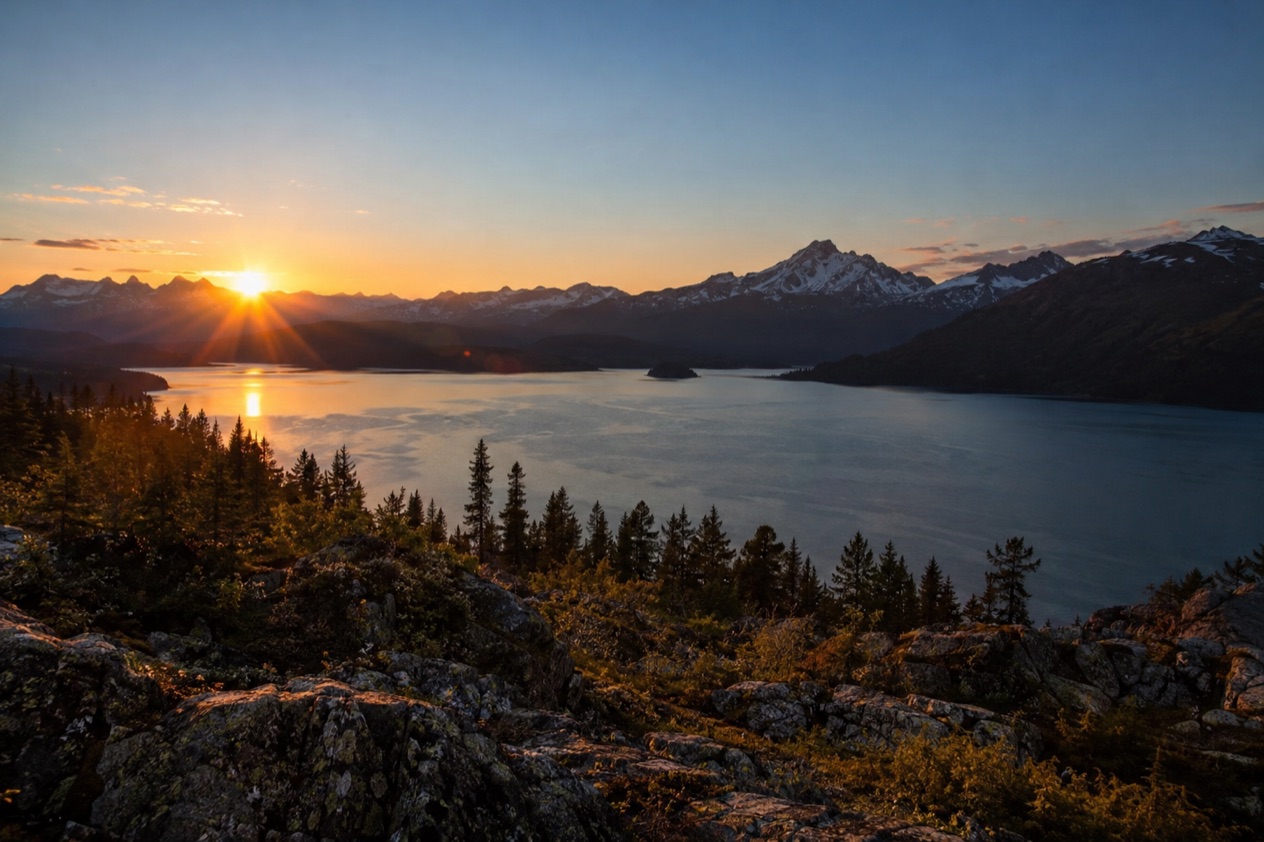
How many hours of daylight does Alaska get?
There is no single answer, because the state stretches from the Anchorage area to the Arctic coast, and the amount of daylight on a given day changes enormously with the town you pick. In midwinter a southern city gets a short but real day, while the far north gets none at all. In early summer the order flips and the north is lit around the clock.
A handful of places tell the story well. Each one below has its own figures, and they should be read as that place’s own, not as a statewide number.
| Place | Moment | Daylight |
|---|---|---|
| Anchorage | December 15 | About 5 hours 34 minutes |
| Fairbanks | May 17 to July 27 | 24 hours of sunlight, 70 straight days |
| Fairbanks | Summer solstice | Sun sets at 12:47 a.m. |
| Utqiagvik | November 21 to January 21 | No daylight |
| Utqiagvik | Polar day and polar night | 84 days of polar day, 68 days of polar night |
| Arctic Circle | June 12 to July 1 | Some part of the midnight sun is visible |
Anchorage in the dark months
Anchorage sits well south of the Arctic, so even in the darkest stretch of the year the sun comes up and goes down. A day in mid-December is brief, and by the time you have finished a late breakfast the light is already low and soft. It is a winter of lamplit streets, steaming coffee shops and long evenings, with daytime plans fitted into a narrow window.
That short day still has a character of its own. The light in the middle of the day tends to be the best of it, and anything you want to see outdoors belongs in those hours. Evenings are the time for museums, restaurants and whatever the season offers indoors.
Fairbanks and the endless summer
Fairbanks is the place travelers picture when they think of Alaska summer light. From mid-May to late July, Fairbanks never gets fully dark, even though the sun dips below the horizon. Even at the solstice, when the sun does finally dip below the horizon, it sets after midnight and the sky stays bright through what would be night anywhere else.
This is the light behind the Midnight Sun Game, a baseball tradition played since 1906 around midnight on June 21, with no stadium lights needed. Fairbanks lies south of the Arctic Circle, so the glow comes from how little the sun sinks rather than from true polar latitudes. You can feel the effect at any hour: dinner at nine looks like afternoon, and a walk at eleven still comes with long shadows.
Utqiagvik at the top of the country
Utqiaġvik, formerly known as Barrow, is the northernmost city in the United States and sits on the North Slope. Its year is split by two long extremes. Polar day lasts much longer than polar night, though the dark stretch is just as striking, with the sun gone from late November until late January.
In the weeks around those dates, the middle of the day is often the brightest part, a pale glow of twilight rather than real daylight. Polar twilight in general follows this pattern, with the sky lightest at midday and darkening toward both ends of it. In summer, the same town lives in the opposite rhythm, with the sun above the horizon day after day.
The Arctic Circle line
Midnight sun is the sun remaining visible at local midnight. It occurs at latitudes north of about 65 degrees 44 minutes, and at the Arctic Circle itself some part of it can be seen in a narrow window from mid-June to the start of July. Refraction in the atmosphere bends the light enough that the effect can reach as far as 56 miles outside the circle.
Farther inside the circle, the stretch of continuous sun grows. At the North Pole, midnight sun lasts about six months. For Alaska travelers, the practical meaning is simple: the farther north the town, the longer the period of round-the-clock light in summer and the longer the dark in winter.
How does daylight change through the year?
Daylight swings from very little in winter to nearly nonstop in summer, and the change is fastest in the spring and the fall. A traveler arriving in March and another arriving in June will not recognize the same town, even though the streets and the mountains look the same.
Winter, when the day shrinks
From late fall through the middle of winter, the day is a short window with a long, low sun. In Anchorage that window shrinks to a little over five hours at its tightest, and in places that lie inside the polar circles the sun disappears altogether for a stretch. True polar night, with stars visible through the whole day, is limited to far higher latitudes than anywhere in Alaska.
What you see in a northern Alaska winter is polar twilight. The sky brightens a little at midday, turns blue or pink along the horizon and fades again. For travelers this is the appeal of the season, a hushed, dim, slow version of the day that suits quiet walks and warm rooms.
Spring and fall, the quick turn
In the shoulder months, the light changes noticeably from one week to the next. Spring brings the day back fast, with evenings stretching a little longer as the weeks go by. Fall does the reverse, and the evenings close in until the short days of winter take over again.
These months are the ones where a month on the calendar tells you least about what the day will feel like. A trip early in a month can have a different light from a trip late in the same month, so the exact dates are worth keeping in mind when you plan a day’s outing.
Summer, when night barely arrives
From late spring into midsummer the sun stays up for most of the day and into the late evening. In Fairbanks, that means a long run from mid-May to late July when sunlight is counted around the clock. Farther north in Utqiagvik, polar day outlasts anything in the interior, and the town goes weeks without a sunset.
The most visible effect is on how a day feels. A late dinner under a bright sky, a ballgame at midnight, a walk at an hour when you would normally be asleep are all part of an Alaska summer. After the solstice the evenings slowly begin to darken again, even though the summer feel hangs on for weeks.
What does it mean for a trip?
Daylight shapes the kind of trip you take because it changes when natural light is available, what the landscape looks like and how you spend your evenings.
Planning a summer day
When the sky stays bright into the night, a day does not have to end at dinner. In Fairbanks you can plan an evening outdoors with plenty of light left, and the Midnight Sun Game around June 21 is a good example of a tradition built entirely on that glow. The day feels long, and the usual rhythm of morning, afternoon and night loosens.
The flip side is that it can be easy to lose track of time. Bright skies at an hour when you would expect dusk can make you stay out later than you meant to. Eating, resting and heading in a little earlier than the sky suggests helps the trip keep its shape.
Planning a winter day
A short winter day puts a limit on how much you can fit in outdoors. In Anchorage, the middle of the day is the time for anything that depends on natural light, and the rest of the schedule can lean on indoor stops, warm meals and long evenings. The pace of the trip is slower, and that is often the point.
Farther north, the planning changes again. In Utqiagvik, where the sun is gone for weeks, the middle of the day gives a soft twilight and nothing more. A trip there in the dark season is about the sky, the cold and the quiet, not about sightseeing in daylight.
Matching the month to the trip
If long days and open evenings are what you are after, look to the weeks around late spring and early summer, when the north is at its brightest. If you would rather see Alaska in its quiet season, the short days of midwinter have a mood of their own, with lamplit towns and low light over the mountains. The shoulder months sit in between and bring a mix of both.
One more thing worth keeping in mind is that the place you choose changes the answer as much as the month. Anchorage, Fairbanks and Utqiagvik can have very different light on the very same day, so the figure for one town should never be borrowed for another. Pick the place first, then read its light.
Good to know before you go
It helps to look up the exact day and town before planning outdoor hours. Fairbanks and Utqiagvik live by very different clocks from Anchorage, and Juneau and the rest of the Southeast, which are not connected to the rest of the road system by road in most cases, have their own light again. It helps to look up the exact day and town you are traveling to before planning outdoor hours.
Sources
- Wikipedia, Midnight sun (https://en.wikipedia.org/wiki/Midnight_sun), checked October 11, 2026
- Wikipedia, Polar night (https://en.wikipedia.org/wiki/Polar_night), checked October 11, 2026
- Wikipedia, Alaska (https://en.wikipedia.org/wiki/Alaska), checked October 11, 2026
- Fairbanks International Airport (https://www.dot.alaska.gov/faiiap/), checked October 11, 2026
- Alaska Department of Transportation, Alaska Marine Highway System, Passenger and vehicle fares (https://dot.alaska.gov/amhs/fares.shtml), checked October 11, 2026
- National Park Service, Katmai National Park & Preserve, plan your visit: nearbyattractions (https://www.nps.gov/katm/planyourvisit/nearbyattractions.htm), checked October 11, 2026
- Alaska Railroad, Glacier Discovery (https://www.alaskarailroad.com/ride-a-train/our-trains/glacier-discovery), checked October 11, 2026
- Explore Fairbanks (https://www.explorefairbanks.com/), checked October 11, 2026
- Computed from the date and the latitude of the place (sunrise equation, solar elevation -0.833 degrees), October 11, 2026