
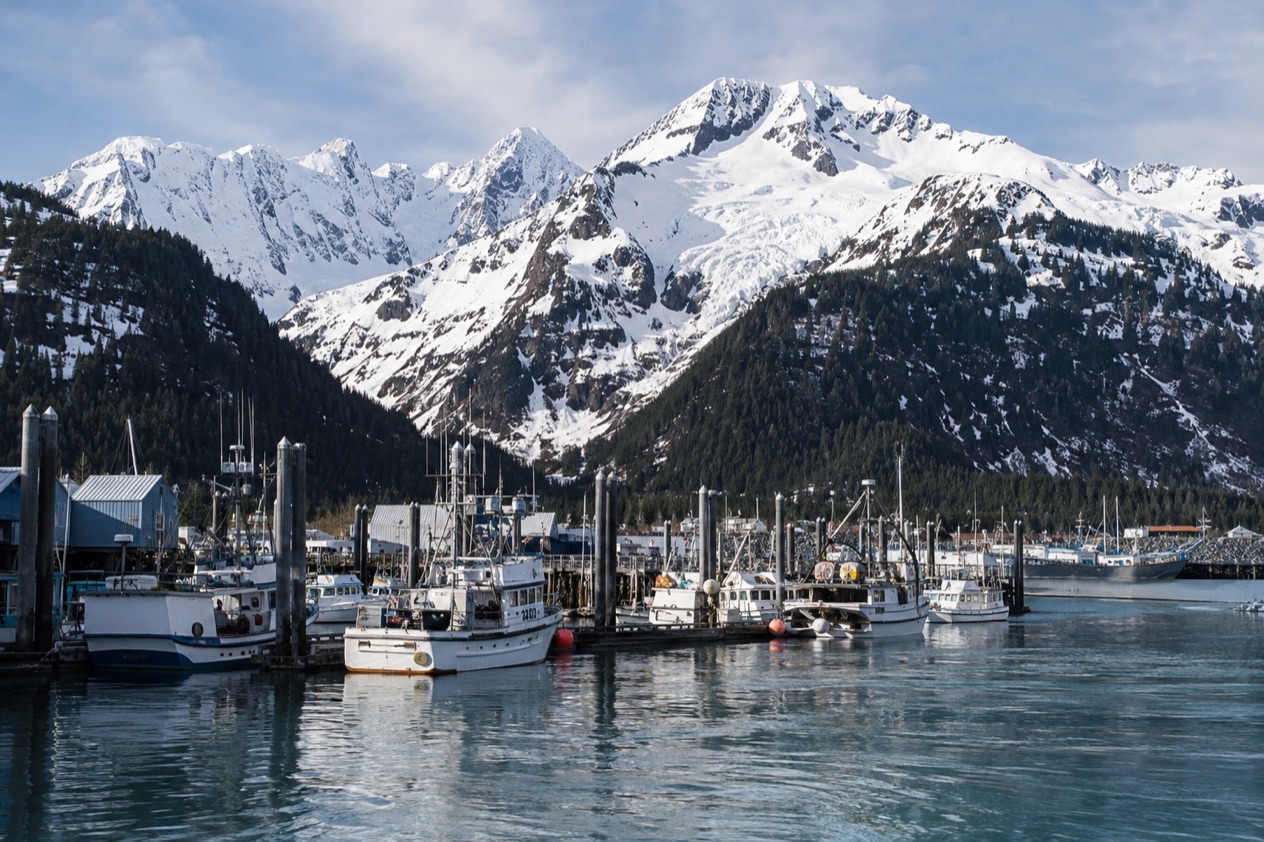
In early May, the mudflats outside Cordova fill with shorebirds arriving from far away, and the town answers with a festival of its own. Fishing boats sit snug in the harbor, mountains rise straight behind the main street, and no road leads out to the rest of Alaska. Cordova is a small fishing town on Prince William Sound, made for travelers who like wetlands, glaciers and a slow pace.
Where is Cordova and what is it like?
Cordova sits on the mainland shore of Prince William Sound, about 50 miles southeast of Valdez and 150 miles from Anchorage, and it is a working fishing town with a quiet, close-knit feel. The sound around it is also home to Whittier and the Alaska Native villages of Chenega and Tatitlek, but Cordova stands apart from them all, because it can only be reached by air or by boat.
That isolation shapes everything. The town does not have the tour-bus rhythm of places on the main road system. Instead you find a harbor where boats come and go, small shops and cafés, and neighbors who know each other.
The Copper River Delta lies next door, a wetland of 700,000 acres that is the largest contiguous wetland on the Pacific Coast of North America. It is a landscape of channels, grass flats and distant peaks, and it shapes the town’s seasons as much as the fishing does.
The name has older layers. James Cook entered the sound in 1778 and first called it Sandwich Sound, before it was renamed for Prince William Henry, a son of George III. Cordova’s own history is tied to copper, since the Copper River and Northwestern Railway once hauled ore from Kennicott down to the town’s harbor.
Cordova suits people who like to wander, watch birds, look at water and talk with locals. It may not suit anyone who wants a long list of attractions, a busy nightlife or a road trip arriving from the highway. Rain is part of the picture here, as the climate section later explains, and the pace follows the weather and the tides more than any schedule.
What is there to do in Cordova?
The big reasons to come are the birds of the delta, the Copper River Highway out to the Million Dollar Bridge, the town’s festivals and, in winter, a very old ski lift. What sets Cordova apart from its neighbors on the sound is that the wild country begins almost at the edge of town, and the town itself still revolves around fishing.
The Copper River Delta and its birds
The delta draws more than 5 million migratory birds each spring, and that arrival is the reason many people plan a trip. Shorebirds crowd the flats in clouds, rise together, wheel over the water and settle again. Even if you are not a birder, the scale of the wetland, with the mountains standing behind it, gives a sense of how big this coast is.
The Copper River Delta Shorebird Festival, hosted by the Cordova Chamber of Commerce, is held in early May to celebrate the migration. It is the natural moment to be here for the birds, and it gives the town a lively, welcoming mood. Binoculars matter more than anything else you bring.
The Copper River Highway and the Million Dollar Bridge
The Copper River Highway begins at the ferry terminal in Cordova and runs 49.5 miles toward the Million Dollar Bridge over the Miles Glacier. The first 12 miles are paved and the rest is gravel. Past mile 36, the road has been de facto abandoned since 2011 because erosion damaged the approach to Bridge 339, so it is not a through route to the bridge by car.
The bridge, officially the Miles Glacier Bridge, spans the Copper River at Mile 48 and is 1,550 feet long. It was built for the railway that carried copper from Kennicott to Cordova. Visitors can reach it by jet boat up the Copper River from Cordova, or by boat downriver from Chitina. It is a fine goal for a day, with the river, the glacier and the old railroad history all in one view.
Festivals through the year
Cordova marks its year with community events. The Iceworm Festival comes each February, with a parade, a talent show, a royal crowning ceremony, an oyster shucking contest, a ping pong tournament and a survival suit race. It is a cheerful midwinter break in a town that knows how to enjoy the dark months.
In July the Copper River Salmon Jam takes place, a nod to the fish that built the town’s economy. Between the Iceworm in winter, the Shorebird Festival in spring and the Jam in summer, a visit can be built around the event that matches your interests.
Mt. Eyak, an old ski lift
The Mt. Eyak ski area has a single chair lift and a rope tow, and it is the oldest working ski lift in North America. It is a small, local place rather than a big resort, which is the charm. Skiers and curious visitors alike can enjoy the idea of riding a lift with that much history above a fishing town.
How many days do you need in Cordova?
A long weekend is enough to taste Cordova, and a week lets you slow down to the pace the town sets. Because the town is reached only by air or boat, the trip starts with a deliberate arrival, and it makes sense to give yourself more than one night.
With two or three days, you can walk the harbor and the main street, get a feel for the fishing town, and drive the paved first miles and beyond of the Copper River Highway. Add a day for the delta if the birds are in, since the wetland rewards patience and a long, unhurried look.
With a week, the Million Dollar Bridge by jet boat becomes a real option, and so does a festival visit. You can leave room for weather, which in this part of Alaska often shapes the plan. A rainy day can be a harbor day, with coffee, a walk and conversation, and the next clear one a day on the delta.
Longer stays can also include a ferry trip to Valdez or Whittier, both linked to Cordova by the Alaska Marine Highway System. Valdez sits about 50 miles from Cordova and is the largest port on Prince William Sound, so it makes a natural pairing for a longer trip on the sound.
Where to stay in Cordova
Cordova is small enough that the question is less about neighborhoods than about the feel of the stay. The town itself, near the harbor and the ferry terminal where the Copper River Highway begins, is the natural base for most visitors. From there, the harbor, the shops and the start of the highway are close at hand, and you are in the middle of the town’s daily life.
A stay in town suits anyone who wants to wander on foot, watch the boats and meet the people who live here. It also puts you near the festivals, which are community events rather than staged shows. Those who come for the delta will find that the town is the point from which everything else starts, whether by road or by boat.
Beyond town, the Copper River Highway leads out into wetland country. The road is paved for its first 12 miles and gravel after that, and it runs through open landscape rather than a string of lodging districts. That makes the outer stretch a place for day outings more than an area to settle in, so the town stays the practical home base for nearly everyone.
Winter visitors who come for the Iceworm Festival or the Mt. Eyak lift will also want to be in town, close to the action. In every season, the simplest plan is to stay in Cordova itself and treat the delta, the highway and the bridge as outings from there.
How do you get to Cordova and get around?
Cordova can only be reached by air or by boat, since no roads connect it to any other Alaskan community besides Eyak. That is the defining fact of any trip here, and it is part of the town’s charm. The town lies about 150 miles from Anchorage, but there is no drive between them.
By water, the Alaska Marine Highway System, the state-owned ferry service, provides regular service to Valdez and Whittier. Stops at Tatitlek and Chenega Bay are made only if prior reservations have been made. The ferry terminal is also where the Copper River Highway begins, so arrival and the start of the road out are in the same spot.
Getting around once you are there is mostly about the town and the one highway. The town can be explored on foot, with the harbor and main street close together.
The Copper River Highway runs 49.5 miles from the terminal toward the Million Dollar Bridge, with the first 12 miles paved and the rest gravel. Past mile 36 the road has been de facto abandoned since 2011, after erosion hit the approach to Bridge 339.
To reach the bridge itself, visitors go by jet boat up the Copper River from Cordova, or by boat downriver from Chitina. The river is the working route, much as the railway once was for copper.
When is the best time to visit Cordova?
Early May is the headline moment, when the Shorebird Festival coincides with the arrival of millions of migrating birds on the delta. If birds are your reason for coming, that is the month to name. July is the other natural choice, with the Copper River Salmon Jam, and the summer air is mild.
The climate in July is cool and damp, with afternoons in the low 60s and nights in the upper 40s. Rain falls on a good share of the days, so bring layers and treat showers as part of the visit. A July day here can mix cloud, drizzle and clear spells.
January is cold, with highs in the low 30s and lows near 19 degrees, and precipitation can fall as rain or snow on a good share of days. That season belongs to the Mt. Eyak lift and, in February, to the Iceworm Festival with its parade, oyster shucking contest and survival suit race.
| Month | Average high (°F) | Average low (°F) | Precipitation (inches) | Days with precipitation |
|---|---|---|---|---|
| January | 33.7 | 19.0 | 6.22 | 11.2 |
| July | 61.6 | 47.6 | 5.70 | 12.4 |
Good to know before you go
Plan the arrival first, since Cordova has no road link to the rest of Alaska and can be reached only by plane or ferry. The Alaska Marine Highway stops at Tatitlek and Chenega Bay only with prior reservations.
Bring rain layers in any month, because precipitation falls on roughly a third of the days in both January and July. Festivals fall in February, early May and July, so choose your season by what you want to see.
Sources
- Alaska.org, dest cordova (https://www.alaska.org/destination/cordova), checked October 11, 2026
- Wikipedia, Cordova, Alaska (https://en.wikipedia.org/wiki/Cordova,_Alaska), checked October 11, 2026
- Wikipedia, Copper River Highway (https://en.wikipedia.org/wiki/Copper_River_Highway), checked October 11, 2026
- Wikipedia, Million Dollar Bridge (https://en.wikipedia.org/wiki/Million_Dollar_Bridge), checked October 11, 2026
- Wikipedia, Prince William Sound (https://en.wikipedia.org/wiki/Prince_William_Sound), checked October 11, 2026
- Wikipedia, Climate of Alaska (https://en.wikipedia.org/wiki/Climate_of_Alaska), checked October 11, 2026
- NOAA NCEI, U.S. Climate Normals 1991-2020, monthly (https://www.ncei.noaa.gov/access/services/data/v1?dataset=normals-monthly-1991-2020&stations=USW00026410), station Cordova M K Smith Ap, elevation 31 feet, checked October 11, 2026