
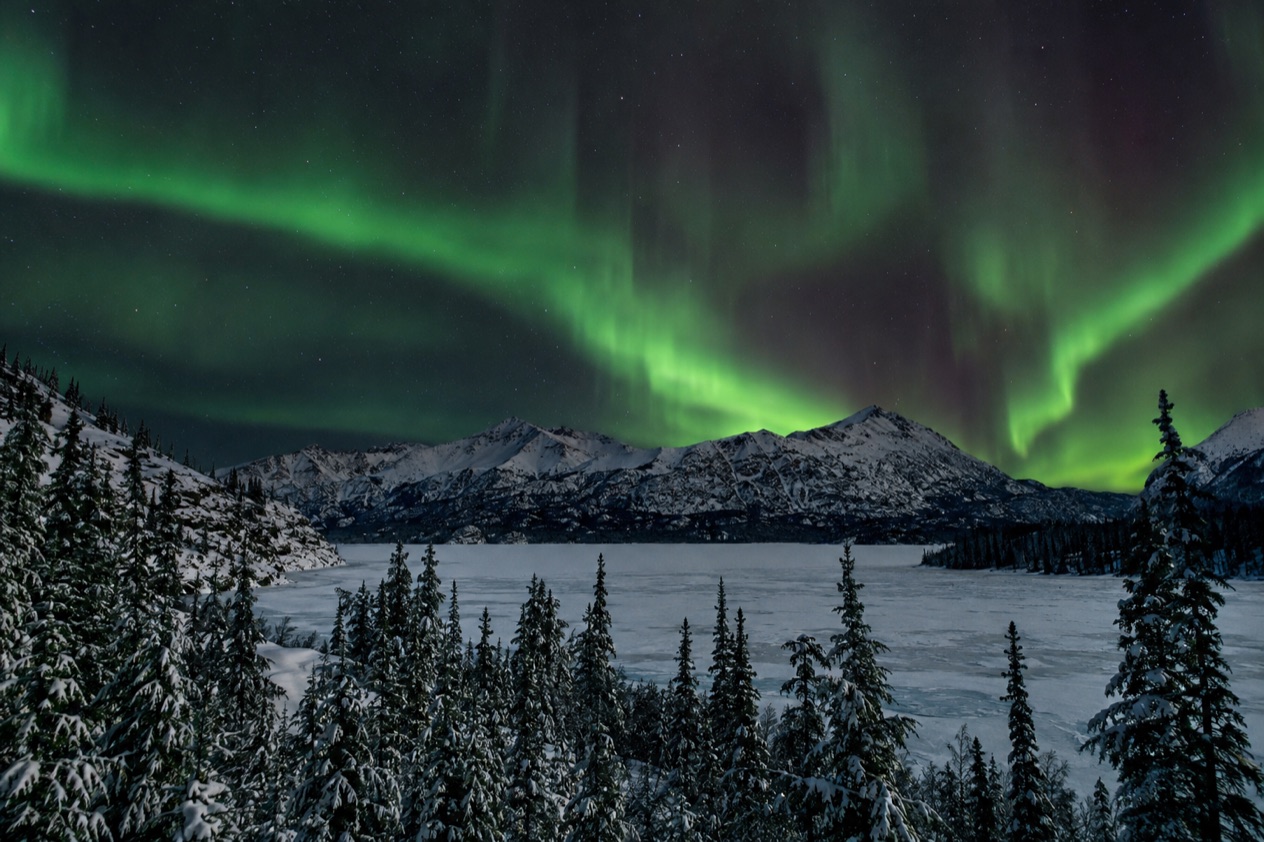
Out past the last streetlights near Fairbanks, a cold stillness settles in, and then a pale green band slides across the sky, brightens, and starts to ripple like a curtain in a draft. People stamp their boots, pour something hot from a thermos and keep their eyes upward. In Alaska, this scene belongs to the dark half of the year, from late summer into early spring, and the Interior around Fairbanks is where many travelers plan it.
When is the best time to see the northern lights in Alaska?
The best time is the dark season, roughly from late August to late April around Fairbanks, with the strongest odds in the cold, clear nights of fall, winter and early spring. The northern lights oval, the zone where the lights are most likely, covers most of Alaska, so you are already well placed once you arrive. Darkness and clear skies matter more than any single date.
The aurora itself is a collision between charged particles from the sun and gas molecules high in the atmosphere, and it can glow green, red and purple. It hangs far above the clouds, so what stops you from seeing it is cloud cover, moonlight or a bright sky, not a lack of lights up there. Auroral activity also follows an 11-year solar cycle, and the busy years around the recent peak have given watchers extra chances.
Fairbanks and the Interior
Fairbanks sits at about latitude 64.8, and it is the town most associated with aurora watching, with many tours and viewing sites set up for it. The University of Alaska Fairbanks Geophysical Institute says that if the weather is clear and you stay at least three nights, it is highly likely you will see the aurora. That is a good reason to plan a few evenings rather than a single one-night attempt.
Local favorites for getting away from town lights include Chena Lakes Recreation Area, Tanana Lakes Recreation Area, Cleary Summit and Ester. Others are the Wickersham and Murphy Domes, Haystack Mountain on the Elliot Highway, and turnouts along the Elliot, Steese and Parks Highways. Chena Hot Springs Road, Nordale Road and the Ballaine Road turnout near the Goldstream Creek bridge also make the list.
Dark sites away from city glow work best, and areas well outside cities are preferred. Dress warmly, because watchers spend long hours standing in the cold and dark. If you want to photograph the display, you need a camera that supports manual exposure of 5 to 40 seconds.
Riding the Aurora Winter Train
The Alaska Railroad’s Aurora Winter Train links Anchorage and Fairbanks on weekends from mid-September to mid-May, northbound on Saturday and back south on Sunday, with select mid-week departures too. It stops at Wasilla, Talkeetna, Hurricane, Healy and Nenana, and it has onboard dining. On a clear day you may see Denali above the Susitna River.
Along a roadless backcountry stretch south of Hurricane Gulch, the train offers flagstop service, a reminder of how much of Alaska is reached by rail rather than road. The schedule may vary with the number of stops, so treat it as a slow trip with scenery as part of the point. Fairbanks is the end of the line, and the aurora viewing happens once you are there.
Checking the forecast and the cameras
The Geophysical Institute posts an Aurora Forecast on its website, and live aurora cameras run from Poker Flat Research Range, Toolik Field Station, Gakona and Fairbanks. Glancing at them in the evening tells you whether the sky is clear and whether the lights are already moving. A strong geomagnetic storm, a planetary K-index of 5 or higher, can even push the lights well south of the oval, though that is the exception.
Which months and which hours?
Late September to late March is the core window, and the best hours are the late evening through the small hours, with the stretch around midnight the most promising. Fairbanks has a viewing season of roughly August 21 to April 21, but nights need to be properly dark, which is why the deep fall, winter and early spring months carry the weight.
The months
Auroral activity tends to be stronger around the fall and spring equinoxes than at the winter or summer solstice. Over Interior Alaska, the statistical likelihood of seeing the aurora is roughly twice as high at an equinox as at a solstice. Geomagnetic storms also occur more often in the months around the equinoxes, so September and March deserve a look alongside the deep winter.
That does not make December a poor choice. Winter nights are long, and the Winter Solstice Celebration in Downtown Fairbanks takes place during the week of December 21, with fireworks you cannot see in the summertime. If you want the lights plus a festive town, that week has real appeal. Cold is the trade-off, and it is the reason warm layers are essential.
Late winter brings its own draws. Ice art sculptures are on display around Fairbanks from mid-February to the end of March, and the World Ice Art Championships run late February through March with over 80 sculptures by international carvers. In mid-March, the Open North American Championship sled dog race takes place in Fairbanks, which makes a daytime reward for late nights outside.
The hours
In winter in Interior Alaska, the best watching is typically from 9 p.m. to 3 a.m. The three or four hours centered on midnight have the highest probability of spectacular displays. Another source puts the highest probability between 10 and 11 p.m., so a plan that starts after dinner and runs well past midnight covers both views.
That is a late schedule, and it shapes the rest of the trip. Many travelers plan a slow morning, a daytime outing and a nap before heading out. A warm spot to wait, and a camera set up before the sky wakes up, make a long night easier.
The moon
A full or nearly full moon adds ambient light and may hide the dimmer features of an aurora. Moonlight can also enhance colors by activating the cone cells in your eyes, so a bright moon is not a ruined night. If your dates are flexible, a darker moon gives faint displays a better chance, but clear skies matter more than the lunar calendar.
Staying more than one night
Clouds are the main gamble. Because the lights depend on a clear sky as much as on solar activity, three nights give you three separate shots, and that is the guidance behind the highly likely odds in Fairbanks. Webcams and the forecast help you decide each evening whether to head out to Cleary Summit, a lakeside site or a highway turnout.
What about the midnight sun?
The midnight sun and the northern lights do not share a season, because the summer sky around Fairbanks never gets dark enough for the aurora. Between April 22 and August 20, the sky does not get dark enough to see it, even if the display is spectacular. A summer trip is a different trip, and it should be planned for its own sake.
Why summer is out for the lights
The aurora hangs roughly 60 miles up, and its visible top fades out at about 120 to 200 miles. It is there all year in principle, but in the bright northern summer, daylight and twilight simply wash it out. The viewing season in Fairbanks opens again around August 21, as nights lengthen and the sky finally turns dark.
If you land in late April or in August, you are on the edge of the season. These shoulder weeks reward flexibility, because the first dark evenings of late summer can feel like a quiet, uncrowded start to the viewing year. Early and late dates also come with more daylight than deep winter, so the window each night is shorter.
Choosing between the two seasons
If the lights are the goal, aim for the dark months and treat any summer sunshine as a different vacation. Summer travelers who still want a taste of the aurora can watch the live cameras at Poker Flat, Toolik Field Station, Gakona and Fairbanks, or read the Geophysical Institute’s forecast. Those give a sense of the sky without the dates.
Travelers who love long light and the aurora both can make two trips, one in each season. A fall visit from late September gives dark evenings that are still not deep winter, and the Aurora Winter Train starts running in mid-September. That makes September a natural bridge between the bright season and the dark one.
Good to know before you go
Plan on cold, dark, late hours, and pack for standing still outdoors for a long time. Choose dark sites well outside city lights, keep a few nights open for clouds, and watch the forecast and live cameras each evening. Baggage service on the Aurora Winter Train is available only at Anchorage and Fairbanks, and wheelchair access is available at Anchorage, Wasilla, Talkeetna and Fairbanks only.
Sources
- University of Alaska Fairbanks Geophysical Institute, Aurora forecast (https://www.gi.alaska.edu/monitors/aurora-forecast), checked October 11, 2026
- Wikivoyage, Northern lights (https://en.wikivoyage.org/wiki/Northern_lights), checked October 11, 2026
- Wikipedia, Aurora (https://en.wikipedia.org/wiki/Aurora), checked October 11, 2026
- Explore Fairbanks, winter events (https://www.explorefairbanks.com/events/winter-events/), checked October 11, 2026
- Alaska Railroad, Aurora Winter (https://www.alaskarailroad.com/ride-a-train/our-trains/aurora-winter), checked October 11, 2026