
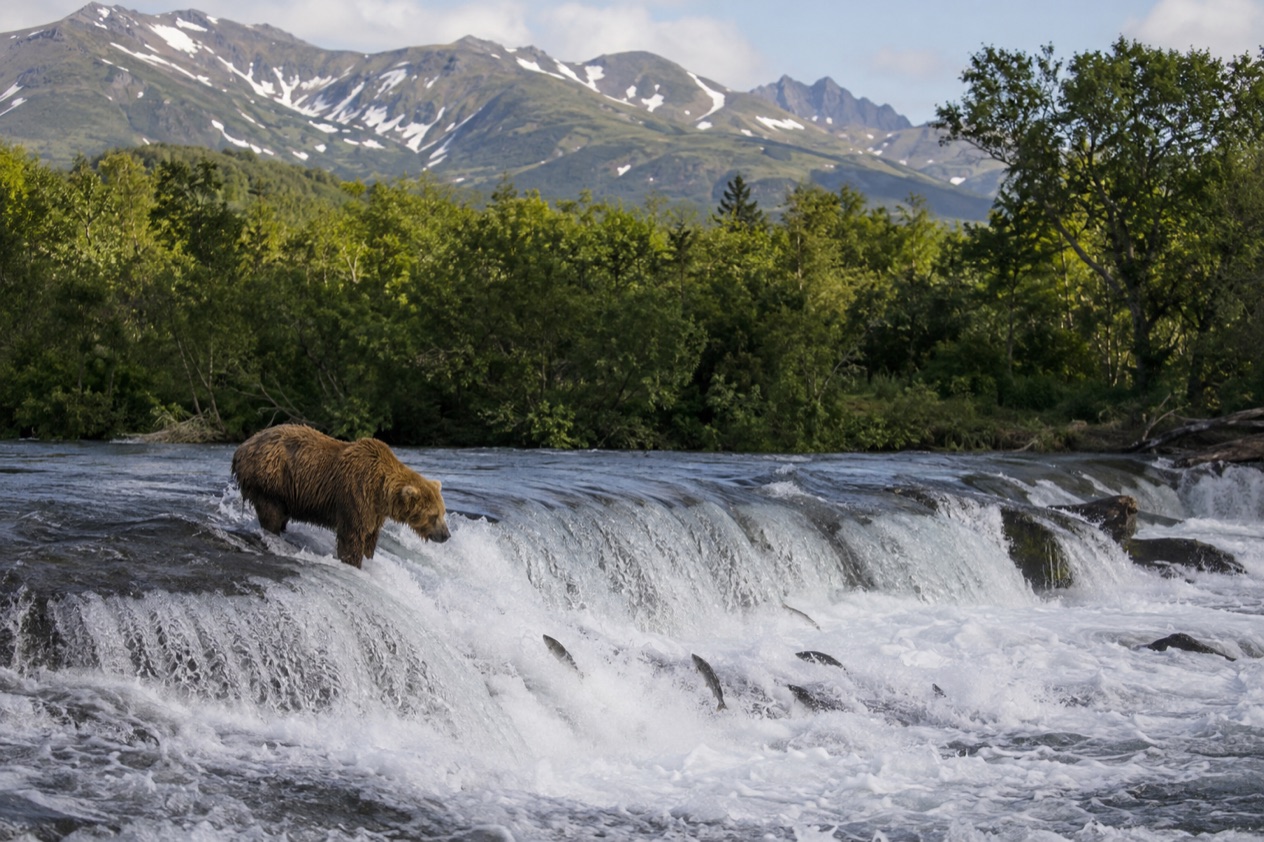
A brown bear stands at the lip of a waterfall with its mouth open, and a sockeye salmon leaps straight into it. Everyone on the viewing platform goes quiet, then someone laughs.
That scene belongs to southwest Alaska in summer, where bears gather along salmon streams, coastal sedge flats and the shores of big lakes.
Where can you see bears in Alaska?
Homer, on the road system, is the gateway to the first two. All three species of North American bear live in Alaska, but the salmon-fed brown bears of the coast are the ones people travel to see.
The brown bear is the same animal people call grizzly inland. On the coast it grows much bigger, because spawning salmon supply the nutrition and the abundance behind the enormous size of the bears. Males outweigh females, and the largest coastal bears are heavy animals indeed. Seeing one wade through a river changes how you picture the word “large.”
Brooks Camp and Brooks Falls, Katmai
Brooks Camp sits at the mouth of the Brooks River, on the shore of Naknek Lake. It is Katmai’s most popular destination, known for combining bear viewing with sport fishing, scenery, history and facilities. Katmai has one of the highest densities of bears on earth, and few places offer comparable viewing.
The falls themselves are modest, only about six feet high. Salmon leap over them on the way to their spawning grounds in Brooks Lake, and bears take positions at the top and in the pools below.
In July the concentrations are greatest, with up to 25 bears seen at one time. Watching them is the whole show: the jostling for the best fishing spot, the patient ones that simply open their mouths, the cubs kept at a careful distance from big males.
Away from the falls, hiking trails around Brooks Camp offer bear viewing, cultural history, quiet forests, alpine tundra and rugged mountain scenery. Daily bus tours run from the camp to the Valley of Ten Thousand Smokes, the site of the largest volcanic eruption of the 20th century. It makes a good change of pace from a day of watching water.
Silver Salmon Creek and Chinitna Bay, Lake Clark
Lake Clark National Park and Preserve is remote and undeveloped, with no road access. At Silver Salmon Creek or Chinitna Bay, visitors may watch coastal brown bears graze on sedges. The scene is quieter and more pastoral than the falls: bears grazing a meadow near the tideline, cubs tumbling in the grass, and a wide sky over Cook Inlet.
Many of the park’s bears live on the west side of Cook Inlet. This is also where lodges and guides operate, so the experience tends to feel like a stay in the wild rather than a day outing. Inland, the park offers backpacking over tundra slopes and past turquoise lakes, and a visit to Dick Proenneke’s historic cabin on upper Twin Lake.
Kodiak and the wider range of the brown bear
The Kodiak bear lives on the islands of the Kodiak Archipelago in southwest Alaska, and it is one of the largest bear subspecies. About half of the archipelago lies within the Kodiak National Wildlife Refuge. Salmon runs extend from May through September on most of the archipelago, which is the food source that builds these bears.
Bears elsewhere in the state live differently. In Denali National Park, they wait at the burrows of Arctic ground squirrels, hoping to pick off a few. Near Anchorage, an interactive map shows the activities of urban bears. For salmon-fed concentrations, though, the southwest coast is the draw.
Homer, the gateway
Homer is the closest location to both Katmai National Park and Preserve and Lake Clark National Preserve, which is why it is called the gateway to bear viewing. Visitors can see wild bears up close with the support of well-equipped lodges and guides. Homer works as a base for sorting out the trip, and the town gives you a place to wait if weather changes the plan.
When is the best season?
Along the coast near Homer, bear viewing runs from June through September, when brown bears gather on coastal sedge flats and streams. At Brooks Falls, bears usually congregate from July through early September.
| Place | Bear activity or service season |
|---|---|
| Brown bears across Alaska | Out of dens from late May until late fall |
| Coastal sedge flats and streams (Homer area) | June through September |
| Kodiak Archipelago salmon runs | May through September |
| Brooks Falls | July through early September |
| Brooks Camp NPS visitor center, ranger station, campground | June 1 to September 17 |
| Brooks Lodge meals and lodging | Through September 17 |
Late spring and early summer
Brown bears can be seen from late May, when they leave their dens. In spring they eat grasses and clams, so the scene is a bear grazing a green meadow or digging along a tideflat, not standing in a river. On Kodiak, males come out of their dens in early April, and sows with new cubs stay until late June.
This is a good time for the sedge-flat bears of Lake Clark’s coast. The viewing is calmer and more about behavior than action, and it suits people who like watching an animal simply go about its day. June also sits inside the period when Brooks Camp’s park services are open, from the first day of the month.
July, the salmon season
In summer, bears eat salmon swimming home to spawn, and Brooks Falls is at its busiest. July has the greatest concentrations of bears, and as many as 43 bears have been sighted at the falls in a single day. Bears are omnivores that range over hundreds of square miles looking for food to fatten up for winter, so the river is a rare spot where so many cross paths.
If a crowd of bears is your picture of the trip, this is the month. Expect the fishing spots to be contested and the viewing platforms to be lively. The sockeye run is the reason the bears stay.
September and Fat Bear Week
In September, a smaller number of bears can be seen at Brooks Falls, a maximum of about 18 at one time. By fall, bears turn to berries and seeds, and the animals you see are heavy and well fed. That fatness is the subject of Fat Bear Week, an annual event held in late September or early October by Katmai National Park and Preserve.
Anyone can take part by voting online for a favorite bear. The National Park Service and Explore.org organize it, and live webcams at Brooks Falls and along the Brooks River let the public watch from home.
To qualify, a Katmai bear must have been spotted catching sockeye salmon at the Brooks River. Meals and lodging at Brooks Lodge are available through September 17, and only very limited visitor services may continue at Brooks Camp through September 30, so the in-person season closes before the voting does.
Late fall and winter
Bears can be seen until late fall, when they go into hibernation. Kodiak bears begin entering their dens in late October. That makes October a month for watching online rather than visiting, and the real viewing returns when the dens open again in spring.
How do you book a bear viewing trip?
A bear viewing trip is usually built from three pieces: a gateway such as Homer, a flight to a remote site, and a lodge, guide or campground at the other end. Most of these places are not on the road system, so planning starts with how you will get there. The details of each operator belong to the operator, but the shape of the trip follows from how the parks are reached.
Getting to the bears
Lake Clark is not on the road system, so access is primarily by small aircraft. Homer is the closest location to the park and to Katmai, so many trips begin there. Katmai’s Brooks Camp sits at the mouth of the Brooks River on Naknek Lake, and the park’s backcountry also relies on aircraft, including chartered ones.
Some pilots argue that Katmai is best seen from the air, and flightseeing is a popular activity there. Whether you fly out for a day or stay at a lodge, the flight is part of the experience, with lakes, rivers and volcanic country passing below.
Lodges, camping and guides
At Brooks Camp, the National Park Service operates a visitor center, ranger station, campground and auditorium with daily ranger-led programs from June 1 to September 17. Meals and lodging at Brooks Lodge are available through September 17. For bear viewing in general, well-equipped lodges and guides are part of what lets visitors see wild bears up close in comfort.
Brooks Camp also serves as a starting point for backcountry adventures in Katmai. Fishing is a draw, with streams holding numerous, trophy-sized fish. Visitors combine the bears with a day on the river or a bus tour to the Valley of Ten Thousand Smokes.
Planning around the weather
Strong storms sweep through the Katmai area any time of year, so carry waterproof rain gear and extra food, since weather may delay pick-up from a chartered aircraft for days. Do not make your schedule too tight. Allow extra time for delays and always have a backup plan, which means leaving a buffer day before any flight home.
A visit to Katmai carries some inherent risk, so preparation can make the difference between an adventure and a tragedy. Always let a responsible person know where you are going and when you expect to return.
Trip planners can be filled out in person at the King Salmon and Brooks Camp visitor centers, or you can email your itinerary to Katmai’s dispatch office. Park staff do not track individual trips, but a detailed itinerary may give rangers valuable information in an emergency.
Backcountry travelers should consider carrying a satellite phone or a satellite-based text messaging device. That applies to anyone heading beyond the camp, where there is no road and help comes by air.
Good to know before you go
People in Alaska must keep all human sources of food secure from bears, and the Alaska Department of Fish and Game provides a page about bear resistant containers. Dangerous bear situations should be reported to ADF&G using the wildlife encounter form.
For preparation at home, bear safety videos are available on loan from ADF&G offices in Anchorage, Fairbanks and Juneau. Pack waterproof layers for the storms that can cross Katmai in any season, and remember that Brooks Camp’s park services and lodge close in mid-September.
Sources
- Alaska Department of Fish and Game, Living with bears (https://www.adfg.alaska.gov/index.cfm?adfg=livingwithbears.main), checked October 11, 2026
- National Park Service, Katmai National Park & Preserve, plan your visit: brooks camp (https://www.nps.gov/katm/planyourvisit/brooks-camp.htm), checked October 11, 2026
- National Park Service, Katmai National Park & Preserve, plan your visit: safety (https://www.nps.gov/katm/planyourvisit/safety.htm), checked October 11, 2026
- National Park Service, Katmai National Park & Preserve, plan your visit: things2do (https://www.nps.gov/katm/planyourvisit/things2do.htm), checked October 11, 2026
- Homer, bear viewing (https://www.homeralaska.org/things-to-do/outdoors-and-recreation/bear-viewing/), checked October 11, 2026
- Wikipedia, Brown bear (https://en.wikipedia.org/wiki/Brown_bear), checked October 11, 2026
- Wikipedia, Kodiak bear (https://en.wikipedia.org/wiki/Kodiak_bear), checked October 11, 2026
- Wikipedia, Brooks Falls (https://en.wikipedia.org/wiki/Brooks_Falls), checked October 11, 2026
- Wikipedia, Fat Bear Week (https://en.wikipedia.org/wiki/Fat_Bear_Week), checked October 11, 2026
- National Park Service, Lake Clark National Park & Preserve, plan your visit (https://www.nps.gov/lacl/planyourvisit/index.htm), checked October 11, 2026
- Alaska Department of Fish and Game, Wildlife viewing (https://www.adfg.alaska.gov/index.cfm?adfg=viewing.main), checked October 11, 2026