
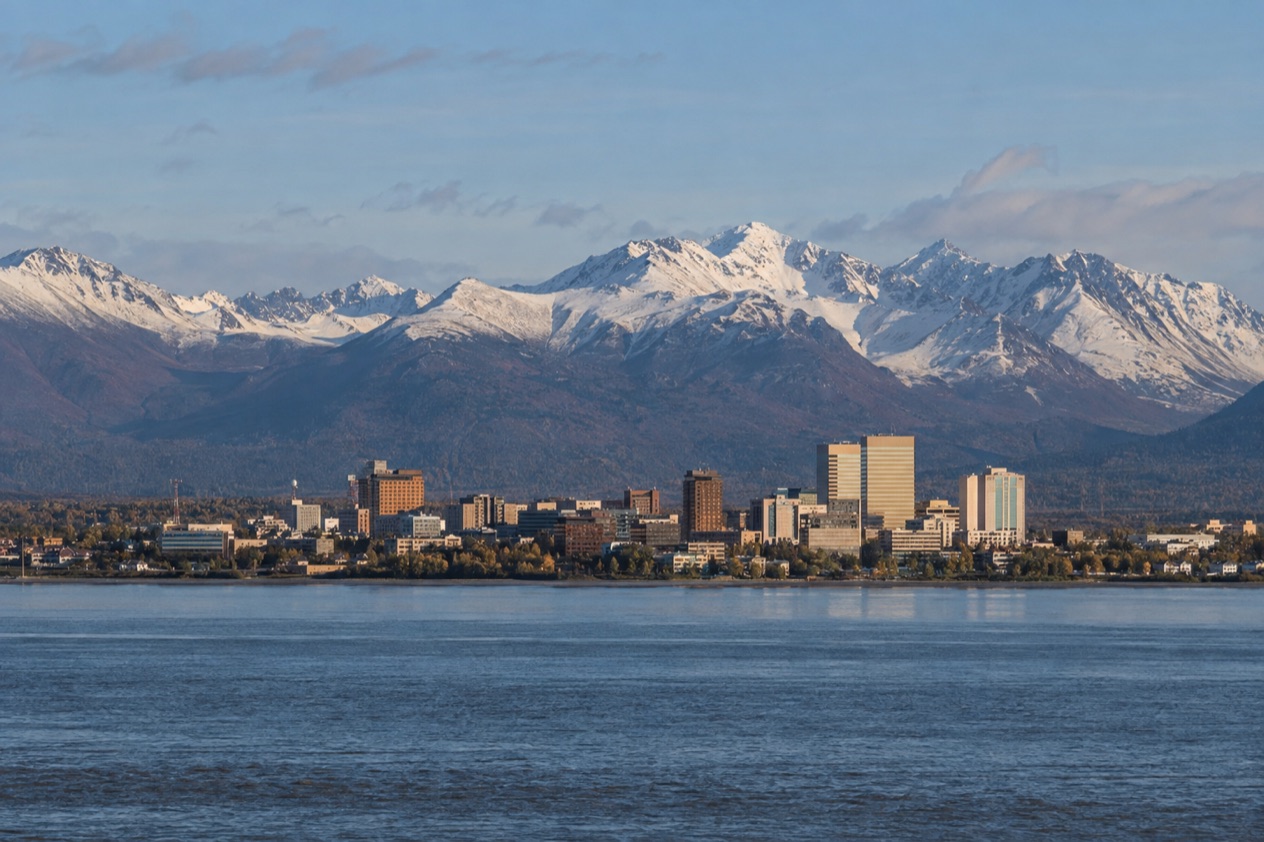
You step out of the Anchorage airport and the air smells of spruce and cold water, with mountains standing at the edge of the city as if someone had set them there for the view. Streets are wide, trucks are everywhere, and the talk at the next table is about fishing, flights or the weather. A few things are worth knowing before you arrive: how the layers work, how the wildlife rules apply, how the seasons change what is on offer, and how the city sits on a very large piece of land.
What should you know before visiting Anchorage?
Four things matter most in Anchorage: dress in layers whatever the month, treat bears as part of everyday life, remember that many activities belong to one season, and understand that the city is huge and surrounded by wild country. Get those four right and the rest falls into place.
The size surprises people first. The Municipality of Anchorage covers 1,961 square miles, stretching from Eklutna in one direction to Portage in the other. It is a city with a downtown grid, but it is also a municipality with mountains, valleys and trails inside its borders. Wildlife is part of that, and all three North American bear species live in Alaska, so the idea of bears as distant postcard animals does not hold here.
Seasons shape the visit as well. Dog sledding in Anchorage typically runs from October through March, while the northern lights are active over the city from late September through the middle of April. Flightseeing tours, on the other hand, leave from Anchorage all year. A trip planned around one of these things looks very different from one planned around another.
First-time visitors are often surprised by how quickly Anchorage moves from city to wilderness, and by how ordinary the mix feels to residents. Alaska has about six times as many pilots per capita as the rest of the United States, so small planes are part of daily life rather than a special occasion. Anchorage also sits within Dena’ina Ełnena, the homeland of the Dena’ina Athabascan people, and that history is present in the city, in the names and in the places where you can learn about Dena’ina culture.
Fees, passes and reservations
The material available for Anchorage gives no park pass amounts, entry fees or reservation rules, so there is no fee table to consult here. What it does give is a picture of what to settle before you go: which season you are visiting and which activities belong to it.
Dog sledding in Anchorage typically operates from October through March, though summer dog sledding is also available. Flightseeing tours or charters from Anchorage are offered year-round by floatplane, fixed wing and helicopter, so the choice of aircraft is the main decision rather than the month. If a winter festival is part of your plan, Anchorage Fur Rondy is Alaska’s largest and oldest winter festival, and it began in 1936 as a three-day sporting event.
Anchorage also offers festivals, concerts, live music, marathons and cultural celebrations through the year, and visitors can sign up for the Anchorage Local E-newsletter to stay informed about local happenings. That newsletter is a simple way to learn what is on during your dates before you commit to an itinerary.
Money, phones and getting online
Anchorage is in the United States, so you pay in U.S. dollars like anywhere else at home, and nothing about money needs special preparation for American travelers.
One useful detail is the clock. Alaska keeps its own time zone, nine hours behind Coordinated Universal Time in standard time and eight hours behind during daylight saving time. The change happens on the second Sunday in March and returns on the first Sunday in November, which matters if you are calling home, catching a flight or timing a tour.
For road conditions, the Alaska Department of Transportation runs the Alaska 511 website, which also publishes incidents and closures reported through Waze. It sorts roads into categories from Good and Fair to Difficult, Very Difficult, Hazardous, Road Closure and No Winter Maintenance. The map page also lets you add cameras to a My Cameras list, handy for watching a road you plan to take.
Getting around and staying connected
Getting around Anchorage starts with understanding the scale of the place. The municipality is spread across 1,961 square miles, and many of the things that draw people, from the aurora to the mountains, are reached from the city rather than inside its center. Anchorage is described as one of the best bases from which to chase the aurora, with many prime locations easily accessed from the city.
For roads outside the city, Alaska 511 is the tool the state provides. Its categories tell you whether a road is in good shape, hazardous or closed, and some roads carry the label No Winter Maintenance. Waze-reported incidents appear on the same site, so a closure reported by drivers can show up alongside official information.
Some trips skip the road altogether. Flightseeing tours and charters leave Anchorage by floatplane, fixed wing or helicopter, which fits a state where small aircraft are an ordinary way to travel. Beyond this, the material gives nothing on taxis, ride-hailing, buses, rental cars, SIM cards or Wi-Fi, so the sensible approach is to plan your outings around the places you want to reach and look at the road conditions before you set out.
Weather, daylight and wildlife
Anchorage weather changes with the season, and layers are the answer in all of them. From spring to early fall, temperatures in Alaska range from 50 to 70 degrees Fahrenheit, with possible rain and wind. The advice is to dress in layers and carry a backpack, so you can add or remove clothing as the weather changes, with an outer shell that is fully waterproof and breathable and has a hood.
| Month | Average high (°F) | Average low (°F) | Precipitation (inches) | Days with precipitation | Snowfall (inches) |
|---|---|---|---|---|---|
| January | 22.7 | 11.0 | 0.75 | 2.7 | 12.4 |
| April | 45.1 | 29.9 | 0.43 | 1.4 | 4.0 |
| July | 66.2 | 52.9 | 1.82 | 5.1 | 0.0 |
| October | 42.0 | 30.7 | 1.82 | 5.2 | 5.6 |
In January, the cold is real and snow is part of the scene, so winter clothing is the point of the trip. April is cool, with some snow still falling.
July is mild enough for a light jacket in the afternoon and a warmer layer in the evening, and October brings chilly days that can drop to the freezing mark at night, with the first snow.
Light changes with the calendar too, and the northern lights are a seasonal chance rather than a promise. They are active over Anchorage from late September through the middle of April, and the aurora can be seen in the city’s skies from the middle of August through April.
All three species of North American bears (black, brown including grizzly, and polar) live in Alaska. People in Alaska must keep all human sources of food secure from bears, and dangerous bear situations should be reported to the Alaska Department of Fish and Game using its wildlife encounter form.
Local customs and etiquette
Alaskans tend to dress for the day rather than for the occasion. Fleece, boots and a rain shell turn up at restaurants, concerts and offices, and nobody looks twice. Visitors who arrive in practical clothes fit in at once, and those who bring a hooded jacket and sturdy shoes will be comfortable at nearly every table and trailhead.
The pace is relaxed and conversation is friendly. People will ask where you are from and what you hope to do, and they are happy to trade stories about weather, fish and flights. Plans bend around conditions here, so a tour moved by a day or a trail closed by snow is taken in stride rather than treated as an affront.
Respect for the land runs through local habits. Anchorage lies on the homelands of the Dena’ina Athabascan people, and many residents value the chance for visitors to learn about Dena’ina culture while they are here. Approaching that history with curiosity and listening more than telling is the welcome approach.
With wildlife, the habit is distance and care. Locals keep their food and trash tidy, avoid crowding animals for a photo and talk about bears with calm familiarity.
Good to know before you go
Seasons decide what is available. Dog sledding in Anchorage typically runs from October through March, the northern lights are active from late September through the middle of April, and flightseeing departs year-round. If you are visiting Anchorage in winter, Fur Rondy brings Alaska’s oldest winter festival, complete with outhouse races in which teams steer outhouses on skis. One last habit is worth keeping: look at Alaska 511 before any drive and carry a waterproof shell in your daypack, even on a morning that looks clear.
Sources
- Visit Anchorage (https://www.anchorage.net/), checked October 11, 2026
- Wikipedia, Climate of Alaska (https://en.wikipedia.org/wiki/Climate_of_Alaska), checked October 11, 2026
- Alaska 511 (https://511.alaska.gov/), checked October 11, 2026
- Alaska Department of Fish and Game, Living with bears (https://www.adfg.alaska.gov/index.cfm?adfg=livingwithbears.main), checked October 11, 2026
- Alaska.org, what to wear (https://www.alaska.org/advice/what-to-wear-in-alaska), checked October 11, 2026
- Wikipedia, Alaska Time Zone (https://en.wikipedia.org/wiki/Alaska_Time_Zone), checked October 11, 2026
- NOAA NCEI, U.S. Climate Normals 1991-2020, monthly (https://www.ncei.noaa.gov/access/services/data/v1?dataset=normals-monthly-1991-2020&stations=USW00026451), station Anchorage Intl Ap, elevation 120 feet, checked October 11, 2026
To plan your stay
- Best Time to Visit Anchorage: Long Summer Days, Northern Lights, Weather by Month and Festivals
- Things to Do in Anchorage: Museums, Alaska Native Heritage, Chugach Trails and Day Trips
- Where to Stay in Anchorage: Downtown, Eagle River, Girdwood and Lodging Types
- Anchorage from the Lower 48: Flights, Roads, Ferries and Trains Once You Arrive