
On a Southeast Alaska morning the mist lifts off a channel lined with spruce, and a glacier shows its blue edge between the clouds. On the Norwegian coast a small ferry slides across a fjord while red wooden houses sit tight against the water and waterfalls drop from the cliffs.
Both are northern, wild and very scenic, but they feel different once you arrive. This is a comparison for travelers deciding which one fits the trip they have in mind.
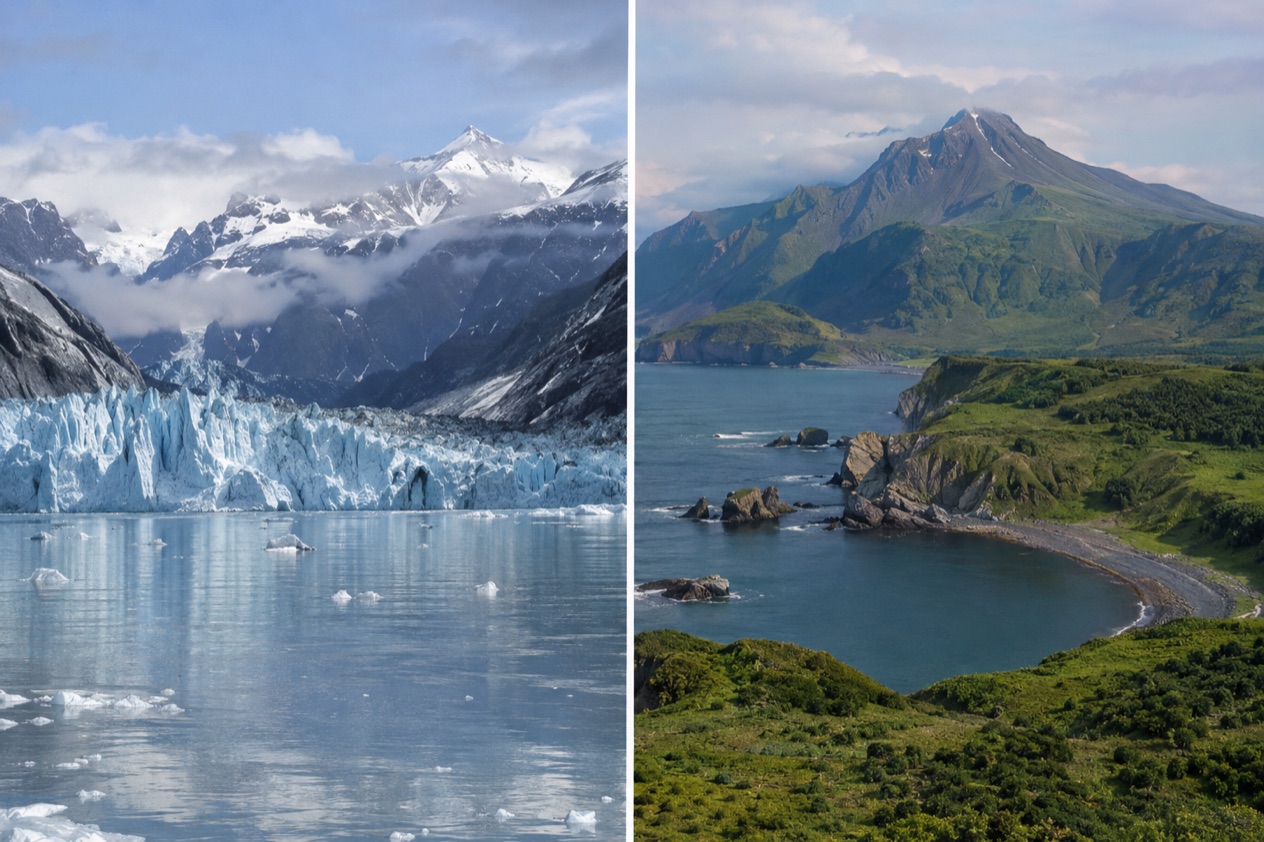
Which is better, Alaska or Norway?
Alaska suits travelers who want big, open country, national parks and a sense of distance, while Norway suits those who want wild scenery woven together with old towns, museums, good food and a long-settled cultural landscape. Alaska is a place you go to be outdoors, and Norway is a place where the outdoors comes with cities, harbors and centuries of history. Neither is a wrong choice, and the table sums up the differences in a glance.
| Category | Alaska | Norway |
|---|---|---|
| Scenery | Glaciers, the tallest peak in North America, rainforest coast, tundra | Deep fjords, waterfalls, mountain plateaus, island chains |
| Vibe | Frontier, big-country, few roads | Tidy coastal villages, old harbor towns, Scandinavian calm |
| Things to do | National parks, glacier cruises, train rides, flightseeing | Fjord cruises, museums, historic wharves, hiking, coastal voyages |
| Wildlife | Bears, moose, whales and eagles are chances in the right places | Whales, reindeer, sea birds and puffins are chances in the right places |
| Weather | Varies sharply by region, from wet Southeast to the Arctic | Mild coast, colder interior, dark winters in the far north |
| Getting there | Many places reachable only by air or water | Oslo is the capital and main gateway |
| Best for | Wilderness seekers and road-trip dreamers | Culture lovers who also want fjords |
If you picture yourself on a park bus watching the horizon for animals, Alaska matches that picture. If you picture a harbor with wooden warehouses, a museum afternoon and then a fjord at dinner, Norway does. The two overlap in cruising, hiking and chasing northern light, so the difference is mostly about how much civilization you want around the scenery.
Scenery and wildlife
Alaska is built on a scale that is hard to hold in the mind. It is by far the largest state, with 586,000 square miles, and it is thinly populated, so much of what you look at has no building in sight.
Glacier Bay National Park and Preserve covers more than three million acres of ice, water and forest in Southeast Alaska, and it is part of a UNESCO World Heritage Site. Tongass National Forest, also in the Southeast, is the largest national forest in the country.
Then there is the height. Denali rises to 20,310 feet and is the highest mountain in North America, and on a clear day it dominates the sky above the park that bears its name. Animals are part of the draw. Bears, moose, caribou, eagles and whales live in the state, though seeing one is a chance and never a promise.
Norway packs its drama into a narrower, more intimate frame. The fjords are long, steep-sided arms of the sea, with farms perched on ledges, waterfalls falling straight into the water and mountains that seem to rise from the surface. Farther along the coast the landscape breaks into islands and jagged peaks, and fishing villages with red and ochre buildings sit at the foot of them.
Wildlife in Norway is quieter than in Alaska but still real. Sea birds crowd the cliffs, whales are sometimes seen from boats along the northern coast, and reindeer graze on the high plateaus. Norway has no counterpart to the sheer size of Alaska’s bear and moose country, but it offers more places where a viewpoint, a village and a good meal all sit within reach of each other.
As for the light, both are northern and both play with it. In summer, places above the Arctic Circle in either country can see the sun at midnight, and in the far north of Norway the evenings stretch out in the same way. Alaska’s Fairbanks is south of the Arctic Circle yet the sun sets at 12:47 a.m. at the summer solstice, which gives you a sense of how long those days run.
Who wins depends on what you want to look at. For raw scale, glaciers, a towering mountain and a sense of being far from everything, Alaska takes it. For the fjord, the waterfall and the village set against the water, Norway takes it. If you value the combination of landscape and cultural setting, Norway has the edge, and if you value emptiness, Alaska does.
Things to do
In Alaska the main activities revolve around parks, water and the sky. Denali National Park and Preserve, established in 1917, is centered on the Denali Park Road, which runs 92 miles from the George Parks Highway to Kantishna. Private vehicles can drive only the first 15 miles, up to Savage River Bridge, so most of the park is seen by going beyond that point in other ways.
Glaciers and boats in Alaska
Glacier Bay is the clearest example of the state’s water-and-ice side. No roads lead to the park, and it is most easily reached by air or sea travel, which already says something about the kind of trip it is. Inside, you look at tidewater glaciers, mountain walls and forested shores from the water, and the quiet is part of the experience.
Southeast Alaska towns such as Juneau, Skagway and Ketchikan are built around the same water. Juneau, the capital, is not connected by road to the rest of the North American highway system, so the town feels like an island of streets between mountains and the channel.
Museums, wharves and fjords in Norway
Norway adds a layer that Alaska does not have, which is the built past. In Bergen, the old wharf of Bryggen is a World Heritage Site and a former Hanseatic League trading center, with wooden buildings that tell the story of the merchants who worked there.
Beyond the cities, the fjords are the main event, and they are seen by boat, from a viewpoint, or on a hike above the water. Coastal towns offer seafood, fish soups and the sweet brown cheese Norwegians love on waffles, and a day often ends with a simple supper by the harbor. On Syttende mai, May 17, Norwegians celebrate Constitution Day with parades, children in folk costume and flags in every village.
Alaska has its own local flavor in food and tradition, such as salmon and halibut from nearby waters and the Midnight Sun Game that Fairbanks has held since 1906 in the twilight around midnight on June 21.
Weather and the best time to go
Alaska has several climates in one state, so the answer depends on where you are headed. Southeast Alaska is wet, with Juneau averaging over 50 inches of precipitation a year and some areas of the region receiving as much as 275 inches. Valdez gets heavy snow, up to 300 inches in a year, which tells you how a winter there looks.
At the other end, Utqiaġvik is the northernmost city in the United States, and its polar day lasts 84 days while its polar night lasts 68. This is a place where the calendar and the light have very little to do with each other, and where a visit in the dark months feels like a different trip from one in the bright ones.
Norway’s weather is also a matter of region. The coast is shaped by the sea and tends to be milder and damper than the interior, while the high country and the far north bring colder, snowier winters. In summer, the northern part of the country, above the Arctic Circle, sees the sun at midnight, and in winter those same latitudes go through a stretch of darkness in which the northern lights are a chance.
For a summer trip, both countries give long days and open landscapes, so you can fit a lot into one day and stay outside late. Expect rain in either place, particularly along the coasts, and plan layers rather than counting on clear skies.
Seasons also decide what is open. In Alaska, services such as park roads, boats and many lodges follow their own calendars, so the month you pick shapes what you can do, and each place has to be checked on its own.
The practical rule on both sides is to start from the activity you want and choose the month around it.
Getting there and getting around
Alaska is a U.S. state, so Americans arrive without leaving the country, though the geography makes the trip feel like a long one. Travelers from the contiguous states can drive to Alaska on the Alaska Highway through Canada, which is paved and maintained year-round. A lot of the state, however, lies beyond the road network altogether.
That is most visible in Southeast Alaska. Only Haines, Hyder and Skagway have direct road connections to the contiguous North American road system, and other communities rely on the Alaska Marine Highway. Juneau, as noted, has no road link to the outside, and Glacier Bay is reached by air or sea. In practice, a trip to Alaska is often a chain of flights and boats, not a single drive.
Inside the parks the rules are specific. At Denali, private vehicles stop at Savage River Bridge, and beyond it the park road is a different experience. Many rental car companies also prohibit their vehicles on the Dalton, Denali, Steese and Cassiar Highways and on the Nabesna and McCarthy Roads, and insurance may not cover damage there. A rental agreement deserves a careful read before you plan a route.
Norway is a foreign country for Americans, with Oslo as its capital and largest city and the usual starting point for a trip. The country is long and its coast is cut by fjords and islands, so moving around often means combining roads, boats and the occasional flight. The shape of the land is what decides the route, as it does in Alaska.
Norway keeps its own time, Central European Time, which runs ahead of most of the United States, so plan for the shift when you arrive. The logistics feel different from Alaska’s, because the distances are shorter and the settled areas more continuous, but the rhythm of ferries and mountain crossings gives the two places something in common. In both, getting around is part of the trip rather than a way of skipping it.
Who should choose which
Choose Alaska if you want scale, silence and a landscape that still feels larger than the people in it. It suits travelers drawn to national parks, glacier viewing from the water, long drives through big country and the thrill of seeing Denali on a clear day. It also suits those who like the idea of a trip that is partly about the logistics of reaching remote places, and who want to stay within the United States.
Choose Norway if you want fjords and mountains together with old towns, museums and a culture you can taste and visit. It suits travelers who like to move between a city afternoon and a coastal evening, who care about history such as the Vikings and the Hanseatic merchants, and who enjoy a festival like Syttende mai with the whole country in the streets.
Combining them is possible but it makes for a big trip, and the two are different enough that a single visit to each is a better plan than a rushed double. If you want both, the cleanest approach is to do them in separate seasons or separate years, giving each its own full itinerary. That way you take in Alaska’s open spaces and Norway’s fjords without cutting either short.
Good to know before you go
Alaska uses the U.S. dollar and observes all federal holidays except Columbus Day, adding Seward’s Day on the last Monday in March and Alaska Day on October 18. Norway uses the Norwegian krone, so a card or a small amount of local currency is needed there. In both places, daylight and seasonal closures shape the day, so build your plan around what is running in the month you travel.
Sources
- Wikipedia, Alaska (https://en.wikipedia.org/wiki/Alaska), checked October 11, 2026
- Wikivoyage, Alaska (https://en.wikivoyage.org/wiki/Alaska), checked October 11, 2026
- Wikipedia, Climate of Alaska (https://en.wikipedia.org/wiki/Climate_of_Alaska), checked October 11, 2026
- Wikipedia, Midnight sun (https://en.wikipedia.org/wiki/Midnight_sun), checked October 11, 2026
- Wikipedia, Denali National Park and Preserve (https://en.wikipedia.org/wiki/Denali_National_Park_and_Preserve), checked October 11, 2026
- Wikipedia, Glacier Bay National Park and Preserve (https://en.wikipedia.org/wiki/Glacier_Bay_National_Park_and_Preserve), checked October 11, 2026
- Wikipedia, Norway (https://en.wikipedia.org/wiki/Norway), checked October 11, 2026