
In Alaska, a wall of blue ice groans somewhere out of sight, and the light lingers so long over the water that dinner feels like a daytime affair. In Hawaii, the evening smells of plumeria and grilled fish, trade winds rustle the palms, and the surf keeps up its slow rhythm after dark. Both are American getaways that feel like another world, and choosing between them comes down to whether you want wild northern country or warm Pacific islands.
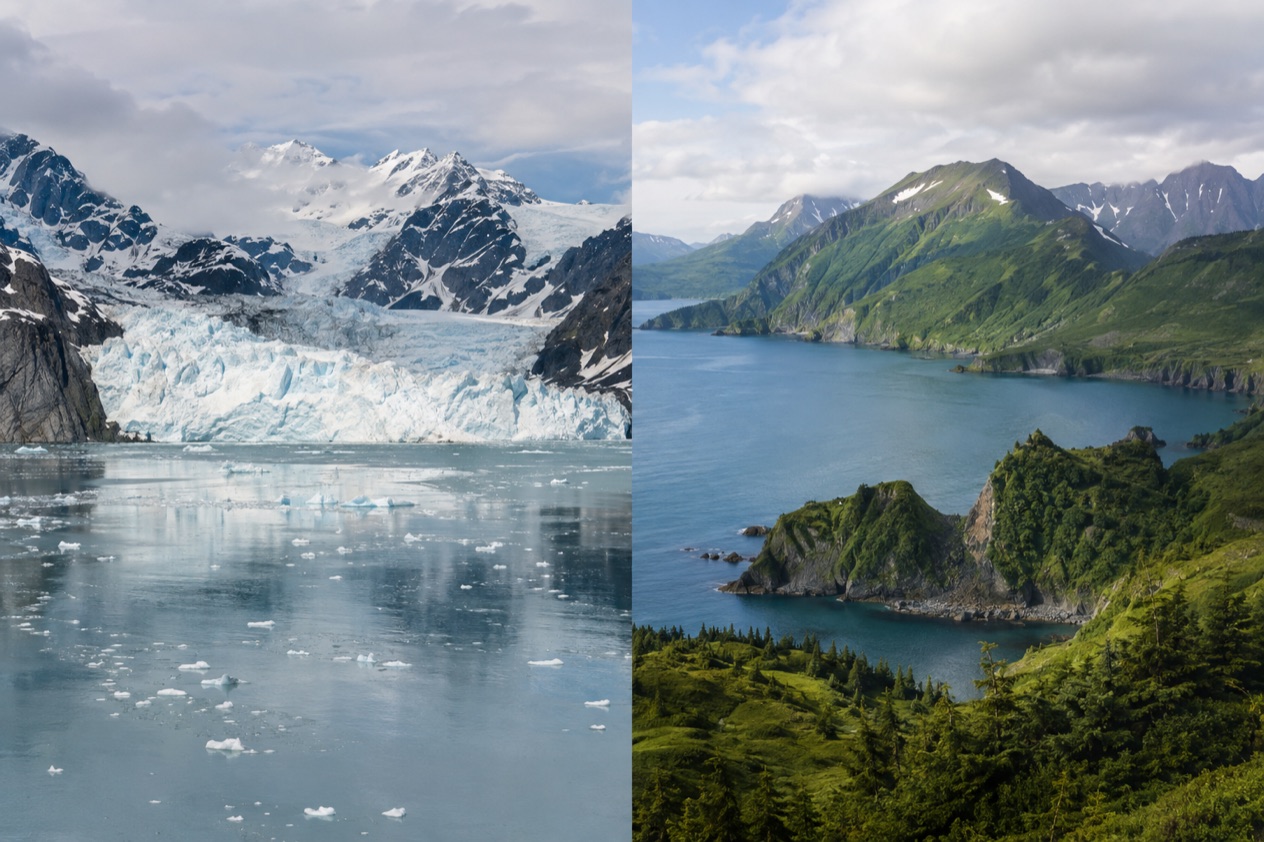
Which is better, Alaska or Hawaii?
Alaska is better for travelers who want big, raw landscapes, glaciers and a sense of distance, while Hawaii is better for those who want warm days, beaches and an easy rhythm of sun and surf. Neither is a better vacation in the abstract. They answer different wishes, and the comparison below lays out where they part ways.
| Category | Alaska | Hawaii |
|---|---|---|
| Scenery | Glaciers, the tallest mountain in North America, vast forests and fjords | Volcanic peaks, green valleys, waterfalls and shorelines |
| Vibe | Frontier and expedition, wide open and quiet | Island and unhurried, built around the outdoors and the water |
| Things to do | Park roads, glacier and wildlife cruises, flightseeing, hiking | Beaches, surfing, snorkeling, volcano hikes, luaus, food stops |
| Wildlife | Bears, moose, whales and eagles, always a chance and never a promise | Sea turtles, tropical fish, whales and birdlife, also a chance |
| Weather | Changeable and sometimes very wet or very snowy, with extreme daylight swings | Warm all year, with a drier season and a wetter one |
| Getting there | A very large state with few roads, reached by air, by sea or by the Alaska Highway through Canada | A chain of islands about 2,000 miles southwest of the mainland |
| Best for | Nature lovers, road-trippers, cruise and park travelers | Beach lovers, honeymooners, families who want warmth and variety |
The split shows up in how a day feels. In Alaska you plan around a landscape, a road, a boat or a flight, and the scale of the place shapes everything. In Hawaii you plan around an island, and the day bends easily between a trail in the morning and a beach in the afternoon.
Some travelers find the choice easy the moment they picture the trip. If the image in your head is a cold, clear morning with a huge mountain in the distance, that is Alaska. If it is a warm evening with a drink in hand and the sound of waves, that is Hawaii.
Scenery and wildlife
Alaska is scenery on a scale that is hard to take in. Denali rises to 20,310 feet and stands as the highest mountain in North America, and the park around it is a country of tundra, braided rivers and open valleys. Southeast Alaska is another picture altogether, with the Tongass National Forest, the largest national forest in the United States, wrapping around channels and islands.
Glaciers are the other signature. Glacier Bay National Park and Preserve lies west of Juneau and covers more than three million acres, and it belongs to a UNESCO World Heritage Site inscribed in 1979. You may hear ice cracking and see chunks fall into the water, and on any given day you may spot whales, bears, moose or eagles, though none of them is ever guaranteed.
The light is part of the show. Far north, in Utqiaġvik, the sun stays up for a long stretch each summer, and even in Fairbanks, which sits south of the Arctic Circle, the sun does not set at the summer solstice until a quarter to one in the morning. Evenings stretch out so far that a walk at ten at night can feel like afternoon.
Hawaii answers with color and shape. Waterfalls spill down the wetter sides of the islands, and flowers like hibiscus, plumeria and orchids seem to grow everywhere.
Wildlife in Hawaii lives mostly in and near the water. Sea turtles may glide past snorkelers, tropical fish crowd the reefs, and whales and dolphins are sometimes seen from shore or from a boat. On land, birdsong in the forests and the sight of mongoose or colorful songbirds along the trails are part of the scenery.
As for who wins, it depends on what you want to look at. For sheer grandeur, ice, mountains and a feeling of being small, Alaska takes it. For beauty that you can step into, with warm water, soft sand and a landscape that is easy to enjoy in a swimsuit, Hawaii takes it. People find Alaska the more humbling place and Hawaii the more welcoming one.
Things to do
In Alaska, the big experiences are parks, water and ice. Denali National Park and Preserve, established in 1917, is built around Denali Park Road, which runs 92 miles from the George Parks Highway to Kantishna. Private vehicles can drive only the first 15 miles, up to Savage River Bridge, so the rest of the park reveals itself on its own terms.
Southeast Alaska is the place for boat trips among forested islands and tidewater glaciers. Glacier Bay has no roads leading to it, so you arrive by air or by sea, and that arrival is part of the experience. Fairbanks adds something quirky, the Midnight Sun Game, a baseball game played around midnight on June 21 and contested since 1906.
Alaska food leans on what comes from cold water and wild country, with salmon, halibut and crab on many menus and berries in desserts and jams. Towns like Juneau and Skagway reward a slow wander after the day’s outing, with a coffee, a bakery stop or a seafood lunch. Evenings are quiet, and the pleasure is in long light and a sense of space.
Hawaii offers a different menu of days. On land there are volcano hikes, rainforest walks, botanical gardens and scenic coastal drives, and the Big Island adds the chance to see the slopes of Mauna Kea and Mauna Loa, where snow falls in winter.
Food is a big part of the plan. Poke, plate lunches, shave ice, fresh pineapple, grilled fish and, on many islands, a luau with music and hula are the classic tastes. Farmers’ markets and roadside stands fill the gaps between meals, and each island has its own small specialties.
Day trips differ in spirit. From an Alaska base you head out to a glacier, a park or a small town by boat, plane or road, and the day trip is often the highlight of the trip. From a Hawaii base you drive to a lookout, a waterfall or a beach town, and the day trip is a bonus on top of a good home beach.
Weather and the best time to go
Hawaii has two seasons rather than four. The dry season runs from May to October and the wet season from October to April, and the temperature barely changes between them. Summer days reach around 88°F with warm nights, and winter days sit near 83°F, with lows at sea level that seldom fall below 65°F.
That means Hawaii works in any month, and the real question is what kind of day you want. The drier months favor long, sunny beach hours, while the wetter months bring showers that pass through and often leave rainbows behind. Higher up it is a different story, and on Mauna Kea and Mauna Loa snow can fall at 13,800 feet in winter.
Alaska is a place of strong contrasts, and conditions depend heavily on where you are. Juneau averages over 50 inches of precipitation a year, and some parts of Southeast Alaska get as much as 275 inches, so rain gear matters on the Inside Passage. Valdez can receive up to 300 inches of snow in a year, which tells you what winter looks like in some corners of the state.
Daylight is the other half of the weather story. In Utqiaġvik, polar day lasts 84 days and polar night lasts 68, a rhythm that shapes life there completely. Farther south the swings are smaller but still dramatic, and you plan your days around how much light there is rather than the clock.
For Hawaii, pick the dry or wet season by your appetite for sunshine and for quieter, greener scenery. For Alaska, think first about which place you are visiting, since a service or road may run for only part of the year, and then about whether you want long light, snow or something in between.
Getting there and getting around
Hawaii is an island state in the Pacific, about 2,000 miles southwest of the U.S. mainland, and it consists of 137 volcanic islands. Visitors deal with the eight main islands, and Honolulu, on Oʻahu, is the capital and largest city. Hawaii is in the Hawaii–Aleutian Time Zone, UTC−10:00, so your body clock and your calls home both need adjusting.
Once there, each island is a world of its own, separated from the others by water. Oʻahu, Maui, Kauaʻi and the Big Island each have their own character, and visitors choose one or two rather than trying to see all of them. That keeps the trip relaxed and avoids too much time spent on transfers.
Alaska is by far the largest state, with 586,000 square miles, and it is sparsely populated. Distances are huge and roads are few. Juneau, the capital, is not connected by road to the rest of the North American highway system, and in Southeast Alaska only Haines, Hyder and Skagway have direct road connections to the contiguous road system. Other communities in the region rely on the Alaska Marine Highway.
Some travelers drive. Those coming from the contiguous U.S. can reach Alaska on the Alaska Highway through Canada, which is paved and maintained year-round. Glacier Bay shows the other side of the picture, since no roads lead to it and it is most easily reached by air or sea.
If you plan to rent a car in Alaska, read the fine print about where you can take it. Many rental companies prohibit their vehicles on the Dalton, Denali, Steese and Cassiar Highways and on the Nabesna and McCarthy Roads, and insurance may not cover damage there. In Hawaii the rental question is simpler, and the main thing is to match your car to the island you have chosen.
Who should choose which
Choose Alaska if you are drawn to big landscapes and a sense of discovery. It suits people who love national parks, glaciers, wildlife watching, boat trips and long summer light, and who do not mind that getting around takes planning. It also suits those who like a trip with a story to tell, such as the ride into Denali or the morning on the water near a glacier.
Choose Hawaii if you want warmth, a beach and a rhythm that asks little of you. It suits honeymooners, families who want a mix of sand, hiking and culture, surfers, snorkelers and anyone who has been dreaming of a warm evening by the water. It is also the more flexible choice if your travel dates fall in the colder part of the year.
Combining the two in one trip is possible but rarely sensible, since they sit in opposite corners of the Pacific world and each rewards time. A better idea is to treat them as two vacations in two different years. Do the one that fits your current mood, then save the other for a season of life when you want something else.
If you cannot decide, think about what a good day means to you. If it means being outdoors with a view you will remember for years, lean toward Alaska. If it means feeling rested, warm and well fed, lean toward Hawaii.
Good to know before you go
Both states are part of the United States, so there is no currency to change and no special entry formalities. Alaska observes all federal holidays except Columbus Day and adds Seward’s Day on the last Monday in March and Alaska Day on October 18. Hawaii became the 50th state on August 21, 1959, and its own statehood day is part of the local calendar.
In both places, follow the rules posted at parks and trailheads and stay alert around wildlife, cliffs and the water. In Alaska, remember that daylight, snow and rain shape what is possible on any day, and that a road or service you want may be closed for part of the year.
Sources
- Wikipedia, Alaska (https://en.wikipedia.org/wiki/Alaska), checked October 11, 2026
- Wikivoyage, Alaska (https://en.wikivoyage.org/wiki/Alaska), checked October 11, 2026
- Wikipedia, Climate of Alaska (https://en.wikipedia.org/wiki/Climate_of_Alaska), checked October 11, 2026
- Wikipedia, Midnight sun (https://en.wikipedia.org/wiki/Midnight_sun), checked October 11, 2026
- Wikipedia, Denali National Park and Preserve (https://en.wikipedia.org/wiki/Denali_National_Park_and_Preserve), checked October 11, 2026
- Wikipedia, Glacier Bay National Park and Preserve (https://en.wikipedia.org/wiki/Glacier_Bay_National_Park_and_Preserve), checked October 11, 2026
- Wikipedia, Hawaii (https://en.wikipedia.org/wiki/Hawaii), checked October 11, 2026