
Somewhere past Tok, with the Alaska Range behind the windshield and a long ribbon of highway ahead, the question comes up at the gas pump or over a map spread on the hood: what exactly do we need to get through the border? Driving between Alaska and the rest of the country means passing through Canada, and the border is a routine stop for travelers who have their papers in order. A passport is the safest document to carry, and the rest depends on who is in the car and which way you are going.
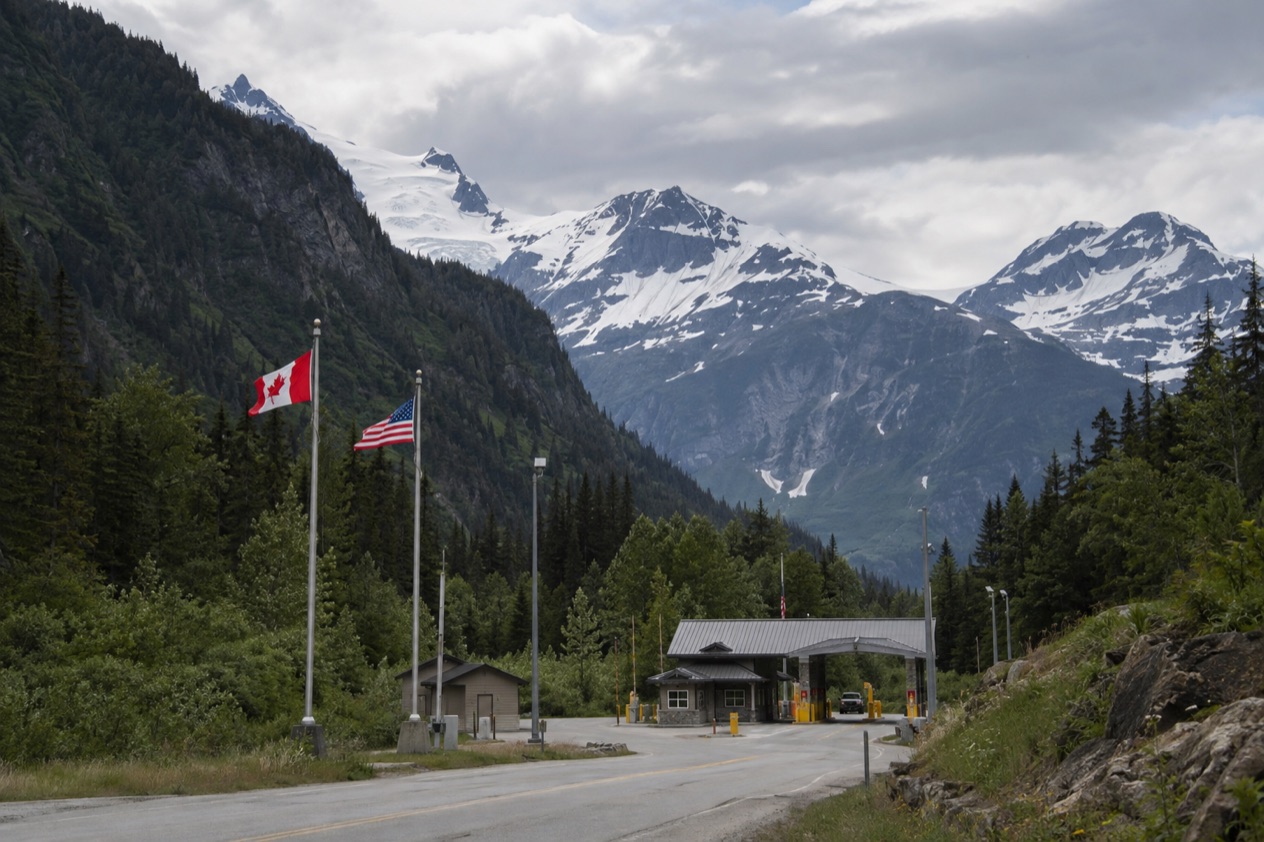
What do you need to cross the border between Canada and Alaska?
You need proof of identity and citizenship, and a passport is the document that covers nearly every case. The Government of Canada describes a passport as the only reliable and universally accepted travel identification document, and it is also what proves a person’s right to return to their own country. For a road trip that crosses the line once on the way out and once on the way back, it is the one item that keeps every border officer’s questions short.
Trusted Traveler cards are the other document worth knowing. Canada says that if you travel between Canada and the United States often, a NEXUS card will save you time at the border. For a once-in-a-lifetime drive up the Alaska Highway the card is unlikely to matter, but a resident of Anchorage or Fairbanks who heads into the Yukon regularly may find it worthwhile.
Before you reach the booth
Land border wait times for crossing from the United States into Canada can be checked ahead of time, which helps when you are timing a day of driving around a crossing. It is a small habit that turns a stop into something you planned for rather than something that surprises you at the end of a long afternoon.
Border officers may also examine travelers’ digital devices at the Canadian border. Phones and laptops are part of the inspection process like any bag in the trunk, so it is sensible to treat them that way when you pack. Anyone carrying items made from wildlife should know that permits under CITES are needed to transport, import or export listed species or goods made from them.
If you fly into Canada instead
Some Alaska trips begin or end with a flight through a Canadian airport. Travelers flying into Canada can use Advance Declaration in ArriveCAN to submit their customs and immigration declaration before they board, which moves some of the paperwork out of the arrival hall. Canada also offers faster connections between international flights at select airports, useful when a layover is short.
A Canadian citizen needs a valid Canadian passport to board a flight to Canada. Permanent residents of Canada need their permanent resident card to re-enter. Canada’s guidance on passports is written for its own citizens, but the same principle holds for everyone: the document you carry decides how smoothly the first conversation goes.
Where are the crossings?
Three highways tie Alaska to the Yukon and British Columbia: the Alaska Highway, the Haines Highway and the Top of the World Highway. Each one begins or ends at a different Alaska town and gives the trip a different character, so the choice of route shapes the journey more than the border stop itself does.
The Alaska Highway
The Alaska Highway begins in Dawson Creek, British Columbia, at the junction with Highway 2 and Highway 97, and ends at Delta Junction, Alaska, by way of Whitehorse in the Yukon. It is made up of British Columbia Highway 97, Yukon Highway 1 and Alaska Route 2. It opened to the public in 1948, and although it was once legendary as a rough, challenging drive, it is now paved over its entire length.
Delta Junction sits at Historic Milepost 1422. From there the Richardson Highway continues 96 miles to Fairbanks, which is often unofficially counted as the end of the Alaska Highway at Historic Milepost 1520.
Tok lies at the junction of the Alaska Highway and the Glenn Highway, between the Tanana River and the Alaska Range, and it began in 1942 as an Alaska Road Commission camp. The camp earned the nickname Million Dollar Camp because so much money went into building and maintaining it.
Tok is a natural pause. The Tok River State Recreation Site has a small campground, trails and river access for small boats. The Eagle Trail State Recreation Site, on the Tok Cutoff, has a campground, picnic areas and hiking trails, plus access to the historic Valdez-Eagle Trail and the Alaska Range high country. The guidebook The Milepost, published every year since 1949, covers the Alaska Highway mile by mile.
The Haines Highway
The Haines Highway links Haines, Alaska, with Haines Junction in the Yukon, passing through British Columbia on the way. It is about 152 miles long, and 45 of those miles are in Alaska. The Alaska portion is part of Alaska Route 7, and the Yukon portion is Highway 3.
The road follows the old Dalton Trail from the port of Haines inland to Klukshu, Yukon, and then continues to Haines Junction. The U.S. Army built it in 1943 as an alternate route from the Pacific Ocean to the Alaska Highway. Year-round access was not achieved until 1963, a reminder of how recently this was a road that closed with the weather.
The Top of the World Highway
The Top of the World Highway begins at a junction with the Taylor Highway near Jack Wade, Alaska, and runs 79 miles to the ferry terminal in West Dawson, Yukon. The Yukon portion is Yukon Highway 9. It takes its name because it skirts the crest of the hills, giving views down onto the valleys, and it is one of the most northerly highways in the world at those latitudes.
This crossing is open only during the summer months, and it is not particularly safe in winter, even for snowmobiles, because there are no trees for shelter. Most of the Canadian side is unpaved, with paved stretches near Dawson and in a few short sections, including the last one at the Canada-U.S. border. A branch road also leaves the highway toward Clinton Creek, the site of a former asbestos mine shut down since 1979.
What do you do coming back into the U.S.?
You present a document that proves your citizenship or status, and which one works depends on who you are and whether you arrive by land or by air. By land or sea, a U.S. citizen has a wider set of choices than by air, which is why the same traveler may carry different papers on the road than at the airport.
| Traveler | Documents accepted at a land or sea entry |
|---|---|
| U.S. citizen | Valid U.S. Passport, Passport Card, Enhanced Driver’s License, Trusted Traveler Program card (NEXUS, SENTRI or FAST), U.S. Military ID on official orders, U.S. Merchant Mariner document, Form I-872 American Indian Card, or Enhanced Tribal Card |
| U.S. or Canadian citizen child under 16 (under 19 with a school, religious or youth group) | Birth certificate (original, photocopy or certified copy) or other proof of citizenship |
| U.S. Lawful Permanent Resident | Permanent resident card (Form I-551) or other valid evidence of permanent residence status |
| Canadian citizen | Valid passport, Enhanced Driver’s License, or Trusted Traveler Program card (NEXUS, SENTRI or FAST) |
| Bermudian citizen | Valid passport |
Flying home instead of driving
By air, the list is shorter. A U.S. citizen can enter with a valid U.S. Passport, a Trusted Traveler Program card, a U.S. Military identification card on official orders, or a U.S. Merchant Mariner document for official maritime business. Children traveling by air are required to present their own passport, and an Indian or tribal card cannot be used for air travel.
Lawful permanent residents are not required to present a passport when entering by air, but they must continue to present a valid Permanent Resident Card. A family that drove north with birth certificates for the children and plans to fly south needs to sort this out before the first leg, since the paperwork that works on the road does not work at the gate.
Green cards, renewals and speeding up the line
A lawful permanent resident whose green card is being renewed may return to the United States by showing an expired green card with a receipt notice. A valid passport with a valid USCIS ADIT stamp, or a valid Form I-94 with ADIT stamp, DHS seal and printed photo, also works.
USCIS has extended green card validity for renewals to 24 months. CBP notes that this evidence is not sufficient to gain entry to other countries, which matters for anyone who also passes through Canada.
U.S. Customs and Border Protection offers tools that shorten the process. Enhanced Passenger Processing is a pre-primary line segmentation process for U.S. citizens entering the country. Trusted Traveler Programs help frequent travelers move through the line at the airport or port of entry, and CBP offers mobile apps to expedite the process.
Good to know before you go
The Top of the World Highway is a summer road, so a late-season plan built around it needs a fallback, and the Haines Highway and the Alaska Highway are the other two ways through. Keep passports, birth certificates and any permanent resident cards together in one easy-to-reach spot rather than at the bottom of a duffel.
A phone you hand over for inspection should be one you are comfortable handing over. The drive from the Yukon back into Alaska often ends in Tok, where a campground by the river and a stretch of trail are a good way to close the day.
Sources
- Canada Border Services Agency, Cross the Canadian border (https://www.cbsa-asfc.gc.ca/travel-voyage/menu-eng.html), checked October 11, 2026
- U.S. Customs and Border Protection, Western Hemisphere Travel Initiative (https://www.cbp.gov/travel/us-citizens/western-hemisphere-travel-initiative), checked October 11, 2026
- U.S. Customs and Border Protection, U.S. citizens (https://www.cbp.gov/travel/us-citizens), checked October 11, 2026
- Government of Canada, Travel documents (https://travel.gc.ca/travelling/documents), checked October 11, 2026
- Wikipedia, Alaska Highway (https://en.wikipedia.org/wiki/Alaska_Highway), checked October 11, 2026
- Wikipedia, Top of the World Highway (https://en.wikipedia.org/wiki/Top_of_the_World_Highway), checked October 11, 2026
- Wikipedia, Haines Highway (https://en.wikipedia.org/wiki/Haines_Highway), checked October 11, 2026
- Wikipedia, Tok, Alaska (https://en.wikipedia.org/wiki/Tok,_Alaska), checked October 11, 2026