
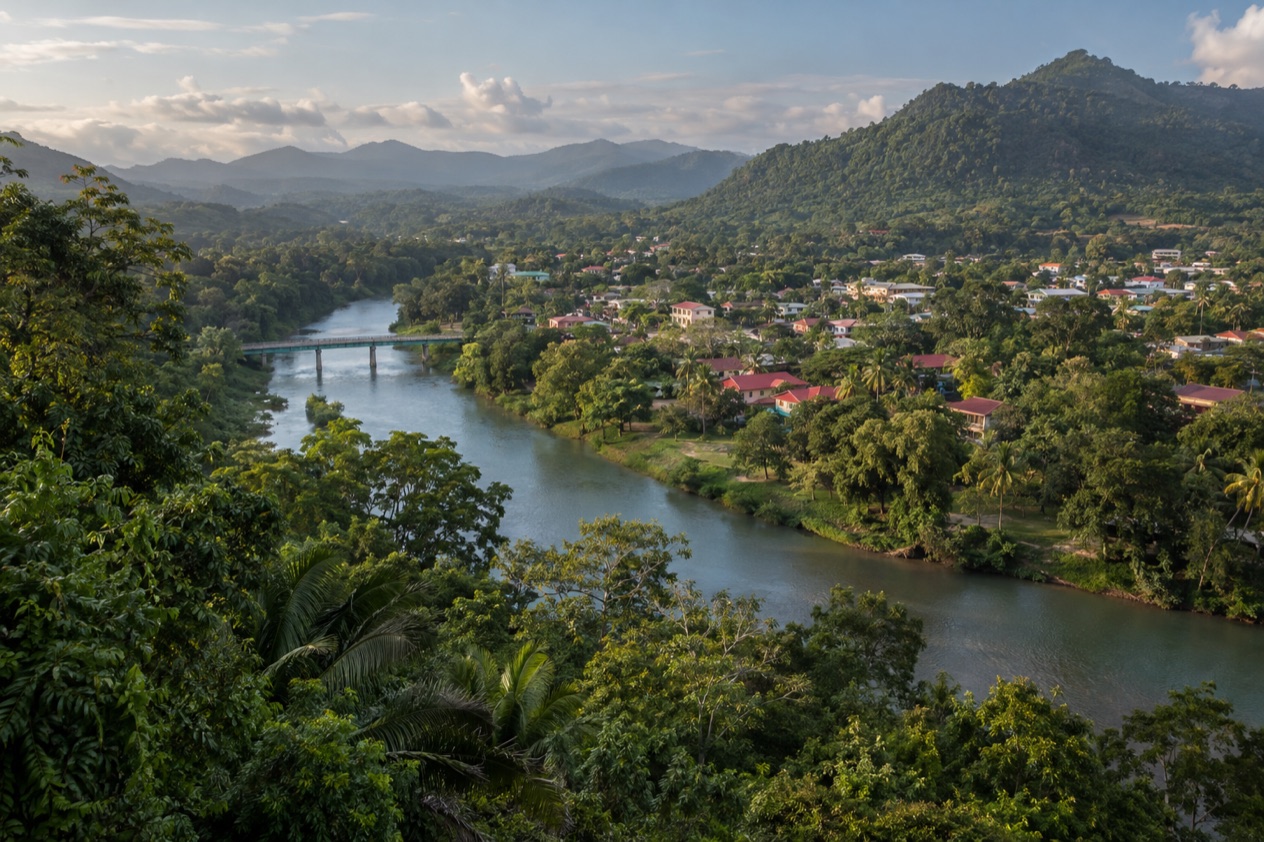
You arrive in San Ignacio with the Macal River below you and the one-lane Hawkesworth Bridge linking the town to its sister, Santa Elena. The streets run uphill from the river, and English is the language you hear at the counter and the corner shop. A few practical points are worth settling before you go: the entry papers, the money, the roads and the medical care in the Cayo District.
What should you know before visiting San Ignacio and the Cayo District?
Four things matter most here: your passport and onward ticket, the Belize dollar and its fixed rate, the roads and the lack of roadside help, and how far medical care can be from a rural lodge. Everything else, from the ruins to the river, is easier once those are in order.
What tends to surprise first-time visitors is how compact and how close to the border this part of Belize feels. San Ignacio sits on the banks of the Macal River in western Belize, and Cayo District touches Guatemala to the west.
The ruins are scattered around the town: Cahal Pech rests high above the Macal River, Xunantunich sits on a ridge above the Mopan River, and Caracol lies deeper in the district. You can build a stay around the town and reach several civilizations’ worth of stone from the same hotel.
The twin towns together are the third largest urban area in the country, yet they feel like a small river town, with a bridge that lets one vehicle cross at a time. English is the major language of the district, so asking directions is straightforward, and you will hear Spanish and Creole around the markets too.
Entry, fees and paperwork
U.S. citizens need a U.S. passport valid for the length of their stay. Belize does not require a visa from tourists staying fewer than 30 days, and no special immunizations are required of visitors. Every traveler must show proof of an onward or return ticket and sufficient funds to cover the whole stay.
Visitors are usually given a 30-day stay. Those planning to stay longer get their passport re-stamped at a local immigration office and pay an additional fee for each extra month, up to a maximum of six months. The Visitor’s Permit Extension adds 30 days, provided you do not work or engage in business without consent, and the nearest Immigration Office can tell you whether you qualify.
Families should know that when children travel without both parents, immigration officials require proof of consent and identification from the non-traveling parent, along with the children’s birth certificates. Anyone coming overland from Guatemala will find that different fees apply depending on whether the stay is under or over 24 hours.
| Fee | Amount | Who pays |
|---|---|---|
| Visitor’s Permit Extension (additional 30 days) | BZ$200.00 | All nationals |
| Passenger Service Fee, Philip S. W. Goldson International Airport | US$53.50 | Departing passengers |
| PACT fee, Philip S. W. Goldson International Airport | US$20.00 | Departing passengers |
| Overnight parking, Philip S. W. Goldson International Airport | US$9.00 | Drivers leaving a vehicle overnight |
Money and cards
The Belize dollar is the local currency, and its official value is pegged at BZ$2 to US$1. That fixed rate makes mental math easy: halve any Belize dollar price and you have the U.S. figure.
Read price tags and menus carefully, because a sign may be in either currency. Fees in this part of the country, such as the airport charges, are quoted in U.S. dollars, while the immigration extension fee is set in Belize dollars. Knowing which currency a figure is written in keeps you from paying double or half of what you expect.
That history sits behind the stable peg you see at every counter.
Getting around
Traffic in Belize is organized around two-lane paved roads and, beyond them, dirt or gravel tracks, and that mix defines getting around the Cayo District. San Ignacio lies about 63 miles west of Belize City and 22 miles west of Belmopan. A bus from San Ignacio to Belmopan takes one hour, and Hopkins is a three-hour bus ride via Belmopan.
Caracol is the district’s long outing. It lies roughly 25 miles south of Xunantunich and the town of San Ignacio, and the only road there is paved for the last 9.9 miles, connecting to the Western Highway between San Ignacio and Belmopan and to Santa Elena. Xunantunich sits about 0.6 miles from the Guatemala border, and Cahal Pech is near the town itself.
If you drive, valid U.S. or international driver’s permits are accepted only for three months after initial entry. Driving at night is strongly discouraged, and roadside assistance is frequently unavailable. Plan your arrival at the lodge or hotel with those two facts in mind.
Flying out, passengers departing from Philip S. W. Goldson International Airport are expected to arrive at least three hours before scheduled departure.
Health and the sun
Medical care deserves real thought. In Belize, emergency services are usually unavailable or significantly delayed, and serious injuries or illnesses normally require evacuation to another country. Advanced treatment is scarce in Belize City and Belmopan, and in rural and remote areas even basic care is hard to find or not available at all. La Loma Luz Hospital in Santa Elena is the main hospital of the twin towns.
With that in mind, evacuation insurance is a sensible thing to sort out at home before you fly. It matters most if your plans take you to jungle lodges and trails far from town.
On vaccinations, the CDC recommends hepatitis A for unvaccinated travelers one year old or older, and hepatitis B for unvaccinated travelers younger than 60, while older travelers may get vaccinated. Typhoid vaccine is recommended for those who might visit rural areas with poor sanitation, spend a month or more, or visit friends or relatives. Travelers allergic to a hepatitis A vaccine component should receive a single dose of immune globulin instead.
The sun in western Belize is strong, and the ruins, with their open plazas and tall temple platforms, give little shade. A hat, sunscreen and a water bottle belong in your day bag, and so does repellent for the river valleys.
Local customs and etiquette
Greetings matter. A friendly “good morning” or “good afternoon” when you enter a shop, a bus or a small restaurant is the normal courtesy, and people respond in kind. Belizeans tend to be relaxed and conversational, so a short chat before a transaction is part of the rhythm rather than a delay.
Dress is casual across the Cayo District. Shorts and sandals suit the town and the trails, but if you step into a church in San Ignacio or Santa Elena, cover your shoulders and keep your voice low. Swimwear belongs at the river and the pool, not on the streets or at the market.
In the market, prices for produce and everyday goods are usually set, and the stalls are a place for buying fruit, tortillas and snacks rather than haggling. Craft sellers may be open to a friendly conversation about price, but keep it light and good-humored. A meal out is unhurried: servers will not bring the check until you ask for it, which is a courtesy rather than neglect.
Travelers should also know that the Immigration Act prohibits “homosexual” persons from entering Belize, though immigration authorities have not enforced that law. There are no legal restrictions on consensual same-sex relations, but there continues to be significant hostile sentiment toward people based on real or perceived sexual orientation.
Good to know before you go
The U.S. State Department rates Belize Level 2, “Exercise increased caution”, because of crime, and says the south side of Belize City has historically had the highest concentration of violent crime.
The Atlantic hurricane season runs from June 1 to November 30, so a trip in those months falls inside it. A season of this kind brings an average of 14 named storms across the Atlantic basin, and it is worth leaving room in your plans for changes.
Keep your return ticket, proof of funds and passport together and easy to reach, since you may be asked for all three at the border or the airport. Counterfeit and pirated goods bought as souvenirs can lead to fines or confiscation when you bring them back to the United States. Before you leave town for the ruins, fill the tank and the water bottle, because the road beyond offers little help.
Sources
- U.S. Department of State, Belize Travel Information, Entry and exit requirements (https://travel.state.gov/), checked October 11, 2026
- U.S. Department of State, Belize Travel Information, Health (https://travel.state.gov/), checked October 11, 2026
- U.S. Department of State, Belize Travel Information, Traveling and transportation (https://travel.state.gov/), checked October 11, 2026
- U.S. Department of State, Belize Travel Information, Local laws and special circumstances (https://travel.state.gov/), checked October 11, 2026
- U.S. Centers for Disease Control and Prevention, Belize traveler view (https://wwwnc.cdc.gov/travel/destinations/traveler/none/belize), checked October 11, 2026
- Wikipedia, Belize dollar (https://en.wikipedia.org/wiki/Belize_dollar), checked October 11, 2026
- Wikipedia, Languages of Belize (https://en.wikipedia.org/wiki/Languages_of_Belize), checked October 11, 2026
- Philip S. W. Goldson International Airport (Belize), FAQ (https://www.pgiabelize.com/about-us/faq/), checked October 11, 2026
- Belize Immigration Department, Visitor's permit (https://immigration.gov.bz/permits/visitors-permit/), checked October 11, 2026
- Tropic Air, Belize immigration and visas (https://www.tropicair.com/belize-immigration-visas/), checked October 11, 2026
- Maya Island Air, Belize visa requirements (https://www.mayaislandair.com/belize-visa-requirements/), checked October 11, 2026
- NOAA National Hurricane Center, Climatology (https://www.nhc.noaa.gov/climo/), checked October 11, 2026
- Wikipedia, San Ignacio, Belize (https://en.wikipedia.org/wiki/San_Ignacio,_Belize), checked October 11, 2026
- Wikivoyage, San Ignacio (Belize) (https://en.wikivoyage.org/wiki/San_Ignacio_(Belize)), checked October 11, 2026
- Wikipedia, Cayo District (https://en.wikipedia.org/wiki/Cayo_District), checked October 11, 2026
- Wikipedia, Xunantunich (https://en.wikipedia.org/wiki/Xunantunich), checked October 11, 2026
- Wikipedia, Cahal Pech (https://en.wikipedia.org/wiki/Cahal_Pech), checked October 11, 2026
- Wikipedia, Caracol (https://en.wikipedia.org/wiki/Caracol), checked October 11, 2026
- U.S. Department of State, Belize Travel Advisory, Level 2, March 11, 2026 (https://travel.state.gov/), checked October 11, 2026
To plan your stay
- Best Time to Visit San Ignacio and the Cayo District: Weather, Maya Sites and Seasons
- Things to Do in San Ignacio and the Cayo District: Maya Ruins, Caves, Rivers and Local Food
- Where to Stay in San Ignacio and the Cayo District: Riverside Lodges, Town Stays and the Mountain Pine Ridge
- San Ignacio and the Cayo District from Belize City: Distance, Bus, Rental Car and Day Trips