
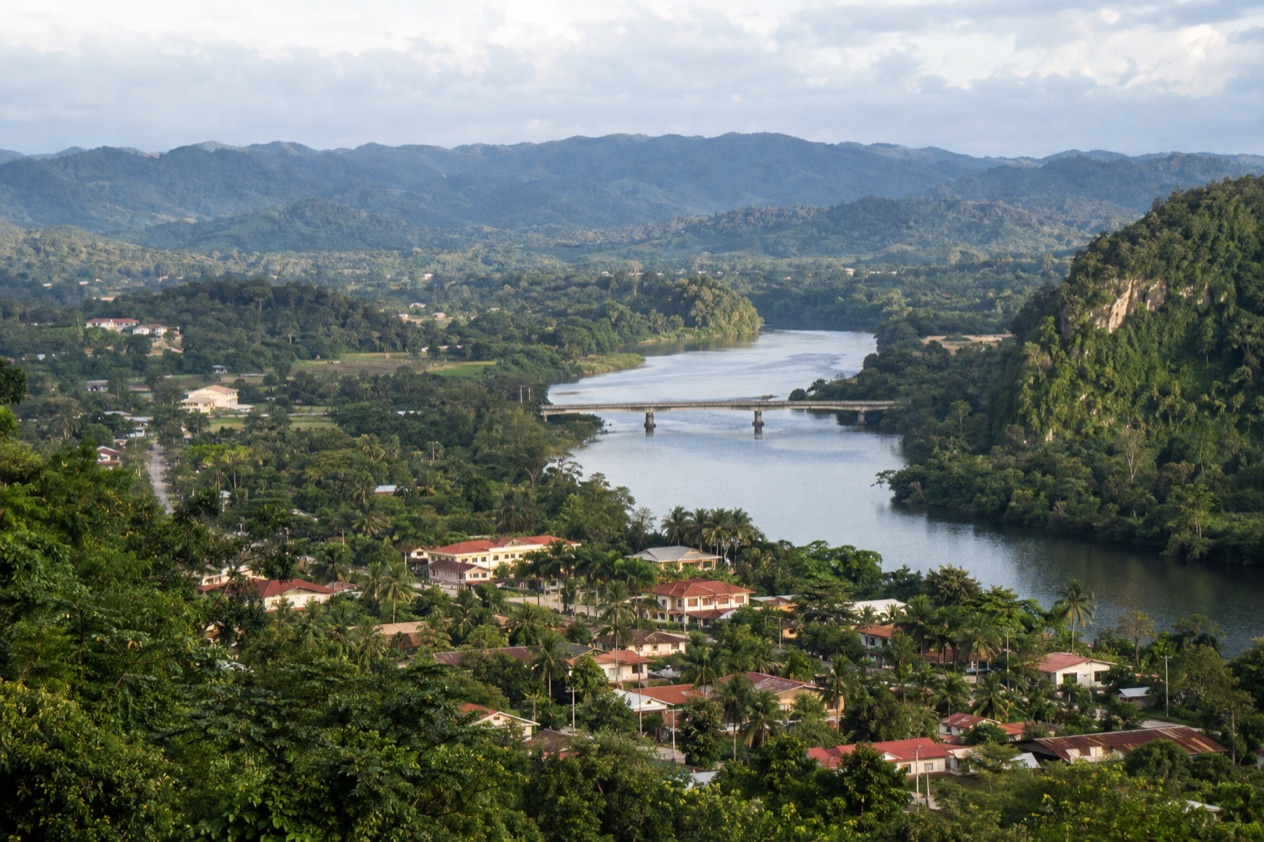
Early in the morning, the one-lane Hawkesworth Bridge hums with pedestrians and slow-rolling vehicles, and the Macal River slides by under the girders while market stalls in San Ignacio start to open. People sip coffee, haggle over produce and head out toward the Maya ruins and the jungle country of western Belize. It is an easy town to like, and an honest one to ask about: how safe is it, and what should a visitor know before arriving?
Is San Ignacio and the Cayo District safe to visit?
Belize has a high crime rate, and isolated incidents of violent crime can happen even during the day and in tourist areas. Belize has a high crime rate and one of the highest per capita murder rates in the world. The crimes reported across the country include sexual assault, home invasions, armed robberies and murder, and much of the violence is linked to gangs.
Violent crime is concentrated in one place more than any other: the Southside of Belize City, historically. That matters for a Cayo trip because it shows where the risk is heaviest, but it does not mean the rest of the country is free of incidents. Isolated cases of violent crime can happen even during the day and in tourist areas, so the usual habits of a careful traveler apply in San Ignacio as anywhere else.
What changes the picture is what happens after something goes wrong. Local police lack the resources and training to respond effectively to serious crimes, and most crimes remain unresolved and unprosecuted. A stolen bag or an assault is therefore not something you can count on the system to put right, which is a good reason to avoid situations that invite trouble in the first place.
Solo travelers and small groups should know that sexual harassment or assault of people traveling alone or in small groups has been reported. Women traveling alone or in small groups are targets for sexual assault, even in tourist areas. For same-sex couples, there are no legal restrictions on consensual same-sex relations, yet significant hostile sentiment exists, and outside tourist friendly areas such as San Pedro Town, couples, especially men, are reluctant to display affection in public because verbal and physical assaults have been reported.
If something happens, dial 911 for the local police. The U.S. Embassy can be reached at +501 822-4011, and it can also help replace a lost or stolen passport. U.S. citizens who are victims of domestic violence are encouraged to contact the embassy as well.
Safety by area in San Ignacio and the Cayo District
San Ignacio and Santa Elena
San Ignacio sits on the banks of the Macal River in western Belize, joined to its sister town Santa Elena by the Hawkesworth Bridge, built in 1949 and the only suspension bridge in Belize. Together the two towns hold a population of 21,229 and make up the third largest urban area in the country. By day this is a working town with traffic, shops and visitors crossing the bridge on foot.
The general warnings for Belize apply here as they do in any town: incidents of violent crime can occur in daylight and in places where tourists gather. The sensible approach is the one you would take in any unfamiliar town, which is to stay aware of your surroundings, keep valuables out of sight and not walk alone into places you do not know.
La Loma Luz Hospital in Santa Elena is the main hospital of the twin towns. Serious injuries or illnesses in Belize normally require evacuation to another country, so the hospital is not a substitute for proper insurance.
The wider Cayo District: ruins and rural country
Cayo is the western district of Belize, with San Ignacio as its capital, and it borders Guatemala to the west. It holds a string of pre-Columbian Maya sites, among them Caracol, Xunantunich, Cahal Pech, Baking Pot, Lower Dover and El Pilar. Reaching them means leaving town and moving into rural country, where even basic medical care may be hard to find or unavailable.
In rural and remote areas of Belize, even basic medical care is hard to find or not available at all, and first responders may not be available outside major cities for urgent medical care. Ambulance services are not widely available, and emergency services are usually unavailable or significantly delayed. Anyone heading out to the ruins or the countryside should plan as if help could be far away.
That is not a reason to skip the district, only a reason to travel with a clear head. Tell someone where you are going, carry what you need for the day and keep the practical points of insurance and evacuation cover in mind before you leave home.
Southside Belize City, the area to know about
San Ignacio lies about 63 miles west of Belize City, so many travelers will hear about the city before they ever see the Cayo District. The U.S. Department of State advises reconsidering travel to Southside Belize City due to crime, and violent crime there is historically concentrated and gang related.
U.S. government employees are strongly discouraged from traveling to the south side of the city, from the Haulover Creek Canal to Fabers Road. For a visitor, that line on the map is worth remembering: it describes the part of Belize City where the risk is highest, and it is not a description of San Ignacio or the Cayo District.
Common scams and how to avoid them
The scams that the official advice names are mostly about money and property, and none of them is tied to San Ignacio itself. Still, they belong to a trip in Belize, so it helps to know what they look like. The simplest protection is the same everywhere: be slow to hand over money or card details, and be suspicious of anything that arrives with pressure attached.
Credit card fraud is the first one. Several credit card fraud rings are believed to be active in Belize, particularly in San Pedro on Ambergris Caye. If your trip takes you out to the cayes as well, keep an eye on your card statements, and do not let a card leave your sight when you pay. It is also a reason to watch your accounts after you get home.
Real estate is the second. Real estate investment scams have been reported in Belize, with tactics that include false promises of amenities and misleading sales tactics.
Real estate investment scams have been reported in Belize, with false promises of amenities and misleading sales tactics. If you find yourself being pushed, the way around it is to say no and walk away, and to make no commitment of any kind on the spot.
Souvenirs carry a rule of their own. Counterfeit and pirated goods are a problem on the way home: you may be subject to fines and may have to give up counterfeit and pirated goods if you bring them back to the United States. In practice, that means a bargain that looks too cheap to be an original is best left on the stall.
One more habit is worth keeping if something does go wrong. A stolen or lost passport can be replaced with help from the U.S. Embassy, and a crime can be reported by dialing 911. Because most crimes in Belize remain unresolved, the real defense against a scam is prevention rather than the hope of a remedy afterward.
Getting around safely
The roads around San Ignacio are part of the Belize road network, and the official advice describes that network plainly: conditions range from two-lane paved roads to dirt or gravel tracks. Drivers operate vehicles on the right side of the road, as in the United States. That familiar rule does not make every road familiar, so drive slowly where the surface changes.
Driving at night is strongly discouraged in Belize. Roadside assistance is frequently unavailable, which turns a breakdown after dark into a much bigger problem than it would be at home. If you plan an excursion to a ruin or a lodge in the Cayo District, build your day so you are back where you are staying before nightfall.
Valid U.S. or international driver’s permits are accepted in Belize only for a period of three months after initial entry. For a typical vacation that is a limit you will not reach, but it is a rule worth knowing if you plan a long stay.
Buses link San Ignacio with the rest of the country. The distance to Belmopan, the capital, is 26 miles, and a bus takes one hour. Hopkins is 87 miles away, and a bus via Belmopan takes three hours. Belmopan lies east of San Ignacio, and Belize City is farther east.
Within the twin towns, the Hawkesworth Bridge is a feature to keep in mind. It is a one-lane suspension bridge connecting San Ignacio and Santa Elena. It is the link between San Ignacio and Santa Elena, and anyone traveling between the two will pass over it.
Accessibility is limited. In Belize, the law does not provide for accessibility to persons with disabilities, and most public and private buildings and transportation are not accessible. Travelers with limited mobility should keep that in mind when thinking about buses, buildings and sites in the Cayo District.
Beach, water and weather safety
San Ignacio is an inland town, so there is no beach in the picture, only the Macal River running past the town and the rivers and forest of the district around it. Treat a river as a river and take local guidance on a given spot rather than assume.
The weather question that matters for the calendar is the Atlantic hurricane season, which runs from June 1 to November 30. Belize lies within the area that season covers, and an inland location does not remove the chance that a tropical system brings days of heavy rain. If you travel in those months, expect the weather to be a factor in your plans and keep your schedule flexible.
Health risks are the other half of the picture. The U.S. Centers for Disease Control and Prevention identifies Belize as a Zika risk area. Other diseases are also prevalent in the country, among them malaria, leishmaniasis, diarrheal illness, dengue fever and New World screwworm. Mosquitoes and insect bites are a matter for the rainforest country of western Belize, so protection against them belongs in your preparation.
Lodging has a hidden hazard of its own. Many hotels and other lodgings in Belize are not equipped with carbon monoxide detectors, even if they contain sources of this potentially lethal gas. A battery-powered detector in your luggage is a small way to cover that gap.
Specialized prescription medications may be completely unavailable in Belize, so bring what you need for the length of your trip. Advanced medical treatment is scarce in Belize City and Belmopan, and in rural and remote areas even basic care is hard to find. The practical conclusion is to arrive in good health and with your own supplies.
Good to know before you go
The U.S. State Department rates Belize Level 2, “Exercise increased caution”, because of crime, and says the south side of Belize City has historically had the highest concentration of violent crime.
Money and medicine decide how a problem plays out. The Department of State, U.S. embassies and U.S. consulates do not pay medical bills for U.S. citizens in Belize, Medicare and Medicaid do not apply overseas, and most hospitals and doctors in Belize do not accept U.S. health insurance. The Department of State strongly recommends supplemental insurance to cover medical evacuation, and in a country where serious injuries normally mean evacuation abroad, that advice is the single most useful thing to arrange before you fly.
Beyond that, the habits are simple: keep valuables out of sight, stay out of Southside Belize City, and finish drives before dark. The hurricane season covers the months from June to the end of November, so keep your plans flexible if you travel then.
Sources
- U.S. Department of State, Belize Travel Information, Travel Advisory (Level 2) (https://travel.state.gov/), checked October 11, 2026
- U.S. Department of State, Belize Travel Information, Safety and security (https://travel.state.gov/), checked October 11, 2026
- U.S. Department of State, Belize Travel Information, Local laws and special circumstances (https://travel.state.gov/), checked October 11, 2026
- U.S. Department of State, Belize Travel Information, Health (https://travel.state.gov/), checked October 11, 2026
- U.S. Department of State, Belize Travel Information, Traveling and transportation (https://travel.state.gov/), checked October 11, 2026
- U.S. Department of State, Belize Travel Advisory, Level 2, March 11, 2026 (https://travel.state.gov/), checked October 11, 2026
- Wikipedia, San Ignacio, Belize (https://en.wikipedia.org/wiki/San_Ignacio,_Belize), checked October 11, 2026
- Wikivoyage, San Ignacio (Belize) (https://en.wikivoyage.org/wiki/San_Ignacio_(Belize)), checked October 11, 2026
- Wikipedia, Cayo District (https://en.wikipedia.org/wiki/Cayo_District), checked October 11, 2026
- NOAA National Hurricane Center, Climatology (https://www.nhc.noaa.gov/climo/), checked October 11, 2026
To plan your stay
- Best Time to Visit San Ignacio and the Cayo District: Weather, Maya Sites and Seasons
- Things to Do in San Ignacio and the Cayo District: Maya Ruins, Caves, Rivers and Local Food
- Where to Stay in San Ignacio and the Cayo District: Riverside Lodges, Town Stays and the Mountain Pine Ridge
- San Ignacio and the Cayo District from Belize City: Distance, Bus, Rental Car and Day Trips