
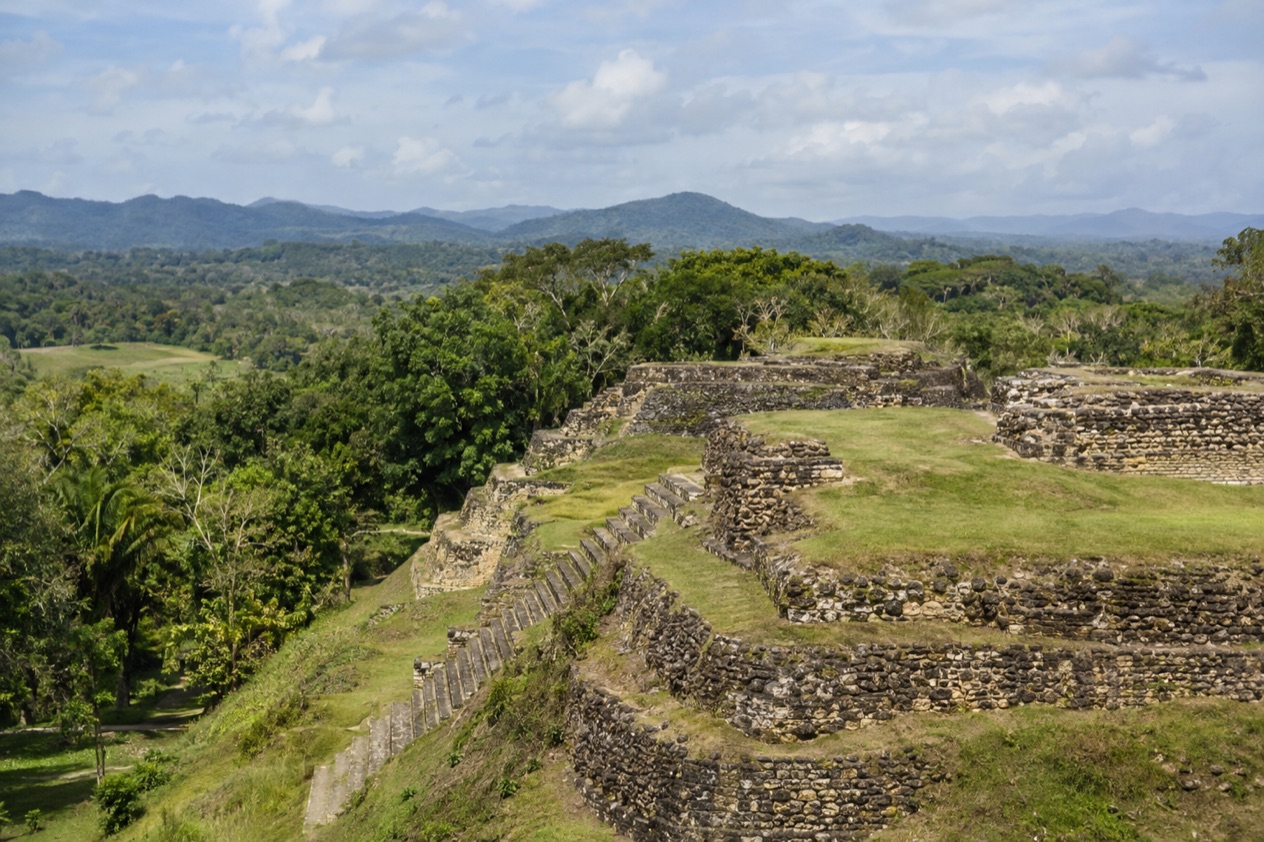
The first thing you notice at Lubaantun is the stone itself: dark, squared blocks fitted together without a trace of mortar, climbing in terraces out of the Toledo jungle. Birdsong and the rustle of the canopy replace the noise of any crowd. This is a quiet Maya city in southern Belize, and a visit here is a slow walk among plazas, ball courts and high stepped platforms.
Is visiting Lubaantun worth it?
Yes, if you like your ruins unhurried and a little mysterious, and you are happy to spend time in the far south of Belize rather than on the better-known northern and western circuits. Lubaantun suits travelers curious about how the Maya built, anyone who enjoys a site where the setting is half the experience, and families or friends who like to wander on their own terms along marked trails.
What sets it apart from other Maya sites in the country is the masonry. Most structures here are laid from large blocks with no mortar, and the stone is mostly black slate rather than the limestone typical of the region. The result looks sharper and darker than the pale temples you may have seen elsewhere.
It flourished in the Classic era, from the 730s AD to the 890s, and you read that history in the walls.
What to see at Lubaantun
The city is built across a ridge, and the visit moves between open plazas and raised platforms. Handrails are provided in places, and you stay on the marked trails, which is how the site is meant to be explored.
The mortarless walls
Look closely at any terrace face and you see the signature of Lubaantun: large blocks, cut and set tightly against one another with no mortar holding them. The dark slate gives the walls a clean, almost tailored look, and some corners are rounded rather than sharp, which is unusual enough that builders and archaeologists still study it.
Take your time at the edges of the platforms, where the stonework is easiest to see up close. The light changes the color of the blocks through the day, from gray to nearly black when it is damp. Jumping on monuments is not permitted, and you may not remove stone, earth or pottery from the site.
The ball courts
Recent research shows that Lubaantun has three ball courts, to the east, west and south of the main E group buildings. The Maya ball game was part sport, part ritual, played with a heavy rubber ball between sloping walls, and its courts sat at the heart of a city’s public life.
Standing in a court, you can picture the crowd on the surrounding platforms. The grass floor is quiet now, framed by those dark stone walls, and it is one of the best places to understand how the city was laid out around its ceremonies.
The plazas and stepped platforms
The core of the city is a sequence of plazas bounded by tall terraced structures, built when Lubaantun was at its height. From the upper levels, where the trail allows, you look out over the jungle canopy and the hills of Toledo.
This is also where the site’s finds come into focus. Archaeologists recovered a large collection of miniature ceramic objects here, one of the features that most distinguishes Lubaantun. As for the crystal skull often linked to the site, investigators concluded it was not found here at all but bought at an auction in 1943. The real story is in the stone around you.
Hours, tickets and rules
Lubaantun is open every day, including Sundays and public and bank holidays, so a visit does not have to be built around a closed day. Ticket categories separate residents from non-residents and run through several age groups, including children, adults and Belizean Golden Citizens aged 65 and over.
| Site | Open | Last tour |
|---|---|---|
| Lubaantun | Every day, 8:00 am to 5:00 pm, including Sundays and public and bank holidays | One hour before closing |
Visitors must wear outdoor-appropriate footwear for the rugged terrain, stay on the demarcated trails and use handrails where they are provided. No loud noise, shouting or music is permitted, and no jumping on monuments.
At all Belize archaeological reserves, smoking, starting a fire, camping, hunting or feeding wildlife, and consuming alcohol are prohibited. Pets must be leashed, garbage must be carried out, and coolers or ice boxes stay at the parking lot and designated picnic areas. A guide may take a maximum of 15 visitors.
How to get to Lubaantun
Lubaantun lies in Belize’s Toledo District, about 26 miles northwest of Punta Gorda, the town that serves as the natural base for the far south. The site is now accessible by automobile and has a small visitors’ center, so you arrive at a proper entrance rather than at the end of a trek.
The ruins sit close to the village of San Pedro Columbia, about 2 miles away by one measure, and one mile by another. Either way, the village is the landmark that tells you that you are close. It is a small Maya community, and passing through it is part of the experience of reaching the site.
From Punta Gorda, you head northwest toward San Pedro Columbia and continue to the visitors’ center. Once you are there, the trails take you into the ruins themselves.
When to visit Lubaantun
Any day of the week works, since the gates open at 8:00 am and close at 5:00 pm. Arriving near opening gives you the full run of the day, and it matters because the last tour starts an hour before closing. A late arrival leaves you little time to see the plazas and courts properly.
The site is open on Sundays and on public and bank holidays, so a holiday weekend need not rule it out. The Atlantic hurricane season runs from June 1 to November 30, and a trip in those months shares the calendar with it, so keep an eye on the forecast as your dates approach.
Because the setting is a jungle ridge and the stone is dark slate, the site photographs and feels different with the light. Soft light brings out the texture of the blocks, and the quiet of the place is part of the draw at any hour.
Tips for your visit
Start with the shoes. The terrain is rugged, and outdoor-appropriate footwear is required, so leave the sandals for the beach. Bring water and whatever you need for a day among trees. Coolers and ice boxes must stay at the parking lot and the designated picnic areas, so plan your food accordingly.
Think about a guide. A guide may lead a group of up to 15, and a good one will explain the construction, the ball courts and the story of the miniature ceramics in a way that a quiet walk cannot. If you go on your own, stay on the demarcated trails and use the handrails.
Pair Lubaantun with the village of San Pedro Columbia, which you pass on the way, or with a base in Punta Gorda. Keep voices low, since loud noise, shouting and music are not permitted, and take your litter with you when you leave.
Good to know before you go
The U.S. State Department rates Belize Level 2, “Exercise increased caution”, because of crime, and says the south side of Belize City has historically had the highest concentration of violent crime.
Lubaantun is a protected archaeological reserve, so the rules are the ones above: nothing is removed, nothing is damaged, and you leave the place as you found it. The Atlantic hurricane season runs from June 1 to November 30, which is worth remembering when you choose your dates for the south.
Sources
- NICH ticketing, Lubaantun (https://ticketing.nichbelize.org/product/lubaantun/), checked October 11, 2026
- Wikipedia, Lubaantun (https://en.wikipedia.org/wiki/Lubaantun), checked October 11, 2026
- NICH ticketing, Code of conduct (https://ticketing.nichbelize.org/code-of-conduct/), checked October 11, 2026
- U.S. Department of State, Belize Travel Advisory, Level 2, March 11, 2026 (https://travel.state.gov/), checked October 11, 2026
- NOAA National Hurricane Center, Climatology (https://www.nhc.noaa.gov/climo/), checked October 11, 2026