
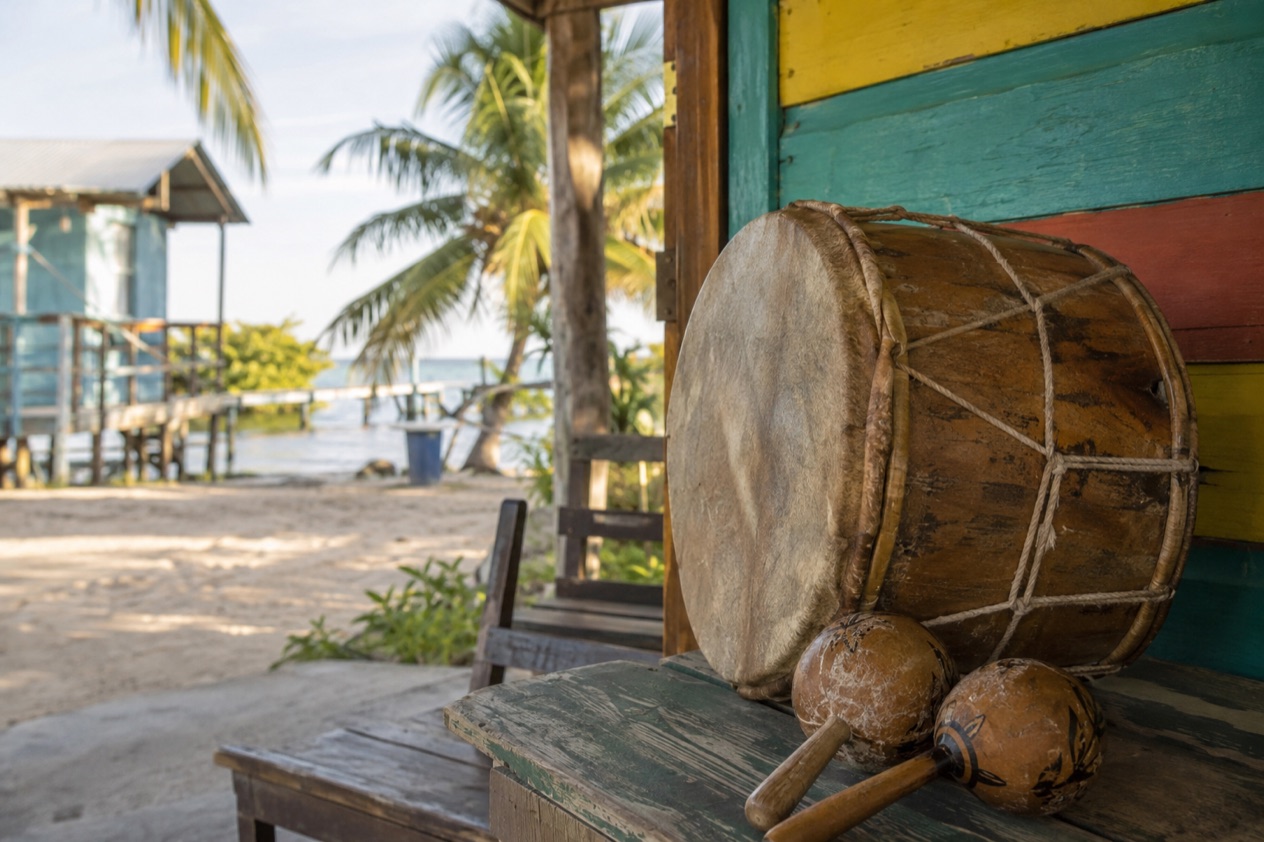
Drums start up in Dangriga, and dancers move in the circle that Garifuna communities have kept alive for generations. Elsewhere in the country a horse-drawn buggy rolls past a field, a Kriol greeting carries across a market, and Spanish drifts over a counter in a northern town. Belize packs several peoples, several languages and thousands of years of Maya history into a small country, and this is how those threads fit together for a traveler.
Who lives in Belize?
Belize is home to a mix of Kriol, Maya, East Indian, Garinagu (Garifuna), Mestizo and Mennonite communities, among others, and no single group defines the country. That blend shows in the way people speak, what they celebrate and how they earn a living, from fishing villages on the coast to farms in the west.
English is the official language and the language of public education, government and most media, so a visitor can get by in it everywhere. Underneath it, though, Belizeans move between tongues easily. The sound of a street in Belize City is not the sound of a market in Corozal, and part of the pleasure of traveling here is hearing the change.
A country of many languages
English is the major language in the Belize District, the most populated one, as well as in Cayo, the district around the capital, and in Toledo, the southernmost. Creole is the main language in the Stann Creek district, where Dangriga and Hopkins are found. In Orange Walk and Corozal, near the frontier, Spanish is the most used language.
Along the way you will also meet what people call Kitchen Spanish, an intermediate form of Spanish mixed with Belizean Creole, spoken in northern towns such as Corozal and San Pedro. It is a good reminder that the languages here do not sit in neat boxes. They blend in conversation, often within a single sentence.
Garifuna, Maya and Mennonite voices
The Garifuna language is spoken by the Garifuna people, and about 16,100 people speak this Arawakan-based tongue. In Mennonite colonies and villages, German is the everyday language. The vast majority speak Plautdietsch, while a minority of some 10 percent speaks Pennsylvania German.
The total ethnic Mennonite population stood at 15,249 in 2022. Hearing a low German dialect at a roadside stand, and then Kriol at the next, is an ordinary part of a Belizean day and one of the clearest signs of how layered the country is.
The cayes and the way Belizeans relax
Belize has the world’s second largest barrier reef and hundreds of small islands called cayes. They are popular recreation areas for urban Belizeans, especially during school vacations and at Easter. That makes the cayes a local pleasure as much as a visitor draw, and Easter weekend also brings an international cross-country cycling race to the country.
History left its marks on the water too. At Turneffe Atoll in April 1718, the pirate Blackbeard captured the sloop Adventure and forced its captain, David Herriot, to join him. It is a small story, but it shows how long these waters have carried people from many places.
What are the main cultures?
The main cultures are Maya, Garifuna, Kriol, Mestizo, East Indian and Mennonite, each with its own music, language, food and calendar. The Maya are the oldest presence, the Garifuna are the most celebrated in song and dance, and the Mennonites are the most visible in the countryside.
Maya heritage
Several Maya ruin sites, including Cahal Pech, Caracol, Lamanai, Lubaantun, Altun Ha and Xunantunich, reflect the advanced civilization and much denser population of the Maya in Belize before 1000 AD. Other centers include Baking Pot in the Cayo District, Nimli Punit in the Toledo District and Lamanai on Hill Bank Lagoon in the Orange Walk District.
The details are striking. The inscriptions on the monuments at Caracol are in Classic Ch’olti’an, the Lowland Maya aristocratic tongue. At Altun Ha, a tomb held the head of the sun god Kinich Ahau, one of the finest carved jade objects of Maya civilization. Cuello, near Orange Walk, has some of the oldest pottery found in present-day Mexico and Central America, and Cerros on Chetumal Bay was a flourishing trade and ceremonial center between about 300 BC and 100 AD.
Garifuna music, language and dance
In 2001 UNESCO proclaimed the language, dance and music of the Garifuna a Masterpiece of the Oral and Intangible Heritage of Humanity. Punta is the most popular genre of Garifuna music and has become the most popular genre in all of Belize. Paranda, a slower variant, gained popularity through artists like Paul Nabor of Punta Gorda.
Garifuna music has seen a resurgence in recent years, popularized by musicians such as Andy Palacio, Mohobub Flores and Aurelio Martinez. Andy Palacio’s album Watina and Umalali: The Garifuna Women’s Project were both released on the Belizean label Stonetree Records. By 1981, around 65,000 Garifuna were living in fifty-four fishing villages in Belize, which helps explain how deeply the culture is tied to the coast.
Mennonite communities
Mennonite life in Belize runs from the traditional to the modern. Shipyard in the Orange Walk District is a traditional and conservative community, while Spanish Lookout in the Cayo District has modernized to a large degree. Noah Hoover Mennonites in Upper Barton Creek and their daughter settlements use horse-drawn buggies and forbid motors and electricity.
Only those communities till their fields with horse-drawn implements. Near Lamanai, Mennonite children sell peanuts to tourists. In the Western Cayo District, Mennonites also play ice hockey, an unexpected sight in a tropical country.
Where can you meet them?
You meet them in towns, villages, museums and ruins across the country, and on the national holidays when people gather. Dangriga is the place to see traditional Garifuna dancers, and Belize City holds the museum that tells the longest story.
The Museum of Belize
The Museum of Belize is an art and history museum in Belize City, housed in a building that served as the Belize City Prison until 1993, when prisoners were moved to Hattieville Prison. In 2002 the former prison was restored and renovated into a national museum.
Inside, exhibits on slavery include a timeline, information about slave revolts and the communities of escaped slaves called maroons. The museum displays Maya artifacts and explores some 3,000 years of Maya history. Other galleries cover the prison’s own history, colonial life, natural history, visual arts and the cultures of the nation’s many ethnic groups.
Maya sites
Altun Ha, thirty kilometers northwest of Belize City, preserves remnants of Maya culture and the tomb where the jade sun god’s head was found. Xunantunich and Cahal Pech sit in the Cayo District, Lubaantun and Nimli Punit in Toledo, and Lamanai in Orange Walk. Each tells a different part of the story of a civilization that was far denser here before 1000 AD.
National holidays and festivals
The calendar is the quickest way into Belizean identity. George Price Day, on January 15, honors the first Prime Minister and became a public holiday in 2021. National Heroes and Benefactors Day, on March 9, was originally Baron Bliss Day, after a wealthy Englishman who left his fortune to the former British Honduras.
Saint George’s Caye Day, on September 10, commemorates the 1798 battle, and San Pedro Town hosts an annual regatta. Independence Day, on September 21, marks the day in 1981 when Britain granted independence to the country once called British Honduras, renamed in 1973.
Garifuna Settlement Day, on November 19, has honored the Garifuna people since 1941. Boxing Day, on December 26, is set aside for charitable works, though many people play sports or go shopping. If a public holiday falls on a Sunday, the following Monday is observed as the bank and public holiday, under Chapter 289 of the laws of Belize.
Good to know before you go
The U.S. State Department rates Belize Level 2, “Exercise increased caution”, because of crime, and says the south side of Belize City has historically had the highest concentration of violent crime.
The Atlantic hurricane season runs from June 1 to November 30, so the September and November celebrations fall within it. English is understood everywhere, which makes it easy to ask about a dance, a dish or a holiday, and a few words of Kriol or Spanish are welcomed in the north and along the coast. At Mennonite farms and villages, the people you meet are going about their working lives, so greet them as you would any neighbor.
Sources
- Wikipedia, Culture of Belize (https://en.wikipedia.org/wiki/Culture_of_Belize), checked October 11, 2026
- Wikipedia, Garifuna (https://en.wikipedia.org/wiki/Garifuna), checked October 11, 2026
- Wikipedia, History of Belize (https://en.wikipedia.org/wiki/History_of_Belize), checked October 11, 2026
- Wikipedia, Languages of Belize (https://en.wikipedia.org/wiki/Languages_of_Belize), checked October 11, 2026
- Wikipedia, Mennonites in Belize (https://en.wikipedia.org/wiki/Mennonites_in_Belize), checked October 11, 2026
- Wikipedia, Public holidays in Belize (https://en.wikipedia.org/wiki/Public_holidays_in_Belize), checked October 11, 2026
- Wikipedia, Museum of Belize (https://en.wikipedia.org/wiki/Museum_of_Belize), checked October 11, 2026
- U.S. Department of State, Belize Travel Advisory, Level 2, March 11, 2026 (https://travel.state.gov/), checked October 11, 2026
- NOAA National Hurricane Center, Climatology (https://www.nhc.noaa.gov/climo/), checked October 11, 2026