
The road to Cockscomb leaves the Southern Highway at Maya Center Village and turns to dirt, running toward a long ridge of forested mountains that, from the coast, looks like the crest of a rooster. Beyond the gate the air changes: it is green, damp and loud with birds and insects. This is the world’s first jaguar preserve, and a visit here means walking quiet forest trails in the Stann Creek District.
Is visiting Cockscomb Basin Wildlife Sanctuary worth it?
Yes, if you want to walk inside real rainforest rather than look at it from a road, and especially if the idea of jaguar country appeals to you. It suits travelers staying in Dangriga, Hopkins or Placencia who want a day in the interior, as well as anyone with a keen eye for birds, tracks, butterflies and plants. It is less a sightseeing stop than a place to slow down and listen.
What sets it apart from other reserves nearby is its purpose. The sanctuary was established in 1986 as the first protected area created for the jaguar, and it is known worldwide as the premier habitat for the animal, which is most often found in the West Basin wilderness.
Jaguars are shy, and seeing one is a rare stroke of luck rather than something to count on. The reward is the setting itself: a large protected basin ringed by mountains, with trails laid out for visitors and for the scientists who research the forest.
It also works as a gateway. Victoria Peak Natural Monument is reached through the sanctuary, so the same entrance serves a casual forest walk and a serious mountain expedition.
What to see at Cockscomb Basin Wildlife Sanctuary
The trail system and the forest
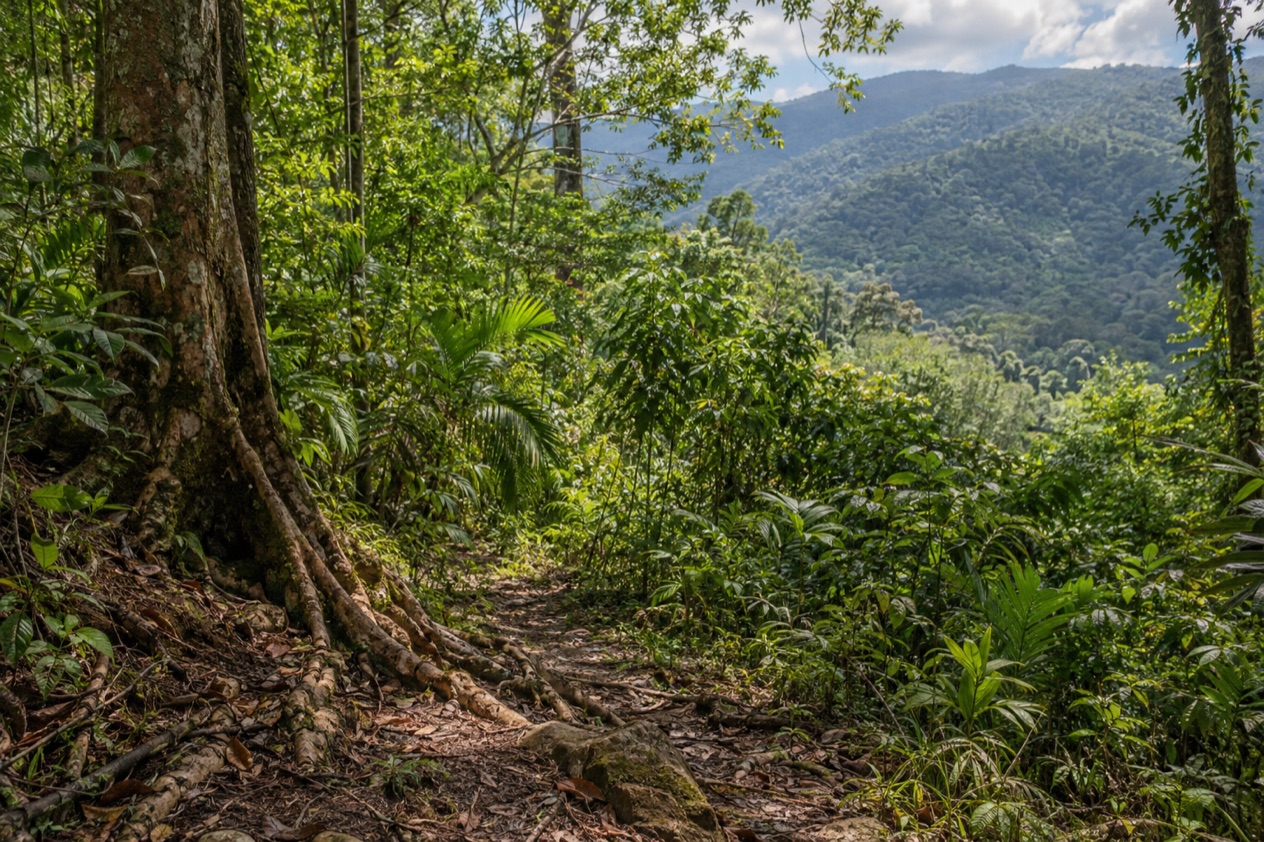
The sanctuary is crossed by a low-intensity trail system, built to let visitors and researchers move through the forest without remaking it. Paths wind among huge trees, ferns, palms and vines, and the ground often holds clues to what passed in the night: tracks in the mud, fallen fruit, a rustle in the leaf litter.
Look up as much as down. Toucans, motmots, parrots and a long list of smaller forest birds live here, and troops of howler monkeys sometimes announce themselves with a roar that carries a long way. Butterflies drift along sunny gaps in the canopy. Go slowly, stop often and let the forest come to you.
The two basins and the creeks
The sanctuary is made of two adjacent basins. The West Basin is drained by the Swasey Branch, and the East Basin is the upper watershed of South Stann Creek. Together they hold running water, rocky stretches and low forest along the creeks, set against a backdrop that climbs steeply toward the high ridges.
Elevations here run from the low reaches of South Stann Creek to the summit of Victoria Peak, which rises to 3,810 feet. That range of height is part of why the area shelters so many kinds of habitat. Together with Victoria Peak Natural Monument, the protected land holds an estimated 21 ecosystems, 19 on land and 2 in water.
Jaguar country and the West Basin
The West Basin is where the jaguar is most often found, and the whole sanctuary was shaped around protecting that cat. You are walking in the territory of the largest predator in the Americas, along with other forest wildlife that shares it. Most of what you will notice are traces: a print, a scrape, a stillness in the undergrowth.
The preserve covers more than 136 square miles, so the animals have room to keep their distance from visitors. That is exactly the point of a place like this, and it makes any sighting feel earned.
Maya history in the basin
People lived in this basin long before it was a reserve. Evidence of Maya habitation here goes back as far as 10,000 BCE, and the neighboring village of Maya Center keeps that heritage alive. Knowing this changes how the forest feels: it is an old landscape of human use as well as wilderness. The name itself comes from the Cockscomb Mountain ridge, whose jagged outline resembles a rooster’s comb and can be seen from the Caribbean coastal plain.
Hours, tickets and rules
The sanctuary opens in the morning and closes in the late afternoon, so it is a daytime visit. Fees differ for Belizean nationals and for non-nationals, and the entrance fee is collected at Maya Center Village, before the road continues to the protected area itself. Victoria Peak Natural Monument has its own fee for non-nationals.
| Site | Open | Admission |
|---|---|---|
| Cockscomb Basin Wildlife Sanctuary | 8:00am to 4:30pm | Non-nationals BZD 10, Belizean nationals BZD 2.50 |
| Victoria Peak Natural Monument (reached through the sanctuary) | Visiting season February 1 to May 31 | Non-nationals BZD 10 per day |
The sanctuary is operated by the Belize Forest Department and the Belize Audubon Society. For a Victoria Peak hike, the Belize Audubon Society asks that you book and seek a qualified tour guide by emailing [email protected].
How to get to Cockscomb Basin Wildlife Sanctuary
The sanctuary lies off the Southern Highway, about 20 miles south of Dangriga Town. From the highway you turn off at Maya Center Village, and from the fee collection point there, the protected area itself is six miles down an unpaved road.
By vehicle
Driving, turn off the Southern Highway at Maya Center Village. If you are coming from the Hummingbird Highway, that turnoff comes about 20 minutes after you join the Southern Highway. From the village you continue on the unpaved road to the protected area.
By bus and taxi
Buses running from Belize City to Punta Gorda Town can stop at Maya Center Village on request, and that journey takes about 3.5 hours. From the village, you can hire a local taxi to the sanctuary for BZD 40.00 one way.
By air and taxi
Maya Island Air and Tropic Air fly from Belize City to Dangriga Town, a flight of approximately 20 minutes. From Dangriga, a taxi to the sanctuary costs about USD 75.
When to visit Cockscomb Basin Wildlife Sanctuary
The gates open at 8:00am and close at 4:30pm, and those hours frame any visit. Arriving at the opening puts you on the trails in the early day, when forest birds are typically active, and leaves the late afternoon to wind down before closing.
For Victoria Peak, the planning window runs from February 1 to May 31, so anyone with a summit hike in mind should aim for those months. Plan the Peak separately from a simple forest walk, since it is a much bigger undertaking than the ordinary trails.
The Atlantic hurricane season runs from June 1 to November 30, and a trip in those months should leave room for plans to change. Whatever the month, this is a rainforest basin, so expect green, damp surroundings rather than dry, open country. Come for the forest as it is on the day, and let the weather be part of it.
Tips for your visit
Bring what a forest walk calls for: sturdy shoes, water, insect repellent and a hat. Binoculars are useful for birds and for the canopy, and a camera with a good zoom suits a place where wildlife keeps its distance. Pack light so the walking stays pleasant.
Because the entrance fee is paid at Maya Center Village and the protected area is six miles beyond on an unpaved road, plan the logistics before you set out, especially if you are relying on a taxi. Pairing the sanctuary with a base in Dangriga, Hopkins or Placencia keeps the day simple.
If you want a longer stay, there are two places to sleep on site. The Balum Naj cabin sleeps a maximum of 6 people in two rooms, one with a double bed and one with a bunk and a single bed. The dormitory sleeps 30 people in 5 rooms, with 3 bunk beds in each.
Resorts nearby also build the sanctuary into their programs. Hamanasi, for one, offers a visit to Cockscomb Basin Wildlife Sanctuary and Jaguar Preserve and a Jaguar Preserve Night Hike among its scheduled rainforest adventures, both part of its Reef & Rainforest Package. Hamanasi also lists a Mayflower Jungle & Waterfall Hike, a Cave & Jungle Adventure and Jungle River Canoeing.
Good to know before you go
The U.S. State Department rates Belize Level 2, “Exercise increased caution”, because of crime, and says the south side of Belize City has historically had the highest concentration of violent crime.
Carry Belize dollars for the entrance fee and the taxi from Maya Center Village, since both are quoted in BZD. The hurricane season runs from June 1 to November 30, so a visit in those months calls for flexibility. In the forest itself, the habits that matter are the simple ones: stay on the trails, move quietly and keep your distance from wildlife.
Sources
- Belize Audubon Society, Cockscomb Basin Wildlife Sanctuary (https://belizeaudubon.org/cbws/), checked October 11, 2026
- Wikipedia, Cockscomb Basin Wildlife Sanctuary (https://en.wikipedia.org/wiki/Cockscomb_Basin_Wildlife_Sanctuary), checked October 11, 2026
- Belize Audubon Society, Victoria Peak Natural Monument (https://belizeaudubon.org/vpnm/), checked October 11, 2026
- Hamanasi Adventure and Dive Resort, rainforest adventures (https://www.hamanasi.com/belize-rainforest-adventures/), checked October 11, 2026
- U.S. Department of State, Belize Travel Advisory, Level 2, March 11, 2026 (https://travel.state.gov/), checked October 11, 2026
- NOAA National Hurricane Center, Climatology (https://www.nhc.noaa.gov/climo/), checked October 11, 2026