
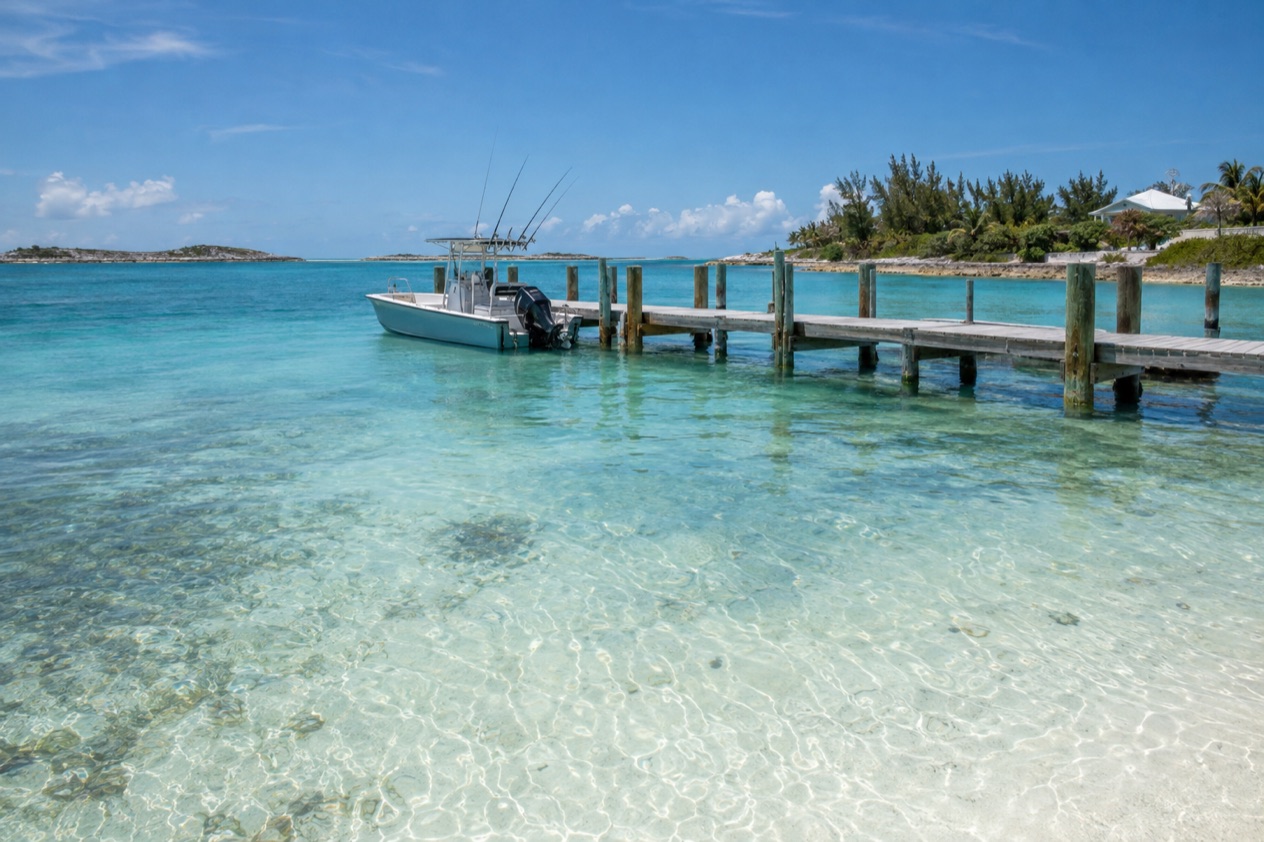
Early in the day, fishing boats idle along the docks of Alice Town while someone carries a warm loaf of Bimini bread across the road, and the talk at the rail is about what the Gulf Stream is sending in. Bimini is a thin strip of sand and scrub in the Bahamas, a place built around boats, wrecks and old stories. It suits travelers who like salt air, a small settlement and a long list of things to do on the water.
Where is Bimini and what is it like?
Bimini sits in the Bahamas, 50 miles east of Florida’s coast, and it is really two islands in one: North Bimini, where nearly everything happens, and South Bimini, which is far quieter. The islands lie in the Atlantic, with the Gulf Stream running along their western side, and that closeness to deep water shapes how people here spend their days.
North Bimini is long, flat and narrow, about 7 miles from end to end and only 700 feet across, with roughly sixteen hundred residents. You can feel the narrowness in daily life.
The sea is never far on either side, houses and docks crowd along the water, and the main settlement, Alice Town, strings out along a road known as the King’s Highway. Shops, restaurants and bars line it, and most of the hotels, restaurants and points of interest on the island are in or near Alice Town.
South Bimini is another world. About 180 people live there, and the island holds the airport, a protected dry forest with an interpretive nature trail, and the research station where shark scientists work. The pace across both islands is slow and tied to boats: mornings start at the docks, afternoons stretch out, and evenings are for a plate of Bahamian food and a drink at a harbor-side bar.
Bimini rewards people who love fishing, diving, snorkeling, history and unhurried days. It is less obviously for anyone who wants a long list of big attractions, nightlife on the scale of a big resort town or a place with many separate neighborhoods to explore. Its appeal is concentrated: a small town, a few famous wrecks and ruins in the water, and plenty of sea.
What also sets Bimini apart is its past. Rum-runners, a hotel with the first casino in the Bahamas, legends of a magic spring and a stone road under the sea all belong to this one small place, and they give a short walk down the King’s Highway more to think about than the size of the island suggests.
What is there to do in Bimini?
The big reasons to come are the water, the history and the food, and they overlap constantly: a wreck is a dive, a story and a landmark at once. Most of what you do begins at a dock in Alice Town.
Diving and snorkeling the SS Sapona
The wreck of the SS Sapona lies off South Bimini and is a popular scuba and snorkeling site. The top of the ship rises out of the water while the bottom half stays submerged, so from a boat you see a concrete hull standing in the sea long before you reach it. It is a striking shape against the flat horizon, and it draws divers, snorkelers and photographers.
The ship has a story as odd as its look. It was one of a fleet of concrete vessels ordered under President Woodrow Wilson as troop transports in World War I, when steel was scarce, and it is said to have been designed by Henry Ford.
Carl Fisher, a developer of Miami Beach, bought it for scrap and briefly ran it as a casino. A Nassau liquor merchant later used it as a floating warehouse during Prohibition, and a hurricane in 1926 drove it aground where it sits today.
The Bimini Road and the Fountain of Youth
West of the bluff of North Bimini, in the water, lie square blocks and straight alignments of stone known as the Bimini Road. The line runs for 1,500 feet, with stones lying in an orderly row, and it can be reached by boat only.
It is also a popular scuba diving site. Some people link it to the lost continent of Atlantis, and some researchers compare its design to a submerged harbor in the Mediterranean. Whatever you believe, it is a good reason to be out on the water.
On land the legends continue. Juan Ponce de León is said to have sailed for Bimini in 1513 looking for a spring that restored youth, and although he never found it, he came upon the Gulf Stream and Florida instead. Locals still call a well near the road to the airport the Fountain of Youth, and two bronze busts of Martin Luther King Jr. stand on the island to honor his legacy.
Fishing, beaches and the nature trail
Bimini is known for waters teeming with tuna, and boats and marinas are part of the scene everywhere on North Bimini. Alongside the fishing come endless white sandy beaches, which are the setting for slow afternoons rather than organized activity. Walk the shoreline, find a spot and watch the boats go out.
On South Bimini, the Bimini Nature Trail runs through a protected dry forest, with signs about local plants and animals, and connects to Shell Beach. It is a change of pace from the docks and a way to see the island as scrub and sand rather than as a harbor. Shark research happens on South Bimini too, and the lab there takes interns in marine biology.
Alice Town, Bahamian food and a bit of history
The King’s Highway in Alice Town is where you eat, drink and wander. Bimini offers excellent Bahamian cuisine and freshly baked Bimini bread, which is worth seeking out at breakfast or alongside a plate of fish or conch. The bars and restaurants are close together, so an evening is often a stroll from one to the next.
Look for the history too. On North Bimini, the Bimini Bay Rod and Gun Club was built in 1920 as a three-story hotel and casino, the first casino in the Bahamas and the largest hotel in the country at the time. Today a modern resort holds the island’s only casino, so gambling remains part of the island’s story a century later.
How many days do you need in Bimini?
A long weekend gives you a real taste of Bimini, and a week lets the island’s slow rhythm take over. The place is small, but the water gives each day something different to do.
With two or three days, base yourself in Alice Town. Spend one morning on a boat for the SS Sapona or the Bimini Road, one afternoon on a beach with no agenda, and an evening on the King’s Highway sampling Bahamian dishes and Bimini bread. Add a visit to the Fountain of Youth well near the airport road and a look at the bronze busts of Martin Luther King Jr. if you want some history on land.
A longer stay opens up South Bimini. The nature trail through the dry forest, Shell Beach at its end and the shark research station make a day that feels very different from Alice Town. Fishing deserves its own day, since the island is known for tuna, and so does a slow wander around the marina and docks, where the comings and goings change by the hour.
If you only have one day, the seaplane trip from Fort Lauderdale makes it possible. The flight takes 25 minutes each way, which leaves time for a boat outing and a meal, though not for the unhurried evenings that Bimini does best.
Anyone who likes the idea of a base for multiple days of diving, snorkeling or fishing will want longer than that. People who prefer to see a place and move on may be satisfied with a couple of days.
With even more time, think about combining Bimini with other islands. Flamingo Air flies from South Bimini Airport to Freeport, which makes a connection to Grand Bahama possible.
Where to stay in Bimini
Most travelers stay in Alice Town on North Bimini, because it is the hub of tourism on the island, with most of the hotels, restaurants and points of interest. Staying here puts the docks, the bars and the food a few steps from your door, and the King’s Highway is the center of evening life. It suits people who want to walk out and find something going on.
Also on North Bimini are the Bimini Big Game Club Resort and Marina, set in the heart of the island, with a marina of 75 slips out front for guests who arrive by boat. That makes it a natural fit for anglers and boaters, who tie up beside their lodging. A large beachfront resort complex on the same island holds the only casino, and it appeals to travelers who want a resort setting with gaming on the premises.
South Bimini is the other option. Its population is small, it holds the airport and the nature trail, and it is a different kind of stay: quiet, spare and close to the wild side of the island. Think of it for a visit centered on the trail, Shell Beach or shark research rather than evenings out.
Choosing comes down to what you want from the days. If the boat and the harbor are your focus, Alice Town or a marina stay keeps you close to them. If you want a resort base with a casino, the large complex on North Bimini fits. If you want stillness, look to South Bimini.
How do you get to Bimini and get around?
You reach Bimini by air, by sea or by seaplane, and almost every route starts in Florida. Commercial and charter airlines fly into South Bimini Airport, and visitors then ferry across to North Bimini. North Bimini Airport also serves the island, and both airports receive domestic flights from other islands of the Bahamas as well as international flights from the United States.
The seaplane is the most direct route from Florida. Tropic Ocean Airways runs a same-day trip from Fort Lauderdale that takes 25 minutes each way.
By sea, Baleària operates an international passenger ferry between Port Everglades in Fort Lauderdale and Bimini, using the high-speed catamaran HSC Jaume II. Boaters can also arrive under their own power, and the marinas of North Bimini are set up for it. From South Bimini Airport, Flamingo Air flies to Freeport.
Once on North Bimini, the geography does much of the planning for you. The island is a narrow strip, and Alice Town gathers its shops, restaurants and bars along the King’s Highway, so most of what a visitor wants sits in one stretch of town.
Boats are the way to reach the Sapona, the Bimini Road and the water beyond. South Bimini is a separate island, so getting there is a matter of crossing the water.
When is the best time to visit Bimini?
The winter and spring months, roughly December through May, are the natural choice for a first trip, because they fall outside the official hurricane season and the sea and air are milder. In Nassau, January afternoons reach the high 70s and nights the mid-60s, with rain on about four days. The sea near Alice Town averages 76.3°F in January, which is cool enough that most people on a boat will want a layer in the morning.
Summer is hotter and wetter. In Nassau, July afternoons reach about 91 degrees and nights stay in the mid-70s, with rain on about twelve days, so showers are a regular part of the pattern.
The sea near Alice Town averages 88.9°F in July, warm enough that it offers little relief from the heat. Summer is also the stretch when the water, the boats and the long days appeal most to those who come for the sea and do not mind the heat.
Fall brings the heart of the hurricane season, so the late months of the year need a little more flexibility in your plans. The island’s own history is a reminder: the SS Sapona ran aground in a hurricane in 1926.
Around the end of the year, Junkanoo season brings the Bahamas’ costumed street parades and music to many islands, which can add a festive note to a winter visit. Because the fishing, diving and beach days that make up Bimini do not depend on one particular month, the choice mostly comes down to heat, rain and how you feel about the hurricane season.
Good to know before you go
The U.S. State Department rates the Bahamas Level 2, “Exercise increased caution”, and says most crime occurs in Nassau on New Providence and in Freeport on Grand Bahama.
The Atlantic hurricane season runs from June 1 to November 30, and Bimini lies in the Atlantic, so a trip that falls inside those dates deserves a watch on the forecast and some flexibility in your plans. The rest of the year is outside the official season.
Alice Town concentrates the island’s hotels, restaurants and bars, so plan your days around it and around the water. Taste the Bimini bread, spend time at the docks and leave room for the stories behind the wrecks and ruins. Because North Bimini is such a narrow island, the sea is part of nearly every view, and that is the main reason people come back.
Sources
- Bahamas Ministry of Tourism, Investments & Aviation (bahamas.com), Bimini (https://www.bahamas.com/islands/bimini), checked October 10, 2026
- Wikipedia, Bimini (https://en.wikipedia.org/wiki/Bimini), checked October 10, 2026
- Wikivoyage, Bimini travel guide (https://en.wikivoyage.org/wiki/Bimini), checked October 10, 2026
- Bahamas Ministry of Tourism, Investments & Aviation (bahamas.com), Sapona Shipwreck (https://www.bahamas.com/natural-wonders/sapona-shipwreck), checked October 10, 2026
- Bahamas Ministry of Tourism, Investments & Aviation (bahamas.com), travel blog, Bimini landmarks (https://www.bahamas.com/blog/the-historical-landmarks-of-bimini), checked October 10, 2026
- Bahamas Ministry of Tourism, Investments & Aviation (bahamas.com), travel blog, Bimini North and South, where to stay (https://www.bahamas.com/blog/the-best-of-bimini-where-to-stay-on-this-dual-island-destination), checked October 10, 2026
- Bahamas Ministry of Tourism, Investments & Aviation (bahamas.com), Fountain Of Youth (https://www.bahamas.com/natural-wonders/fountain-of-youth), checked October 10, 2026
- Wikipedia, Resorts World Bimini (https://en.wikipedia.org/wiki/Resorts_World_Bimini), checked October 10, 2026
- Wikipedia, South Bimini Airport (https://en.wikipedia.org/wiki/South_Bimini_Airport), checked October 10, 2026
- Wikipedia, Geography of the Bahamas (https://en.wikipedia.org/wiki/Geography_of_the_Bahamas), checked October 10, 2026
- Open-Meteo Marine API, average 2015-2024, checked October 10, 2026
- NOAA NCEI, GHCN-Daily station BF000078073 (Nassau Airport), normals 1991-2020 computed from the daily record (https://www.ncei.noaa.gov/access/services/data/v1?dataset=daily-summaries&stations=BF000078073), checked October 10, 2026
- U.S. Department of State, The Bahamas Travel Advisory, Level 2 (https://travel.state.gov/), checked October 10, 2026
- NOAA National Hurricane Center, Climatology (https://www.nhc.noaa.gov/climo/), checked October 10, 2026
All our pages
When to go
- Best Time to Visit Bimini: Weather by Month, Sea Temperatures, Festivals and Crowds
- Bimini in January: Sea Temperature, Wreck Snorkeling, Crawfish and a Two-Day Plan
- Bimini in February: Weather, Sea Temperature, Crawfish Season and What to Do
- Bimini in March: Crawfish Season's Last Weeks, the Sea and What to Do
- Bimini in April: Warming Sea, the Sapona Wreck and Two Days on North Bimini
- Bimini in May: Weather, Sea Temperature, the Sapona Wreck and a Two-Day Plan
- Bimini in June: Sea Temperatures, the Sapona Wreck, Island Food and a Two-Day Plan
- Bimini in July: Warm Sea, Long Days, Sapona and Island Beaches
- Bimini in August: Sea Temperature, Crawfish Season, Sapona Wreck and a Two-Day Plan
- Bimini in September: Weather, Sea, Crawfish Season and Two Days on North Bimini
- Bimini in October: Warm Sea, Crawfish Season and Two Islands to Explore
- Bimini in November: Sea Temperature, Crawfish Season, the Sapona Wreck and a Two-Day Plan
- Bimini in December: Weather, Sea Temperature, Junkanoo Season and What to Do
Things to do
- Things to Do in Bimini: Diving the SS Sapona, the Bimini Road, Alice Town and Bahamian Food
- Bimini Road: Atlantis Legend, Diving Site and How to Reach It by Boat
Where to stay
Getting there
- Bimini from Miami: Ferry from Port Everglades, Flights to South Bimini and a Day on North Bimini
- Bimini Airport to Alice Town: South Bimini Arrival, the Ferry Across and What Waits in Town