
On a July evening in Hope Town, the red-and-white stripes of the lighthouse catch the last sun while dinghies tie up along the harbor and someone grills fish on a dock. Days in the Abacos run long and hot, and life happens on the water or just beside it. July is the month for island-hopping by boat, for warm swims and for slow harbor dinners in the settlements of Elbow Cay, Green Turtle Cay and Marsh Harbour.
What is the weather like in the Abacos in July?
July is hot, humid and bright, with a sea warm enough to feel like part of the day’s heat, and long evenings that stay light well after dinner is ordered.
| Month | Sea at the Abacos (°F) | Daylight on the 15th (hours and minutes) |
|---|---|---|
| June | 83.5 | 13 h 51 min |
| July | 86.5 | 13 h 41 min |
| August | 86.7 | 13 h 06 min |
In Nassau, highs average about 91°F in July, with lows in the mid-70s, and the same sticky warmth is what you should expect to meet on the Abacos’ docks and porches. Rain comes in showers on a good share of days, often as an afternoon squall that passes and leaves the air steamier than before. Mornings are the clearest and softest part of the day.
Daylight lasts nearly fourteen hours in mid-July, which gives you a long window: an early boat ride, a break indoors or in the shade when the sun is overhead, and a second wind around five when the light turns golden over the harbors. Evenings stay warm enough to eat outside in a T-shirt.
Dress for heat and sudden showers: thin cotton or linen, a hat, sunglasses and a light rain shell that packs small. Because the sea is so warm, wet swimwear dries fast on deck and is often the most useful outfit of the day.
Can you swim in the Abacos in July?
You can take a long swim at any hour, yes, because the sea stays in the mid-80s and keeps that warmth deep into the evening.
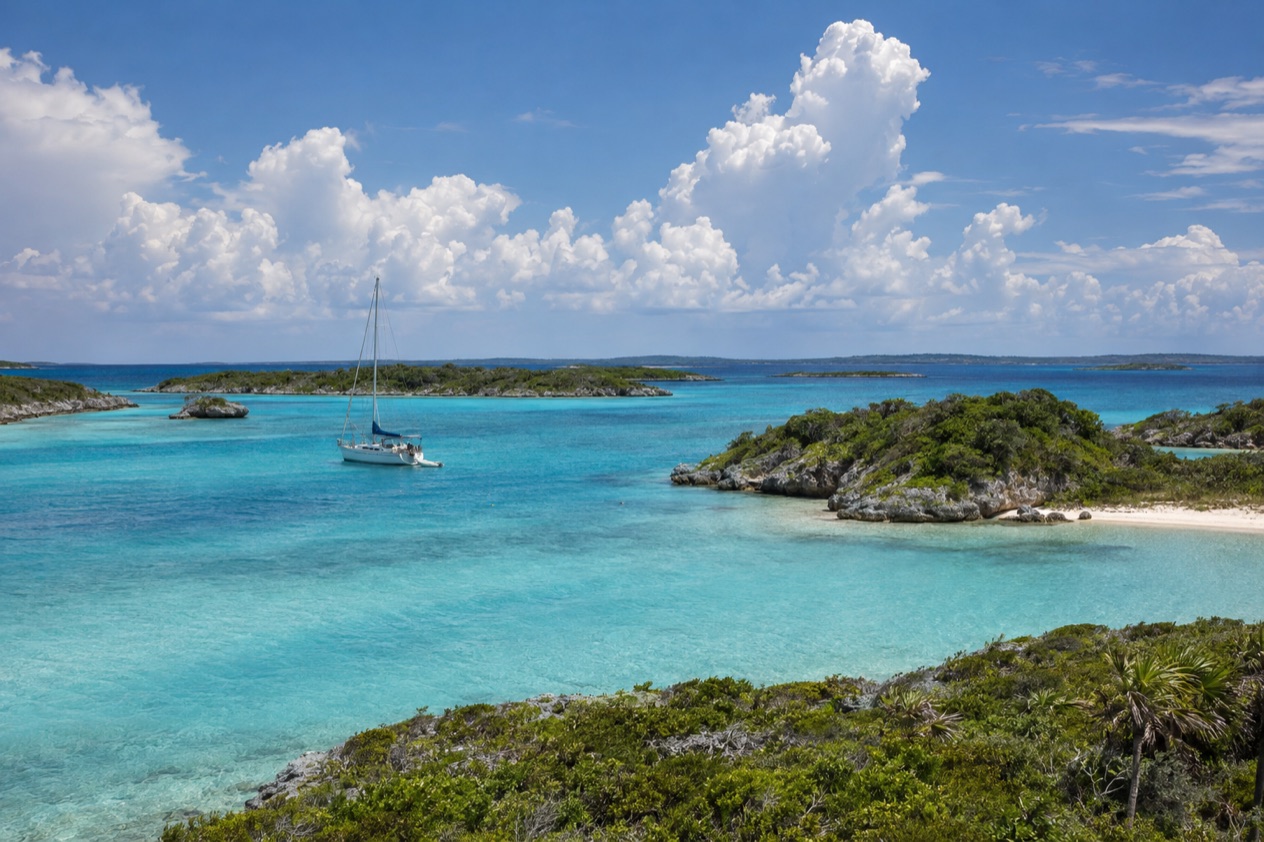
The Abacos are built around a sheltered inner sound, the Sea of Abaco, dotted with cays, and most visitors spend their days on boats moving between sandy shores and shallow flats. Beaches facing the open Atlantic are a different experience from the harbor-side coves, and the surf there tends to be livelier than in the sheltered water inside the cays. Conditions vary by day and by stretch of shore, so choose your spot with that in mind.
Snorkeling suits this water, and a mask, fins and a rash shirt are all you need beyond sunscreen. Reef-safe sunscreen matters because you will be in the water for hours under a strong sun.
What to do in the Abacos in July
The month’s big date is July 10, Independence Day in the Bahamas, and the settlements mark it with music, cookouts and boats dressed in bunting. Expect a festive mood in the harbors around that day, with family gatherings, goombay rhythms and plates of cracked conch, grilled fish and peas and rice.
July is also the season for fresh seafood. Conch salad is mixed to order with lime, onion and pepper, and chilled coconut water or a Bahamian rum drink goes with it on a shaded porch. Late afternoon is the hour for a cold drink at a dockside bar once the heat eases.
Hope Town and Elbow Cay
Hope Town sits on Elbow Cay and is its only settlement. Colorful clapboard cottages line lanes shaded by flowering trees, and the candy-striped lighthouse rises over the harbor. On the outskirts, cars and golf carts can go, but the village itself is meant for strolling, past picket fences, a small museum and a few shops and cafés.
Part of the charm is how the settlement began, co-founded in 1785 by Wyannie Malone, a South Carolina widow who came with her four children following the American Revolution. Before the airport at Marsh Harbour opened in 1959, fishing and shipwreck salvage kept the cay alive.
In July, aim for the early morning when the lanes are cool and the harbor is glassy, then return at sunset when the lighthouse glows. The middle of the day suits the water or a table in the shade.
Marsh Harbour and the boat life
Serving as the chain’s commercial center, Marsh Harbour on Great Abaco offers the international airport, marinas, grocery stores and waterfront restaurants. It is where boats are chartered and supplies are loaded before heading out to the cays.
In July the harbor is busy with moored sailboats, and evenings bring the sound of halyards and conversations drifting from decks. It is a practical base more than a sightseeing stop, but its restaurants serve fresh seafood and the sunsets over the water are worth a pause.
Abaco National Park and the Bahama Parrot
Abaco National Park, set up in 1994, protects the northern breeding grounds of the Bahama Parrot and spreads across 20,500 acres of pine forest in the south of Great Abaco. The parrot nests here, and birdwatchers come hoping for a glimpse or at least the loud calls echoing through the pines.
Go early, before the heat builds under the canopy, and bring water, bug repellent and a hat. Sightings are never guaranteed, but the forest itself, quiet and resinous, is a very different Abaco from the harbors.
Green Turtle Cay and the smaller settlements fill the rest of the picture, reached by boat, with quiet streets, small bars and views across the Sea of Abaco. Dorian struck the Abacos hard, and the islands are still rebuilding, so you will see both repaired homes and cleared lots.
A two-day itinerary for the Abacos in July
Day 1. Start in Hope Town at first light, when the lanes are cool and the harbor is still. Walk the village, stop at the lighthouse area and have breakfast at a small café. By late morning, when the sun is strong, slip into the water or take a boat along Elbow Cay’s shoreline for a swim and a snorkel.
At a spot by the harbor, lunch means conch salad or grilled fish, then a rest in the shade. In the late afternoon, wander the village again as the light softens, then eat dinner on a dock as the lighthouse lights up. If a squall rolls in, wait it out in a café or the small museum.
Day 2. Spend the morning in Marsh Harbour on Great Abaco, then head toward Abaco National Park for early birdwatching among the pines, sunrise being the best moment before the heat. Return to the coast for lunch at a waterfront restaurant.
Afternoon is for a boat trip across the Sea of Abaco toward a quiet cay with a sandy shore and shallow water. Return for a sunset drink and a seafood dinner in Marsh Harbour. If it rains, browse the shops and grocery stalls, or linger over a long lunch.
Is the Abacos busy in July?
July is lively, with families on summer break and boaters filling the harbors, though the islands are never crowded in the way big resort towns are.
The week around Independence Day is the liveliest, with local families gathering and visitors joining the festivities. Rooms, rental boats and restaurant tables are easier to secure when you plan ahead, and the holiday week deserves the earliest booking, while the weeks on either side are more relaxed.
Quiet corners remain easy to find: a morning on a cay with no one else, a lane in Hope Town before breakfast, a table late in the evening. The pace stays unhurried even at the busiest harbors.
What to pack for the Abacos in July
Pack for sun, salt water and quick showers, and keep everything light.
- Swimsuits and a rash shirt, because you will spend hours in the water.
- For the fierce sun up on deck, bring a wide-brimmed hat and sunscreen that is reef-safe.
- Mask and snorkel for the shallow sea.
- A light rain shell for afternoon squalls.
- Insect repellent for the pine forest and warm evenings.
- Water shoes for rocky or shell-strewn shores.
Good to know before you go
The U.S. State Department rates the Bahamas Level 2, “Exercise increased caution”, and says most crime occurs in Nassau on New Providence and in Freeport on Grand Bahama.
July falls inside the Atlantic hurricane season, which runs from June 1 to November 30, with the peak still weeks away. Travelers are urged to keep up with hurricane updates from the Bahamas Ministry of Tourism & Aviation, which keeps watch on tropical systems. The Abacos were struck by Hurricane Dorian in 2019 and are still rebuilding in places.
No Bahamian visa is required for U.S. citizens who come as bona fide visitors. Upon arrival, travelers must show a ticket for return or onward travel, and proof of funds may also be requested. For entry, the Bahamas Department of Immigration requires a passport with at least six months of validity, and it does not accept passport cards.
The Abacos in July vs June and August
Moving earlier to June gives a slightly cooler sea and the longest days of the year, with the summer vacation just beginning and the harbors less festive. The hurricane season has only just started, and the Independence Day celebrations are still ahead.
August brings a sea a touch warmer still, but days begin to shorten and rain falls on more days. Boating remains good, though the season edges closer to its peak storm weeks, so keep an eye on forecasts. Choose June for the longest light and a quieter feel, July for Independence Day and warm water at its steadiest, and August if you want the warmest sea and do not mind a few more showers.
Is July a good time to visit the Abacos?
Yes, for travelers who love water, boats and long evenings and are happy with heat and the occasional squall.
It suits families, snorkelers, anglers and anyone who wants a slow harbor-to-harbor rhythm. It is less suited to visitors who dislike humidity or want cool air for walking all day. On arrival, get on the water first, whether with a boat or a swim, since that is how the Abacos are meant to be seen. What July gives that no other month quite does is the Independence Day mood, music drifting over the harbors, and a sea that stays warm until the light is gone.
Sources
- Open-Meteo Marine API, average 2015-2024, checked October 10, 2026
- sunrise-sunset.org, sunrise and sunset calculated for the 15th of the month, checked October 10, 2026
- NOAA NCEI, GHCN-Daily station BF000078073 (Nassau Airport), normals 1991-2020 computed from the daily record (https://www.ncei.noaa.gov/access/services/data/v1?dataset=daily-summaries&stations=BF000078073), checked October 10, 2026
- NOAA National Hurricane Center, Climatology (https://www.nhc.noaa.gov/climo/), checked October 10, 2026
- Bahamas Ministry of Tourism, Investments & Aviation (bahamas.com), Hurricane and storm information (https://www.bahamas.com/hurricane-storm-information), checked October 10, 2026
- Wikipedia, Hurricane Dorian (https://en.wikipedia.org/wiki/Hurricane_Dorian), checked October 10, 2026
- Bahamas Ministry of Tourism, Investments & Aviation (bahamas.com), travel blog, Abacos and Grand Bahama after Hurricane Dorian (https://www.bahamas.com/blog/things-to-know-when-visiting-the-bahamas-after-dorian), checked October 10, 2026
- Bahamas Ministry of Tourism, Investments & Aviation (bahamas.com), The Abacos (https://www.bahamas.com/islands/abacos), checked October 10, 2026
- Wikipedia, Abaco Islands (https://en.wikipedia.org/wiki/Abaco_Islands), checked October 10, 2026
- Bahamas National Trust, Abaco National Park (https://bnt.bs/explore/abaco/abaco-national-park/), checked October 10, 2026
- Wikipedia, Hope Town (https://en.wikipedia.org/wiki/Hope_Town), checked October 10, 2026
- Bahamas Ministry of Tourism, Investments & Aviation (bahamas.com), Hope Town (https://www.bahamas.com/natural-wonders/hope-town), checked October 10, 2026
- Wikipedia, Geography of the Bahamas (https://en.wikipedia.org/wiki/Geography_of_the_Bahamas), checked October 10, 2026
- Bahamas Ministry of Tourism, Investments & Aviation (bahamas.com), Island FAQ (https://www.bahamas.com/plan-your-trip/island-faq), checked October 10, 2026
- Bahamas Department of Immigration, Entry requirements (https://www.immigration.gov.bs/entry-requirements/), checked October 10, 2026
- Bahamas Department of Immigration, Before your arrival (https://www.immigration.gov.bs/entry-requirements/before-your-arrival/), checked October 10, 2026
- U.S. Department of State, The Bahamas Travel Advisory, Level 2 (https://travel.state.gov/), checked October 10, 2026
To plan your stay
- Things to Do in the Abacos: Hope Town Lighthouse, Tahiti Beach, Cays and Conch
- Where to Stay in the Abacos: Treasure Cay, Hope Town, Green Turtle Cay and Marsh Harbour
- The Abacos from Miami: Flights to Marsh Harbour, Island Connections and Hope Town
- Know Before You Go to the Abacos: Entry Papers, Money, Getting Around and Health