
In early January the Abacos still carry the echo of the New Year: a goatskin drum heard from a porch, cowbells and whistles from a Junkanoo group rehearsing, boats rocking quietly at their moorings in Hope Town harbor. Crawfish is on the menu at every waterfront table, the holiday rush has thinned, and the cays go back to their own pace. January in the Abacos suits travelers who want pastel cottages, a red-and-white lighthouse, boat days and long dinners without the busiest weeks of the year.
What is the weather like in the Abacos in January?
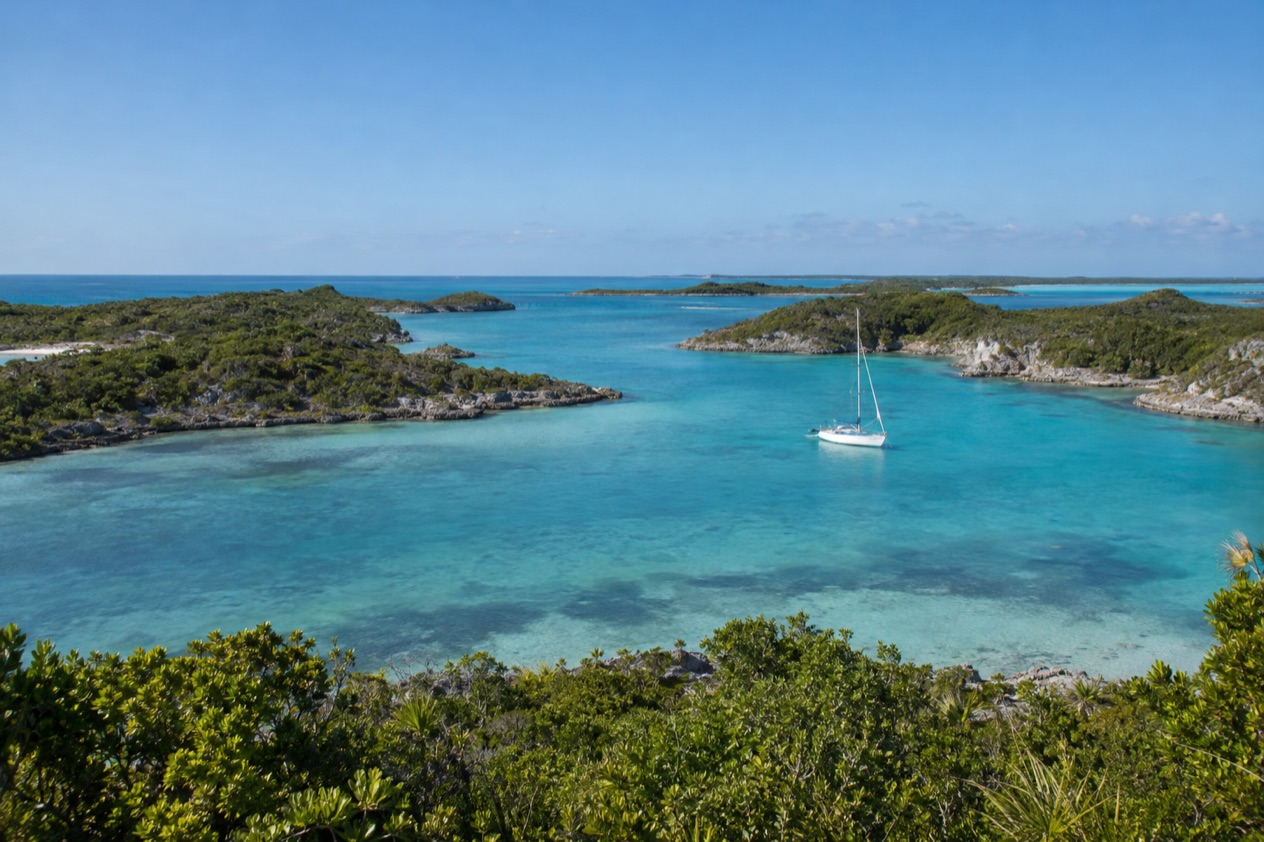
January is mild and bright, with sea and air that feel like a gentle spring rather than a beach summer. The sea is what gives the month its character, and the daylight is already stretching a little after the shortest days of December.
| Month | Sea at the Abacos (°F) | Daylight on the 15th (hours and minutes) |
|---|---|---|
| December | 78.2 | 10 h 32 min |
| January | 77.3 | 10 h 42 min |
| February | 76.1 | 11 h 19 min |
For the air, the nearest picture comes from Nassau, where January highs average about 79°F and nights cool to the mid-60s. Think of mornings that call for a light layer on a boat deck or a porch, afternoons warm enough for shorts in the sun, and evenings when you want a sweater over dinner on a dock.
Rain in Nassau in January falls on only a few days, and the showers that do come tend to pass quickly. On a cay, that usually means a gray hour, a rinse of the streets, then sun again. A shower is a reason to duck into a café or a gallery, not to cancel the day.
The sea sits in the upper 70s, which is pleasant to look at and a little brisk for a long float. Days are just under eleven hours long, so plan the big outings, a boat trip or a walk around Hope Town, for the middle of the day, and leave the golden late afternoon for a drink by the water.
Can you swim in the Abacos in January?
Yes, for a refreshing dip rather than a long soak: with the sea in the upper 70s, most people will want a swim that is invigorating and a towel close at hand when they step out.
Conditions change from day to day and from one stretch of shore to another, as they do on any island chain. A harbor side of a cay and an ocean side can feel very different on the same afternoon. On Elbow Cay, Tahiti Beach is known for soft sand and gentle waves, which makes it a pleasant place for a picnic and beach games, and a good spot to wade in and judge the water for yourself.
January is a month for being on and around the water as much as in it: a boat ride between cays, a walk along the sand at low tide, a swim for those who like it cool. A rash guard or a thin wetsuit top will help if you are used to bathwater temperatures, and a towel or a light cover-up for the walk back is welcome after you leave the water.
What to do in the Abacos in January
The sound of the month is Junkanoo. Junkanoo is a street parade of colorful costumes, dance routines and music from whistles, cowbells, horns and goatskin drums, and the biggest celebrations take place in Nassau on Boxing Day and New Year’s Day. It is also a tradition celebrated across the islands and throughout the year, so in January you may catch a rehearsal, a school group practicing, or the beat of a drum drifting out of a settlement in the evening.
The season on the plate is crawfish, which is in season from August 1 to March 31, so January sits squarely inside it. On many Bahamian menus crawfish and lobster are used interchangeably. Look for crawfish salad, a mix of onions, sweet peppers, lime juice and diced lobster, often served on greens or tucked into a sandwich, and for stew lobster, chunks of crawfish simmered in a rich brown gravy.
Hope Town and Elbow Cay
Elbow Cay, a little island in the Abaco chain, has just one settlement, Hope Town, and come January the place moves at an easy rhythm. The village was co-founded in 1785 by Wyannie Malone, a widow from South Carolina who arrived with her four children after the American Revolution. Before the Marsh Harbour airport was built in 1959, fishing and shipwreck salvage were the main livelihoods here, and you can still feel the working harbor in the way boats come and go.
The streets are made for wandering: colorful cottages, small shops, art galleries and beachside cafés, with a red-and-white striped lighthouse watching over the harbor. Bikes can be rented for exploring the town, and cars and golf carts are permitted on the outskirts.
Waterfront restaurants serve fresh local seafood, and a candlelit table on the harbor is one of the most pleasant ways to end a January day. Tahiti Beach is the place to bring a picnic.
Marsh Harbour and the Great Abaco side
Marsh Harbour on Great Abaco is the commercial hub of the Abacos and the third-largest city in the Bahamas. It is where the supplies are bought, the boats are fueled, and the ferries and charter captains gather. Great Abaco, the main and largest island, is served by Leonard M. Thompson International Airport in Marsh Harbour, and Treasure Cay Airport, also international, serves the settlement of Treasure Cay.
In January the waterfront restaurants and marinas feel local rather than crowded. It is a good place to start a day with a Bahamian breakfast, stock up on snacks for a boat day, and look for a harbor-view lunch of conch fritters or crawfish salad. The Abacos chain spans 120 miles, divided into North, Central and South Abaco, and Marsh Harbour sits at the center of it all.
Abaco National Park and the Bahama parrot
Set aside on Abaco since 1994, Abaco National Park spans 20,500 acres, its purpose being to safeguard the Bahama parrot’s northern breeding grounds. The pine forest and wild country it protects are a different world from the colorful harbors of the cays, and a reminder that the Abacos are more than boats and beaches.
If you have an interest in birds, January brings pleasant temperatures for being outdoors. You may hear a parrot before you see one, and sightings are never a promise, so treat the park as a chance rather than a guarantee. Bring binoculars, a hat, and patience.
A two-day itinerary for the Abacos in January
Day 1 starts in Marsh Harbour, with a slow breakfast at a harbor-side café while the town wakes up. Spend the morning wandering the waterfront and the small shops, then take an early lunch of crawfish salad or a conch fritter plate before heading out to the water. The upper-70s sea makes the middle of the day the best time to be afloat, with the sun at its warmest.
In the afternoon, cross to Elbow Cay and settle into Hope Town. Walk the lanes past the cottages and galleries, then drift to the harbor as the light turns golden. For dinner, choose a waterfront restaurant, where stew lobster or fresh fish is the natural order. If the weather turns gray, the town’s galleries and cafés are made for a slow, dry hour.
Day 2 belongs to the beach and the wild side of the island. Start with a bike ride around Hope Town, passing the cottages and beachside cafés, and spend the late morning at Tahiti Beach with a picnic. January days are only just over ten hours long, so keep the afternoon loose and the last hour for a walk along the water.
If the day brings rain, shift to a long lunch and a gallery browse, or use the time for a conversation with a boat captain about the next day’s plan. For the final evening, return to the waterfront in Marsh Harbour for crawfish and the sound of rigging in the breeze.
Is the Abacos busy in January?
January is quieter than the holiday weeks that come just before it, and the pace eases once the New Year festivities are over.
The first days of the month still feel like the holidays, with families and boaters lingering and the Junkanoo spirit in the air. After that the cays settle down.
Restaurants, marinas and small hotels have more room, and the harbor towns feel like themselves again. That said, the Abacos are a boating destination with a small number of rooms, so for the first week it is wise to book early, as you would for any holiday week.
For the quieter weeks later in the month, planning can be more relaxed, though a favorite table or a room with a harbor view still rewards a little forethought. Flights come into the airports at Marsh Harbour and Treasure Cay on Great Abaco, and Hope Town on Elbow Cay is small, so the choice of where to stay is limited and worth settling before you travel.
What stays quiet in January is the pace of the water and the walking: no cruise-day rush on Hope Town’s lanes, no wait for a seat at the harbor, and a sense that you are visiting a place rather than a destination. Still, weekends bring local boaters and visitors, so a dinner table is easier to find midweek.
What to pack for the Abacos in January
January in the Abacos calls for layers that move between boat deck, harbor lane and restaurant terrace.
- A light sweater or windbreaker, for breezy boat rides and cooler evenings on a dock.
- Shorts and a swimsuit, because afternoons are warm and a dip is tempting.
- A rash guard or thin wetsuit top, since the sea is brisk for anyone used to warmer water.
- Sandals and walking shoes, for bike rides and lanes in Hope Town.
- Binoculars, for the chance of spotting a Bahama parrot near Abaco National Park.
- A light rain jacket, for the occasional passing shower.
Good to know before you go
The U.S. State Department rates the Bahamas Level 2, “Exercise increased caution”, and says most crime occurs in Nassau on New Providence and in Freeport on Grand Bahama.
January falls outside the official Atlantic hurricane season, which runs from June 1 to November 30. The Abacos lie about 193 miles east of Miami and are served by international airports at Marsh Harbour and Treasure Cay.
For entry by air, the Bahamas Department of Immigration says the passport must be valid for at least six months and passport cards are not accepted. U.S. citizens do not need a Bahamian visa for a visit not exceeding eight months, and all visitors must hold a return or onward ticket. Visitors may be asked to show proof of sufficient funds.
The Abacos in January vs December and February
Moving the trip four weeks earlier brings you to December, when the sea is a touch warmer and the days are at their shortest. It is the month of Christmas and the Boxing Day Junkanoo, so the cays feel festive and busier, and rooms are in higher demand. Crawfish is in season in all three months, but December has the holiday atmosphere that January loses.
Moving four weeks later brings February, when the sea is cooler still and the days are noticeably longer, with a little more light for boating, bikes and beach picnics. The holiday crowds are well behind, and the cays settle into a steady winter rhythm. Crawfish season is still open, and it runs through the end of March.
If you want the warmest water and the holiday mood, choose December. If you want longer days for exploring and a quiet, settled feel, February is the better pick. January sits in between: a gentle month with the New Year’s drumbeat still in the air, fewer people than December, and a sea that suits a quick swim.
Is January a good time to visit the Abacos?
Yes, for travelers who like harbor towns, boat days, bike rides and seafood dinners more than hot beach afternoons.
You will love January if you enjoy wandering Hope Town’s lanes, sitting at a waterfront table with crawfish, and spending a day on the water in cool, bright weather. It also suits birders who want a pleasant season for Abaco National Park and travelers who prefer a quieter place after the holiday rush. If your idea of a beach vacation is hours of warm-water swimming, another month will suit better.
On arrival, head first to the water: a harbor-side lunch in Marsh Harbour or a stroll along the Hope Town waterfront will set the rhythm of the stay. What makes January special here is the mix of the New Year’s drums still lingering in the air, a sea that invites a quick dip and a lighthouse watching over a quiet harbor.
Sources
- Open-Meteo Marine API, average 2015-2024, checked October 10, 2026
- sunrise-sunset.org, sunrise and sunset calculated for the 15th of the month, checked October 10, 2026
- NOAA NCEI, GHCN-Daily station BF000078073 (Nassau Airport), normals 1991-2020 computed from the daily record (https://www.ncei.noaa.gov/access/services/data/v1?dataset=daily-summaries&stations=BF000078073), checked October 10, 2026
- Bahamas Ministry of Tourism, Junkanoo (https://www.bahamas.com/events/junkanoo), checked October 10, 2026
- Wikipedia, Junkanoo (https://en.wikipedia.org/wiki/Junkanoo), checked October 10, 2026
- Bahamas Ministry of Tourism, Christmas season (https://www.bahamas.com/blog/christmas-season-officially-launched-in-the-bahamas), checked October 10, 2026
- Bahamas Ministry of Tourism, Investments & Aviation (bahamas.com), Junkanoo (https://www.bahamas.com/events/junkanoo), checked October 10, 2026
- Bahamas Ministry of Tourism, crawfish season (https://www.bahamas.com/blog/its-crawfish-season), checked October 10, 2026
- Bahamas Ministry of Tourism, Investments & Aviation (bahamas.com), The Abacos (https://www.bahamas.com/islands/abacos), checked October 10, 2026
- Wikipedia, Abaco Islands (https://en.wikipedia.org/wiki/Abaco_Islands), checked October 10, 2026
- Bahamas National Trust, Abaco National Park (https://bnt.bs/explore/abaco/abaco-national-park/), checked October 10, 2026
- Wikipedia, Hope Town (https://en.wikipedia.org/wiki/Hope_Town), checked October 10, 2026
- Bahamas Ministry of Tourism, Investments & Aviation (bahamas.com), Hope Town (https://www.bahamas.com/natural-wonders/hope-town), checked October 10, 2026
- Bahamas Ministry of Tourism, Investments & Aviation (bahamas.com), travel blog, Hope Town (https://www.bahamas.com/blog/the-top-5-most-romantic-things-to-do-in-hope-town-abaco), checked October 10, 2026
- Wikipedia, Geography of the Bahamas (https://en.wikipedia.org/wiki/Geography_of_the_Bahamas), checked October 10, 2026
- Bahamas Ministry of Tourism, Investments & Aviation (bahamas.com), Island FAQ (https://www.bahamas.com/plan-your-trip/island-faq), checked October 10, 2026
- Bahamas Department of Immigration, Entry requirements (https://www.immigration.gov.bs/entry-requirements/), checked October 10, 2026
- Bahamas Department of Immigration, Before your arrival (https://www.immigration.gov.bs/entry-requirements/before-your-arrival/), checked October 10, 2026
- U.S. Department of State, The Bahamas Travel Advisory, Level 2 (https://travel.state.gov/), checked October 10, 2026
- NOAA National Hurricane Center, Climatology (https://www.nhc.noaa.gov/climo/), checked October 10, 2026
To plan your stay
- Things to Do in the Abacos: Hope Town Lighthouse, Tahiti Beach, Cays and Conch
- Where to Stay in the Abacos: Treasure Cay, Hope Town, Green Turtle Cay and Marsh Harbour
- The Abacos from Miami: Flights to Marsh Harbour, Island Connections and Hope Town
- Know Before You Go to the Abacos: Entry Papers, Money, Getting Around and Health