
In Hope Town, on Elbow Cay in the Abacos, the red-and-white striped lighthouse watches over a harbor of moored sailboats while golf carts and bicycles roll past pastel cottages. Some 250 miles of water away from that scene lies Staniel Cay in the Exumas, where pigs trot down a sandy beach to meet the boats and nurse sharks circle the dock at the marina. Both island groups are among the Bahamas’ great boating and beach destinations, but they feel very different once you arrive, and this comparison helps you pick the one that fits your kind of vacation.
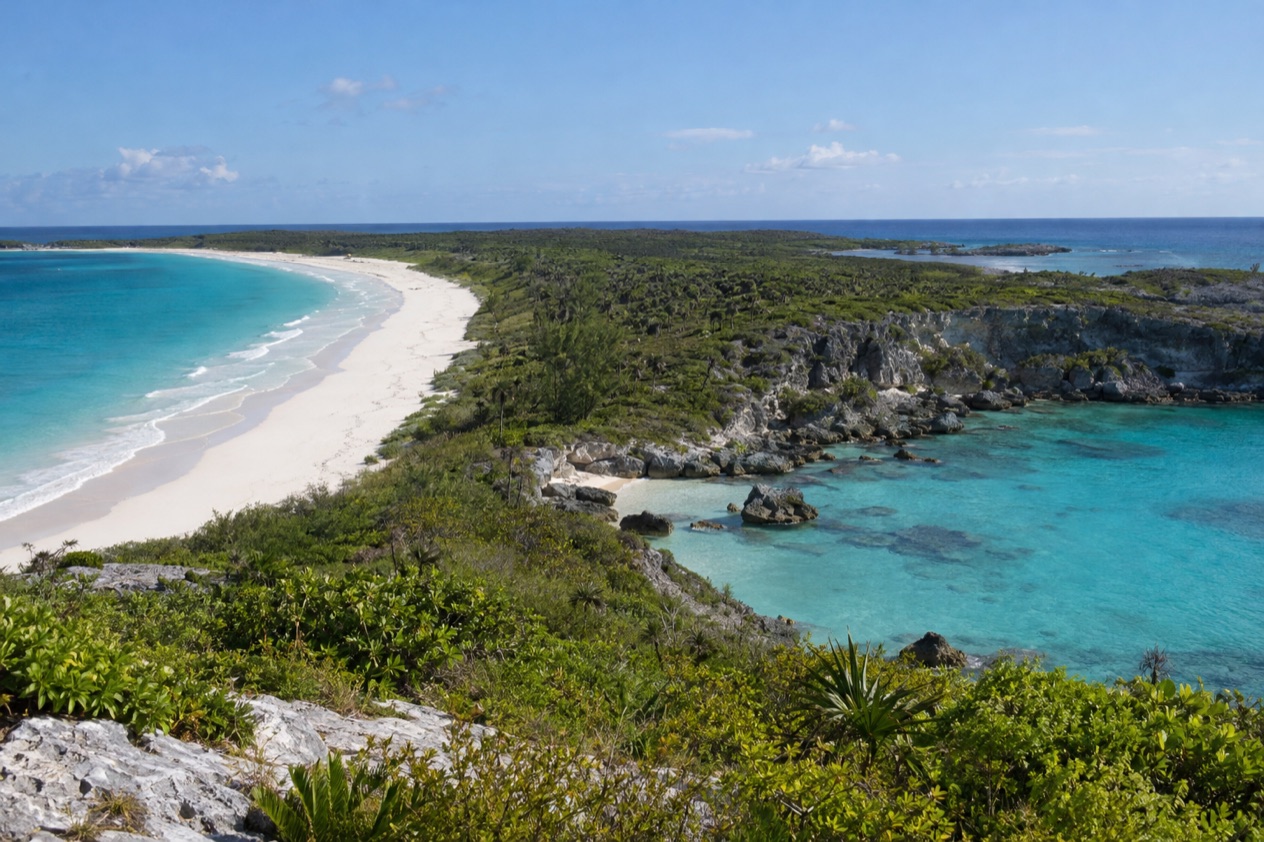
Which is better, the Abacos or the Exumas?
The Abacos suit travelers who want a walkable, cottage-lined village, a sailing-town atmosphere and a short hop between small islands by ferry, while the Exumas suit those who want sandbars, wildlife encounters and a chain of cays to explore by boat. Neither is better in every way. The Abacos feel like a string of old settlements with a loyalist-era history, and the Exumas feel like an open stretch of water dotted with hundreds of islands.
The table puts the two side by side, and the sections that follow fill in the details one topic at a time.
| Category | The Abacos | The Exumas |
|---|---|---|
| Shape of the group | An island chain spanning 120 miles, split into North, Central and South Abaco | A district of over 365 islands and cays, with Great Exuma the largest |
| Beaches | Soft sands and gentle waves at Tahiti Beach on Elbow Cay | Tropic of Cancer Beach on Little Exuma, and Pig Beach near Staniel Cay |
| Vibe | Historic harbor villages, bicycles, golf carts and sailboats | Open water, sandbars, cays and seaside grills |
| Things to do | Hope Town lighthouse and museum, bike rides, Abaco National Park, cays by ferry | Nurse sharks, the plane wreck at Norman’s Cay, George Town, grilled lobster on Little Exuma |
| Evenings | Waterfront restaurants serving local seafood by candlelight | Seaside stops and harbor-front meals around George Town |
| Weather | Atlantic hurricane season applies in late summer and fall | Atlantic hurricane season applies in late summer and fall |
| Getting there | Flights to Marsh Harbour or Treasure Cay, then ferry or boat to the cays | Flights to Exuma International on Great Exuma, or Staniel Cay Airport in the cays |
| Best for | Couples, families who like villages, sailors, history lovers | Boaters, wildlife seekers, beach-hoppers, food-on-the-sand travelers |
Beaches and the sea
The Abacos offer beaches that feel like part of village life. On Elbow Cay, Tahiti Beach has soft sands and gentle waves, the kind of spot where a picnic and a few beach games fill an afternoon.
In Hope Town, a sunset walk along the shore, with the quiet sound of small waves, is one of the simplest pleasures on the island. The sea around the Abacos is a protected-feeling sheet of turquoise and green, dotted with cays that sit just offshore.
Green Turtle Cay, one of the barrier islands off Great Abaco, adds another kind of shoreline. It is long and very narrow, so the water is never far from you whichever way you walk. The island has no airport, which keeps its pace slow, and the beaches are tied to the island’s single main settlement, New Plymouth, with its old clapboard houses.
The Exumas take beaches in a different direction, toward the dramatic and the offbeat. Tropic of Cancer Beach on Little Exuma is the longest beach on that island, named because the Tropic of Cancer crosses Pelican Beach there.
It is a place to walk a long, open shoreline with the sea changing color in front of you. Near Staniel Cay, Pig Beach is a sandy beach occupied by pigs, and it draws boat visitors for exactly that reason.
The Exumas are also about what lies between the beaches. Local memory describes running barefoot across sandbars and passing from one shade of blue to the next, and that is how many travelers experience the cays, by boat from one patch of sand to another.
At Compass Cay, nurse sharks live at the protected marina, and visitors can hang out at the dock and share a moment with them. At Staniel Cay Marina, swimming with nurse sharks is allowed at your own risk, and the sharks can bite if hands go near their mouths.
So who wins? For a beach day folded into a village stay, with a picnic, a bicycle and a sunset stroll, the Abacos win. For beaches that come with a story, whether pigs, sharks or the Tropic of Cancer line, and for the feeling of hopping among sandbars, the Exumas win.
If you plan to spend most of your time on the water, the Exumas offer more places to land. If you want the beach to sit close to dinner and a bed in town, the Abacos make that easy.
Things to do
In the Abacos, the center of gravity is Hope Town on Elbow Cay. It is the only settlement on the island, founded in 1785 by Wyannie Malone, a widow from South Carolina who arrived with her four children after the American Revolution.
The Wyannie Malone Museum keeps that story alive with memorabilia, artifacts, old photos and documents. The harbor is watched over by one of the last operational kerosene-fueled lighthouses in the world, and seeing it lit up at dusk is a highlight of the village.
Beyond the lighthouse, Hope Town rewards slow wandering. Bikes can be rented to ride past colorful cottages, local shops, art galleries and beachside cafés. Cars and golf carts are permitted on the outskirts. Evenings are about waterfront restaurants serving fresh local seafood, with candlelit tables overlooking the harbor. Before the airport at Marsh Harbour opened in 1959, fishing and shipwreck salvage were the livelihoods here, and that maritime past still shapes the town’s character.
Elsewhere in the Abacos, Marsh Harbour is the commercial hub, a working town and the jumping-off point for the ferries to the cays. Green Turtle Cay adds the clapboard lanes of New Plymouth.
For nature, Abaco National Park on Great Abaco was set aside in 1994 to protect the northern breeding grounds of the Bahama Parrot, and the birds nest in underground cavities in the pine forest. The park covers 20,500 acres of that pine woodland.
The Exumas run on a more playful list. Pig Beach near Staniel Cay is the best-known stop, with pigs on a sandy shore and boats pulling up to meet them. Nurse sharks at Compass Cay and Staniel Cay Marina turn a dock into a wildlife stop. In the northern Exumas, the plane wreck in the lagoon at Norman’s Cay, a crashed cargo plane in shallow water, can be reached by a tour from Staniel Cay or Nassau if you do not have your own boat.
On Great Exuma, George Town was founded in 1793 and is the district’s largest town. Its Government Building, inspired by the Government House in Nassau, is a popular attraction, and the deep water of Elizabeth Harbour draws sea-faring travelers.
The Exuma Sailing Club trains local boys and girls in the harbor and holds annual regattas, so the waterfront has a sailing culture of its own. On the southern end of Little Exuma, Santanna’s is a seaside stop on Queen’s Highway known for its grilled lobster.
If food is your priority, both groups centre on seafood. The Abacos lean toward candlelit harbor dining. The Exumas lean toward grilled lobster at a roadside seaside table, a very different mood. For anglers, free-diving spearfishing is permitted in the Bahamas with a valid permit, while spearfishing with scuba gear is prohibited.
Weather and the best time to go
Both island groups sit in the Bahamas and share the same broad rhythm of seasons, with a warmer, wetter stretch in summer and a milder, drier stretch in winter. To feel the contrast, look at Nassau, where January highs sit near 79°F and July highs reach almost 91°F. July rain in Nassau arrives on far more days than January rain, usually as short, sometimes heavy showers rather than all-day gray.
For the Abacos, that rhythm shapes the kind of vacation you have. A winter visit suits strolling Hope Town, riding bikes and eating outside at the waterfront restaurants in comfortable air. A summer visit suits boat days, with long hours of daylight for ferry hops between the cays, though afternoon showers can interrupt the plan and you should expect them.
For the Exumas, the same seasons shape the boating. The cays, sandbars and beaches are open-air destinations, so a calm, sunny day matters more than in a village with indoor corners to retreat to. Winter can be a pleasant time to wander Tropic of Cancer Beach or George Town on foot. In summer, the long days stretch the boat trips to Pig Beach, the sharks at Compass Cay and the Norman’s Cay wreck.
The Atlantic hurricane season applies to both groups and covers the late summer and fall, so a trip planned in those months should keep the weather flexible. Tour plans, ferry hops and boat days are the parts of a vacation that storms disturb first. Outside the official season, the months from December through May carry less of that uncertainty, which is why many visitors treat winter and spring as the easy planning window for either place.
If you have a choice, pick the Abacos for a cooler-season village stay and the Exumas for a boat-centered trip in the longest days you can find. The two pair well with their seasons, but neither is closed in any month, and the character of each place stays recognizable all year.
Getting there and getting around
The Abacos lie in the north of the Bahamas, about 193 miles east of Miami. Two airports serve the chain, both on Great Abaco: Leonard M. Thompson International Airport in Marsh Harbour, and Treasure Cay Airport in the settlement of Treasure Cay. All Abaco air travel connects through or originates in Florida or Atlanta, so the way in runs through those gateways.
Once you are on Great Abaco, the cays are reached by water. Elbow Cay is accessible from Marsh Harbour by private boat or regularly scheduled ferry, and that is the way to Hope Town.
Green Turtle Cay can only be reached by ferry from the mainland or by boat, because the island has no airport. Little Abaco lies just west of the northern tip of Great Abaco, and the chain divides into North, Central and South Abaco.
On the cays themselves, getting around is part of the charm. In Hope Town, bikes can be rented to explore, and cars and golf carts are permitted on the outskirts. Green Turtle Cay is long and narrow, so its length is a matter of a few miles of road, and New Plymouth is the main settlement there.
The Exumas have a different arrival pattern. Exuma International Airport on Great Exuma is the primary gateway, just a few miles from George Town, and it has daily domestic and international flights. Farther up the chain, Staniel Cay Airport serves as an official Port of Entry in the Exuma Cays, with Customs and Immigration. That makes Staniel Cay a real entry point for the northern cays, close to Pig Beach and the marina sharks.
Great Exuma stretches a long way, and Little Exuma is joined to it by a small bridge, so the main islands connect on land. That link brings Tropic of Cancer Beach and Santanna’s into reach from George Town. Beyond them, the cays are for boats. For the Norman’s Cay wreck, a tour from Staniel Cay or Nassau is the route if you do not have your own boat.
Who should choose which
Choose the Abacos if you want a place with a village at its center. Couples will like Hope Town for bike rides, art galleries, a sunset walk and candlelit seafood dinners. Families who enjoy a picnic and beach games at Tahiti Beach will find that rhythm easy to settle into.
History lovers get the Wyannie Malone Museum, the lighthouse and the story of a settlement founded after the American Revolution, and bird lovers get Abaco National Park with its Bahama Parrots. Anyone who likes the idea of ferry hops between small cays belongs here too.
Choose the Exumas if you want the water to be the main event. Boaters will find Elizabeth Harbour, the sandbars and the long chain of cays. Wildlife seekers get Pig Beach, the nurse sharks at Compass Cay and the plane wreck at Norman’s Cay.
Travelers who like a seaside table, and a plate of grilled lobster at Santanna’s on Little Exuma, will love the casual style. People who enjoy long beaches, like Tropic of Cancer Beach, suit the Exumas as well.
Combining the two takes planning, because they are separate island groups, each with its own airports and its own way in. One practical approach is to choose a base in each, such as Hope Town for the Abacos and George Town or Staniel Cay for the Exumas, and treat them as two trips.
If time allows only one, pick by mood. A village, a lighthouse and a bike point to the Abacos. Sandbars, sharks and a boat point to the Exumas.
Good to know before you go
The U.S. State Department rates the Bahamas Level 2, “Exercise increased caution”, and says most crime occurs in Nassau on New Providence and in Freeport on Grand Bahama.
The Atlantic hurricane season runs from June 1 to November 30, which matters for ferries, boat days and flights into both groups. The nurse sharks at Staniel Cay Marina can bite if you put your hands near their mouths, so keep your hands out of the water around them.
Free-diving spearfishing needs a valid permit, and scuba spearfishing is prohibited. Each island group has its own airports, so plan arrivals for the specific place you are visiting rather than for the Bahamas as a whole.
Sources
- Bahamas Ministry of Tourism, Investments & Aviation (bahamas.com), The Abacos (https://www.bahamas.com/islands/abacos), checked October 10, 2026
- Wikipedia, Abaco Islands (https://en.wikipedia.org/wiki/Abaco_Islands), checked October 10, 2026
- Bahamas National Trust, Abaco National Park (https://bnt.bs/explore/abaco/abaco-national-park/), checked October 10, 2026
- Wikipedia, Hope Town (https://en.wikipedia.org/wiki/Hope_Town), checked October 10, 2026
- Bahamas Ministry of Tourism, Investments & Aviation (bahamas.com), Hope Town (https://www.bahamas.com/natural-wonders/hope-town), checked October 10, 2026
- Bahamas Ministry of Tourism, Investments & Aviation (bahamas.com), travel blog, Hope Town (https://www.bahamas.com/blog/the-top-5-most-romantic-things-to-do-in-hope-town-abaco), checked October 10, 2026
- Wikipedia, Green Turtle Cay (https://en.wikipedia.org/wiki/Green_Turtle_Cay), checked October 10, 2026
- Bahamas Ministry of Tourism, Investments & Aviation (bahamas.com), The Exumas (https://www.bahamas.com/islands/the-exumas), checked October 10, 2026
- Wikipedia, Exuma (https://en.wikipedia.org/wiki/Exuma), checked October 10, 2026
- Wikivoyage, Exuma travel guide (https://en.wikivoyage.org/wiki/Exuma), checked October 10, 2026
- Wikipedia, George Town, Exuma (https://en.wikipedia.org/wiki/George_Town,_Bahamas), checked October 10, 2026
- Bahamas Ministry of Tourism, Investments & Aviation (bahamas.com), Exuma Sailing Club (https://www.bahamas.com/experiences/exuma-sailing-club), checked October 10, 2026
- Bahamas Ministry of Tourism, Investments & Aviation (bahamas.com), Protecting The Exumas (https://www.bahamas.com/experiences/protecting-the-exumas), checked October 10, 2026
- Bahamas Ministry of Tourism, Investments & Aviation (bahamas.com), Santannas Exuma (https://www.bahamas.com/experiences/santannas-exuma), checked October 10, 2026
- NOAA NCEI, GHCN-Daily station BF000078073 (Nassau Airport), normals 1991-2020 computed from the daily record (https://www.ncei.noaa.gov/access/services/data/v1?dataset=daily-summaries&stations=BF000078073), checked October 10, 2026
- U.S. Department of State, The Bahamas Travel Advisory, Level 2 (https://travel.state.gov/), checked October 10, 2026
- NOAA National Hurricane Center, Climatology (https://www.nhc.noaa.gov/climo/), checked October 10, 2026
To plan your stay
- Best Time to Visit the Abacos: Weather by Month, Sea Temperatures, Crowds and Festivals
- Things to Do in the Abacos: Hope Town Lighthouse, Tahiti Beach, Cays and Conch
- Where to Stay in the Abacos: Treasure Cay, Hope Town, Green Turtle Cay and Marsh Harbour
- The Abacos from Miami: Flights to Marsh Harbour, Island Connections and Hope Town