
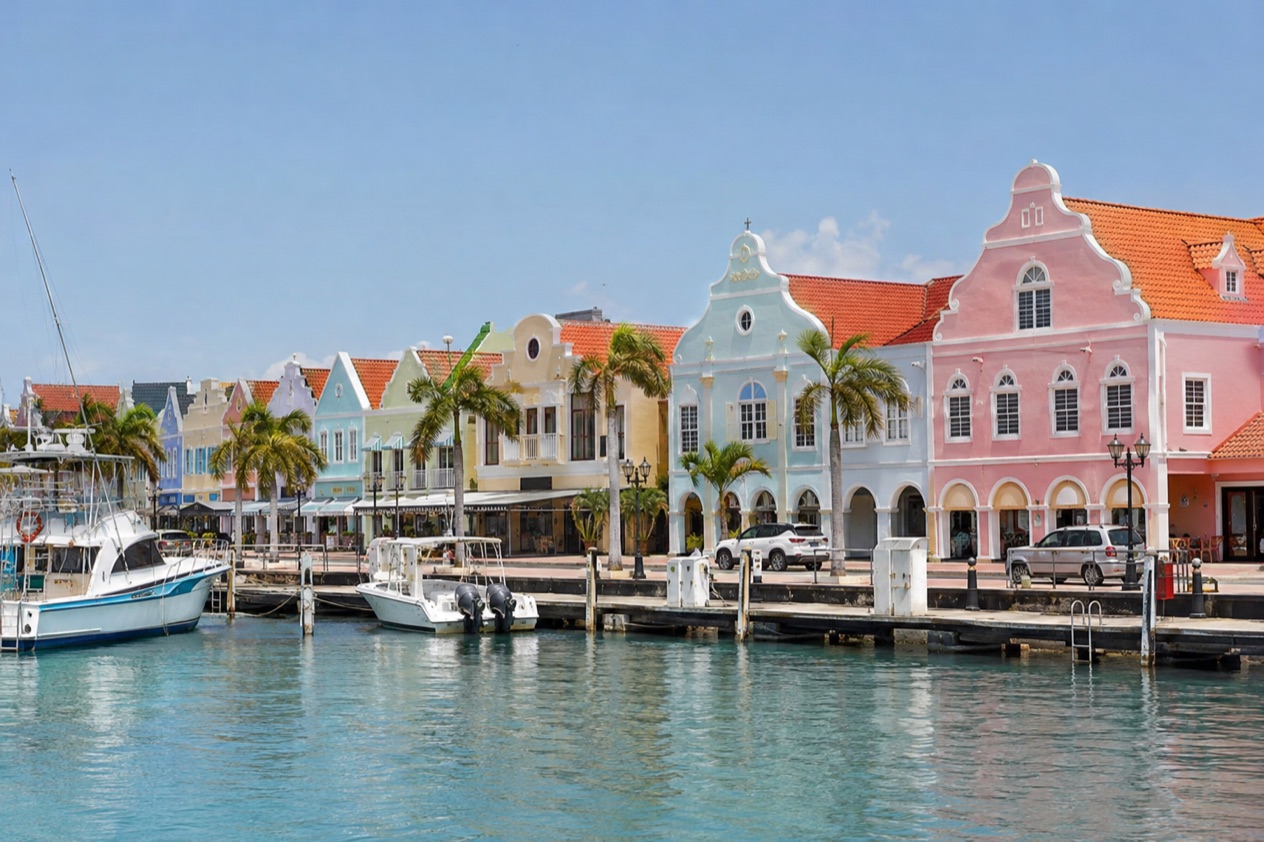
Late in the morning on Main Street, the pastel Dutch facades of Oranjestad glow pink, yellow and turquoise in the sun, the tram bell rings, and the smell of fresh pastechi (a fried pastry filled with cheese or meat) drifts out of a café door while a ship’s horn sounds across the harbor. Oranjestad is the capital of Aruba, a compact harbor town of colonial buildings, shops, small museums and waterfront restaurants. It suits travelers who like to wander a town on foot, and it is also the starting point for the rest of the island.
What are the best things to do in Oranjestad?
The best things to do in Oranjestad are to walk the old center between the fort and the harbor, shop along Main Street, learn the island’s story in a small museum, and then use the town as a base for beaches, boat trips and the wild north coast. The town is not large, so a morning of sightseeing leaves the afternoon free for the sea.
What makes the town pleasant is its mix of old and new. A fort from the days of pirates stands a few steps from duty-free jewelry counters, and a tower that once guided ships now keeps company with sidewalk cafés. Dutch influence shows in the gabled roofs and bright paint, while the language you hear on the street is often Papiamento, the island’s own mix of Portuguese, Spanish, Dutch and African influences.
- Fort Zoutman and the Willem III Tower: the oldest building in town, with a former lighthouse and clock tower at its gate.
- The Archaeological Museum: a restored family home that tells the story of the island’s first people.
- The downtown tram: a hop-on hop-off ride that links the cruise terminal with Main Street, its museums and its shops.
- Shopping on Main Street: jewelry, perfume, Dutch treats, aloe products and souvenirs along a pedestrian mall.
- Eagle Beach and Palm Beach: the white-sand resort coast on the leeward side, a short drive from the center.
- An island tour into Arikok National Park and out to the rugged windward coast, where the landscape turns to cactus and rock.
- The Aloe Vera factory in Hato: a free tour of a product the island has grown since the nineteenth century.
- Dinner on the water and a night out on Palm Beach: seafood, keshi yena and live music by the sea.
A good first day follows that order. Start on foot in the old center while the light is soft, take the tram through Main Street for the shops, and keep the late afternoon for the beach on the leeward side. If a shower or a cloudy spell interrupts, the museums and the covered shopping arcades fill the hours easily, and nobody minds lingering over coffee in a courtyard café.
Sights and landmarks in Oranjestad
The sights of Oranjestad sit close together around the harbor, which makes it a town to cover slowly on foot. The city was founded around 1796 on the southwestern coast, and its main harbor is Paardenbaai, meaning Bay of Horses, the island’s largest passenger port. Buildings from different centuries stand side by side, painted in the sweet colors that have become the town’s signature.
Fort Zoutman and the Willem III Tower
Fort Zoutman is the oldest remaining building in Oranjestad, raised to protect the coastline from pirates and completed in 1798. It is named for a Dutch rear admiral who never set foot on Aruba but won a victory over the English in the North Sea, a small irony that locals enjoy telling. The thick walls and low silhouette suit the story, and the fort sits right at the edge of the harbor, a reminder of why the town grew where it did.
At the fort’s original entrance stands the Willem III Tower, built in 1868 and used as both a lighthouse and a public clock tower. Its light was put out in 1963, and today the tower is more a landmark than a signal. The best time to stand in front of it is in the morning or late afternoon, when the white walls pick up warm light and the harbor is busy with boats and the movements of ships.
The Archaeological Museum
The Archaeological Museum is housed in the renovated Ecury family home, a restored townhouse on Schelpstraat in the center. Its collection preserves the Amerindian heritage of the island, from about 2500 BC to 1880 AD, and it gives the island a deeper past than the Dutch period most visitors expect. Pottery, tools and shell objects show how the first inhabitants lived by fishing and gathering on a dry island.
The oldest part of the complex is a cunucu house built in 1870, the traditional country dwelling of Aruba, with thick walls and a low roof. Boy Ecury, a young Aruban hero of World War II, lived in the house as a child. The visit suits anyone who wants context before heading out to see Arawak drawings in the Fontein cave in Arikok National Park, or on the Ayo rock formation.
Main Street and the downtown tram
Main Street is now a remodeled pedestrian mall, and the downtown tram rolls through it. The tram is a hop-on hop-off ride that connects the cruise terminal with the center, with six stops at monuments, museums and key shopping areas. It is a pleasant way to get a sense of the layout, and you can step off wherever a façade or a café catches your eye.
Shops along the way sell jewelry, fragrance, Dutch delicacies such as cheese and stroopwafels, aloe skin products and local souvenirs. Aruba is often called the shopping paradise of the Caribbean for its duty-free prices and its wide choice of international brands. Passengers returning to the United States are entitled to an exemption of $800 per person, so a few purchases are worth thinking about.
The green stadhuis and other old buildings
Between the harbor and the shopping streets, look for the green stadhuis, the town hall, where legal marriages are performed. Couples sometimes pose on its steps, and the building is one of the prettiest corners for a photograph. Around it, restored historic buildings now hold shops, galleries and restaurants, with colonial details such as shutters, gables and arched doorways.
A walk with no fixed plan works well here. Turn down a side street, follow the color of a wall, and you will find small courtyards, local bakeries and the occasional mural. The town’s new bus station and streetcar service have given the center a fresh look without hiding the older streets, so the old and the new feel like parts of one place.
Beaches and outdoor things to do in Oranjestad
The beaches near Oranjestad lie on the leeward coast, the west and southwest side of the island, where the resort strips and the white sand are found. The east wind blows across the island all year, and the windward coast, to the north and east, is rough and wild. The two coasts feel like different places, and the contrast is part of what makes a few days on Aruba interesting.
Eagle Beach
Eagle Beach is a ten-minute drive from the cruise port and is one of the best-known stretches of sand on the island. It is wide and open, with the bent fofoti trees that lean along the shore, shaped by the steady trade wind. Walkers like it for the long line of sand, and the low-rise resorts behind it leave the horizon open.
Come in the late afternoon if you like soft light, when the sand turns golden and the fofoti trees make long shadows. Bring a hat and sunscreen, since the sun is strong all year and the wind hides how hot it is. Sunset here draws people to the water’s edge to watch the sky change color over the sea.
Palm Beach
Palm Beach is the strip of resorts in the Noord district, north of the center, lined with hotels, beach bars, shopping centers, restaurants and movie theaters. It has the liveliest atmosphere on the island, with beach clubs and music in the evenings. Moomba Beach Bar and Restaurant sits between the Marriott and the Holiday Inn, with an open-air restaurant that serves an all-you-can-eat breakfast buffet.
It suits travelers who want shops and restaurants within a short walk of the sand, and who enjoy people-watching. Mornings are quieter, with joggers and early walkers on the shore. By afternoon the loungers fill and the bars start to hum, and the beach stays animated until the sun goes down.
Surfside Beach and Renaissance Island
Surfside Beach is the closest beach to the cruise port, reachable on foot, and it sits close to the airport runway, so planes pass overhead. It is a local stretch of sand beside the town, with a casual feel and a view of the harbor entrance. It is a good choice when you want a beach without going far from the center.
Renaissance Island is a 40-acre island with the only private beaches on Aruba, and access is limited to guests of Renaissance Wind Creek Aruba Resort. A free water taxi runs from the hotel. Those who are not staying there will find the public beaches on the main island more than enough for a day by the sea.
Wild coast, caves and lookouts
Beyond the resort strip, Aruba turns dry and rocky. The windward coast is rough, with waves crashing against black limestone, and the interior is a landscape of cactus, boulders and open sky. At the northwest tip stands the California Lighthouse, and on the north coast are the ruins of Bushiribana, a gold smelter that now serves as a dramatic lookout.
In the middle of the island rises Hooiberg, the lone hill that is a landmark from many parts of the island. In Arikok National Park, the Fontein cave holds Arawak drawings, as does the Ayo rock formation. These places reward a morning outing, ideally before the heat builds, with water and a hat in the bag.
Baby Beach lies in the south near San Nicolas, far from the town and the resort strip, and a day there pairs well with a look at the murals of San Nicolas. The south of the island has its own quieter rhythm, with fishing boats at Savaneta and small local restaurants where the catch of the day goes straight to the grill.
Island tours and excursions in Oranjestad
The excursions people take from Oranjestad cover the island’s three faces: its rugged nature, its sea and its craft traditions. Aruba is small, so a half day or a full day is enough to see a great deal, and the town makes a convenient base for all of them. The cruise port is on the northern side of downtown, and the sights fan out from there.
Arikok National Park and the windward coast
Arikok National Park covers a large share of the island’s interior and the rough east coast, and it is the best place to see Aruba as it looked before the resorts. The land is dry and rocky, with cactus, divided by trails and by caves. In the Fontein cave, Arawak drawings can be seen, and the Ayo rock formation, a scatter of huge boulders, carries more of them.
The park suits travelers who like landscapes and history over beach time. Go in the morning, when the air is cooler and the light picks out the rock, and carry water and sun protection. A jeep or a guided island tour is how many people see the park, and the north coast with Bushiribana and the California Lighthouse fits naturally into the same day.
The Aloe Vera factory in Hato
Aloe arrived on Aruba in 1840, and the dry climate suited it so well that it became one of the island’s best-known products. The Aloe Factory and Museum is in Hato, and visitors can see how the plant is cut, processed and turned into creams and gels. The tour is free, with no booking needed, so it fits into a day without planning.
The visit is a good break from the heat and gives a sense of local farming history. You walk past the fields where the spiky plants grow, see the old equipment, and can buy skin products at the shop. It suits anyone who likes to see how things are made, and it pairs well with a morning at the museum or a stroll in town.
| Site | Open |
|---|---|
| Aloe Vera factory tour, Hato | During opening hours, a tour every 15 minutes |
| Renaissance Island | Daily, 7 a.m. to 7 p.m. |
A boat trip along the leeward coast
The leeward coast is made for boats, and sailings along the west and southwest shores give a view of Aruba from the water: the resort strip, the pale beaches, the long line of the island under a dry sky. Many outings combine sailing with snorkeling stops and time for a meal on board, and sunset trips follow the light as it fades behind the horizon.
The boat view suits anyone who wants to see the island without walking, and it offers a rest from the sun in the shade of the deck. Leave the camera ready for the moment the sun touches the sea, when the sky turns orange and the beach lights come on one by one along the shore.
Smaller outings worth the detour
San Nicolas, in the south, has become the island’s street-art town, with large murals on the sides of old buildings and a lively local mood in the evening. Savaneta, a fishing village, is known for seafood eaten close to where it was caught.
Hooiberg offers a lookout over the whole island for those willing to climb its steps. Each of these pairs well with a day that heads south or inland rather than along the resort coast.
What to eat in Oranjestad
Eating in Oranjestad means fresh fish, hearty stews and a few dishes that you will not find anywhere else. Aruba’s home cooking draws on Amerindian, European colonial, African, merchant and Asian influences, and the result is a cuisine of many layers. The first inhabitants, the Caquetio, lived on freshly caught fish and conch, and both are still found on menus today.
Keshi yena and island classics
Keshi yena is the dish most closely tied to the island: a whole round of Dutch cheese, hollowed out and filled with spiced chicken, beef or fish, olives and raisins, then baked until the cheese melts into the filling. It is rich and salty-sweet, and it shows the Dutch and Caribbean sides of Aruba in a single bowl. Order it as a main course and share it if appetites are modest.
Alongside it you will see sopi di pisca, a fish soup, and stoba, a slow-cooked stew of goat or beef. Pan bati is a thick, slightly sweet pancake often served with stews, and funchi, a firm cornmeal side, plays the role of polenta. Fresh fish such as mahi-mahi or grouper is usually grilled and served with plantains and rice.
Pastechi, snacks and the morning bakery
Pastechi are the snack of the island, crisp half-moon pastries filled with cheese, ham, chicken or beef. They are sold in small bakeries and cafés and eaten at breakfast, for a quick lunch or as a late snack. They taste best warm, straight from the fryer, with a cup of strong coffee on the side.
Dutch influence shows in the cheese and in the sweets. In the center, shops sell Dutch delicacies, and bakeries sell pastries and cakes that reflect the island’s links to the Netherlands. A stop in one of these places is a pleasant way to take a pause between a museum and a stroll along the harbor.
Seafood, drinks and the Autentico event
With so much sea around, seafood has pride of place. Conch, shrimp, fresh fish and lobster appear on menus, often prepared simply with lime, garlic and local peppers. Along the harbor, restaurants have terraces where you can watch the boats come in while you eat, and the setting is as much a part of the meal as the food.
To drink, there is cold local beer, rum cocktails and fresh fruit juices, and in the heat a tall glass of something cold is hard to resist. The legal drinking age is 18, although many establishments do not enforce it strictly. Every October the culinary event Autentico takes place, a chance to sample the island’s fusion of flavors and its traditional dishes.
Things to do in Oranjestad at night
Evenings in Oranjestad begin at the waterfront, where terraces fill as the sky turns orange and the ships’ lights come on in the harbor. Dinner is the main event, often long and unhurried, and afterward people stroll the lit streets or head toward the music of the resort strip. The mood is relaxed and sociable, closer to a holiday town than a big-city nightlife scene.
Dinner by the harbor
The harbor is the natural place for dinner, with restaurants close to the water serving grilled fish, steaks, Dutch-influenced dishes and local specialties. A table outdoors gives a view of the boats and the glow of the port, and the sea breeze keeps the evening comfortable. The temperature barely changes through the year, so eating outside after dark is the norm.
After the meal, a walk along the waterfront is a pleasant way to end the evening. The colonial buildings are lit, the shops stay open for window browsing, and the air carries the smell of the sea. Fort Zoutman and the Willem III Tower look their best after dark, with the white tower standing against the night sky.
Music and nightlife on Palm Beach
Palm Beach is where most of the night entertainment happens. The strip of resorts holds shopping centers, restaurants, movie theaters and nightly entertainment, and beach bars play music with their feet almost in the sand. Moomba Beach Bar and Restaurant, between the Marriott and the Holiday Inn, features live bands and deejays several nights a week.
It is the place for a cocktail at sunset that turns into dancing after dark, with the sound of the sea in the background. Resort casinos add another option for those who like an evening of cards or slot machines. As elsewhere, the legal drinking age is 18, and the mood is festive rather than rowdy.
Quieter evenings
Not every evening needs music. A late walk on Eagle Beach, with the fofoti trees silhouetted against the stars, is one of the island’s simple pleasures, and a sunset drink on a terrace needs nothing more than a chair and a view. The sea breeze and the low light make it a gentle time of day.
In town, a coffee and a Dutch pastry in a café on a side street suit the evening just as well, and the harbor makes a good spot for a slow stroll when the day’s heat has gone. For travelers who prefer a calmer pace, Oranjestad after dark offers plenty of ways to unwind without ever hearing a bass line.
Things to do in Oranjestad with kids
Children in Oranjestad find plenty to look at: boats in the harbor, a tram that stops at the shops, a fort with a tower, and a beach within reach. The town is compact, the attractions are close together, and the pace can be slow. The main thing to keep in mind with young travelers is the sun, which is strong all year, with a temperature that stays near 82°F.
The tram, the fort and the harbor
A ride on the downtown tram is an easy win with children, who enjoy hopping on and off at the stops. The route runs between the cruise terminal and the center, passing Main Street, and it breaks up a walk that might otherwise feel long in the heat. Stop for an ice cream or a cold drink, and let the kids choose where to get off.
Fort Zoutman and its tower give children a story: pirates, a lighthouse, a clock and an admiral who never came. The harbor, with its ships coming and going, adds a moving show of its own, and the port can hold up to five vessels at a time. Watching a large ship leave the dock is a small event that children tend to remember.
Museums, aloe and hands-on stops
The Archaeological Museum brings the island’s first people to life through objects, with pottery and tools that children can picture in use. The old cunucu house gives a sense of how people lived in a simple home, and a visit connects well with a trip to see the Arawak drawings in the caves of Arikok National Park.
The Aloe Vera factory tour, free and without booking, is a short and practical stop for families. Children can see the spiky plants, watch how the gel is made and learn why aloe is a part of island life. It is a break from the sun and a good example of how a local product is made.
Beach days and what to keep in mind
Eagle Beach and Palm Beach are the usual choices for family beach time, with wide sand, shade from the fofoti trees and beach bars close by. The sea on the leeward coast is often gentler than on the windward side, but it can change, so keep a close eye on children near the water. The windward coast is rough and is better for looking than for playing.
The wind keeps the air moving but does not hide the sun, so hats, sunscreen, water and a shaded break in the middle of the day matter more than anything. Plan the outdoor outings for the morning and keep the afternoon for a slow lunch, a museum or a rest. A flexible day, with time to stop for ice cream, tends to work best.
Good to know before you go
The U.S. State Department rates Aruba Level 1, ‘Exercise normal precautions,’ and says Aruba is generally a safe destination for travelers, with petty crime the main concern in popular tourist areas.
Oranjestad is on the southwestern coast, and its center can be explored on foot, with the downtown tram linking the cruise terminal to the shops. Aruba is a foreign island, so expect prices in a mix of currencies and stores that welcome visitors, and the shops are used to selling to travelers.
The busiest months run from December to April, while the best time to visit the island in general is from February to August. For shopping, remember that prices on the island run lower than in the United States on many goods, and that duty-free pricing means the manufacturer’s price carries no import tax. Come with comfortable shoes for the old streets and a light layer for the evening breeze.
Sources
- Aruba Tourism Authority, Oranjestad region (https://www.aruba.com/us/our-island/regions/oranjestad), checked October 9, 2026
- Wikipedia, Oranjestad, Aruba (https://en.wikipedia.org/wiki/Oranjestad,_Aruba), checked October 9, 2026
- Wikivoyage, Oranjestad (Aruba) travel guide (https://en.wikivoyage.org/wiki/Oranjestad), checked October 9, 2026
- Aruba Tourism Authority, Fort Zoutman Historical Museum (https://www.aruba.com/us/explore/fort-zoutman-historical-museum), checked October 9, 2026
- Aruba Tourism Authority, Archaeological Museum (https://www.aruba.com/us/explore/archaeological-museum), checked October 9, 2026
- Aruba Tourism Authority, Downtown trolley, Oranjestad (https://www.aruba.com/us/explore/downtown-trolley), checked October 9, 2026
- Aruba Tourism Authority, Shopping (https://www.aruba.com/us/things-to-do/shopping), checked October 9, 2026
- Aruba Tourism Authority, Duty-free shopping (https://www.aruba.com/us/things-to-do/shopping/duty-free), checked October 9, 2026
- Aruba Tourism Authority, Museums (https://www.aruba.com/us/things-to-do/arts-and-culture/museums), checked October 9, 2026
- Aruba Tourism Authority, Cruise port (https://www.aruba.com/us/plan-your-visit/aruba-by-cruise/cruise-port), checked October 9, 2026
- Aruba Tourism Authority, Renaissance Island (https://www.aruba.com/us/explore/renaissance-island), checked October 9, 2026
- Aruba Tourism Authority, Local Aruba cuisine (https://www.aruba.com/us/things-to-do/dining/local-aruba-cuisine), checked October 9, 2026
- Aruba Tourism Authority blog, Beach bars and restaurants (https://www.aruba.com/us/blog/aruba-bars-restaurants-on-the-beach), checked October 9, 2026
- Aruba Tourism Authority, Best time to visit (https://www.aruba.com/us/our-island/one-happy-island/when-is-the-best-time-to-visit-aruba), checked October 9, 2026
- U.S. Department of State, Aruba Travel Advisory, Level 1, issued August 19, 2026 (https://travel.state.gov/content/tsg_aem/us/en/home/international-travel/travel-advisories/destination.abw.html), checked October 9, 2026