
In Uvita, the morning begins with scarlet macaws squabbling in the almond trees and the first fishing boats heading out past the sandbar. In the dry months the beach road fills with surfers, yoga students and families carrying coolers toward Marino Ballena National Park.
In the green months the mountains behind town turn a deep, dripping emerald and the afternoons belong to thunder. This is the southern Pacific coast, and the season you choose decides whether you get long sunny beach days, humpback whales, or empty trails and a rain jacket.
When is the best time to visit Uvita?
The best time for most travelers is the dry season, from about December through March, when mornings are bright and the beach days are the most reliable of the year. Along this coast, humpbacks pass by twice each year, first around December through April and later around July through October, so whale watching becomes one more reason for visitors to come. That overlap in the early months makes the winter stretch the easiest recommendation.
For beach and sea time, January and February are the sweet spot. Mornings tend to be clear and the water is warm enough that you stay in for as long as you like.
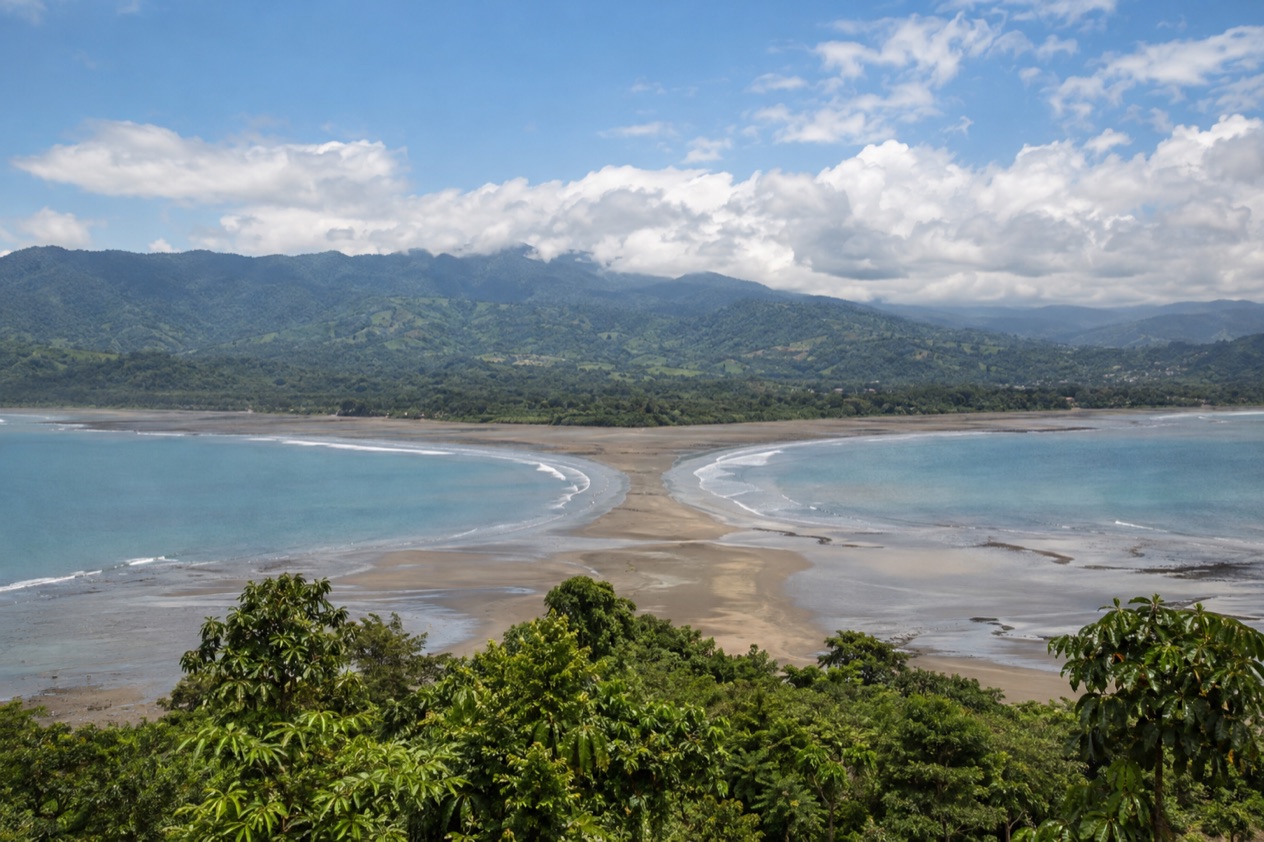
The sandbar at Playa Ballena, shaped like a whale’s tail at low tide, is most photogenic when the sky is clear, so a dry-season morning walk out along it is the classic Uvita picture. Rip currents are a real feature of this coast, so choose your swimming spot with care.
For sightseeing, the shoulder months of December and April are a good compromise. The hills are still green from the rains, waterfalls such as Nauyaca run full and the crowds are thinner than in the heart of winter. Rainforest walks, bird watching and the trip up to the falls all feel better in cooler morning light, whatever the month.
If you want quiet and lower prices, aim for the green season, especially September and October. Mornings can be lovely, afternoons turn to downpours, and the town slows down. Whales are still around then, which makes it a rewarding time for patient, flexible travelers who plan outings for the morning.
Families should know that March brings spring break, and the beaches and restaurants get loud and busy with groups of students and holidaymakers. Early January and the weeks after Christmas are also busy.
If your children’s school schedule allows it, early December or the weeks in April around Easter give you warm water and calmer sand, though Easter week itself is a local vacation and crowded. Traveling in July and August, when whales are back, is a family favorite for those who accept afternoon rain.
Uvita weather by month
Uvita stays hot and humid all year, and the real difference between months is how much rain falls and how often.
| Month | Average high (°F) | Average low (°F) | Rain days | Sea (°F) |
|---|---|---|---|---|
| January | 82.1 | 71.4 | 18.6 | 85.8 |
| February | 83.4 | 72.2 | 12.9 | 87.0 |
| March | 84.1 | 73.4 | 15.3 | 87.4 |
| April | 83.1 | 73.6 | 23.3 | 87.8 |
| May | 81.9 | 73.8 | 29.7 | 87.7 |
| June | 81.5 | 73.5 | 29.4 | 85.8 |
| July | 81.0 | 72.9 | 30.8 | 85.3 |
| August | 81.0 | 72.8 | 30.7 | 85.6 |
| September | 80.8 | 72.9 | 29.6 | 85.8 |
| October | 80.0 | 72.8 | 30.7 | 85.1 |
| November | 79.9 | 72.3 | 29.2 | 83.0 |
| December | 81.2 | 71.6 | 25.3 | 84.5 |
The year runs in two broad halves. From about December to March the rain thins out and February is the driest month by a clear margin, though even then showers pass through on a good share of days. April is the turning point, with showers building toward the heavier rains.
From May to November it rains on nearly every day, usually as afternoon downpours that follow a bright morning, and the wettest stretch comes in September, October and November. Temperatures hardly move, so the thermometer never tells you the season, but the sky does. The sea stays warm throughout and cools only a little in the final months of the year.
What is there to do in Uvita in each season?
The dry months, December to March
This is the season for long beach days. Mornings are the time for the walk out along the sandbar at low tide, snorkeling or kayaking when the water is clear, and swimming in the warm, shallow sections of Marino Ballena National Park. Boat tours go out in search of humpback whales and dolphins from December on, and the whale-watching chances climb as the season builds.
Inland, this is the best time to head to the Nauyaca waterfalls, where trails are firmer and the drive from town is easier. Surfers travel north to Dominical, where the beach break draws crowds. Evenings are for fresh fish, ceviche and a casado, the plate of rice, beans, plantain and salad that every soda serves, eaten on a terrace with the sound of cicadas.
The green months, May to November
The green season is a different Uvita. Plan the day like a local: go out early for birdwatching, a rainforest walk or a morning at the beach, then retreat for lunch, a nap or a waterfall visit when the afternoon storm arrives. The hills are lush and loud with frogs after dark, and the quieter trails give you a better chance of spotting toucans, monkeys and sometimes a sloth.
Humpbacks return from roughly July to October, and many people think that second window is better than the first, with fewer boats and a sense of having the sea to yourself. Skip long hikes to high viewpoints in the wettest weeks, because trails turn muddy and rivers rise quickly. Leave surf-camp weeks and any plan that needs a guaranteed sunset for another time of year.
The shoulder weeks and the winter holidays
April and early December are the shoulder months. Showers return in the afternoon but mornings are often bright, the forest is at its greenest and the beach is far less crowded than in January. They suit travelers who want swimming, whales at the edge of a season and rooms that are easier to find.
Christmas and New Year are the festive weeks, with lights in the restaurants, families arriving from the capital and a busy beach. Book rooms and any whale tours early, keep mornings for the sea and leave the middle of the day for shade and a cold coconut.
When is Uvita cheapest and least crowded?
The quietest stretch is the green season, and above all September and October, when the town feels like it belongs to its residents again. Many visitors have gone home, some small lodges slow down, and you can often find a room without booking far ahead. The beach at Marino Ballena can feel nearly empty on a weekday morning, with only a few walkers and the pelicans.
The busiest weeks are the ones that line up with North American vacations: Christmas and New Year, the weeks around spring break in March, and the days of Easter week, when Costa Rican families also head to the coast. The summer months of July and August bring a second, milder wave of travelers, mostly families on school vacation and whale watchers. Expect peak-season rates, full restaurants and parking that fills early near the park entrance.
If you want sun and few people, look for the edges: the first days of December, the weeks after New Year once schools reopen, and the stretch just after Easter. These give you something of the dry season mood without the loudest crowds. If you want the quietest town of all, accept the rain and travel in the green months with a flexible plan.
Which months should you avoid in Uvita?
Avoid October and November if you want sunny beach days, because those are the wettest months and rain falls on almost every day. Roads can flood, rivers rise, boat tours are sometimes canceled and the sea can be rough and murky after heavy storms. If you do travel then, treat the mornings as your best window and keep the afternoons flexible.
The rest of the green season, from May to September, is wet but workable. Storms are heavy and often arrive in the afternoon, with thunder over the mountains and sudden rivers on the dirt tracks. The Atlantic hurricane season overlaps with these months, and a tropical system can still bring days of heavy rain to a Pacific coastline, so keep plans loose and watch the forecast before long drives.
Heat is part of the picture at any time, since it stays hot and humid all year. The hottest and stickiest hours are midday, and March and April feel closest to the warmest stretch, so plan hikes for the early morning.
Sargassum, the seaweed that piles up on many Caribbean beaches in spring and summer, is not what defines a Pacific beach like this one, though logs and debris wash up after heavy rain. No season guarantees a spotless or perfectly calm beach, so look at what the tide has left before you settle in.
When can you swim in Uvita?
You can swim in Uvita in every month, because the sea stays warm all year, but conditions on the beach are what decide each day. The water is warmest in the spring months and cools slightly toward the end of the year, though it always feels comfortable without a wetsuit. For a traveler, those months feel warm and inviting.
In the dry months the water is often clearer and calmer in the morning, which makes it the best time for snorkeling and for wading out along the sandbar. In the rainy months, runoff can cloud the water near river mouths, and surf can build, so plan a swim for early in the day and watch the sky.
Along this coast, rip currents pose a serious threat and are responsible for multiple drownings of American visitors annually, plus the majority of beaches lack lifeguards and any notice of hazardous conditions. Ask a local or your hotel about the day’s conditions, stay near other swimmers and never swim alone. Do not assume a beach is safe because it looks calm.
Festivals and events in Uvita through the year
Winter holidays, Easter and Independence Day
Christmas and New Year are the biggest moments of the dry season. Families come down from the Central Valley for tamales, a Costa Rican Christmas staple wrapped in banana leaves, and the beach turns into a sociable place with music in the evenings. New Year’s night is celebrated with fireworks and long dinners, so book a table early.
Easter week, Semana Santa, moves every year, and when it falls in March or April it is the busiest local vacation. Many Costa Ricans head to the coast, and the beach is full for days with picnics, music and families, while businesses in some towns slow down or close on the holiest days. In mid-September, Independence Day, on September 15, brings school parades and children carrying handmade lanterns in the evening, a charming moment in the middle of the quiet season.
Nature seasons: whales, dolphins and turtles
Humpback whales show up two times a year, once around December through April and again around July through October, putting on the region’s greatest wildlife show. Mothers and calves are the main sight, and you may see tail slaps, breaches and spouts from a boat or from the shore. A local whale and dolphin festival is usually held in the park’s area in the late summer, with music, food stalls and talks about marine life.
Sea turtles are another seasonal chance, since they sometimes nest on quiet Pacific beaches in the green months. Sightings are never certain, and any night visit should go with a guide who respects the animals and the rules. Dolphins, often seen on boat trips, are a year-round possibility, and spotted dolphins sometimes race the bow.
Town life and local fiestas
Beyond the big dates, Uvita has a small-town calendar of school events, church celebrations and weekend fairs where families gather for food and music. Look for a small farmers’ market, local bakeries selling empanadas and fresh bread, and a lively soccer game on the field. These moments change from week to week and have no fixed dates, so they are best found by asking at your hotel.
The dry season also brings a social buzz, with yoga retreats, surf lessons and pop-up markets that set up along the road toward Dominical. In the green season, the scene softens and calendar highlights become quieter, with potluck dinners and live music in small open-air bars. Evenings are a good time to sit down, order a cold drink and listen to the rain on the roof.
Sources
- Open-Meteo / ECMWF ERA5, normals 1991-2020 computed for the grid cell at 9.1561N 83.7347W, checked October 8, 2026
- Open-Meteo Marine API, average 2015-2024, checked October 8, 2026
- sunrise-sunset.org, sunrise and sunset calculated for the 15th of the month, checked October 8, 2026
- U.S. Department of State, Costa Rica Travel Information, Safety and security (https://travel.state.gov/content/travel/en/international-travel/International-Travel-Country-Information-Pages/CostaRica.html), checked October 8, 2026
- U.S. Department of State, Costa Rica Travel Advisory, issued April 1, 2026 (https://travel.state.gov/content/travel/en/traveladvisories/traveladvisories/costa-rica-travel-advisory.html), read via the State Department open data API on October 8, 2026