
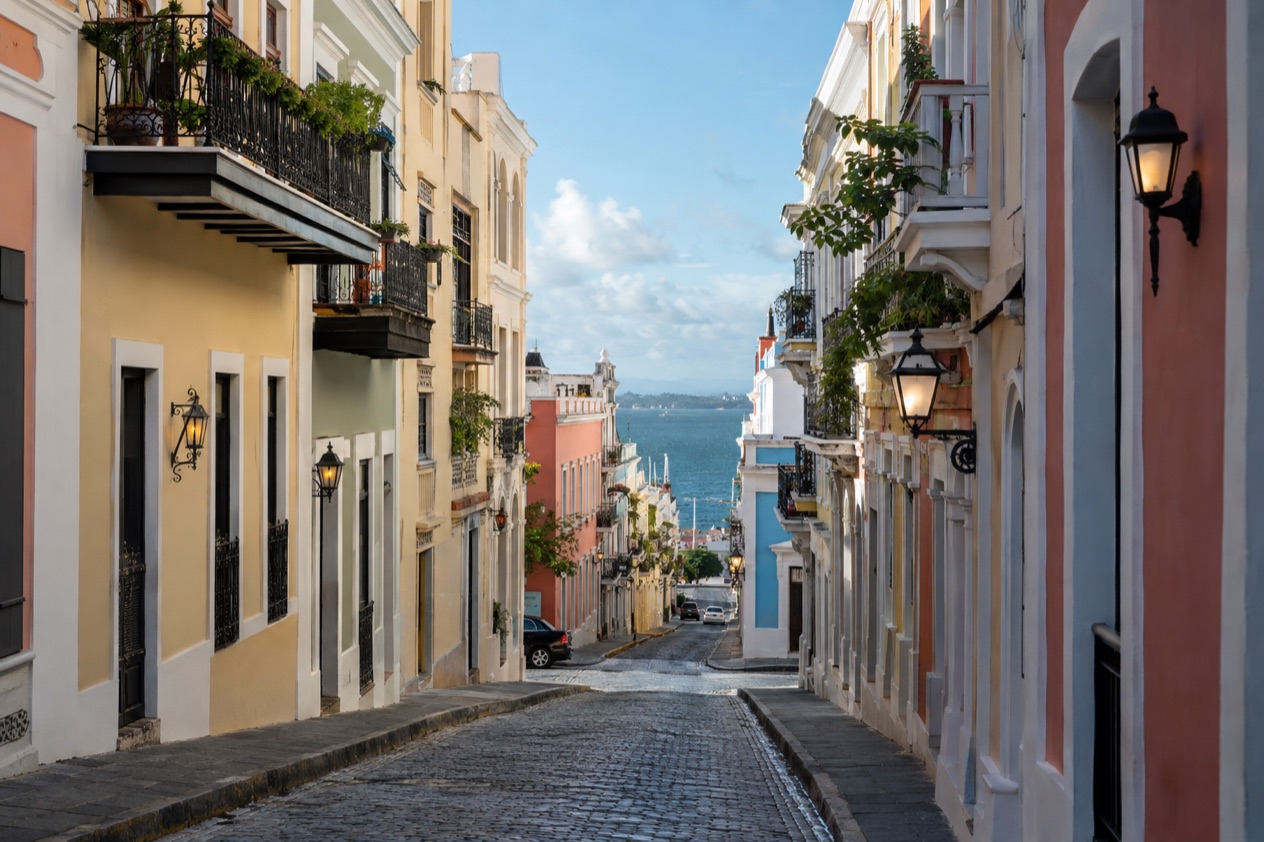
Early in Old San Juan, delivery carts rattle over blue-gray cobblestones and the pastel balconies catch the first sun. A few miles east, the evening belongs to Condado and Isla Verde, where surf thunders beside the hotel towers and the casino lights come on. San Juan is really several small worlds along one coast, and the neighborhood where you sleep decides which one you wake up in.
What is the best area to stay in San Juan?
For a first visit, Old San Juan is the classic choice, and Condado is the easy one if you want a beach, restaurants and a city feel in the same walk. Isla Verde suits beach vacations, families who want resort comforts and anyone with an early flight, since the airport sits right beside it. Santurce suits travelers who care more about food, murals and nightlife than a hotel pool, and it tends to be where independent travelers on a tighter budget look for guesthouses and apartments.
The areas differ less in distance than in mood. Old San Juan is a walled colonial city on a small islet, where you step out of your door straight into plazas, forts and cafes, but where there is no big resort beach at the doorstep.
The two beach-and-hotel strips are Condado and Isla Verde, where towers look out on the Atlantic and you will find pools, casinos and rows of restaurants that go on and on. Santurce sits between them in spirit as well as on the map, a lived-in district of galleries, bars and small kitchens around Calle Loiza.
Think about how you plan to spend your days. If you want to wander cobblestone lanes at dawn, before the cruise crowds arrive, sleep in the old city. If you want to walk from your room to the sand with a towel over your shoulder, choose Condado or Isla Verde.
If you will be out every night eating and listening to music, Santurce puts you in the middle of it. Many visitors split a longer stay between two areas, a few nights of history and a few nights by the sea.
Getting around shapes the decision too. Old San Juan is a place for walking, and a car there is more burden than help. Condado is compact and walkable along its main avenue, with local buses and short rides to the old city.
Isla Verde is spread along its beachfront and is simplest with a ride or a rental. Keep your own style in mind: a light sleeper, a family with strollers or a couple wanting a romantic base will each rank these areas differently.
The beaches are another thread. San Juan’s urban shores meet the Atlantic and receive consistent waves, meaning the scene shifts daily and varies from one patch of sand to another.
If swimming is a priority, ask your hotel about the local beach and follow any flag, sign or lifeguard you find. When you stay in the old city, the Balneario de Escambron makes a fine match, a public beach park located just beyond Old San Juan and valued for calmer water protected by a reef.
The best areas to stay in San Juan
Old San Juan
Picture the San Juan you see on postcards: blue cobblestone lanes, tight and narrow, brick and stone buildings with flat roofs dating to the 16th and 17th centuries, bougainvillea spilling over balconies, and plazas where shade is shared by pigeons and the dominoes of old men. El Morro and San Cristobal, the two forts, hold down the western and northern edges, while the city walls continue beside a good stretch of the shoreline. Evenings are lively with live music drifting from small bars, and mornings are soft and quiet before day visitors fill the lanes.
Lodging here means converted colonial houses, boutique hotels, small guesthouses and apartments above shops, usually with thick walls, tall doors and a courtyard or rooftop. Rooms are often charming and compact, and some streets can be noisy at night, so ask for an upper floor or an interior room if you sleep lightly. Large resorts and big pools are not the style of the old city.
You get around on foot. Free trolleys serve Old San Juan, though routes and schedules can change, so confirm locally.
The old city is connected to the mainland by three bridges, and the airport and the hotel strips are a short ride away. One smart move is to take an evening walk, once the air cools, along the promenade by the southern wall, Paseo de la Princesa, and then wind through the lanes to the Puerta de San Juan, the last city gate still standing.
Condado
Since the early twentieth century, Condado has grown as a streetcar suburb of the old city and now stands as the polished, urban beach district. Its main street, Ashford Avenue, runs along the shore lined with hotels, restaurants, shops and apartment towers, and the Atlantic beaches lie to the north. Mornings bring joggers and paddleboarders, afternoons bring sunbathers, and at night the avenue fills with diners heading to open-air restaurants.
The lodging mix is wide: full-service resort hotels, upscale properties, smaller boutique places, guesthouses and a good number of apartments. It is a comfortable first-time base because you can eat well without a car, and it sits between two and six miles from Old San Juan, Isla Verde and the airport, a short ride in each direction. Surf can be strong on some stretches, so check conditions and flags before swimming.
Local buses serve the area on two routes, T21 and D53, which can be handy for a budget day in Santurce or the old city. Most visitors rely on walking along the avenue and short rides at night. A tip: walk east or west along the water at sunset to see how each stretch differs, then choose a spot for dinner instead of settling on the first restaurant.
Isla Verde
Isla Verde is the resort strip closest to the airport, a beachfront district of high-rise hotels, casinos, restaurants and wide sand. It is named after a tiny cay ringed by coral just off the shore. The feel is a classic beach vacation: pool decks, beach chairs, umbrella drinks, and kids digging holes while parents watch the waves from a lounge chair.
Lodging leans toward large hotels and resorts, with some all-inclusive style packages, condo-style apartments and a few smaller places tucked behind the beach. It suits families, groups, short stays and travelers with early flights. The old city and Condado are between three and six miles to the west, easy by ride or car, though you will likely want one of them for dinner or sightseeing once or twice.
Getting around here usually means a ride or a rental, since the district stretches along the shore and the airport is on its southern border. Planes pass overhead, so ask about the room’s side if noise matters to you. East of the airport, the coastal stretch of Pinones is known for beachside kiosks selling alcapurrias and bacalaitos, a good lunch outing from an Isla Verde base.
Santurce
A district of arts and food, Santurce also claims Condado within its barrio and sits around Calle Loiza. Expect street murals, galleries, small bars, bakeries and restaurants where locals outnumber tourists. It is the area for travelers who like to eat and wander more than lounge, and its pace is livelier and less polished than the beach strips.
Lodging is mostly guesthouses, small inns and apartments, with fewer large hotels. That makes it a sensible choice for independent travelers and longer stays, and for anyone who wants a kitchen and a neighborhood. The beaches of Condado and the old city are a short ride away, and you will likely use rides in the evening.
Streets can feel quiet by day and busy at night, so look at the exact block before booking. A good tip is to plan a food crawl through the district, trying fritters, mofongo and a cold piragua from a cart, then go back to your room by ride.
San Juan areas compared
| Area | Best for | Feel | Getting around |
|---|---|---|---|
| Old San Juan | First visit, history, couples | Colonial, walled, cobblestone lanes | On foot, car not needed |
| Condado | Beach plus city, first-timers, restaurants | Upscale, urban, beachfront | Walkable along Ashford Avenue, two local bus routes, short rides |
| Isla Verde | Beach vacations, families, early flights | Resort strip, high-rise hotels, casinos | Rides or rental car, airport next door |
| Santurce | Food, art, nightlife, longer stays | Local, creative, lively at night | Rides, some bus routes, short hops to Condado |
The main trade-off is beach against local life. Isla Verde and Condado put sand and sea at your doorstep, while Old San Juan and Santurce give you streets, plazas and neighborhood cooking, with the beach a short ride away. You rarely get both at once, though Condado comes closest, which is why it is such a common compromise.
The second trade-off is quiet against nightlife. Old San Juan can be romantic and calm after the day crowds leave, yet its bars keep some streets busy. Isla Verde is calm in the early morning and busy around its casinos and restaurants in the evening. Santurce is the most energetic after dark, so choose a side street if you prefer to sleep early.
A third trade-off is convenience against character. A resort near the airport makes arrivals and departures simple, and a colonial guesthouse makes the whole trip feel different, but it may mean a narrow staircase and a smaller room. Match the area to the memory you want to bring home, whether that is sunrise over the old walls or a long afternoon on a lounge chair.
If your stay is long enough, a split works well: begin in the old city to absorb the history on foot, then move to a beach strip to rest. If it is short, pick one base and take rides for the rest, since distances are small by island standards and the districts are linked by bridges and main avenues.
How to choose your hotel in San Juan
Start with the style of vacation. An all-inclusive or resort-style stay, with pool, restaurants and beach access under one roof, suits families and people who want to unplug, and you will find that style mostly in Isla Verde and along Condado. A boutique hotel, guesthouse or apartment suits travelers who want to eat out, walk and see the neighborhoods, and they cluster in Old San Juan, Condado and Santurce.
Next, think about where the water is. Beachfront rooms open directly onto the Atlantic, with sound and views to match, but surf is steady on the city beaches and conditions change from day to day.
Rooms on the lagoon or bay side, or a block inland, are often quieter and sometimes less costly in feel and scale. Ask the hotel how the beach in front of it usually is, and follow flags, signs and lifeguards where they exist.
Seaweed is worth a question as well. Sargassum can reach some coasts of the island in certain springs and summers, so ask your hotel whether it has been affecting its stretch of sand lately. Think of it as a possibility rather than a certainty, and beaches in the city that face north deal with it in a different way than the coasts to the east and south.
Timing matters for booking. Christmas season, which runs from late November into mid-January, and the Calle San Sebastian Street Festival in Old San Juan in mid to late January fill the old city and the beach strips quickly, so book early if your dates touch them. Holy Week moves every year, and school breaks bring families, so check the calendar before you choose a date and a neighborhood.
The Atlantic hurricane season runs from June 1 to November 30, with most activity from mid-August to mid-October. If your travel dates land in that stretch, review the cancellation policy at your hotel and, closer to departure, watch the National Hurricane Center along with local official alerts, since forecasts can change fast. Outside the season, the main planning factor is simply how busy the area is.
Families should look at pool access, room layouts with a kitchenette, and a beach that feels manageable for children, remembering that no beach can be promised calm. Travelers with limited mobility should ask about elevators and step-free entrances, since Old San Juan’s colonial buildings and uneven cobblestones can make access harder than in a modern beach hotel. Ask directly and ask for specifics.
Before you book, check a few things: the noise on your floor and side of the building, the distance to the beach, parking if you will rent a car, and how you will get from the airport. Read recent guest comments for hints about street sound, air conditioning and water pressure. The old city and Isla Verde each have their own quirks, and a short email or call often settles them.
Good to know before you go
The airport is in Isla Verde, so any of the areas above is a short ride from arrivals, and a ride or rental car is the usual way to reach your hotel. The U.S. dollar is the currency in San Juan, which makes using cash simple, and travelers from the United States do not need a passport or a visa.
Cards are widely taken, though, though the forts of the San Juan National Historic Site do not accept cash, so keep a card in your pocket for your sightseeing days. Both English and Spanish hold official status, and knowing just a little Spanish helps a lot when you reach a guesthouse desk.
Sources
- National Park Service, San Juan National Historic Site, Fees & Passes (https://www.nps.gov/saju/planyourvisit/fees.htm), checked October 8, 2026
- National Park Service, San Juan National Historic Site, Hours & Operating Seasons (https://www.nps.gov/saju/planyourvisit/hours.htm), checked October 8, 2026
- Wikipedia, Old San Juan (https://en.wikipedia.org/wiki/Old_San_Juan), checked October 8, 2026
- Wikipedia, Condado (https://en.wikipedia.org/wiki/Condado,_Puerto_Rico), checked October 8, 2026
- Wikipedia, Isla Verde (https://en.wikipedia.org/wiki/Isla_Verde,_Puerto_Rico), checked October 8, 2026
- NOAA National Hurricane Center, Climatology (https://www.nhc.noaa.gov/climo/), checked October 8, 2026
To plan your stay
- Best Time to Visit San Juan: Weather, Beaches, Festivals and Hurricane Season
- Things to Do in San Juan: Old San Juan Forts, City Beaches, Street Food and Nights Out
- San Juan Airport to City: Taxis, Buses and Getting to Condado and Old San Juan
- Know Before You Go to San Juan: Entry, Forts, Money and Getting Around