
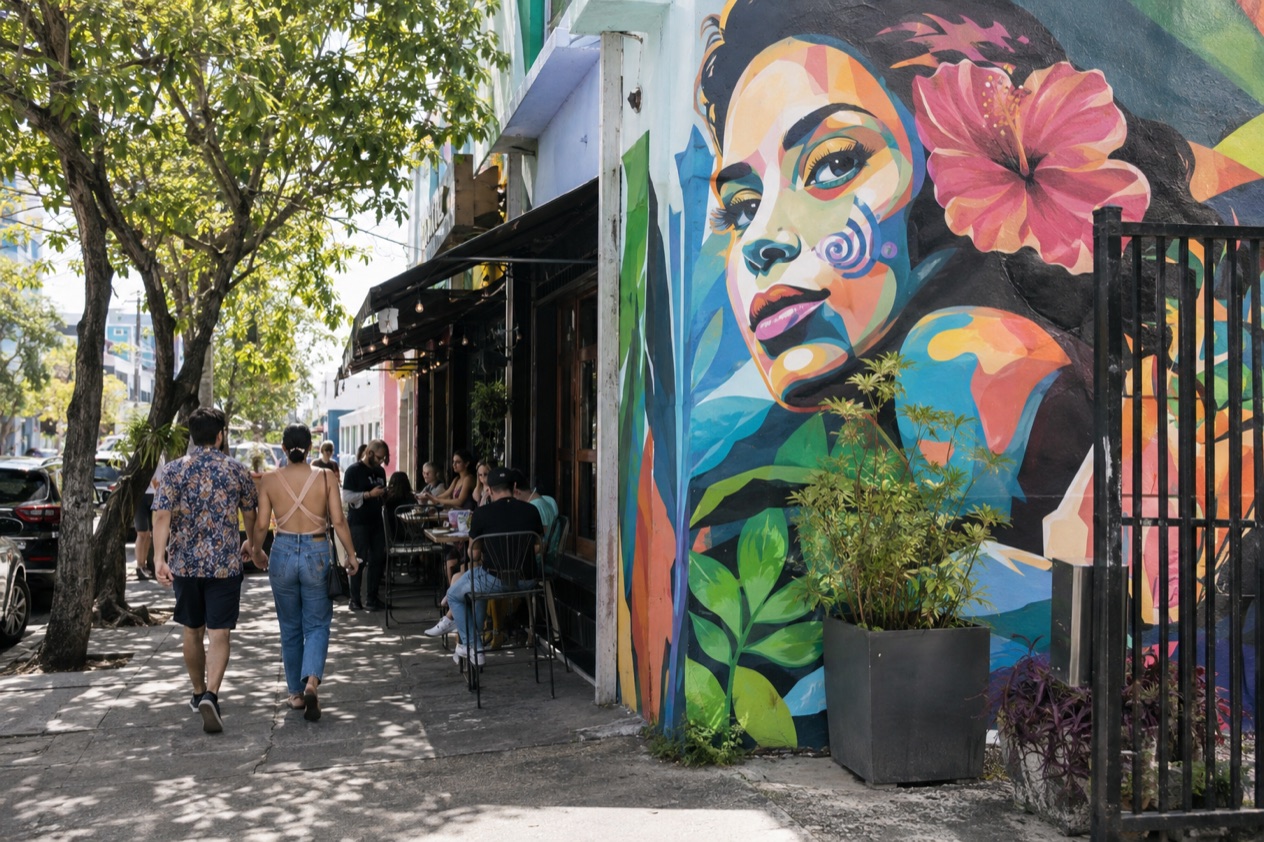
On a weekend evening in Santurce, music spills out of open doorways along Calle Loiza, and the walls above the sidewalks are covered in giant murals that seem to change every time you look up. Plates of alcapurrias and cold drinks pass across counters while people argue happily about where to go next. This is San Juan’s arts and food district, a lived-in neighborhood just east of the old city, for travelers who would rather eat, wander and listen than tick off monuments.
What is Santurce like?
Santurce is the creative, restless heart of San Juan, a big residential district where galleries, street art, bars, bakeries and neighborhood restaurants sit side by side with ordinary city life. It is not a polished resort strip, and that is much of its appeal. Buildings range from tidy pastel houses to weathered concrete blocks, and a wall that was blank last month may now hold a mural five stories tall.
The story goes back a long way. The area was officially established in 1773 as the municipality of San Mateo de Cangrejos, a name that nods to the crabs that once swarmed its shores.
Later, the steam tramway that began running in 1880 carried passengers from Old San Juan through Santurce toward Rio Piedras, and the district grew along that line. In 1917 the Condado Vanderbilt Hotel opened on its shore, which is often described as the birth of tourism on the island.
Today Santurce is a patchwork of about forty subbarrios, among them Condado, Miramar, Ocean Park and Isla Grande, each with its own feel. Water is never far: the Atlantic on one side, San Juan Bay and several lagoons on the others.
It suits curious travelers, art lovers, night owls and anyone who likes eating where residents eat. It asks a little more of you than a hotel strip does, since you walk, look around and choose as you go.
Things to do in Santurce
Calle Loiza and the street art
Calle Loiza is one of Santurce’s food and nightlife hubs, alongside La Placita de Santurce, with bakeries, bars, small restaurants and shops that keep different hours as the day turns. The murals are the draw for a slow walk: large painted facades, small stencils and whole side streets turned into open-air galleries. Many of the best pieces are on the blocks near the street’s busiest stretch, so you can wander without a fixed plan.
Late afternoon is a good time to start, when the light is softer and the heat eases, and then let dinner decide where you end up. Weekend evenings are livelier, with music and groups spilling onto the sidewalks. Wear comfortable shoes, because the pleasure here is in turning corners.
Museum of Art of Puerto Rico
This is one of Santurce’s two major museums, and it is the one to choose for a broad look at Puerto Rican art, from colonial-era religious works to modern painters and printmakers. The galleries give context to the colors and themes you have just seen on the walls outside. Gardens around the building offer a shaded place to rest afterward.
It suits a hot or rainy part of the day, when you want a few unhurried hours indoors. Pair it with a late lunch nearby, and save your energy for the streets in the evening.
Museum of Contemporary Art and the Performing Arts Center
The Puerto Rico Museum of Contemporary Art is the second of the district’s major museums, showing current work by island and Caribbean artists in a more experimental setting. It is a good counterpart to the older collection, and it gives a sense of how closely the neighborhood’s creative scene is tied to its galleries.
Nearby, the Luis A. Ferre Performing Arts Center is a striking modern building and the main venue for concerts, opera, dance and theater. Even if you do not have a ticket, the architecture is worth a look from outside. If an evening performance fits your plans, dinner in Santurce beforehand makes for a full night out.
The beaches of Condado and Ocean Park
Along the Atlantic edge, Santurce’s coastline stretches for miles, running from the Condado peninsula east past Ocean Park. These beaches face the open ocean and get steady surf, so conditions change from day to day and from one stretch to another. Where a flag, a sign or a lifeguard is present, follow it.
Morning is a calm time to walk the sand, and the sea air is welcome after a night of music. Condado has the hotel-and-promenade feel, while Ocean Park is more residential and relaxed, a place for a long beach stroll with a coffee in hand.
Within reach, Old San Juan lies to the west, linked by three bridges, with its forts and cobblestone streets. The Balneario de Escambron, a public beach park known for calmer water inside a reef, sits just outside the old city.
Eating and drinking in Santurce
Santurce is where San Juan comes to eat, and the range runs from counter-service fritters to long, leisurely dinners. The base of the island’s cooking is sofrito, a sauté of garlic, onions, culantro, cilantro and peppers, and you will smell it in almost every kitchen. Start with the classics: mofongo, mashed fried plantain, often shaped into a mound and filled or topped with meat or seafood, and tostones, twice-fried plantain slices.
For something quick, look for fritters such as alcapurrias and bacalaitos. Arroz con gandules, rice with pigeon peas, is widely regarded as the national dish, and it often appears as a side next to roast pork, lechon asado.
Pasteles, a kind of plantain-based tamale, are a holiday favorite but turn up at casual places too. Many of these dishes carry African, Spanish and Taino influences, which is part of why the food tastes so layered.
Cafes and bakeries are the right choice for the morning, with strong coffee and something sweet or savory alongside. In the evening, bars along Calle Loiza and the surrounding streets offer cocktails, local beer and small plates, and the crowd tends to be a mix of neighbors and visitors.
At the end of a meal, tembleque, a coconut pudding, is a gentle finish. Around the holidays, coquito, a spiced coconut drink served in small glasses and a bit like eggnog, is the drink to look for.
If you want a cold treat on a hot afternoon, piraguas, shaved ice with fruit syrup, are sold from carts and kiosks around the city. Beach kiosks, called quioscos, are part of a day by the water and a good place for a casual bite after swimming.
Staying in Santurce
Santurce suits travelers who want to live a little like a resident: guesthouses, small boutique hotels, apartments and rentals in a lively neighborhood rather than a resort. It is a good base if your days revolve around food, art and walking, and if you like being a short ride from the old city and the beach strips.
The neighboring areas offer a different rhythm. Condado, which is itself part of Santurce, has a hotel-and-promenade feel with the ocean close by. Isla Verde, to the east, is the other beach-and-hotel strip, closer to the airport. Old San Juan, to the west, is the walled colonial city with its plazas and forts, and it is beautiful but built around sightseeing rather than neighborhood life.
Nights in Santurce can be lively, especially on weekends near Calle Loiza, where music and conversation carry late. If you value quiet, ask about the street and the side of the building, or look toward the calmer residential blocks near the shore. Light sleepers may prefer to stay a few blocks away from the busiest bar stretches.
Its central position is a real advantage. The airport is only a few minutes by car, and the old city, the beaches and the museums are all close enough that you can move between them without planning a whole day around transport.
Getting to Santurce
Santurce sits north of Hato Rey, east of Old San Juan and west of the Isla Verde resort area, so it is easy to reach from most places you will stay in the city. From Luis Munoz Marin International Airport it is only a few minutes by car, and Isla Grande Airport, the smaller commercial field, is also close.
Three bridges connect the district to the old city, so the trip west is short and direct.
Within the neighborhood, walking lets you enjoy the murals, shops and restaurants, particularly in the cooler hours of the morning and evening. Because Santurce is large, with dozens of subbarrios, it helps to pick one area for the day and explore it on foot, then take a car to the next.
Today the layout of long avenues and cross streets makes it simple to orient yourself once you know where Calle Loiza runs.
Good to know before you go
Santurce uses the U.S. dollar, and U.S. citizens need no passport and no visa to visit. The Atlantic hurricane season runs from June 1 to November 30, with the peak in September, so travelers in those months should follow the National Hurricane Center and local official alerts. Wear light clothing, carry water for long walks, and keep an eye on beach flags and signs wherever you swim.
Sources
- Wikipedia, Santurce (https://en.wikipedia.org/wiki/Santurce,_San_Juan,_Puerto_Rico), checked October 8, 2026
- Wikipedia, Puerto Rican cuisine (https://en.wikipedia.org/wiki/Puerto_Rican_cuisine), checked October 8, 2026
- NOAA National Hurricane Center, Climatology (https://www.nhc.noaa.gov/climo/), checked October 8, 2026