
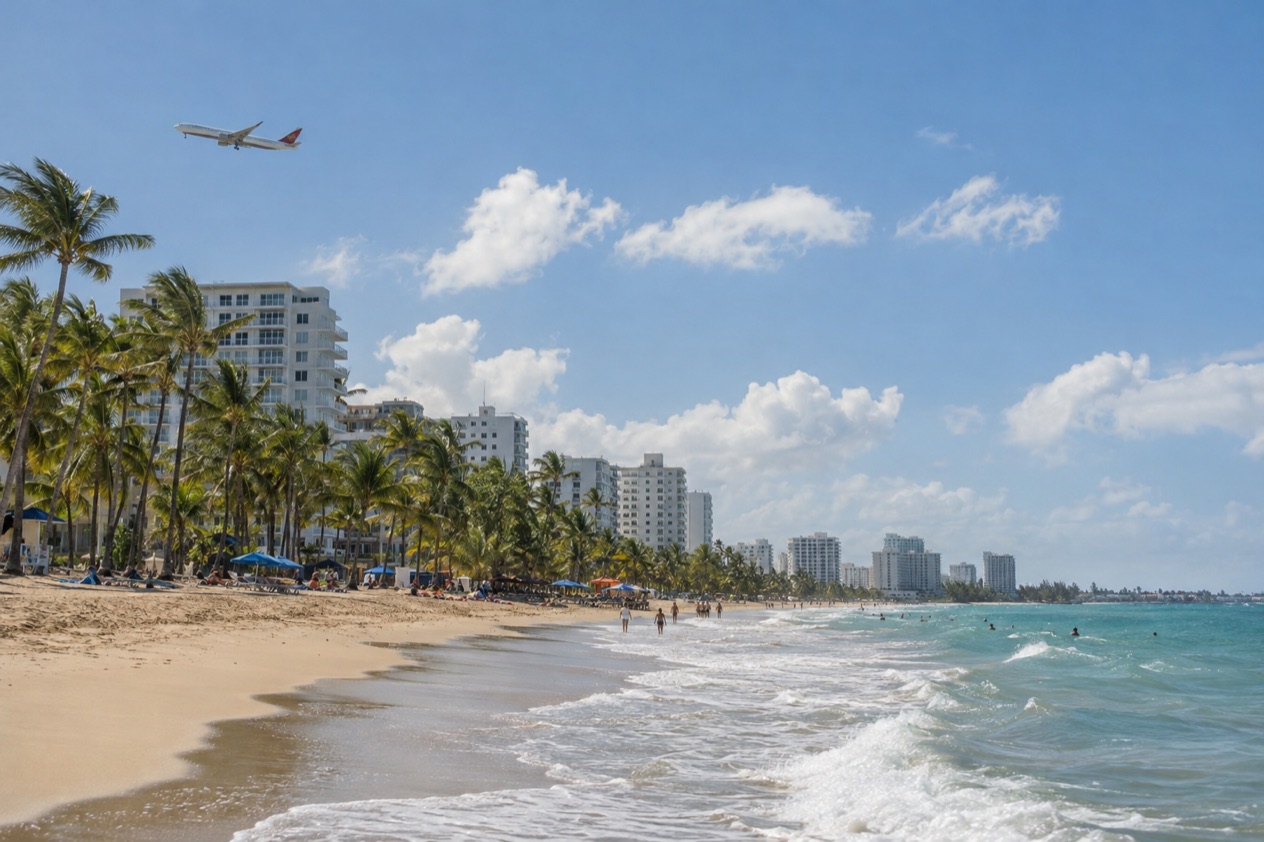
Early in the morning on Isla Verde, joggers and walkers share the sidewalk along the beach, the palms rattle in the trade wind, and a jet drops low over the water toward the airport runway. By midday the sand is lined with umbrellas and the air smells of sunscreen and frying plantains. This is San Juan’s resort strip, a place to stay a few steps from the Atlantic and to eat well without going far.
What is Isla Verde like?
Isla Verde is a lively beachfront resort district where the day revolves around the sand, the pool and the next meal. It sits in the municipality of Carolina, though almost every traveler thinks of it as part of greater San Juan. Tall hotel towers, condo buildings, casinos and restaurants run in a line along the Atlantic, with the airport just behind them to the south.
The name comes from a small cay ringed by a coral reef, a speck of land that lies off the shoreline at Punta del Medio. You will not visit it, but it gives the district its green name.
To the west lies Santurce, to the east the Loíza side of the coast, and in between the neighborhood feels more like a vacation village than a city center. Jets pass overhead now and then, which locals barely notice and visitors quickly stop noticing too.
People who love Isla Verde tend to want an easy beach vacation. Families like the hotel pools and the short walk from room to sand. Couples come for the evening strolls and the casino nights.
Travelers on a short stopover appreciate being so close to the terminal. The area also has a cultural thread, since it is home to Casa Cuba, Puerto Rico’s main Cuban social club, a reminder of how many communities have settled on the island.
Compared with the cobblestones of Old San Juan or the arts-and-food bustle of Santurce, Isla Verde is more relaxed and more resort-like. It is the place you come back to after a day out, kick off your sandals and watch the surf.
Things to do in Isla Verde
The beach and the seaside promenade
The long public beach is the heart of the neighborhood. It faces the Atlantic, so the water has steady surf and conditions change from day to day and spot to spot. Some mornings the sea is gentle enough for a wade, other days the waves are strong, so look for flags, signs or a lifeguard and follow them where they are present.
The best hours are early, when the sand is nearly empty and the light is soft, and late afternoon, when the hotel towers throw long shadows. Bring a hat and water, because the sun here is strong at midday.
Evening walks and the casinos
After dark the main avenue lights up. Hotel casinos, lounges and open-air terraces draw a mix of vacationers and locals out for a drink or a bit of music.
A good rhythm is dinner at around sunset, then a slow stroll to see which place has music. Weekends are livelier, and the mood is festive without being rowdy. Wear light clothing, since the night stays warm.
Casa Cuba and the neighborhood’s Cuban thread
Casa Cuba, Puerto Rico’s main Cuban social club, is based in Isla Verde.
If that sparks your curiosity, ask at your hotel or in a cafe about Cuban food and music nearby. It is a pleasant way to connect the resort strip with the island’s wider history of migration and exchange.
Watching planes from the beach
Because the airport sits right behind the hotels, the sky over Isla Verde is a show of its own. Aircraft glide in low over the water, and from the sand you can watch them line up toward the runway. The old dedicated viewing spot near Piñones for plane fans has been closed to the public since the attacks of September 11, 2001, for airport security reasons, so the beach itself is where most people enjoy the view.
Within reach beyond the district, Condado and Old San Juan lie a few miles west, and the beachside kiosks of Piñones sit just east of the airport. They make easy half-day outings from your hotel.
Eating and drinking in Isla Verde
Eating in Isla Verde ranges from hotel restaurants with ocean views to casual counters where you eat with your fingers. Because the district is a resort strip, most places are used to visitors, and menus often mix island dishes with familiar American favorites. That makes it easy to eat well even on a first day when you are still finding your bearings.
The island’s classic dishes are what to look for. Mofongo is mashed fried plantain, often shaped into a bowl and filled with shrimp, chicken or pork. Lechon asado is roast pork with crackling skin.
Tostones are twice-fried green plantain slices, good with a garlicky dip. Pasteles are plantain-based parcels steamed in leaves, and alcapurrias are fritters you can eat out of hand. These turn up in restaurants, kiosks and casual roadside places called chinchorros.
For a more local, rustic meal, the kiosks of Piñones, just east of the airport, are famous for alcapurrias and bacalaitos, which are crisp salt cod fritters. They are a favorite outing for a lunch by the sea, and the contrast with the polished hotel dining rooms is part of the fun.
Back in the district, breakfast can be as simple as strong Puerto Rican coffee with a pastry at a cafe, or a full plate of eggs and fried sides at a hotel restaurant. In the afternoon, piraguas, shaved ice with fruit syrup, are a cooling treat, and tembleque, a silky coconut pudding, makes a gentle ending to dinner.
At night the bars and lounges serve rum drinks, from simple rum-and-cola to fruit cocktails and piña coladas, which are a Puerto Rican point of pride. Many are in hotels, with open sides to catch the breeze. A good plan is a casual seafood lunch, a slow afternoon on the sand and a sit-down dinner with a drink at sunset.
Staying in Isla Verde
Isla Verde suits travelers who want the beach at the door. It is one of the two beach-and-hotel strips of San Juan, along with Condado, and it leans toward big resorts, high-rise condos and casino hotels rather than small guesthouses. For a getaway built around a pool, a patch of sand and a place to eat right below, this is the spot to settle in.
Compared with Condado, Isla Verde feels a bit more spread out and resort-like, with fewer streets to wander for shops and boutiques. Compared with Old San Juan, which has cobblestones, forts and plazas, it is a quieter place to sleep and a more beach-centered one.
Santurce, the arts and food district, offers more local nightlife and a grittier urban energy. Many visitors pick Isla Verde for the beach and take a short ride for the rest.
Noise is worth a thought. The airport is right next to the district, so planes pass overhead during the day. Casino hotels and lounges can be lively late, so if you want early nights, ask for a room away from the main bar or pool deck.
It is a good base for families, for couples looking for a classic beach break and for travelers with early flights, since the terminal is so close. It is also convenient for anyone connecting to the islands of Culebra or Vieques, because domestic flights from the airport connect to them. If you want to spend most days among museums, forts and walking streets, a base in Old San Juan may suit better, with Isla Verde as a beach day trip.
Getting to Isla Verde
No corner of San Juan greets you from the sky more simply than Isla Verde, since the island’s main gateway, Luis Muñoz Marín International Airport, sits squarely within the neighborhood. Most arrivals can be at their hotel in a short ride, and some airport-area hotels are close enough that the trip feels like a hop.
A ride by taxi from the airport to Condado or Old San Juan, among the main tourist areas, runs around $20. The distance to those areas is roughly 3 to 6 miles west, depending on where you are headed, so expect a ride of a modest length, longer at rush hour.
The airport connects to Hato Rey, the financial and commercial center, by the Teodoro Moscoso Bridge, and to Old San Juan by the Baldorioty de Castro Expressway. Those are the two main road routes you will hear drivers mention.
Once you are in Isla Verde, getting around on foot is easy for the beach, the hotels and the nearby restaurants. A free SITRAC bus runs, but only within the Isla Verde hotel district, so it works for short hops between hotels and the beach rather than for outings farther afield. The public bus costs 75 cents a ride.
Plan on a short ride, and settle your return before you head out so you are not stuck at a kiosk at dusk.
Good to know before you go
The U.S. dollar is the currency in Puerto Rico, and Americans do not require a passport or a visa. Flights from the mainland are domestic, so arrival is simple. Spanish and English are both official, and a few words of Spanish go a long way in cafes and shops.
The Atlantic hurricane season runs from June 1 to November 30, with the peak in September. When your trip gets close and those months are on the calendar, stay tuned to the National Hurricane Center plus alerts from local officials. The Atlantic surf can be strong on any day of the year, so check flags on the beach before you swim, and keep valuables out of sight when you leave the sand.
Sources
- Wikipedia, Isla Verde (https://en.wikipedia.org/wiki/Isla_Verde,_Puerto_Rico), checked October 8, 2026
- Wikipedia, Luis Muñoz Marín International Airport (https://en.wikipedia.org/wiki/Luis_Muñoz_Marín_International_Airport), checked October 8, 2026
- Wikipedia, Piñones (https://en.wikipedia.org/wiki/Piñones,_Puerto_Rico), checked October 8, 2026
- NOAA National Hurricane Center, Climatology (https://www.nhc.noaa.gov/climo/), checked October 8, 2026