
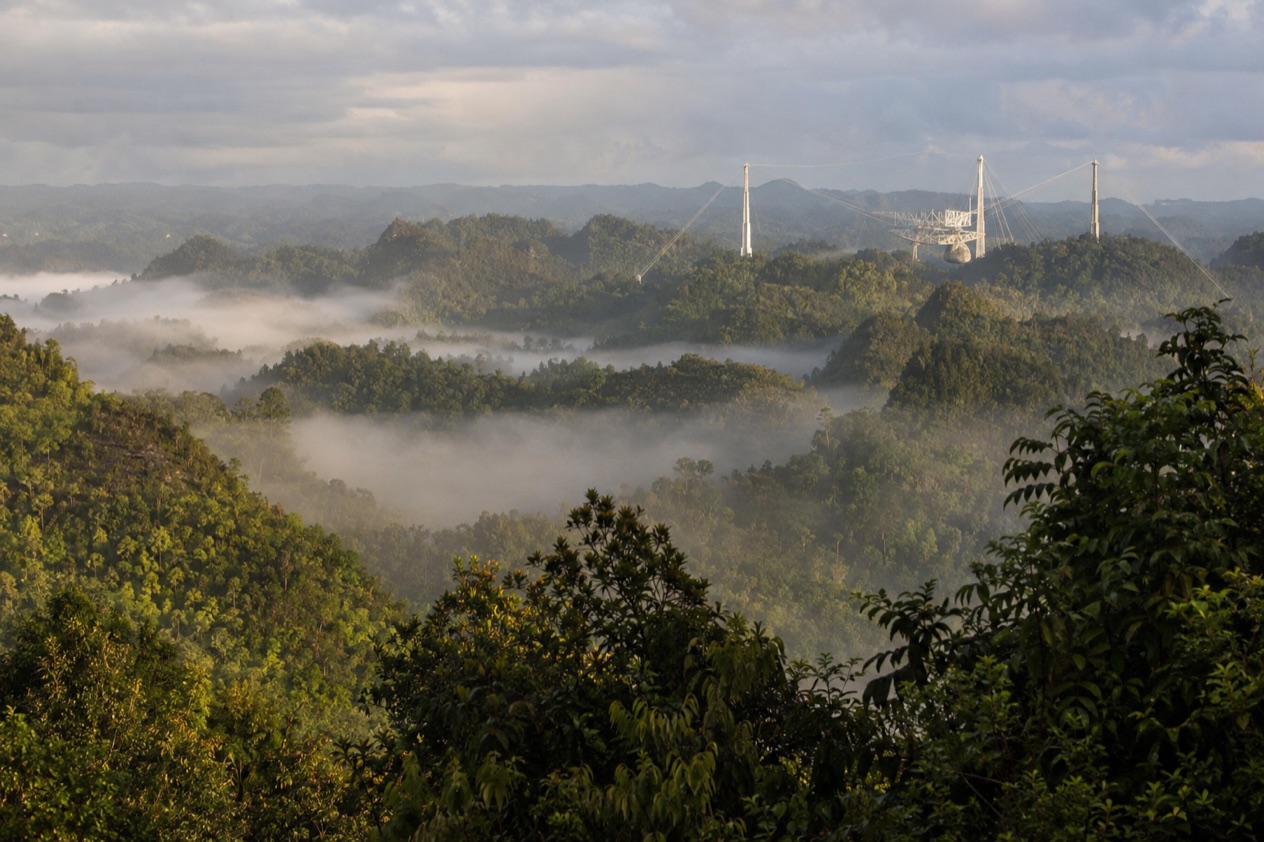
The road climbs out of the coastal plain into green, karst hills where the limestone knobs rise like upturned bowls, and somewhere in those hills a famous radio telescope once sat in a sinkhole, ringed by jungle. Today the dish is gone, but the site still draws people who grew up on the movies shot here and on the science done here. This is a visit about memory, ideas and the stubborn beauty of the hills of northern Puerto Rico.
Is visiting Arecibo Observatory worth it?
Yes, if you are curious about science, space or the history of a place that shaped both, and less so if you are hoping to stand in front of a giant dish. The main telescope collapsed on December 1, 2020, and the National Science Foundation announced two years later that it would not be rebuilt. What remains is a story, told well, in a landscape that makes the story easy to imagine.
Families with curious kids, amateur astronomers, film fans and anyone who likes a place with a strong sense of purpose will get the most from it. The visitor center stayed in operation after the collapse, so there is still a front door and a place to learn what happened here. An educational facility is planned for the site, which suggests the visit will keep evolving.
What sets it apart from the other stops on this stretch of the north coast is the kind of wonder it offers. The beaches, caves and lighthouse nearby are about sea and stone. This is about looking up. Pair the two in a single day and you get a very full picture of the northwest: ocean at sea level, sky from the hills.
What to see at Arecibo Observatory
The Ángel Ramos Foundation Visitor Center
The visitor center opened in 1997 and is the heart of any visit today. It is built to explain radio astronomy, atmospheric science and the work of the scientists who spent careers here, in language meant for people who have never read a physics paper. Expect exhibits, models and photographs that bring the old telescope back into view.
Look for the images of the dish in its prime: a vast bowl set into the hills, with a platform suspended high above on cables. Seeing the scale in photographs, then stepping outside into the same air and the same hills, gives the story a weight a screen cannot. It suits older kids and adults best, though younger children enjoy the models and the sheer size of the pictures.
The story of the great dish
For decades this was the world’s largest radio telescope, a title it held until July 2016. Its reflector filled a natural sinkhole, a clever use of the karst terrain, and it listened to faint signals from pulsars, distant galaxies and the edges of the solar system. It also sent radar signals toward nearby worlds and asteroids, and it was a famous voice in the search for life beyond Earth.
Popular culture made it famous well beyond science. It appeared in *GoldenEye* and *Contact*, which made the observatory famous well beyond science. When you look at the hills where the dish once sat, try to picture the cables, the platform and the great curve of metal. Then think about how its loss on that December morning stunned the scientific community and much of Puerto Rico.
The smaller telescope and the LIDAR facility
Science did not stop at the dish. The site also includes a smaller radio telescope and a LIDAR facility, which uses laser light to study the upper atmosphere. They are less famous than the great reflector, but they show that the observatory was always more than one instrument.
If you have a taste for how science actually works, this is the part to linger over. The smaller radio telescope and LIDAR facility show that the observatory was always more than one instrument. It is a good moment to ask the people around you what the site is used for today.
A landmark on the historic register
The observatory was added to the National Register of Historic Places on September 23, 2008, recognition of how much it meant to American science. It remains owned by the National Science Foundation. That status sits oddly and movingly beside the empty sinkhole, as a place can be historic precisely because of what is no longer there.
The site sits in Barrio Esperanza, a name that means hope, which many visitors find a quiet, fitting touch. Take a moment to look at the hills around you. The green is thick, the air is often damp and the karst landscape recalls the natural sinkhole that held the reflector.
Hours, tickets and rules
Before visiting, confirm that the site is open to the public and check current hours, admission, reservation requirements and visitor rules. Think of it as a small museum and gateway to the story, rather than an attraction with a long list of sights. The site belongs to the National Science Foundation, and the educational facility planned for the grounds points to a future with more for visitors to do.
Before building your day around the observatory, confirm current public access. Build your day around the surrounding area, with the visitor center as one pleasant, unhurried part of it. The mood is closer to a campus or a research station than to a theme park.
The site includes a smaller radio telescope and a LIDAR facility. Treat the place the way you would any working research facility: with curiosity and a little restraint. Photographs of the surrounding hills are a good way to remember a landscape that holds so much of Puerto Rico’s scientific story.
How to get to Arecibo Observatory
The observatory is in Barrio Esperanza, in the municipality of Arecibo, on the north side of the island. It sits high in the hills at an altitude of 1,634 feet, so the last stretch of any approach is a climb away from the coastal towns. That elevation is why the air feels a little fresher and the views are so wide.
Arecibo is the largest municipality in Puerto Rico by area, which means the observatory can feel a long way from the town center and the shoreline. Plan to treat the trip as a real outing rather than a quick detour. Anyone staying on the coast should expect the drive to take them from sea level to the hills.
Arecibo has a small airport, Antonio (Nery) Juarbe Pol Airport, but it is noncommercial and has no airline flights. Travelers from the mainland therefore land elsewhere on the island and continue to Arecibo and the hills. Whichever way you travel, keep the town of Arecibo in mind as your base for meals, lodging and the other sights of the north coast.
When to visit Arecibo Observatory
Go in the morning if you can. The hills are at their freshest early in the day, the light is soft on the green slopes and the afternoon heat and clouds have not yet settled in. A morning visit also leaves you the rest of the day for the coast, with a long lunch and an unhurried walk by the sea.
Puerto Rico is warm and humid all year, with a drier season from about December to April and a wetter one from about May to November. The north coast and the central hills are among the wetter parts of the island, so a spell of rain can arrive at any time of year. The drier months give you the best chance of clear views across the hills.
The Atlantic hurricane season runs from June 1 to November 30, with its peak around September 10 and most activity between mid-August and mid-October. If you travel in those months, follow the National Hurricane Center and local official alerts, and keep your plans flexible. In May the town of Arecibo celebrates its patron saint festival, the Fiestas Patronales de San Felipe Apostol, with parades, games, artisans, amusement rides, regional food and live entertainment, which makes a lively addition to a visit then.
Tips for your visit
Bring water, a light rain jacket and comfortable shoes. The hills are humid and showers can arrive quickly, so a small layer you can stuff in a bag is more useful than a heavy one. Sunscreen and a hat help on the days the clouds part, and a camera suits the green, rolling views.
Plan on a half day for the observatory, with the visitor center as the main stop. It works well for families with older children, who tend to enjoy the story of the telescope and the film connections. Visitors who find hills and exhibits tiring should pace themselves and take breaks, as the setting rewards a slow rhythm.
Combine the visit with the coast in the afternoon. The Punta Los Morrillos Lighthouse, built in 1898, still operates and stands in a small park called Arecibo Lighthouse and Historical Park, a pleasant place for a walk and a view of the sea. Cueva del Indio is an archeological site where Taíno drawings can be found, and it adds an older chapter of Puerto Rican history to a day that began with the stars.
The beaches of Arecibo include Los Morillos, Los Negritos, Poza del Obispo and Las Tunas. Poza del Obispo Beach is considered dangerous, so choose another stretch for a dip. Conditions on this Atlantic coast change from day to day and beach to beach, so where a flag, sign or lifeguard is present, follow it.
Good to know before you go
U.S. citizens need no passport and no visa to visit Puerto Rico, and the currency is the U.S. dollar. English and Spanish are both official, and a few words of Spanish are always appreciated in the hills and small towns. Keep the usual habits of a traveler: lock the car, keep valuables out of sight and stay aware of your surroundings, especially in unfamiliar areas.
Sources
- Wikipedia, Arecibo Observatory (https://en.wikipedia.org/wiki/Arecibo_Observatory), checked October 8, 2026
- Wikipedia, Río Camuy Cave Park (https://en.wikipedia.org/wiki/Camuy_Caves), checked October 8, 2026
- NOAA National Hurricane Center, Climatology (https://www.nhc.noaa.gov/climo/), checked October 8, 2026