
On a January evening in Puerto Escondido, surfers walk back along Zicatela with boards under their arms while the beach bars light up and fishing boats rest on the sand at Playa Principal. The dry months bring blue skies and steady warmth, the summer rains turn the hills a deep green, and the town fills with visitors at Christmas, Easter and spring break. This Oaxaca coast town rewards a trip at almost any time, but the season you pick decides what the days will feel like.
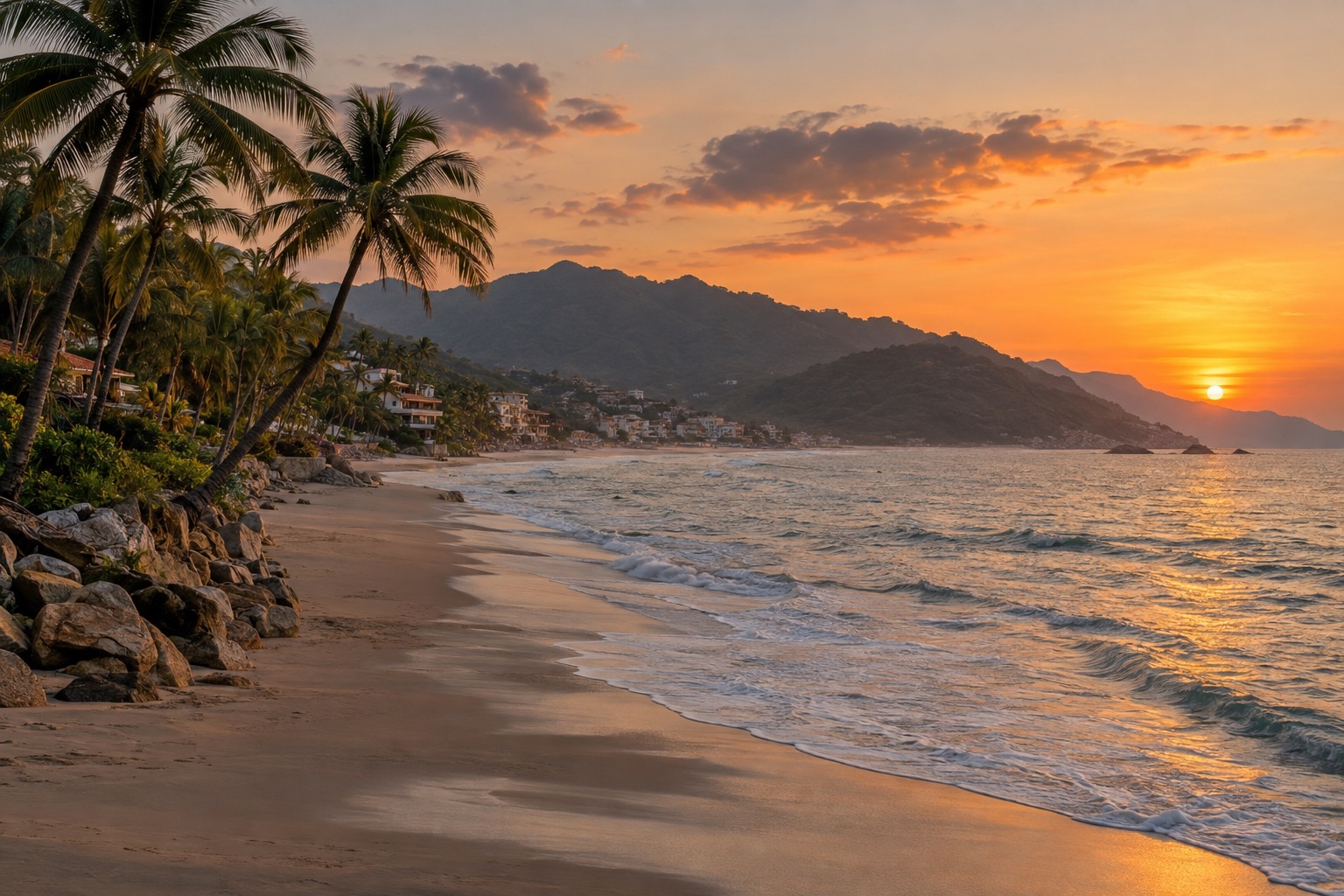
When is the best time to visit Puerto Escondido?
The best time is November through April, when rain nearly vanishes, the sky stays clear and the sea is warm, with December to February the most comfortable for most travelers. Heat never really leaves, but in these months the evenings are soft enough for dinner on a terrace with your feet in the sand.
For beach days and the sea, late November through February is a lovely stretch: sunny mornings, long afternoons and water that is pleasant without being bathwater. Sightseeing outings suit the same months. Boat trips on the lagoons, the turtle coast and walks through the coffee hills are easier without the downpours that come in summer. Spring gets hotter, and from May the afternoons start building into storms.
If you want quiet and a lower bill, look at the green season, from June to October, when the town slows down and rooms are easy to find. Expect rain most days, usually in heavy bursts. Families will do best in the dry winter months, but March is the loud month: spring break brings crowds, music and late nights, and it is not the moment for small children who need an early bedtime.
Puerto Escondido weather by month
The seasons shape a trip to this Oaxaca surf town far more through rain than through temperature.
| Month | Average high (°F) | Average low (°F) | Rain (in) | Rain days | Sea (°F) |
|---|---|---|---|---|---|
| January | 86.1 | 70.6 | 0.13 | 0.2 | 83.0 |
| February | 86.8 | 70.6 | 0.07 | 0.1 | 83.3 |
| March | 87.6 | 71.8 | 0.13 | 0.2 | 82.3 |
| April | 88.5 | 73.8 | 0.25 | 0.4 | 84.6 |
| May | 87.3 | 75.4 | 3.72 | 8.5 | 85.4 |
| June | 84.5 | 74.9 | 14.10 | 18.8 | 87.4 |
| July | 85.3 | 74.6 | 10.06 | 15.9 | 88.7 |
| August | 84.7 | 74.6 | 13.66 | 19.1 | 89.0 |
| September | 83.4 | 74.1 | 19.22 | 22.1 | 88.0 |
| October | 83.7 | 73.6 | 11.49 | 15.9 | 87.2 |
| November | 84.9 | 72.6 | 2.17 | 3.7 | 86.1 |
| December | 85.5 | 71.2 | 0.29 | 0.6 | 84.3 |
Heat is constant here, with afternoons in the mid-80s nearly all year, so the real dividing line is rain. From November to April the days are almost entirely dry, and the cooler nights of midwinter feel pleasant.
May is the transition, with storms arriving in the afternoon. June through October is the wet season, when showers can be heavy and frequent, and September is the wettest month. Even then the sun often returns between downpours, and the sea stays very warm.
When is Puerto Escondido cheapest and least crowded?
The quietest stretch is the rainy season, especially September and October, when the beaches are close to empty and many rooms sit unbooked. Surf camps, hostels and small hotels have space, and restaurants take their time with you.
The busiest weeks are the ones you would expect: Christmas and New Year, Easter week, the March spring break crush and the long Mexican school vacation from early July to late August, when Mexican families fill the coast despite the rain. U.S. holiday weekends also bring a rush. In those weeks rooms get scarce, peak-season rates apply and Zicatela is full from morning to sunset.
Late April and May are a useful in-between. The spring crowds have gone, the heat is high, and the big storms have not yet settled in. November, just after the rains and before the winter holidays, also feels relaxed, with the town green and the sea warm.
Which months should you avoid in Puerto Escondido?
Most travelers are happiest skipping September, and to a lesser degree June through October, when rain falls on most days and tropical storms can pass through the Pacific. The hurricane season runs through the wet months, so plans in that window need some flexibility, and heavy rain can close roads and cancel boat trips.
The rain is not constant all day. It often arrives as a loud afternoon or night storm, then clears. But the sea gets rougher, and the humidity is thick. If you dislike sticky heat, April and May are the hottest, with little relief before the rains break.
Winter nortes, the cold fronts that sweep across the Gulf of Mexico, are far more of a story on the Caribbean side. On this Pacific coast they matter little and do not change the dry, sunny pattern.
Sargassum is generally an issue for Caribbean beaches, and no beach is guaranteed to be free of seaweed, but it is not the first thing that spoils trips here. The U.S. State Department rates Oaxaca at Level 2, “Exercise increased caution.”
When can you swim in Puerto Escondido?
You can swim here all year in terms of temperature, since the sea is warm in every month, but where you swim matters more than when. Zicatela is a powerful surf beach and is not considered a place for swimming, so people head to Puerto Angelito and Carrizalillo, two small coves with gentler water.
The water is a touch cooler in the early months of the year and turns very warm from summer into early fall. Winter mornings are clear and calm in the coves, while in the rainy months swells and cloudy water make swimming less pleasant, even though the temperature is high. Right after heavy rain, the sea can look muddy near river mouths.
Beach life changes with the seasons. In winter the sand is lively with surfers, volleyball games and long lunches of grilled fish. In the green season you share the beach with pelicans and a few early walkers.
Festivals and events in Puerto Escondido through the year
Winter holidays and Carnival
Día de Muertos, from October 31 to November 2, is celebrated in homes and cemeteries across Oaxaca, with marigold altars, candles and sweet bread. In Puerto Escondido it is a quieter, more family affair than in the city of Oaxaca, but you will see altars in shops and restaurants. It falls at the tail of the rains, so the hills are still green.
Christmas and New Year bring the biggest social season, with posadas, fireworks on the beach and a full calendar at beach clubs. Carnival, usually in February or early in the year depending on Easter, adds parades and costumed dancers in town. Easter week, Semana Santa, is a major Mexican vacation, with processions and a packed coast. Reserve rooms well ahead for all of these.
Surf culture and local fiestas
Surf is the heartbeat of the town. Zicatela has drawn surfers for five decades, and the stretch including Marinero and Playa Principal is recognized as a World Surfing Reserve. The biggest swells usually arrive in the summer months, when watching from the sand is a spectacle, though experienced surfers are the ones in the water.
Local fiestas and surf competitions pop up through the year, with live music, street food and dancing along the Adoquín, the pedestrian street in the heart of town. Dates move, so treat them as pleasant surprises rather than anchors for your plans.
Nature seasons: turtles and glowing water
Olive ridley turtles come ashore in mass nesting events called arribadas, and the sanctuary at Playa Escobilla, along the coast, is one of the places where it happens. A single arribada in the 2026-2027 season reported roughly 101,500 nesting females. The timing is tied to the late rainy season and the months after, and you should not expect to walk onto the beach as at a show.
Smaller releases of hatchlings and turtle programs are easier to join. The Centro Mexicano de la Tortuga at Mazunte protects several species, including the leatherback and hawksbill, and makes a calm outing for children.
After dark, the boat trips on Laguna de Manialtepec turn the water into a trail of light, as bioluminescent plankton flashes around the oars. Calm, moonless nights are best. Chacahua National Park, with its lagoons and mangroves, rewards a day on the water for birds and quiet in any dry-season month.
Sources
- Open-Meteo / ECMWF ERA5, 1991-2020 normals, grid cell 15.86N 97.07W, model reanalysis, not a station record, checked September 8, 2026
- Open-Meteo Marine API, average 2015-2024, checked September 8, 2026
- sunrise-sunset.org, sunrise and sunset on the 15th of the month, checked September 8, 2026
- Save The Waves Coalition, savethewaves.org/puertoescondido, checked September 29, 2026
- CONANP, Direccion Frontera Sur, Istmo y Pacifico Sur, official press releases on the Santuario Playa Escobilla, read on September 29, 2026
- CONANP, gob.mx, « Centro Mexicano de la Tortuga », checked September 29, 2026
- El Contribuyente and J.A. del Rio, ISH tables by State 2026, read on September 29, 2026
- U.S. Department of State, Mexico Travel Advisory (travel.state.gov), checked September 29, 2026
To plan your stay
- Things to Do in Puerto Escondido: Zicatela Surf, Baby Turtles, Glowing Lagoons and Fresh Seafood
- Where to Stay in Puerto Escondido: Zicatela, La Punta, Rinconada, Bacocho and El Centro
- Puerto Escondido in January: Dry Weather, Surf, Lagoon Nights and Beach Days
- Puerto Escondido in February: Dry-Season Surf, Lagoon Trips and Beach Days