
Kids at a rainforest visitor center press their noses to the glass to look at a live Puerto Rican parrot, while outside the coquí frogs start their whistling at dusk. Down on the coast, a bag of warm alcapurrias is passed around a picnic table and a piragua vendor shaves ice into a paper cone. Puerto Rico is an easy family vacation, with a rainforest, old forts, glowing bays and warm sea within reach of the capital.
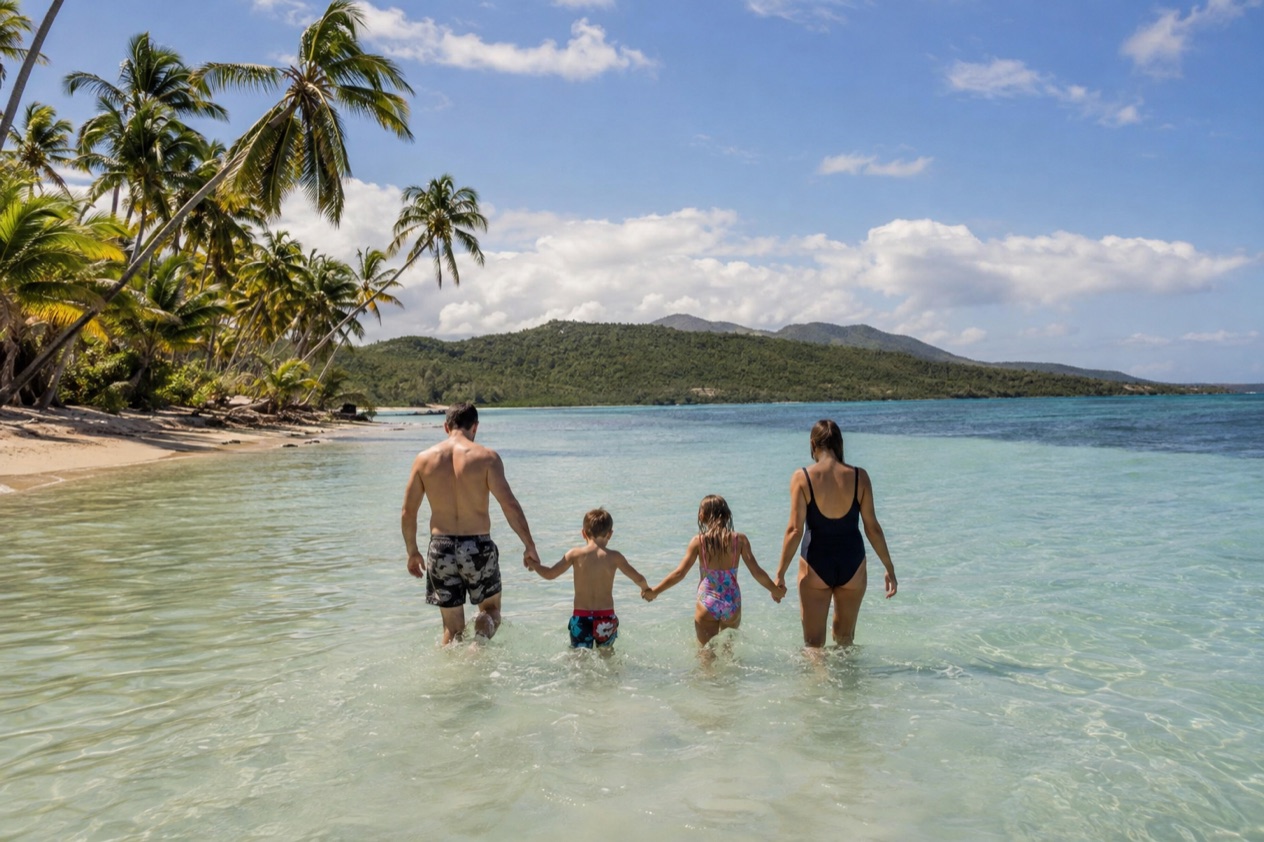
Is Puerto Rico good for kids?
Yes, Puerto Rico suits families well, because so much of what children love sits close together: a rainforest, centuries-old fortresses, beaches, and food that even picky eaters tend to like. Since Puerto Rico is part of the United States, families from the mainland travel as domestic passengers, use the dollar, and require no passport or visa. Spanish and English are both official languages, which makes a few words of Spanish a game rather than a hurdle.
The island is about 100 miles long, so choose one or two well-placed bases rather than trying to cover it all. San Juan is the main gateway, with the airport, the old city and city beaches. The northeast has the rainforest and the departure port for the island ferries. The west has surf and sunsets, and the south is drier and hotter.
Weather and the best time for families
There is no true winter here. Year-round conditions stay warm and humid, while the drier stretch runs from roughly December through April and the wetter one from roughly May through November.
For families, the drier months mean more predictable beach days and fewer afternoons stuck under a rain shelter. The wet season is also hurricane season, which runs from June 1 to November 30 and peaks around September 10, with most activity between mid-August and mid-October.
At that time of year, stay tuned to updates from local officials and the National Hurricane Center, and be ready to adjust your plans. In the central mountains and along the north coast, showers are the typical form the rain takes, so a morning of wet weather is a fine time for a fort, a museum or a relaxed lunch. The south and west coasts are generally drier, which can help when fitting a beach day into your plans.
What kids eat
Food is one of the easiest wins. Tostones are twice-fried green plantain slices, salty and crisp, a natural stand-in for french fries. Alcapurrias are fritters made from green banana and filled with meat, sold at roadside kiosks. Mofongo, mashed fried plantain with garlic, is hearty and worth sharing.
When it comes to sweets, kids usually go for tembleque, a coconut pudding that jiggles, while piraguas, shaved ice topped with fruit syrup, are hawked from carts in plazas and at beaches. At Christmas, pasteles, a kind of plantain tamale wrapped in leaves, appear on tables. Lechon asado, slow-roasted pork, is the celebration dish. Parents can look to mountain coffee, and the adults-only list includes rum.
When the island is most festive
The Christmas season is long, running from late November into mid-January, with lights, music and gatherings that older kids enjoy. In Old San Juan, the Calle San Sebastian street festival wraps up the celebration, a festive and packed bash perfect for children who thrive on commotion and throngs. Families with small ones may prefer to watch the early part of the day and leave before the evening crush.
What are the best things to do in Puerto Rico with children?
The best family days combine El Yunque rainforest, the old forts of San Juan and a night on a bioluminescent bay, with beach time in between. Each one gives children something to touch, climb around or look for, and each works as a half day or a full one.
El Yunque rainforest
El Yunque covers nearly 29,000 acres and is the only tropical rainforest in the U.S. national forest system. Begin at El Portal, the primary visitor center, where live Puerto Rican parrots are on view, the El Yunque movie plays in Spanish and English, and a fully accessible trail welcomes strollers and wheelchairs.
Every day, rangers guide walks and talks, and the Jr Ranger program runs all the time, letting kids learn and pick up a badge along the way. There is a full restaurant on site.
The redesigned center reopened in January 2022. Tickets are valid from 8am to 4pm on the chosen date, and you can come and go through the day. They go on sale 30 days ahead at 9 a.m. ET. Capacity is managed because of limited parking and ongoing recovery construction, so book early. The visitor center closes on Thanksgiving, Christmas Day, New Year’s Day and Three Kings Day.
La Mina Trail, which leads to a waterfall of more than 35 feet dropping into a cold pool, is currently closed for repairs. When it is open, it is short but challenging for small legs because of the winding concrete stairs on the way back. The area gets congested, so arrive early. It is not a picnic area and there are no trash cans, so carry out everything you bring in. No camping is available.
The forts of Old San Juan
Children usually take to the old fortifications at once: thick stone walls, dark passages, lookouts over the sea and wide grassy lawns where kites go up in the breeze. On cobbled streets, the San Juan National Historic Site’s pair of forts lie just a brief stroll from each other, and between them you’ll come across colorful colonial buildings, little plazas and stands selling ice cream.
Kids younger than 16 get in without an entrance pass. Visitors aged 16 and older need an entrance pass, and the park does not accept cash. The standard pass is valid for 24 hours and covers both forts, so you can split the visit between morning and a later cooler hour. The site also has free entrance days during the year.
| Site | Pass | Who needs it |
|---|---|---|
| San Juan National Historic Site (both forts) | Standard pass, valid 24 hours | Visitors over 16 (under 16 free) |
| America the Beautiful Annual Pass | $80 | U.S. citizens and residents |
Glowing bays at night
Three bioluminescent bays can be found in Puerto Rico: Mosquito Bay on Vieques, Laguna Grande close to Fajardo, and La Parguera in Lajas along the southwest coast. Their light shows up throughout the year and peaks on nights without a moon, so look at the lunar calendar before choosing your day. You may see the water sparkle blue-green around a paddle, which is a thrill for children old enough to stay up.
Laguna Grande is the easiest to combine with a stay in the northeast, La Parguera suits families based in the southwest, and Mosquito Bay makes sense if you are already on Vieques. Since glow is a chance and not a promise, treat it as a bonus on a day that also has a beach or a meal.
Beaches and island ferries
Beach conditions vary by coast. Along the south lies the Caribbean, while the Atlantic meets the north and west coasts and brings large winter swells. Culebra and Vieques have sheltered coves and exposed shores, so conditions change from beach to beach and day to day. When a flag, sign or lifeguard is present, follow that guidance, and keep your kids nearby.
For trips to Culebra or Vieques, public ferries leave from Ceiba, not Fajardo. On the east and south coasts, sargassum seaweed sometimes shows up in particular springs and summers, so a beach you visit might not match the photos. Take sunscreen, hats and rash guards for long days in the sun.
Where should families stay in Puerto Rico?
Most families do best in San Juan or on the northeast coast, with a second base in the west or on an island if the trip is long. Which one fits depends on whether you want the old city and restaurants, the rainforest, or long beach days.
San Juan and Old San Juan
San Juan is the practical choice. It has the main airport, a wide choice of places to eat, the old city with its forts and plazas, and city beaches within reach. Staying here lets you do the forts on foot, add a day at El Yunque, and leave early for the east. It suits families with younger children who need short transfers and easy meals.
Old San Juan is atmospheric, with narrow streets and balconies, and it works best for families with kids who like to walk. In the evening, plazas fill with people, music drifts out of doorways and vendors sell piraguas. If your children need a quiet bedtime, stay just outside the old city and visit during the day.
The northeast: Fajardo, Ceiba and El Yunque
Staying in the northeast keeps you near El Yunque, Laguna Grande and the ferry terminal at Ceiba, the departure point for public ferries to Culebra and Vieques. It is a good base for families whose plans center on the rainforest, the glowing bay and an island day. It is also wetter than the south and west, so pack for showers and plan an indoor backup.
A stay here shortens the mornings, which matters because El Yunque is easier early. The tradeoff is fewer dining and sightseeing choices than in the capital, so many families split a trip between San Juan and the northeast.
The west, the south and the mountains
The west has Rincon, the surf town, and the beaches around Aguadilla, which also has an airport with commercial flights. Winter is the big surf season and summer is calmer and better for snorkeling. The south has Ponce, which also has commercial flights, and a drier, hotter climate that suits a sunny beach week.
In the island’s middle, mountain roads lead to towns built around coffee and to air that feels cooler, a welcome shift once you leave the coast and an easy pause when you drive from one side of Puerto Rico to the other. La Parguera, in the southwest, pairs a stay by the water with a bioluminescent night. Whichever base you choose, spread the driving across the trip rather than packing it into a single day.
Good to know before you go
Bring along a card as well as cash, since Puerto Rico uses the U.S. dollar, and remember that the San Juan forts do not take cash. Use ordinary city habits with valuables, and keep a close eye on children in crowds. Hurricane season runs from June through November, so keep an ear on local official alerts as well as the National Hurricane Center, and leave your bookings open to change. Sunscreen, hats and water go in every day bag.
Sources
- Recreation.gov, El Yunque National Forest tickets (https://www.recreation.gov/ticket/facility/10089811), checked October 8, 2026
- USDA Forest Service, El Yunque National Forest, La Mina Trail (https://www.fs.usda.gov/r08/elyunque/recreation/trails/la-mina-trail), checked October 8, 2026
- USDA Forest Service, El Yunque National Forest, home (https://www.fs.usda.gov/r08/elyunque), checked October 8, 2026
- National Park Service, San Juan National Historic Site, Fees & Passes (https://www.nps.gov/saju/planyourvisit/fees.htm), checked October 8, 2026
- NOAA National Hurricane Center, Climatology (https://www.nhc.noaa.gov/climo/), checked October 8, 2026
To plan your stay
- Best Time to Visit Puerto Rico: Dry Season, Hurricane Season, Beaches and Festivals
- Where to Stay in Puerto Rico: San Juan, Rincon, Vieques and the Best Areas for Your Trip
- Getting Around Puerto Rico: Rental Cars, Tolls, Carros Publicos and Ferries to Culebra and Vieques
- Know Before You Go to Puerto Rico: ID, Money, Getting Around and Local Customs