
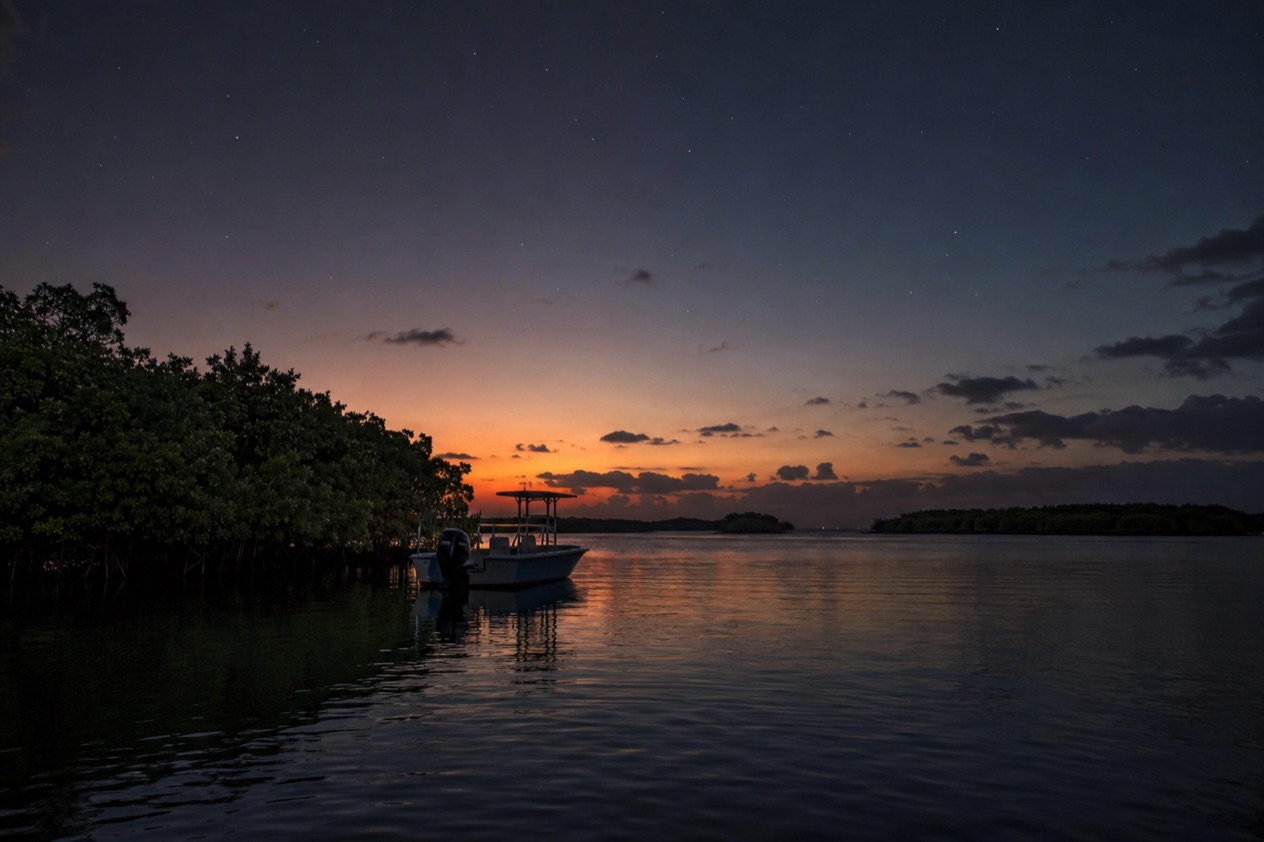
As the last light drains from the sky over the mangroves, the fishing boats of La Parguera idle back toward the docks and the water turns black and still. Then a paddle or a bow wave touches it, and a pale blue-green glow spreads along the edge, as if the surface had been brushed with cold fire. This is Bahía Fosforescente on Puerto Rico’s southwest coast, a night visit built around a small natural wonder and a lively fishing town.
Is visiting La Parguera Bioluminescent Bay worth it?
Yes, if you like quiet natural wonders more than big attractions, and it suits couples, families with curious older children, and anyone who wants one memorable evening on the southwest side of the island. The bay is known for its bioluminescent dinoflagellates, tiny organisms that give off colored light when the water around them is disturbed. The effect is subtle and best appreciated slowly, with your eyes adjusted to the dark.
Before choosing among La Parguera, Mosquito Bay and Laguna Grande, compare their current tour formats and water-access rules. Mosquito Bay in Vieques and Laguna Grande near Fajardo sit on the east side of Puerto Rico.
La Parguera is a living town in the dry southwest, with fishing boats, waterfront restaurants, a lively evening scene and mangrove islets just offshore. You can have dinner, wander the seafront and then go out to the bay, all in one evening.
As with any natural light show, the glow is a chance, not a promise. It tends to be most striking on moonless nights and can look fainter under a bright moon or near artificial light. Go with patience and no expectations of fireworks, and the bay usually rewards you.
What to see at La Parguera Bioluminescent Bay
The glowing water
The star of the visit is the water itself. The dinoflagellates light up when something moves through them, so every ripple, every fish darting away and every drip from a hand or paddle leaves a bright trail. In the best conditions the wake behind a boat looks like a ribbon of pale light, and small flashes dance around it.
Give your eyes time. The first few minutes away from the town lights can seem underwhelming, and then the glow becomes more obvious as your vision adapts. Put away your phone, since a camera screen ruins your night vision and rarely captures what you see anyway.
Mangroves and the night sky
The bay is rimmed by mangroves, their roots tangled in dark channels that look like cutouts against the sky. Away from the streetlights, the stars often appear in surprising numbers, and the sound shifts from engines and music to the lap of water and the calls of night creatures in the roots. On a clear night it is as much a stargazing evening as a glow-in-the-water one.
Part of the pleasure is the contrast with the daytime landscape. This corner of the island is dry and sunburned, with cactus and scrub on the hills, so a lush, dark, shimmering lagoon feels like a different world after dusk.
The town of La Parguera
La Parguera belongs to Lajas, which is also a fishing town, and the harbor shows it. Small boats line the docks, pelicans perch on the pilings and open-air restaurants serve fried fish, seafood stews and cold beer to a mix of families and weekend visitors. After dark the waterfront gets lively, with music drifting from the bars and people strolling the seawall.
It is a good place to arrive early, eat something simple such as a whole fried snapper with tostones, and watch the light fade before heading out to the bay. The mood is relaxed and local rather than polished, which suits the evening well.
Hours, tickets and rules
Choose an operator and confirm its departure time, price, reservation and cancellation policies, boarding conditions and current bay rules before booking. The glow can only be seen once the sky has darkened, which means the visit sits comfortably after dinner or after a late afternoon on the coast. In the hours before, the town is the place to be, with its docks and restaurants.
Think of the bay as a natural area first and an attraction second. The organisms that make the light are delicate, and the mangroves around them are part of a protected, fragile coastal system. Treat the water gently, keep lights low and leave nothing behind, and follow any sign or instruction given by the people who run your outing.
Check the marine weather before your outing and follow the operator’s instructions.
How to get to La Parguera Bioluminescent Bay
La Parguera sits on the southwest coast, in the municipality of Lajas, and the bay is reached from the town’s waterfront. It is a destination for the southwest corner of the island, close to Cabo Rojo and within reach of Guánica, so it fits naturally into a trip along this coast rather than a quick side trip from San Juan.
For flying in, Rafael Hernández Airport in Aguadilla serves international destinations, but map the full drive to La Parguera before booking. Many visitors base themselves in the southwest for a night or two so they do not have to drive after dark on unfamiliar roads, and that is a sensible way to do it.
Once you are in La Parguera, the waterfront is compact and easy to read. The docks, restaurants and seawall are all in the same stretch, so you can park once, eat, wander and head out onto the water without moving around.
When to visit La Parguera Bioluminescent Bay
The best time of day is simply after dark, once the sky has gone black. The best nights are the moonless ones around the new moon, when the glow stands out most clearly. Nights near a full moon are still pleasant on the water, but the light from above can wash out the effect.
The bay glows throughout the year, so no month is off the table. Dry-season evenings, roughly from December to April, tend to bring more stable skies and drier air, which suits stargazing and comfort on the water. The wetter months, from about May to November, can bring showers and cloud cover that dim the night, though a dry hour between showers can still be magical.
Remember that the Atlantic hurricane season runs from June 1 to November 30, with most activity between mid-August and mid-October. If you travel in that window, follow the National Hurricane Center and local official alerts, because forecasts can change quickly and outings depend on conditions.
Local festivals can add color to a trip. The Kite Festival in Lajas is held in February or March, the Blue Marlin Fishing Festival comes in May, the Pineapple Festival takes place in May or June, and the Fiesta de San Pedro is celebrated in June. Festival weekends bring more people to the waterfront, so expect more energy in town and a busier evening.
Tips for your visit
- Wear dark, comfortable clothing and bring a light layer, since it can feel breezy on the water at night.
- Use mosquito repellent, especially near the mangroves, and apply sunscreen earlier in the day rather than just before you go out.
- Keep your phone and any flashlight off during the glow so your eyes can adapt to the dark.
- Bring a dry bag or a waterproof pouch for your valuables, since you will be near the water.
Plan on a relaxed evening rather than a rushed one. Arrive in the late afternoon, take a walk along the waterfront, have dinner and then go out when the sky is fully dark. Anyone traveling with children or anyone who may have trouble boarding should confirm the operator’s age and boarding rules before booking.
The daytime on this coast is worth filling too. Cabo Rojo has the red cliffs, the salt flats and the Los Morrillos Lighthouse, known as El Faro, standing high above the sea, along with beaches such as Playa Sucia and seafood restaurants in Joyuda.
Guánica State Forest, a subtropical dry forest, offers trails and rare birds. The Cabo Rojo National Wildlife Refuge is home to the endangered yellow-shouldered blackbird, and the Laguna Cartagena refuge sits in Lajas itself.
Good to know before you go
U.S. citizens need no passport and no visa to visit Puerto Rico, and the currency is the U.S. dollar. Use the same habits you would on the mainland at night: keep valuables close and stay aware of your surroundings in a dark, unfamiliar spot. Spanish and English are both official, and a few words of Spanish are always appreciated at the dock and in the restaurants.
Sources
- Wikipedia, La Parguera (https://en.wikipedia.org/wiki/La_Parguera), checked October 8, 2026
- Wikipedia, Cabo Rojo (https://en.wikipedia.org/wiki/Cabo_Rojo,_Puerto_Rico), checked October 8, 2026
- Wikipedia, Guánica State Forest (https://en.wikipedia.org/wiki/Guánica_State_Forest), checked October 8, 2026
- NOAA National Hurricane Center, Climatology (https://www.nhc.noaa.gov/climo/), checked October 8, 2026
To plan your stay
- Best Time to Visit Puerto Rico: Dry Season, Hurricane Season, Beaches and Festivals
- Where to Stay in Puerto Rico: San Juan, Rincon, Vieques and the Best Areas for Your Trip
- Getting Around Puerto Rico: Rental Cars, Tolls, Carros Publicos and Ferries to Culebra and Vieques
- Know Before You Go to Puerto Rico: ID, Money, Getting Around and Local Customs