
At a hotel desk in San Juan the clerk greets you in English, but a few streets away the woman at the bakery counter answers your order in quick, musical Spanish and smiles while you point at the pastry. Both moments are normal on the island. English is an official language alongside Spanish, though Spanish is what you hear in most daily life, so a little of it goes a long way.
Do they speak English in Puerto Rico?
Yes, English is understood in many places visitors go, but Spanish is the language most people speak at home, on the radio and in the street. Spanish and English are both official languages of the government, and Spanish predominates. Puerto Rico is a U.S. territory, and Puerto Ricans have been U.S. citizens since 1917, so English reaches the island through school, work, family ties on the mainland and television.
What that means for you depends on where you are standing. Expect the most English in the places built around visitors, and the least in neighborhood spots where locals eat lunch. Starting with a polite greeting and asking whether the other person speaks English is a considerate approach.
Where English is easy to find
Around San Juan’s main gateway, the airport, the big hotels and the busy streets of Old San Juan, you can usually manage fine in English. Staff at resorts, tour desks and many restaurants in the capital switch between languages without a thought, often within a single conversation. The same goes for the places that draw crowds, such as El Yunque and the forts of the San Juan National Historic Site, where visitors from the mainland are the norm.
Puerto Rico has longstanding ties with communities in New York, Orlando, Philadelphia, Miami, Tampa, Boston, Cleveland and Chicago. You will often meet someone who grew up between the two places and moves between languages easily. That makes a friendly chat at a bar or a beach kiosk more likely than you might expect.
Where Spanish takes over
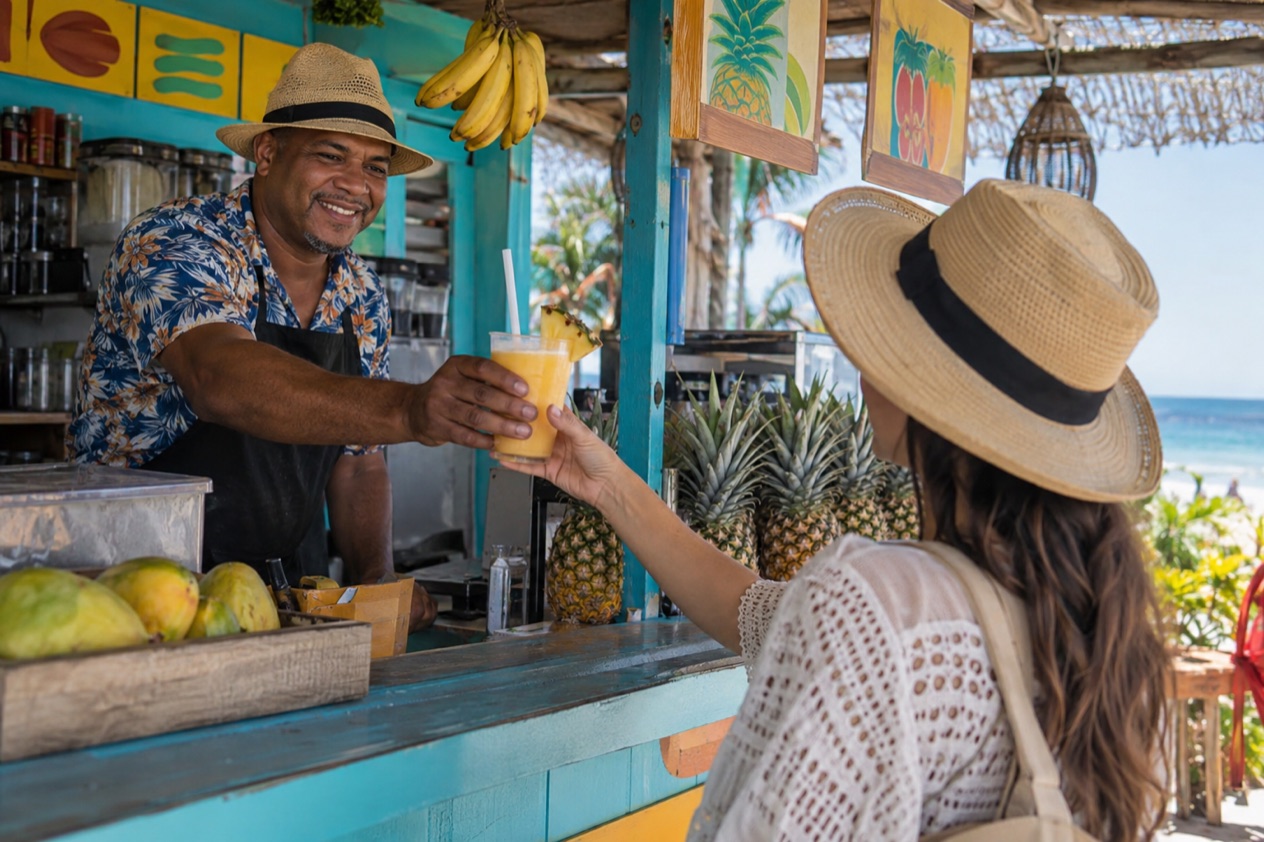
Drive into the central mountains, a coffee town, a fishing village on the west coast or a small-town plaza on a Sunday, and Spanish becomes the working language. Roadside kiosks, family-run bakeries, panaderías, and the lunch counters that serve the plate of the day are often Spanish only, though people tend to be patient and generous with gestures, smiles and a bit of pointing.
This is also where a handful of words pays off. A greeting, a thank you and the name of what you want to eat will change the tone of the exchange. A greeting, a thank you and the name of what you want to eat can make the exchange easier.
Reading menus and signs
Many menus in tourist areas are bilingual, but local spots may list dishes in Spanish with island vocabulary that even a Spanish student may not know. You may see jueyes (blue land crab), carrucho (conch), chillo (northern red snapper), guineo (banana) and habichuela (black turtle beans), along with arepa, mofongo and canoa. Mofongo is mashed fried plantain, often shaped into a mound and served with broth, meat or seafood.
The other dishes most visitors try include lechon asado (roast pork), pasteles (wrapped savory parcels), tostones (twice-fried plantain slices), alcapurrias (fritters), tembleque (a coconut pudding) and piraguas (shaved ice with fruit syrup). If a name is unfamiliar, ask the server what it is. Describing it is a common pleasure for people here, and you may end up with a better plate than the one you meant to order.
A few phrases that help
- Buenos días, buenas tardes and buenas noches for greeting anyone, from a shopkeeper to a bus driver.
- Por favor and gracias, which smooth almost every exchange.
- ¿Habla inglés? to ask politely whether someone speaks English.
- La cuenta, por favor when you are ready to pay at a restaurant.
- ¿Dónde está…? followed by a beach, a bathroom or a plaza, when you need directions.
Asking ¿Habla inglés? before launching into English is a courtesy that works anywhere. Keep your sentences short and your tone relaxed, and most conversations find their way.
Signs, announcements and paperwork
Road signs, government offices and local news broadcasts run mainly in Spanish, and that is true on the highway as much as in town. Place names often come from the Taíno people who lived here before the Spaniards, so you will pass through Arecibo, Bayamón, Caguas, Canóvanas, Guaynabo, Gurabo, Jayuya, Luquillo, Mayagüez, Moca and Naguabo, and the island of Vieques. Learning to say them aloud is a small, enjoyable step, and it helps when you ask for directions.
Spanish and English are both official languages, but local paperwork and services may still be primarily in Spanish. Puerto Rico is also in the Atlantic Time Zone, which is worth remembering when you call home. The language is the only real change of pace.
Is Spanish needed in Puerto Rico?
No, you do not need Spanish to enjoy a vacation in Puerto Rico, but it makes the trip warmer and opens doors outside the resort areas. You can book rooms, order meals and join tours in English in the places most visitors go. Away from them, a few words turn a polite transaction into a conversation.
Think of Spanish here as an upgrade rather than a requirement. Across Puerto Rico, you may move between places where English is common and places where Spanish predominates, so a few phrases can help. A traveler who knows a few phrases will feel at home in both.
The sound of Puerto Rican Spanish
If you have studied Spanish, the island version may surprise you at first. It is quick and relaxed, with consonants softened at the ends of words, and it resembles the accents of the Canary Islands and Andalusia in southern Spain. Puerto Ricans visiting Tenerife or Las Palmas are sometimes mistaken for Canarians, which tells you how close the music of the two accents can be.
Do not be discouraged if a classroom phrase does not land right away. Ask people to repeat more slowly, and most will happily do so. Many will answer your Spanish in English to be helpful, and you can politely keep going in Spanish if you want the practice.
Words with Taíno roots
Some of the words you already know come from the Taíno language of the Caribbean. Hamaca (hammock), huracán (hurricane) and tabaco (tobacco) all passed into Spanish and then into English. On the island, the same heritage lives on in the names of towns, rivers and mountains, so a drive across the map is also a small lesson in language history.
It is a fun detail to carry with you. When you swing in a hammock at a beach guesthouse or hear the word for a storm during hurricane season, you are using a piece of the island’s oldest vocabulary. The Atlantic hurricane season runs from June 1 to November 30, so the word is more than trivia, and travelers in those months should follow the National Hurricane Center and local official alerts.
When Spanish helps most
Spanish is most useful in the mountains and small towns, where coffee farms, roadside kiosks and family restaurants serve neighbors first and visitors second. The central mountains hold coffee towns with cooler air, and the west and south coasts have quiet stretches where daily life runs in Spanish. A friendly greeting at the door of a bakery or a fruit stand is how things begin.
It also helps at the table. Asking about a dish by name, or ordering a cup of mountain coffee in Spanish, tends to bring a smile and sometimes a second helping of conversation. You will hear about a cousin who lives in Orlando or a favorite beach nobody put on a map, and those moments are often the ones that stay with you.
Easy ways to get by without it
If Spanish is not your thing, plan around it with ease. Stay in San Juan or a resort area for the first days, take guided outings that run in English and keep a translation app on your phone for the moments in between. Many of the island’s best-known places, from El Yunque to the forts of Old San Juan, are used to visitors from the mainland.
Pointing, smiling and showing a picture of what you want are all perfectly good tools. Most people in Puerto Rico are warm toward visitors who make an effort, and the effort itself counts more than the grammar. A mistaken word usually gets a laugh and a correction, delivered kindly.
Good to know before you go
The U.S. dollar is the currency in Puerto Rico, and travelers from the mainland who hold U.S. citizenship can visit without a passport or a visa. Flights from the U.S. mainland into San Juan’s Luis Muñoz Marín International Airport are domestic, and Aguadilla and Ponce also have commercial flights.
Year round, Puerto Rico stays warm and humid, and it has a drier stretch from about December to April plus a wetter stretch from about May to November, so pack a light rain jacket for summer and fall. Beach and sea conditions change from day to day, so follow any flag, sign or lifeguard where one is present.
Sources
- Wikipedia, Puerto Rican Spanish (https://en.wikipedia.org/wiki/Puerto_Rican_Spanish), checked October 8, 2026
- Wikipedia, Puerto Rico (https://en.wikipedia.org/wiki/Puerto_Rico), checked October 8, 2026
- Wikipedia, Tourism in Puerto Rico (https://en.wikipedia.org/wiki/Tourism_in_Puerto_Rico), checked October 8, 2026
- NOAA National Hurricane Center, Climatology (https://www.nhc.noaa.gov/climo/), checked October 8, 2026
To plan your stay
- Best Time to Visit Puerto Rico: Dry Season, Hurricane Season, Beaches and Festivals
- Where to Stay in Puerto Rico: San Juan, Rincon, Vieques and the Best Areas for Your Trip
- Getting Around Puerto Rico: Rental Cars, Tolls, Carros Publicos and Ferries to Culebra and Vieques
- Know Before You Go to Puerto Rico: ID, Money, Getting Around and Local Customs