
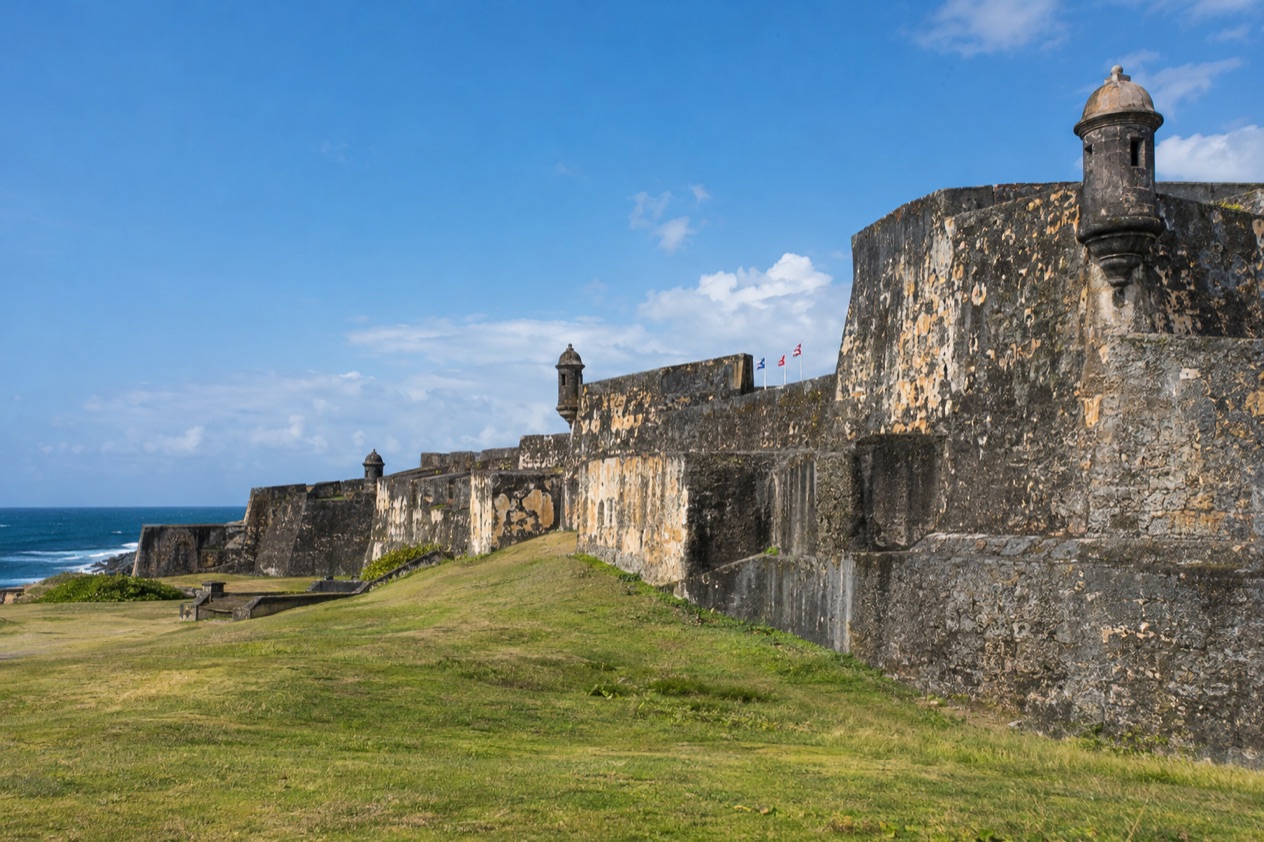
The trade wind comes straight off the Atlantic and flattens the grass on the esplanade, where kids run and kites dip over the old stone. Behind them the pale walls of Castillo San Cristobal climb in tiers, one defensive layer stacked on the next, and the whole hillside looks less like a building than a small stone mountain. It is the fort on the eastern edge of Old San Juan, a visit for anyone who wants to understand how this city was defended and to see it from the top of the walls.
Is visiting Castillo San Cristobal, San Juan worth it?
Yes, for anyone who likes history you can walk through, for families with kids who want room to explore, and for photographers who care about sea views and old stone. It is also a good fit if you only have one fort in your plans, because it offers a different experience from the one on the point.
The famous fort on the western tip, El Morro, is a tall, dramatic sea-facing battery, the image on most postcards. Built and expanded by Spain to defend San Juan from attack by land, San Cristobal uses layers of outworks, ditches, tunnels and gates to slow an army approaching from the east. You spend more time moving through the structure and less time standing in front of it.
Both forts belong to the same UNESCO World Heritage listing, which has covered them since 1983, and one entrance pass includes both. That makes the pairing easy, and the two feel like chapters of one story. San Cristobal tends to reward people who like wandering, peeking into passages and finding a quiet corner of wall with only the wind for company.
It also sits at the start of the walk into the old town. You can finish at the ramparts and be among the blue cobblestones and flat-roofed colonial houses within minutes, which turns a fort visit into the natural opening of a day in Old San Juan.
What to see at Castillo San Cristobal, San Juan
The outworks and the approach
Your first impression is of layers. Low walls, angled bastions and dry ditches sit in front of the main fortress, each one meant to force attackers into a killing ground before they ever reached the heart of the castle. From the esplanade you can read the design like a diagram, one line of defense behind another.
Take your time on the approach. The stone is pale and weathered, the grass is bright green, and the angles change as you walk, which makes this the best part of the visit for photographs. It is also a good place to understand why Spain called this one of the largest forts in its New World empire.
Tunnels, passages and sentry boxes
Inside, the fort turns into a maze of vaulted passages, stairways and dark rooms that link the different levels. The thick walls keep the air noticeably cooler than the sunny grounds, a welcome change on a hot, humid day. Look for the barracks, the storerooms and the old gun chambers, each one telling a little about daily life for the soldiers stationed here.
On the walls you will spot the garitas, the small domed sentry boxes that have become a symbol of Puerto Rico. They were built so a lookout could watch the sea and the land at once, and they make a perfect frame for a photo of the water beyond.
The upper decks and the view
At the top, the cannon platforms open onto wide views over the Atlantic, the roofs of Old San Juan and the coastline stretching east. The wind is strong up here and the light, especially in the morning or late afternoon, turns the stone gold. Old iron guns still point toward the water, and you can imagine how little warning a lookout would have had.
The view also explains the city’s geography. Old San Juan sits on a narrow island, and from these walls you can see why controlling the harbor and the eastern approach mattered so much. It is a good spot to pause, drink some water and let the history sink in before heading back down.
The parade grounds and the grassy esplanade
The open areas around the fort are part of the experience. The wide lawns are where locals fly kites, families picnic and visitors catch their breath between the stone chambers. On a breezy afternoon the sky fills with color, and the contrast between the old gray walls and the bright kites is one of the pleasures of this place.
If you have children, this is where they will burn off energy after the tunnels. The grounds also give you a long, clear view of the fort’s profile, so it is worth turning around once you are outside to see the whole structure at a glance.
Hours, tickets and rules
Entry works through a pass issued by the National Park Service, and a single standard pass covers both San Cristobal and El Morro. Children are admitted without a pass, and several national passes that many Americans already carry work here too. Check the park’s current operating hours before you go.
| Site or pass | Admission | Who it is for |
|---|---|---|
| San Cristobal and El Morro, standard pass | Entrance pass, valid for 24 hours, both forts included | Visitors over the age of 16 |
| Children under 16 | Free, no pass needed | Young visitors |
| America the Beautiful Annual Pass | $80 | U.S. citizens and residents |
| Non-Resident Annual Pass | $250 | Visitors who live outside the U.S. |
| Senior Pass | $20 annual, $80 lifetime | U.S. citizens and residents aged 62 and over |
| Military pass | Free annual pass | Current U.S. military members and their dependents |
| Access Pass | Free | U.S. citizens and residents with a permanent disability |
| 4th grade pass | Free, valid for one year | U.S. 4th graders |
| San Juan National Historic Site annual pass | $35, valid for one year | Up to four adults, children 15 and under free |
| Free entrance days in 2026 | Free | February 16, May 25, June 14, July 3-5, August 25, September 17, October 27, November 11 |
The park does not accept cash, so bring a card for any payment. Everyone over the age of 16 needs an entrance pass, including passengers arriving in a vehicle, and a standard pass lets you enter both fortifications during its validity.
How to get to Castillo San Cristobal, San Juan
From the airport it is the simplest kind of trip: the drive is about 8 miles and usually takes 15 to 20 minutes depending on traffic. That makes the castle one of the easier sights to reach straight after you land, and a good first stop if you have a late-morning arrival and a free afternoon.
Uber operates in Puerto Rico, while Lyft does not. If you arrive by ridehailing, the driver will pick you up and drop you off at Plaza Colon, and the entrance is a short stroll from there, about four to five minutes on foot. The approach through the old town is pleasant, so the walk feels like part of the visit rather than a chore.
Cruise passengers are in luck. Most piers are within a walk of the forts, between 10 and 15 minutes, which makes this an easy port-day stop. One exception is the Pan-American pier, which is about 3 miles away, and taxis are available there.
If you plan to see both forts, El Morro is a 15 minute walk up Calle Norzagaray from San Cristobal. The route follows the northern edge of the old town, with the sea close by on one side and historic buildings on the other, so many visitors treat it as a scenic stroll between the two stone giants. Old San Juan is best explored on foot or by car, since the free trolley that once served the district is no longer available.
For a GPS pin, the entrance sits at 18.28029 N, 66.06411 W. Walkers coming from the main plazas will find the way easy to follow, because the walls of the fort are visible from many points in the neighborhood.
When to visit Castillo San Cristobal, San Juan
Go early in the day or late in the afternoon. The walls are stone, the grounds are open, and the sun in San Juan can be fierce around midday, so the cooler hours bring both comfort and better light for photographs. Cruise days can bring more people, so the first part of the morning is usually the calmer moment.
Late afternoon has a different charm. The golden light on the pale walls is the most photogenic of the day, and the breeze on the upper decks takes the edge off the heat. If your plans allow, you can start with the tunnels in the heat of the day, when the shaded interior is welcome, and climb to the viewpoints once the sun softens.
The island is hot and humid all year, with a drier stretch from about December to April and a wetter one from about May to November. The drier months are the most comfortable for a long walk along open ramparts, while the wetter ones bring showers that often pass quickly. A rainy afternoon is a good reason to spend more time in the covered passages and rooms.
The park offers free entrance on a handful of days each year, and those dates tend to bring more visitors, especially around holiday weekends. The wind on the esplanade also makes spring and the cooler months ideal for kite flying, one of the real pleasures of the grounds.
Tips for your visit
Wear comfortable shoes with good grip. Bring a hat, sunscreen and a bottle of water, since the upper decks offer little shade and the sun feels strong even on breezy days.
Plan on a relaxed visit rather than a rushed one. There is a lot to look at, from the outworks to the tunnels and the decks, and the best moments often come when you stop and watch the sea. Many people pair the castle with El Morro on the same day, and since one pass covers both, that combination makes sense.
Near the fort, Old San Juan offers plenty of ways to extend the day. You can wander the narrow blue cobblestone streets, walk the promenade of Paseo de la Princesa along the southern wall, look at the Puerta de San Juan, the only surviving city gate, or step into San Jose Church, which reopened to visitors after years of renovation. The colorful neighborhood of La Perla sits just outside the old wall.
Families will find the grassy grounds a good place for kids to run, and children under the age limit enter free. Take a card with you, because the park does not accept cash.
Good to know before you go
Puerto Rico uses the U.S. dollar, and U.S. citizens need no passport and no visa to visit. The island stays on Atlantic Standard Time all year, so the clock never changes.
The Atlantic hurricane season runs from June 1 to November 30, with the peak around September 10, so if you visit in those months, follow the National Hurricane Center and local official alerts when you plan outdoor days.
Sources
- National Park Service, San Juan National Historic Site, Fees & Passes (https://www.nps.gov/saju/planyourvisit/fees.htm), checked October 8, 2026
- National Park Service, San Juan National Historic Site, Hours & Operating Seasons (https://www.nps.gov/saju/planyourvisit/hours.htm), checked October 8, 2026
- NPS San Juan National Historic Site, Directions and parking (https://www.nps.gov/saju/planyourvisit/directions.htm), checked October 8, 2026
- Wikipedia, Old San Juan (https://en.wikipedia.org/wiki/Old_San_Juan), checked October 8, 2026
- NOAA National Hurricane Center, Climatology (https://www.nhc.noaa.gov/climo/), checked October 8, 2026
To plan your stay
- Best Time to Visit Puerto Rico: Dry Season, Hurricane Season, Beaches and Festivals
- Where to Stay in Puerto Rico: San Juan, Rincon, Vieques and the Best Areas for Your Trip
- Getting Around Puerto Rico: Rental Cars, Tolls, Carros Publicos and Ferries to Culebra and Vieques
- Know Before You Go to Puerto Rico: ID, Money, Getting Around and Local Customs