
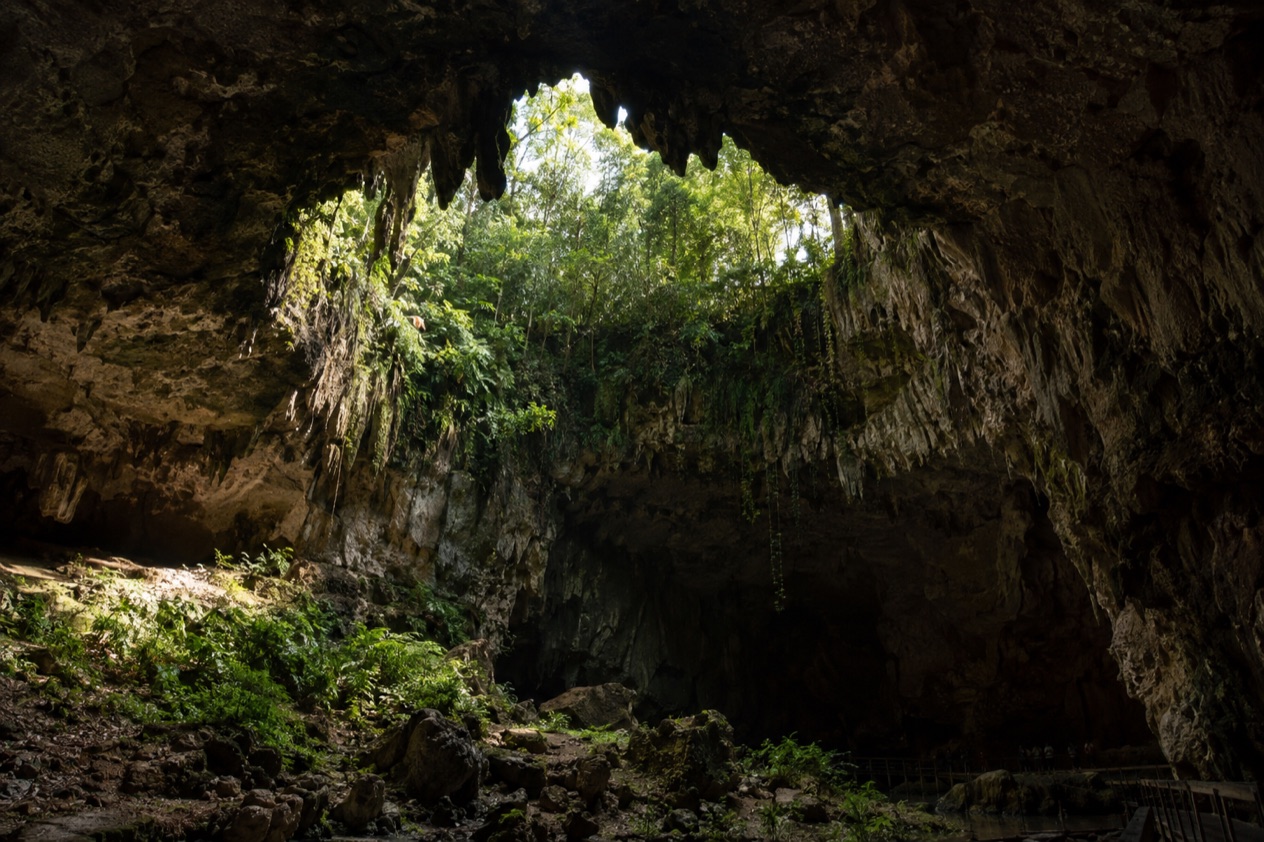
The road drops through a green hush of ferns, bamboo and dripping limestone, and the air turns cooler and wetter long before you see any rock. Then the forest opens onto a sinkhole so deep that the treetops at its bottom look like moss. Rio Camuy Cave Park is a guided visit into the karst heart of northwest Puerto Rico, where a river disappears underground and carves rooms the size of cathedrals.
Is visiting Rio Camuy Cave Park worth it?
Yes, if you like landscapes that feel older than anything else on the island, and it suits families, curious travelers and anyone who has had enough of beaches for a day. This is a place where you look up more than you look out. You come for the scale of the caverns, the damp cool air and the sense that a whole river is flowing somewhere beneath your feet.
What sets it apart from other caves nearby is that it is a national-park-style system rather than a single chamber. The Rio Camuy is one of the great underground rivers of the world, and the park lets you see its work from several angles: a walk through a lit cavern, a view down into a collapsed sinkhole, and the forest that grows on top of it all.
Cueva Ventana, a short way east near Arecibo, is a different experience. It is a cave mouth in a cliff with a view across a river valley, reached on a trail and visited on a guided tour. Rio Camuy is the one for underground drama, Ventana the one for the panorama.
It also fits easily into a day on the northwest coast. Beaches, surf towns and lighthouse parks sit within reach, so the caves can be the cool, shaded middle of a day that begins and ends in the sun. Wear shoes that grip, because limestone and moisture are a slippery pair.
What to see at Rio Camuy Cave Park
Cueva Clara, the walk-through cavern
Cueva Clara is the cave most people picture when they think of the park. You walk in under a vaulted entrance, and the guide leads you along a path through chambers hung with stalactites and rising stalagmites, some of them glistening where water still trickles. Ferns and roots creep down toward the daylight at the mouth, and the air smells of wet stone.
Look for the formations that look like draperies and columns, and for the bats that sometimes roost high in the dark corners. The cave was named for the clarity of its light and the way the entrance glows, and the path curves so that each turn gives a new view of the ceiling. Go slowly, because the floor can be slick.
Tres Pueblos sinkhole
The Tres Pueblos sinkhole is the park’s most dramatic view, a vast circular shaft where the roof of a cavern collapsed long ago. You look down from a platform at a bowl of jungle, with the underground river running somewhere far below. The name refers to the three towns whose lands meet nearby.
Birds swoop across the opening, and vines hang down the walls in long green ropes. It is the best place to understand how this landscape works: rain falls, sinks into the limestone, dissolves it and eventually takes the roof down. Bring a camera, but expect the scale to defeat it.
Spiral Sinkhole and the forest road
The Spiral Sinkhole is a second great pit, smaller than Tres Pueblos but just as deep, with a viewing spot at its rim. Between the main stops, the route winds through thick tropical forest, and that ride or walk is part of the visit. You pass bamboo groves, tree ferns and giant leaves that drip after every shower.
Listen for coquí frogs and birds calling from the canopy. Even if the underground rooms were not there, the forest would make the trip worthwhile, and it is a good reminder that the caves are part of a living ecosystem rather than a museum.
Cueva Ventana, the cave with a window
A short drive east, Cueva Ventana is a large cave set atop a limestone cliff in Arecibo, looking out over the valley of the Rio Grande de Arecibo. Its opening frames the view like a window, which is where the name comes from. It is popular with both Puerto Ricans and visitors, and scenes from Wizards of Waverly Place: The Movie, Treasure Island and Runner, Runner were filmed inside.
The cave is visible from PR-123, but you reach it on a trail that starts beside a Puma Energy gas station on PR-10. A boardwalk leads the first stretch, and a small parking lot sits on a plateau behind the station. Late afternoon light through the opening is the moment photographers wait for.
Hours, tickets and rules
Cueva Ventana, the nearby cave, is also a guided visit, and its admission includes the safety equipment you need for the tour. Its nightly tours run only on certain evenings, which makes it an easy add-on to a northwest itinerary.
| Site | Open | Admission |
|---|---|---|
| Cueva Ventana (Arecibo) | Nightly tours on Wednesdays and Thursdays | Includes necessary safety equipment for a 45-minute guided tour |
Cueva Ventana and the land around it are privately owned, and you reach it by the trail that begins at the gas station on PR-10 rather than by any other route. Visitor numbers there are greatest on Saturdays and Sundays, from early morning until an hour before nightfall.
How to get to Rio Camuy Cave Park
The park lies in the limestone hills of the northwest, inland from the Atlantic coast between Arecibo and the towns toward Isabela. Arecibo’s small airport, Antonio (Nery) Juarbe Pol, has no commercial airline flights, so visitors arrive by road from the larger airports of the island. The north coast highway, PR-10, passes through Arecibo and is the road that leads to Cueva Ventana.
Isabela is a handy base on the western end of the area. It sits on the northwestern coast, west of Quebradillas and east of Aguadilla and Moca, and offers beaches, surf and a gentle town atmosphere in the evening. Arecibo, the largest municipality on the island by area, is a good base to the east, with a lighthouse park and the sites where the Arecibo Observatory once stood.
Plan the cave visit as a half-day outing within a longer coastal route. The surrounding towns have their own character: Isabela is known as the Garden of the Northwest for its wildflowers, and as the Town of Leaf Cheeses for a fresh white cheese wrapped in banana leaves. Stopping for a plate of it or a coastal lunch makes a natural pairing with the caves.
When to visit Rio Camuy Cave Park
Go early in the day. Caves stay cool whatever the heat outside, but the walk through the forest and between the stops is warm and humid, and morning light is softer on the sinkholes. Arriving early also keeps you ahead of the weekend crowds, which at nearby Cueva Ventana peak on Saturdays and Sundays.
The drier season, roughly December to April, gives the most comfortable footing, since the limestone stays less slippery and the forest paths are less muddy. The wetter months bring afternoon downpours that can turn the trails slick, though the caves themselves feel dramatic with the sound of dripping water. A midweek morning in any season is the quietest option.
The Atlantic hurricane season runs from June 1 to November 30, with its peak around September 10. Heavy rain from a tropical system can affect the caves and the roads leading to them, so in those months follow the National Hurricane Center and local official alerts before you plan a day outdoors. For Cueva Ventana, the nightly tours on Wednesdays and Thursdays give you an evening alternative to a daytime visit.
Tips for your visit
Bring shoes with good grip, a light rain jacket and a bottle of water. The caves are damp, the paths can be uneven, and you will want your hands free for the railings. A small camera or phone is enough, and a thin layer helps because the air underground feels cooler than the forest outside.
Plan a half day for the park, and give yourself a second half day for the area. Families with older children will enjoy the sinkholes and the cavern, while anyone with limited mobility should think about the stairs and slippery stretches that caves tend to have.
Combine the caves with something on the coast. Jobos Beach and Montones Beach in Isabela are well known, and the Guajataca Tunnel and El Pozo Brujo are among the town’s main attractions.
Arecibo has its lighthouse park at Punta Los Morrillos, built in 1898 and still in use, and Cueva del Indio, an archeological site where Taino drawings can be found. Isabela’s coastal cliffs are also a recognized nesting area for seabirds, so bring binoculars if you like birds.
At Cueva Ventana, leave your car in the small lot on the plateau behind the gas station and follow the boardwalk to the trail. One caution on the coast: Pozo del Obispo Beach in Arecibo is considered dangerous, and wherever you swim, conditions change from day to day and beach to beach, so follow any flag, sign or lifeguard you find.
Good to know before you go
Puerto Rico uses the U.S. dollar, and U.S. citizens need no passport and no visa. A few words of Spanish go a long way in the small towns around the caves.
The hurricane season runs from June 1 to November 30, so heavy rain is a real possibility in those months, and a wet day is a good reason to swap a beach plan for the caves.
Sources
- Wikipedia, Río Camuy Cave Park (https://en.wikipedia.org/wiki/Camuy_Caves), checked October 8, 2026
- Wikipedia, Arecibo (https://en.wikipedia.org/wiki/Arecibo,_Puerto_Rico), checked October 8, 2026
- Wikipedia, Cueva Ventana (https://en.wikipedia.org/wiki/Cueva_Ventana), checked October 8, 2026
- Wikipedia, Isabela (https://en.wikipedia.org/wiki/Isabela,_Puerto_Rico), checked October 8, 2026
- NOAA National Hurricane Center, Climatology (https://www.nhc.noaa.gov/climo/), checked October 8, 2026
To plan your stay
- Best Time to Visit Puerto Rico: Dry Season, Hurricane Season, Beaches and Festivals
- Where to Stay in Puerto Rico: San Juan, Rincon, Vieques and the Best Areas for Your Trip
- Getting Around Puerto Rico: Rental Cars, Tolls, Carros Publicos and Ferries to Culebra and Vieques
- Know Before You Go to Puerto Rico: ID, Money, Getting Around and Local Customs