
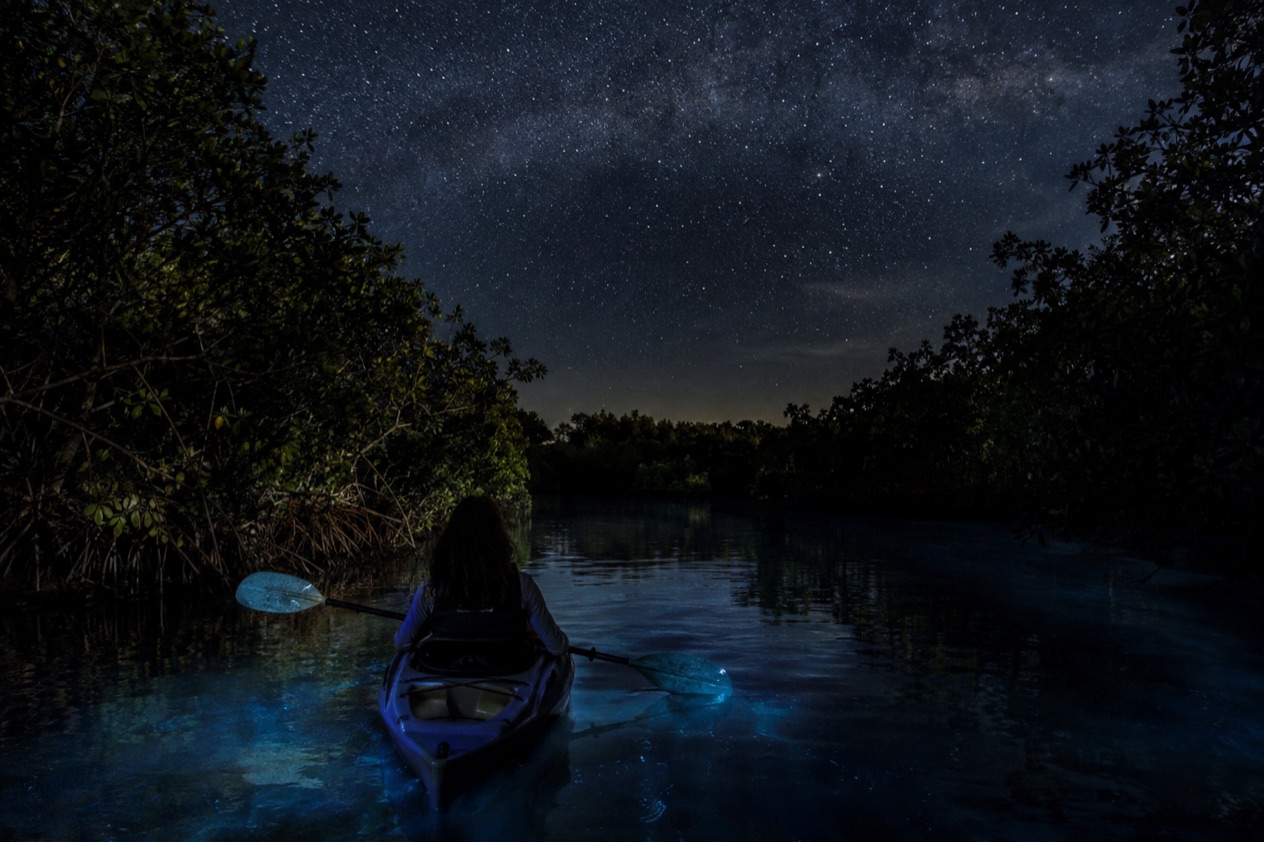
The paddle dips, and the water around it lights up in a pale blue-green streak, as if someone had switched on a lamp under the surface. Fish dart past as glowing comets, and the drops falling from your blade look like sparks. Puerto Rico has three bays where this happens, on the east coast near Fajardo, on the island of Vieques and on the southwest coast at La Parguera, and each one offers a different kind of night on the water.
Where are the bioluminescent bays in Puerto Rico?
Three bioluminescent bays lie in Puerto Rico: Mosquito Bay, on Vieques, plus Laguna Grande by Fajardo at the main island’s northeast corner, and the Phosphorescent Bay in the southwest at La Parguera. The light comes from tiny dinoflagellates, single-celled organisms that flash when the water is disturbed. A paddle stroke, a fish or a hand trailing over the side is enough to set them off.
They glow all year, so the choice between them has more to do with the kind of trip you are building than with the calendar. One means a ferry or a short flight to an island, one fits into a stay near the rainforest and the marinas of the east, and one sits in a quiet fishing village on the Caribbean side.
Mosquito Bay, Vieques
Guinness World Records named Mosquito Bay, known too as Puerto Mosquito, the brightest bioluminescent bay on the planet in 2006, and travelers still cross the water for it above all others. You get there by kayak or by electric boat, always with a guide. When you dip a hand in, your fingers come out trailing light, and on a very dark night a fish passing beneath the kayak can leave a glowing outline behind it.
You can get to Vieques by taking a public ferry from Ceiba or by flying in on a small plane. Flights leave from San Juan’s two airports in about twenty to thirty minutes, and from Ceiba in about five.
Most visitors base themselves in Esperanza, the laid-back waterfront village with guesthouses and open-air restaurants, or in Isabel Segunda, the ferry town on the north coast. Start your stay with a day at Sun Bay, Red Beach and Blue Beach, which stand as the top picks, and wild horses might stroll by you on the road.
Laguna Grande, Fajardo
Most evenings, once night has settled in, guided kayak trips depart from the Las Cabezas de San Juan Nature Reserve close to Fajardo and make their way to Laguna Grande. The route winds through a mangrove channel before opening onto the lagoon, so part of the experience is gliding through dark tunnels of roots with only the sound of paddles and the night insects around you.
It is the easiest of the three to combine with a regular trip, since Fajardo is a short drive from San Juan and from the food kiosks of Luquillo, close to the turnoff for El Yunque. A lot of travelers pass a day in Fajardo on the water, taking a catamaran or sailing trip out to Icacos, a tiny uninhabited cay with white sand and snorkeling, then paddle once evening comes. It suits first-timers who want the glow without an island crossing.
The Phosphorescent Bay at La Parguera
La Parguera is famous for Bahía Fosforescente, where the dinoflagellates give off colored light whenever the water moves. The village is in Lajas, in the southwest, and it has the feel of a working fishing town, with houses on stilts, docks, and small restaurants serving the day’s catch. After the sun goes down the waterfront wakes up, and the bay is the evening’s quiet main event.
Laguna Cartagena National Wildlife Refuge, a protected area, is also in Lajas, and the town’s calendar includes the Pineapple Festival in May or June, a Kite Festival in February or March, the Blue Marlin Fishing Festival in May and the Fiesta de San Pedro in June. If one of them lines up with your dates, you can fill the day with music and local food before heading out on the water. The southwest also tends to be drier than the north and east, which is a plus when you are planning an outdoor evening.
When is the best time to see bioluminescent bays in Puerto Rico?
The best time is a moonless night, and the closer to a new moon you can book, the brighter the show is likely to be. The glow is strongest on dark nights at both Mosquito Bay and Laguna Grande, because moonlight and the lights of the shore wash out the faint blue light of the dinoflagellates. The bays themselves glow throughout the year, so the moon matters more than the month.
A bright full moon does not cancel the experience, but it changes it. You see more of the bay, the mangroves and your companions, and less of the glow. Many people find the shimmering water and a few bursts of light still worth the trip, yet if the glow is the whole reason you are going, plan around the dark of the moon first and everything else second.
Planning around the moon
Look up the moon calendar for your dates before you book flights, ferries or rooms. If you have a flexible week, build it around the new moon and keep the evening before and after as backups, because a cloudy sky or a rainy evening can change a plan quickly. Booking the tour for the first part of your stay leaves room to try again on another night.
On Vieques, that approach pairs well with beach days. You can spend afternoons at Sun Bay or on the long, undeveloped sands that the former Navy lands left behind, then go out at night. On the main island, a Fajardo evening slots neatly after a day at Luquillo or on a boat out to the cays.
Weather and the hurricane season
Puerto Rico is marked by heat and moisture all year, and the calendar there is divided into about two seasons: one that is drier from about December to April and one that is wetter from about May to November. Showers are common in the wetter months, and they can cancel a night on the water or leave you paddling under a gray sky. The north and east are wetter than the south and west, which can matter if you have only one evening to spare.
The Atlantic hurricane season runs from June 1 to November 30, with the peak on September 10 and most activity between mid-August and mid-October. A trip in those months can be wonderful, but plans on the water depend on the forecast. Keep an eye on the National Hurricane Center and on alerts from local officials, and when a storm is on the way, leave your ferry or flight to Vieques flexible. Outside those dates, the season is not a factor.
Which bay for which trip
If you want the most famous glow and have a few days to spend on an island, choose Vieques. If you are staying on the northeast side, or you would rather not take a ferry, Laguna Grande fits an ordinary evening. If you are traveling the southwest coast, La Parguera gives a village atmosphere that the other two do not.
Seeing more than one is easy for a longer stay, and the three bays feel different enough that each is worth the visit. The mangrove channel of Laguna Grande, the open and dark water of Mosquito Bay and the harbor lights of La Parguera give you three distinct nights rather than the same one repeated.
Can you swim in a bioluminescent bay in Puerto Rico?
The ways in that guides run are by kayak at Laguna Grande and by kayak or electric boat at Mosquito Bay, so the glow is something you paddle through or glide across rather than something you dive into. Kayaking is permitted in the Vieques bay and can be arranged through local vendors. For anything beyond that, follow your guide’s instructions and any signs posted at the water.
What you do get is contact with the light. Trail a hand over the side of the kayak, and the water streams off your fingers in glowing threads. Splash gently, and a ring of sparks spreads out from the paddle. The experience is as much about watching the water react as about being in it.
On the water: kayak or electric boat
A kayak puts you close to the surface and makes every stroke visible. It suits people who like to be active, and it is quiet, which helps the eyes adjust to the dark. Conditions vary by night, since wind and chop affect how easy the paddling is, and a guide leading the group keeps everyone together in the dark.
An electric boat on Vieques is the gentler way to see Mosquito Bay. It moves silently, which keeps the night calm, and it suits travelers who would rather sit back than paddle, or who are traveling with older relatives. You still see the glow trail behind the hull and the fish that flash beside it.
What the night is like
Expect a few minutes of adjusting. Your eyes need time to adapt to the dark, and the light often looks faint at first before it grows more vivid. Guides usually ask people to keep phones and flashlights off, which makes sense, since any bright light spoils the glow for everyone on the water.
Photographs rarely capture it, and phone cameras especially struggle in the dark. Most people give up on pictures after a few tries and simply watch. Drones are prohibited on the Vieques refuge, which protects the quiet of the island, so leave yours at home if you are heading there.
Protecting the glow
The dinoflagellates are delicate, and their numbers depend on the health of the mangroves and the water around them. That is the reason the visits are organized and guided, and it is why the bays are described under an ecotourism banner. Treat the water gently, follow the guide, and keep the shoreline as you found it.
Vieques also has a wildlife refuge with no entrance fee, open to the public year-round, though a large part of the eastern side is closed because of unexploded ordnance left from the Navy years. Stay on the open areas and the marked beaches, and treat the closures as firm.
Good to know before you go
For U.S. citizens, a trip to Puerto Rico calls for neither a passport nor a visa, and the currency in use there is the U.S. dollar. Because Spanish and English are both official there and mainland flights are treated as domestic, in a fishing village like La Parguera it helps to know a few words of Spanish.
Mosquito Bay is reached by ferry from Ceiba or a short flight, so allow time to get there and back, especially if you plan a night tour. Wherever you go, a quick check of the moon and the forecast is the best preparation.
Sources
- U.S. Fish and Wildlife Service, Vieques National Wildlife Refuge (https://www.fws.gov/refuge/vieques), checked October 8, 2026
- Wikipedia, Vieques (https://en.wikipedia.org/wiki/Vieques,_Puerto_Rico), checked October 8, 2026
- Wikipedia, La Parguera (https://en.wikipedia.org/wiki/La_Parguera), checked October 8, 2026
- Wikipedia, Fajardo (https://en.wikipedia.org/wiki/Fajardo,_Puerto_Rico), checked October 8, 2026
- NOAA National Hurricane Center, Climatology (https://www.nhc.noaa.gov/climo/), checked October 8, 2026
To plan your stay
- Best Time to Visit Puerto Rico: Dry Season, Hurricane Season, Beaches and Festivals
- Where to Stay in Puerto Rico: San Juan, Rincon, Vieques and the Best Areas for Your Trip
- Getting Around Puerto Rico: Rental Cars, Tolls, Carros Publicos and Ferries to Culebra and Vieques
- Know Before You Go to Puerto Rico: ID, Money, Getting Around and Local Customs