
Early in the morning in a Yucatecan plaza, church bells mix with the smell of corn tortillas and slow-roasted pork, and the limestone facades turn the color of honey. Under the town squares, a network of flooded caves waits behind the next stand of jungle. The Yucatan Peninsula is a place for travelers who like to alternate ancient stones, cool sinkhole swims, walled colonial towns and long, unhurried meals.
What are the best things to do in the Yucatan Peninsula?
The best things to do here are to walk through Maya cities, swim in a cenote, wander the colonial streets of Mérida and Campeche, and eat the regional food at every meal.
- Chichén Itzá, for the stepped pyramid that became one of the New Seven Wonders of the World.
- Mérida, for its plazas, mansions and the evening life of the Paseo de Montejo.
- Campeche’s walled old town, for pastel streets built to fend off pirates.
- A cenote swim, because the peninsula’s underground rivers surface as green and blue pools.
- Uxmal and the Puuc hills, for carved stone facades set in quiet jungle.
- Valladolid, for a colonial town with a cenote almost in its center.
- Cochinita pibil, panuchos and lime soup, the dishes that define the table here.
- The Gulf coast at Progreso, for a beach day close to Mérida.
Sights and landmarks in the Yucatan Peninsula
The peninsula is the historical heartland of the Maya, and its landmarks span stone cities, Spanish cathedrals and fortified ports.
Chichén Itzá
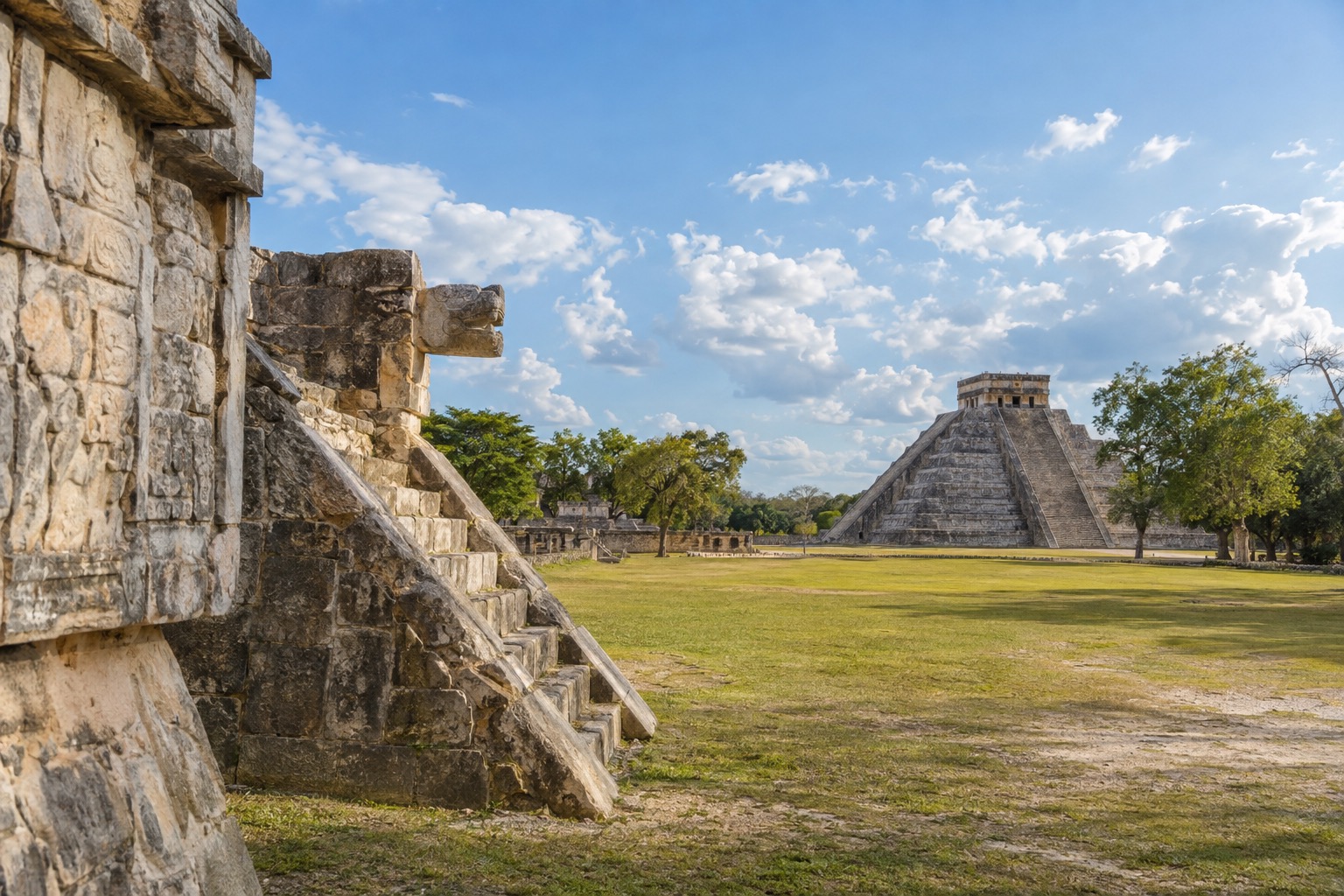
The great stepped pyramid known as El Castillo, or the Temple of Kukulcán, rises from a wide clearing and looks even more precise in person than in photos. Around it stand a huge ball court, an observatory and long colonnades of carved stone. The site has been on the UNESCO World Heritage List since 1988, and the pyramid was named one of the New Seven Wonders in a worldwide public vote in 2007.
You walk the grounds and look up at the pyramid rather than climbing it, since the stairway has been closed to visitors since a fatal fall. Get there when the gates open, before tour buses arrive and before the sun climbs, and leave time for the ball court, where a clap echoes in odd ways. Vendors along the paths sell carved wooden jaguars and woven hammocks.
Mérida
Mérida was built on the Maya city of T’ho, and the Cathedral of San Ildefonso on the main square, finished at the end of the 16th century, is among the oldest cathedrals on the American mainland. The Plaza Grande around it is shaded by laurel trees and lined with arcaded government buildings. Locals sit on the white love seats called confidentes.
North of the center, the Paseo de Montejo is a wide boulevard of grand early-20th-century mansions, including the Twin Houses, Las Casas Gemelas. It is best walked in the cool of the morning or at dusk. The Gran Museo del Mundo Maya, on the edge of town, gives the context for every ruin you will visit, with ceramics, jade and carved stelae.
Campeche’s walled old town
Campeche is a compact port ringed by a hexagonal wall with bastions and gates, built to hold off pirates who raided the coast for years. Inside, the houses are painted ochre, rose, turquoise and yellow, and the streets are quiet and walkable. The historic center joined the UNESCO list in 1999, and a section of the wall was later torn down to open the view of the sea.
Two hilltop forts watch over the town. The Fuerte de San José holds old boats and weapons, and the Fuerte de San Miguel is now an archaeology museum with pre-Hispanic pieces. Walk the ramparts late in the afternoon, when the light softens, then stay for the Gulf-front promenade at sunset.
Ek Balam, Uxmal and smaller sites
Ek Balam, near Valladolid, is a smaller city with a tall acropolis covered in carved stucco figures. It is quieter than Chichén Itzá, and the stonework is remarkably detailed. Uxmal, south of Mérida, is a graceful city with a rounded Pyramid of the Magician and a long, ornate quadrangle in the Puuc style.
Dzibilchaltún, on the road to the Gulf coast, is an older city whose long causeway lines up with the rising sun at the equinoxes. It is an easy first stop for a ruin visit near Mérida.
| Site | Open | Admission |
|---|---|---|
| Chichén Itzá | Daily, 8:00 a.m. to 4:00 p.m. | $105 pesos federal fee plus a state fee of $592 pesos for foreign visitors ($205 pesos for Mexican nationals). Free on Sundays for Mexican nationals and foreign residents of Mexico, with exemptions for children under 13, visitors 60 and older, people with disabilities, and Mexican teachers and students with ID |
| Ek Balam | Daily, 8:00 a.m. to 4:30 p.m. (last entry 4:00 p.m.) | $210 pesos, $105 pesos for Mexican nationals and foreign residents of Mexico |
| Dzibilchaltún | Daily, 8:00 a.m. to 4:00 p.m. | $105 pesos federal fee plus a state fee of $223 pesos for foreign visitors ($90 pesos for nationals) |
| Museum | Open |
|---|---|
| Gran Museo del Mundo Maya, Mérida | Wednesday to Monday, 9:00 a.m. to 5:00 p.m. Closed Tuesdays |
Beaches and outdoor things to do in the Yucatan Peninsula
The outdoors here means cenotes first, then two very different coasts: the calm-looking Gulf side and the Caribbean side with its reefs and islands.
Cenotes
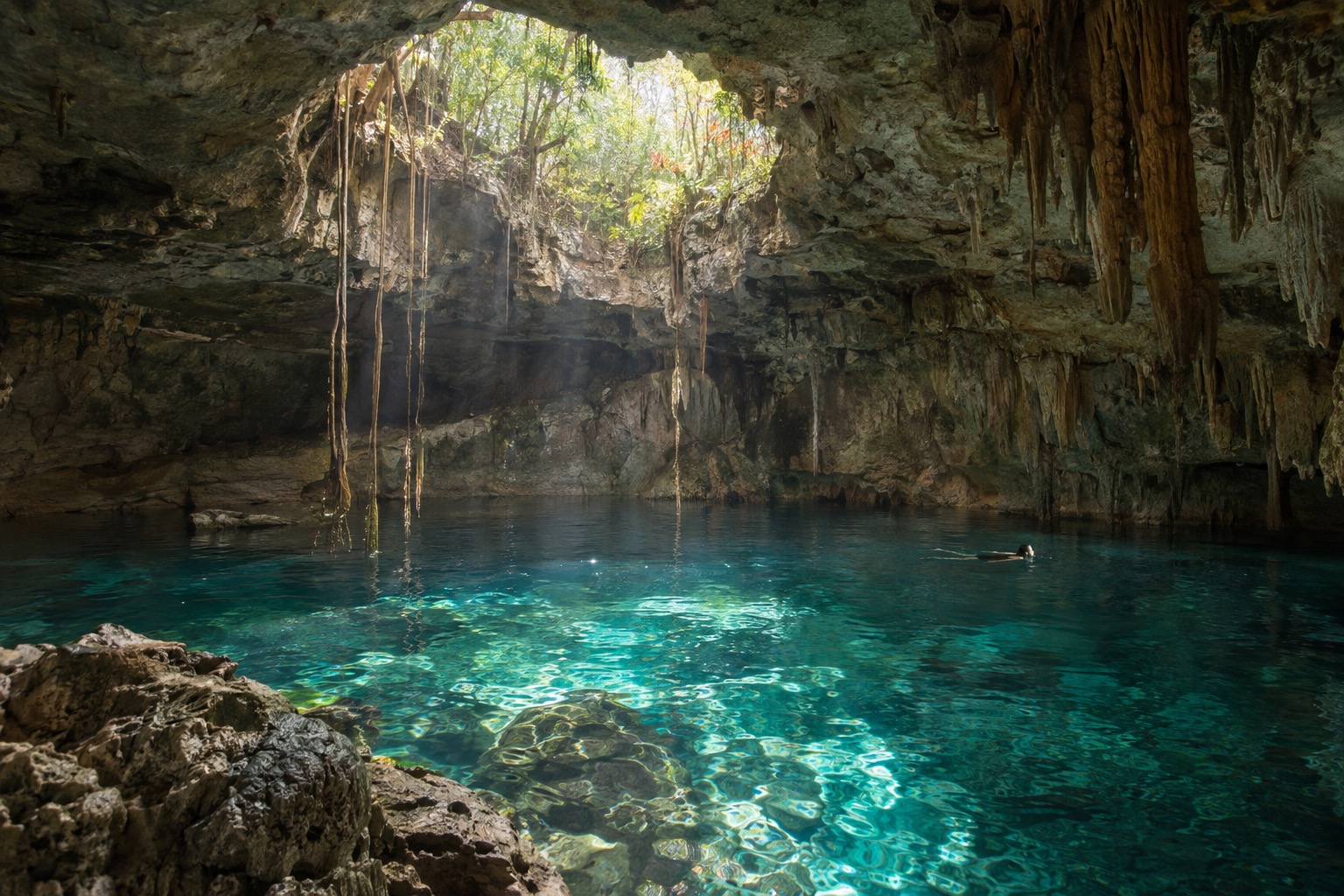
The peninsula is a flat limestone shelf with almost no surface rivers. Rain drains straight through the rock into underground rivers and caves, and where the roof collapses you get a cenote. Counts depend on the definition, but there are thousands across the peninsula. Some are open pools under a hole in the rock, others are caverns lit by a single shaft of sunlight with roots hanging down to the water.
Cenote Zací sits close to the heart of Valladolid, a landscaped freshwater sinkhole open for swimming, with a restaurant and artisan vendors beside it. It makes an easy cool-down after walking the old town. Many other cenotes are scattered along country roads between villages, and each is set up differently, so ask at the entrance what is allowed.
The Gulf coast at Progreso
Progreso is the closest beach to Mérida, and on weekends Mérida families pour in for fried fish, cold beer and a long stroll on the malecon. The water is shallow and the shore stays flat for a long way out. Cruise ships dock at a very long pier because the shelf keeps large vessels far from shore.
The Gulf can turn choppy after a northern wind, so check the beach flags before going in. Weekday mornings are calmer, and the seafood restaurants along the front are good for lunch.
The Caribbean coast and islands
On the eastern edge, white sand and turquoise water run from Cancún south through Playa del Carmen and Tulum, where beaches sit below ruins on the cliff. Offshore, Isla Mujeres has a relaxed town and calm-looking bays, and Cozumel is known for diving and snorkeling along a long reef. Holbox, farther north, is a car-free island of sandy streets and hammocks.
Sargassum can pile up on some of these beaches, depending on the season and the winds, so the exact stretch of sand matters. The Atlantic hurricane season, which governs the whole peninsula, runs from June 1 to November 30.
Lagoons, flamingos and wild coast
The northern and western shores hold shallow lagoons and mangroves where flamingos feed, with Celestún and Río Lagartos the best-known places to see them by boat. Boat trips glide past pink flocks, herons and mangrove tunnels, and the pink color is most striking in the low light of early morning.
Both are quiet fishing towns, so plan on a simple seafood lunch afterward and a slow drive back. They suit travelers who like birds and open water more than resort beaches, and a hat and sunscreen matter on a boat with no shade.
Day trips in the Yucatan Peninsula
The classic day trips radiate from Mérida: Uxmal to the south, Valladolid and its ruins to the east, and the Gulf coast to the north.
Uxmal and the Puuc hills
Uxmal lies about 39 miles south of Mérida, reached by a highway through low jungle and small villages. It is a city of long, carved facades, with latticework and masks of the rain god Chaac repeating along the stone. The Pyramid of the Magician has an unusual oval shape, and the quadrangle beside it is a calm place to sit.
Go early or late in the day, when the stone is warm in color and the grounds quieter. It suits travelers who like architecture, and it pairs well with a village lunch in the Puuc hills before heading back.
Valladolid, Zací and Ek Balam
Valladolid is a Pueblo Mágico, a title it earned in 2012. It sits east of Chichén Itzá and well east of Mérida, so it makes a natural stop between the two coasts. The center has a shaded square, a colonial church and the Convento de San Bernardino de Siena, reached by the Calzada de los Frailes, a preserved colonial avenue.
Spend the morning at Ek Balam, then come back for lunch and a swim at Cenote Zací, which is almost in town. Late afternoon is the best time to walk the Calzada de los Frailes. It suits couples and anyone who likes to wander on foot.
Progreso, Dzibilchaltún and Chicxulub
Progreso is about 30 minutes north of Mérida by highway, so it works for a half day or a full one. On the way you pass Dzibilchaltún, where a long sacbé, a raised Maya road, leads to a small temple that is a quiet first look at Maya architecture.
Farther east along the coast, Chicxulub Puerto sits almost at the center of the buried crater left by the asteroid that ended the age of the dinosaurs. The town has opened a museum devoted to the impact. Plan a ruin in the morning, a fish lunch by the water and a walk on the malecon before the drive back. Smaller outings include the pastel streets of Izamal, the flamingo lagoon at Celestún and the old henequen haciendas that now serve as hotels and restaurants outside Mérida.
What to eat in the Yucatan Peninsula
Yucatecan food is its own cuisine, built on achiote, sour orange, habanero and slow cooking in pits and ovens. Cochinita pibil is the signature, pork marinated in achiote and sour orange, wrapped in banana leaf and roasted until it falls apart, then piled on tortillas with pickled red onion. Poc chuc is grilled pork with citrus, and sopa de lima is a bright chicken broth with lime and crisp tortilla strips. Panuchos and salbutes, fried tortillas topped with turkey or chicken, shredded cabbage and avocado, are standard snacks.
Markets are where you eat well and simply, with counters serving breakfast tamales, tacos and fresh juices. Mérida’s Lucas de Gálvez market is a good place to start. Order a glass of horchata or agua de chaya, and ask for the habanero salsa on the side. On the coast, order ceviche, grilled fish and fried octopus. For sweets, look for marquesitas, crisp rolled crepes filled with cheese and caramel, sold from street carts.
Things to do in the Yucatan Peninsula at night
Evenings in the peninsula’s old towns happen in the plazas, where families, musicians and food stands fill the squares once the day cools down. Mérida has the liveliest scene. Free concerts and dance nights are held in its squares and parks through the week, and couples dance the jarana, a regional folk dance, in their best clothes. Restaurants with courtyards stay busy late, and some serve mezcal and craft cocktails under string lights.
In Campeche, the evening walk along the walls and the sea promenade is the main event, and some towns offer a light and sound show on the fortifications. Valladolid is quieter, with a lit church, street tacos and a mezcal bar or two. On the Caribbean side, Playa del Carmen and Cancún have the beach clubs and late-night music.
Things to do in the Yucatan Peninsula with kids
Children usually like the peninsula best when the day has a swim, a boat or something to climb on or look at in it. Cenote Zací, right in Valladolid, makes a quick stop for a swim, and boat rides to spot flamingos at Celestún or Río Lagartos hold the attention of young kids. In Mérida, the plazas have ice cream sellers, horse-drawn carriage rides and the Maya museum. At Campeche, children enjoy running along the ramparts and looking at the old boats in the fort.
The heat and sun are the main thing to plan around, so schedule ruins for early morning, bring hats, water and sunscreen, and rest in the shade at midday. Ruins have little shade and long walks. Distances between towns are long, so keep drives short, and check the beach flags before kids go in the sea.
Good to know before you go
The peninsula covers three Mexican states, Yucatán, Campeche and Quintana Roo, and a rental car or a mix of buses and tours is the usual way to see it. Pesos are handy in small towns and markets.
Sargassum can affect Caribbean beaches in some seasons, and the Atlantic hurricane season runs from June 1 to November 30, so keep plans flexible if you travel in those months. Yucatec Maya is still widely spoken, and a few words of Spanish go a long way.
Sources
- EBSCO Research Starters (citing INEGI census data), confirmed by Geo-Mexico (geo-mexico.com), checked September 29, 2026
- National Geographic (reportage citant des chercheurs), Wikivoyage "Cenotes of the Yucatan", checked September 29, 2026
- common geographic knowledge
- common knowledge
- NOAA National Hurricane Center, "Tropical Cyclone Climatology", nhc.noaa.gov, checked September 29, 2026
- Wikipedia, "Chichen Itza" infobox, en.wikipedia.org, checked September 29, 2026 (secondary source; official UNESCO whc.unesco.org not reached that day, 403)
- Wikipedia, "Chichen Itza", en.wikipedia.org, checked September 29, 2026
- INAH, official for the Chichen Itza archaeological zone, inah.gob.mx/zonas/146-zona-arqueologica-de-chichen-itza, checked September 29, 2026
- INAH, inah.gob.mx/zonas-arqueologicas, checked September 29, 2026
- INAH, zonas-arqueologicas index listing, inah.gob.mx/zonas-arqueologicas, checked September 29, 2026
- Wikipedia, "Uxmal", en.wikipedia.org, checked September 29, 2026
- Wikipedia, "Merida, Yucatan", en.wikipedia.org, checked September 29, 2026 (source secondaire)
- Gran Museo del Mundo Maya (exploitant), granmuseodelmundomaya.com.mx, checked September 29, 2026
- Wikipedia, "Valladolid, Yucatan", en.wikipedia.org, checked September 29, 2026 (source secondaire)
- INAH, official for the Ek Balam archaeological zone, inah.gob.mx/zonas/21-zona-arqueologica-ek-balam, checked September 29, 2026
- Wikipedia, "Progreso, Yucatan", en.wikipedia.org, checked September 29, 2026 (source secondaire)
- Wikipedia, "Chicxulub crater", en.wikipedia.org, checked September 29, 2026 (source secondaire, citant Renne et al. 2013 et Schulte et al. 2010)
- Wikipedia, "Chicxulub Puerto", en.wikipedia.org, checked September 29, 2026 (source secondaire)
- INAH, official for the Dzibilchaltun archaeological zone, inah.gob.mx/zonas/zona-arqueologica-de-dzibilchaltun, checked September 29, 2026
- UNESCO World Heritage Centre, record 895, whc.unesco.org/en/list/895, checked September 29, 2026
- Wikipedia, "Campeche (city)", en.wikipedia.org, checked September 29, 2026 (source secondaire, citant l'UNESCO)