
The first thing that stops you at the Tottori Sand Dunes is the shift in scale. A coastline of pine and rooftops gives way to a long, pale ridge of sand, rippled by the wind into lines as fine as combed hair.
Beyond the crest lies the Sea of Japan, a landscape you rarely expect to find in this country of green mountains and rice paddies. This is a visit about open space, patterns in sand and a coast shaped over a very long time, reached from the city of Tottori in Tottori Prefecture.
Is visiting the Tottori Sand Dunes worth it?
Yes, if you like landscapes more than monuments, and especially if you are building a trip through the Chugoku region and want one stop that looks like nowhere else on the route. The dunes are not a temple, a castle or a museum. They are a place to stand, look and walk, and the pleasure comes from the scenery itself.
The scale is the first argument. The dunes stretch along the coast for 9 miles, which makes them the largest sand dunes in Japan. Their width is under 1.5 miles, so the sand forms a long ribbon between land and sea rather than a desert. That shape gives you a sense of a sweeping edge of the country, with the sand on one side and the water on the other.
What sets them apart from the other dramatic coasts of western Japan is the origin story. This is not a beach in the usual sense. The sand was carried down from the Chugoku Mountains by the Sendai River and shaped by wind over a span of 100,000 years.
You are looking at mountains that have been ground down, moved to the sea and piled up again by the weather. The dunes also belong to the San’in Kaigan Geopark, a UNESCO Global Geopark, so a visit fits naturally into a wider journey along a coast chosen for its geology.
It suits photographers, who find endless graphic lines in the ripples and the shadows. It is less of a fit if your idea of a good day is a list of named sights with a story at each stop, since here the story is the ground under your feet.
What to see at the Tottori Sand Dunes
The dunes are one continuous landscape, but a few parts of it deserve to be looked at separately: the sand itself, the Hamasaka area, the river that made it all and the line where sand meets sea.
The Hamasaka Dunes area
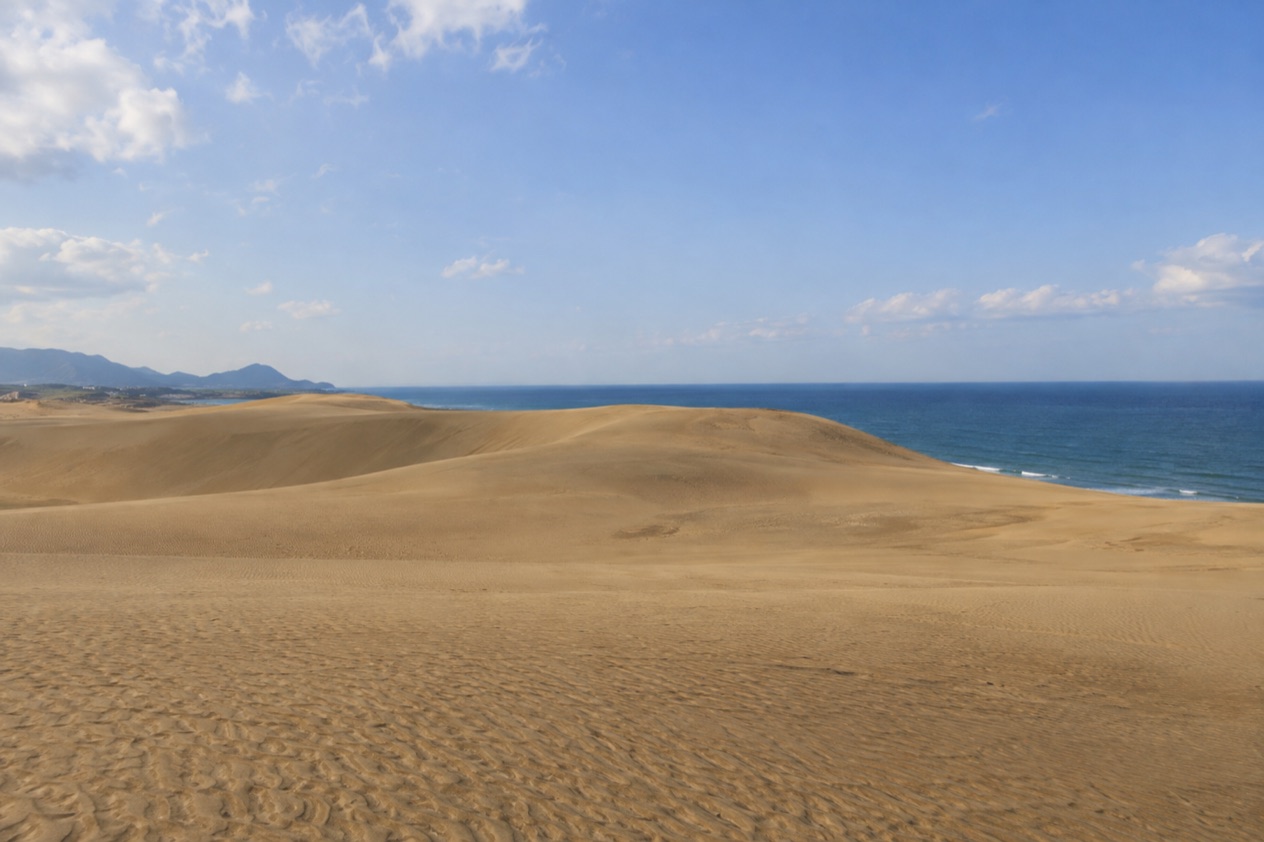
The most famous tourist destination within the Tottori Sand Dunes is the Hamasaka Dunes area, on the eastern side of the Sendai River, covering 545 hectares. When people show a photograph of Tottori, this is usually the stretch they mean: tall, smooth slopes, a sharp crest and the sea behind.
Look at how the sand is arranged. The windward slopes are patterned with ripples, while the steeper faces are smoother and cut by crisp ridgelines. Look at the sky too. On a clear day the sand glows pale against the blue, and on a gray day it turns the color of ash and the whole scene becomes quieter in tone. Both moods make good pictures.
Wind ripples and the shifting surface
The most absorbing detail is also the smallest. The wind draws parallel ripples across the sand, and they change from hour to hour as it moves the grains. Footprints, including your own, do not last. A surface that looked perfectly combed gets rewritten by the next gust.
It is worth stopping to look closely at the grains and the lines they form, at the way a ripple pattern bends around a slope, at the thin shadows that appear when the light is low. Dunes like these are always in motion, which is why they look slightly different each time you see them.
The Sendai River and the story of the sand
To understand the dunes, think of the Sendai River as the supplier. Sediment from the Chugoku Mountains was carried down the river to the coast, and strong winds then shaped those deposits into dunes over about 100,000 years. The mountains inland and the sand on the shore are the same material at different stages of a long journey.
That story is why the dunes sit within the San’in Kaigan Geopark. A geopark is a place recognized for the way its landforms tell the story of the earth, and here the lesson is easy to read from the ground itself. Water, wind and time did all the work, and the result looks designed.
Where the dunes meet the Sea of Japan
The edge of the dunes is where the scene opens up. Pale sand ends at a gray-blue sea, and the horizon feels wide in a way inland Japan rarely does. The coast here belongs to the San’in region, where the Sea of Japan shapes the weather and the light.
Look along the length of the shore and you can see how the sand ribbon curves with the coastline. The contrast between the dry, textured slopes and the moving water is the view visitors remember, and it changes with every cloud that crosses the sun.
When to visit the Tottori Sand Dunes
The dunes change character with the season and with the weather of the day, so the right time depends on the mood you want. There is no single correct moment, only different versions of the same landscape.
In spring and early summer, the pale sand sits against fresh green in the surrounding land, and the light is soft and bright. It is a good moment for photographs of the ripples against a clean blue sky. Open ground by the sea can feel breezy, and the wind is exactly what keeps shaping the surface.
Midsummer is the season of bright sun on a wide stretch of sand, with little shade in sight. The sand takes on a pale, almost white glare, and the sea behind it looks deeper in color by contrast. It is a season to think of as bright, open and exposed, with the water always in view.
Autumn brings a gentler light and clearer lines. The ripples and ridges stand out in sharper relief, and the sea takes on a steel-blue tone. For anyone who prefers texture to glare, this is a rewarding time to look at the dunes.
Winter on the Sea of Japan coast is moodier. Gray skies and wind off the water give the dunes a stark, dramatic look, with the dark sea and pale sand in sharp contrast. It is not the postcard version, but it is arguably the most atmospheric one, and the landscape feels more like an edge of the world than a beach.
Whatever the month, the weather on the day makes the biggest difference. Sun, cloud and wind each produce a different scene, so a flexible plan lets you enjoy whichever version you get. Because the dunes are a landscape rather than an indoor attraction, the sky is part of what you came to see.
Tips for your visit
Think of the dunes as an outdoor landscape where the weather, the wind and the sand set the terms. A visit is mostly about walking, looking and photographing, and the sand gets into everything, so your shoes and bag will carry a little of it home.
The dunes lie outside the city center of Tottori, in Tottori Prefecture. That position makes them part of a coastal trip rather than a city sight, and it is worth thinking of the visit as its own outing instead of a quick stop between errands.
Getting to the region is straightforward on paper. Haneda Airport in Tokyo has daily flights to both Tottori airports: Tottori Sakyu Conan Airport in the east and Yonago Kitaro Airport in the west. The name of the first one, Sakyu, is the Japanese word for sand dune, so the destination is built into the airport itself.
Tottori is the capital and largest city of the prefecture, and most of the city lies within the San’in Kaigan Geopark. That means the geopark is not only a place you visit but also the setting for the city itself. Pairing the dunes with time in Tottori lets you see how the coast and the town sit together.
A good way to shape the day is to give the dunes their own stretch of unhurried time. Walk along the sand, stop to look at the ripples, then turn toward the sea. Leave room to simply stand and watch the wind move across the surface. Photographers will want to linger as the light changes, since the same slope looks different in sun, haze or cloud.
The wider San’in Kaigan Geopark offers a thread to follow if you have more days on this coast. Because the dunes are the best-known part of that story, they make a natural opening chapter for a trip that explores how the sea, the river and the mountains of this region shaped one another.
Good to know before you go
The dunes are an open landscape, so the day is shaped by wind, sun and sky more than by any schedule. Treat the sand with the same care as any natural area, and take your time, since the scenery is the whole point. Dress for the weather of the day, bring what you need for the sea air and bright sand, and let the Sea of Japan coast set the pace of your visit.
Sources
- Wikipedia, Tottori Sand Dunes (https://en.wikipedia.org/wiki/Tottori_Sand_Dunes), checked October 11, 2026
- Japan National Tourism Organization, Tottori (https://www.japan.travel/en/destinations/chugoku/tottori/tottori-and-around/), checked October 11, 2026
- Wikipedia, Tottori (city) (https://en.wikipedia.org/wiki/Tottori_(city)), checked October 11, 2026
To plan your stay
- Best Time to Visit Japan: Cherry Blossoms, Autumn Colors, Weather and Festivals
- Where to Stay in Japan: Ryokan, Temple Stays, Capsule Hotels and the Best Cities to Base In
- Sending Luggage from the Airport in Japan: Hands-Free Travel, Hotel Delivery and Coin Lockers
- Know Before You Go to Japan: Entry, Money, Etiquette and Getting Around