
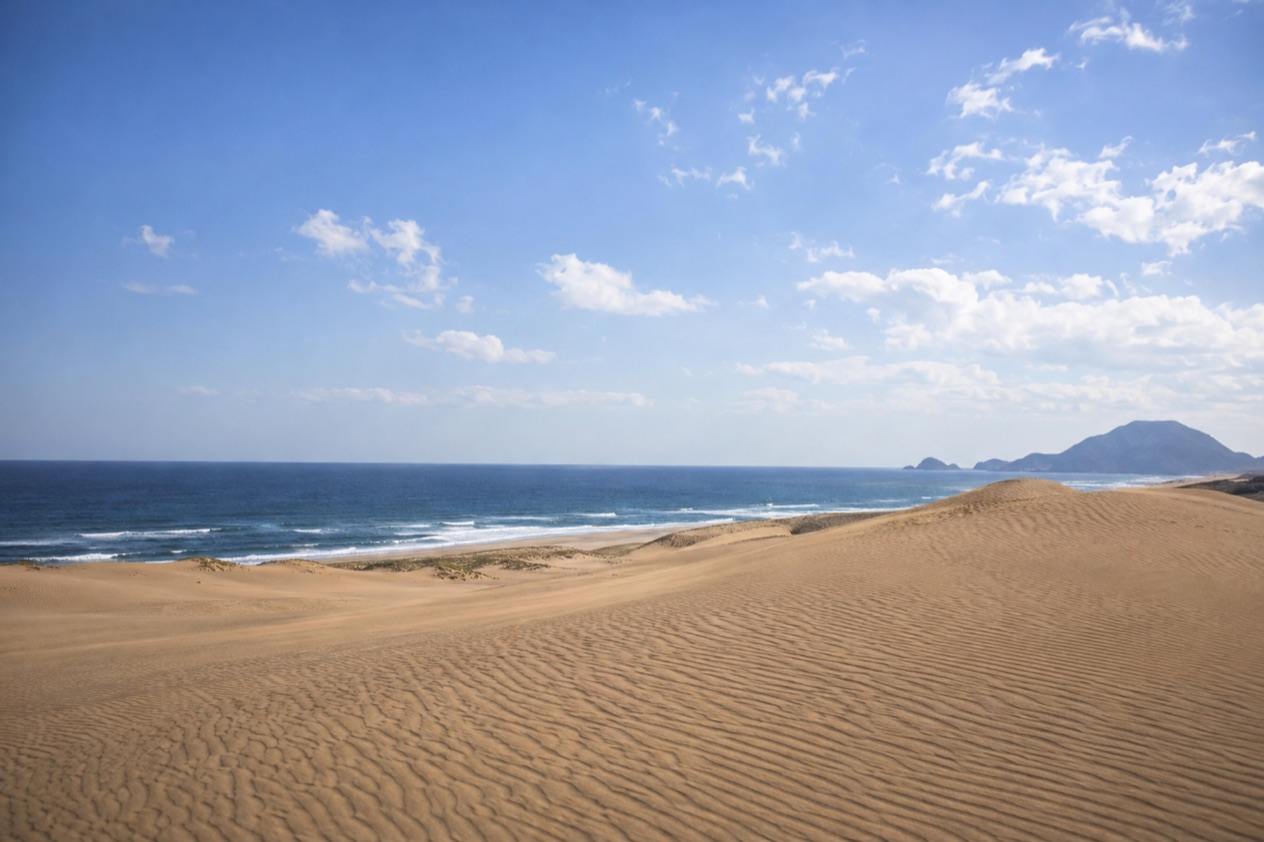
Wind combs the sand into fine ripples along the ridge, and walkers in the distance climb in a thin line toward a horizon where the dune ends and the Sea of Japan begins. Back in town, a bowl of rice topped with seafood or a slice of pear dessert waits at the end of the day. Tottori is a coastal city on the Chugoku side of Japan, a place for travelers who want sand, sea, hot springs and regional food away from the usual big-city circuit.
Where is Tottori and what is it like?
Tottori is a city in Tottori Prefecture, in the Chugoku region of western Honshu, and it is the capital and largest city of the prefecture. It faces the Sea of Japan, and most of the city lies within the San’in Kaigan Geopark, a stretch of coastline recognized for its landforms. Its area is about 295 square miles, which means the city includes far more than a downtown: rice fields, fishing harbors, hills and a long sweep of shore.
The character of the place is that of a regional capital that has never been in a hurry. You will find a compact-feeling grid of streets around the station, a castle hill with old stone walls, small museums, shopping arcades and restaurants built around what comes from the nearby sea and farms. People come mainly for the dunes, and the rest of the trip tends to grow out of that, with a bath in an onsen, a seafood lunch and a wander through a town that does not run on tour-bus schedules.
Tottori is best known for being near Japan’s largest sand dunes, the Tottori Sakyu, which lie outside the city center. That proximity shapes everything, from the souvenirs (sand-colored sweets, camel motifs) to the way visitors plan a day around wind and light on the sand.
It suits travelers who like to take their time, who enjoy regional cooking and who are happy with a trip built around one landscape rather than a list of headline sights. Think of Tottori as a place for slow days, a good meal and open skies, and as a base for exploring the western end of the prefecture too.
What is there to do in Tottori?
The things to do in Tottori come down to a handful of reasons: the dunes, the sea and its food, the hot springs and the castle-town streets.
The Tottori Sand Dunes
The Tottori Sand Dunes are located outside the city center, and they are the reason people put Tottori on a map. You walk onto a landscape of ridges and hollows that feels closer to a desert than to anything else in Japan, then crest the highest rise and find the sea spread out in front of you. Wind keeps redrawing the surface, so the patterns underfoot are never quite the same twice.
Visitors often pair the walk with other activities on and around the sand. You may see people sandboarding, paragliding or riding a camel for a short stretch, and there is a sand museum nearby where sculptors build large works from sand. Bring shoes you do not mind filling with grit, and expect to be shaking out your socks for a while after.
Seafood, crab and pears
Tottori’s cooking follows the Sea of Japan and the local farmland. Crab is a big name on this coast, and winter menus often center on it, grilled, boiled, in hot pot or stirred into rice porridge. Fish markets and harbor-side restaurants serve squid, shrimp and whitefish, and an izakaya (a casual Japanese pub) in town is a good place to try a bit of everything with a cup of local sake.
The prefecture is also associated with pears, and you may find them in jelly, ice cream, sweets and plain fresh slices. Another local taste is curry, which shows up in surprising places around town. A food-focused day here is about browsing a market, choosing a counter and letting the menu follow the season.
Hot springs, castle ruins and quiet streets
After a day outdoors, a soak in an onsen (a natural hot spring bath) is a natural next step, and the prefecture has several hot spring districts. Bathing habits are the usual ones: wash and rinse before getting in, leave the towel out of the water and keep the bath for soaking. Some ryokan (traditional inns) pair a bath with a multi-course dinner and a futon laid out on tatami floors.
In the city itself, the old castle hill rises behind the downtown, with stone walls where the keep once stood, and a museum and gardens nearby offer a lower-key side of Tottori. Shopping arcades and side streets hold small cafés, bakeries and shops selling sand-themed souvenirs. It is the kind of town where wandering with no goal usually turns up a bowl of noodles or a coffee worth sitting down for.
How many days do you need in Tottori?
Two days is a good length for Tottori, and a long weekend gives you room to add a hot spring night or a side trip. With a short stay you can see the dunes, eat well and walk the castle hill, and that already makes for a full, satisfying visit.
A stay of two days might look like this: one day centered on the dunes and the sand museum, with a seafood meal in the evening, and a second day for the castle ruins, local museums and the town’s cafés and shops. Because the dunes lie outside the center, leave generous room for getting out there and back rather than squeezing in too much.
Three or four days let you slow the rhythm. You could spend an evening at an onsen, take a ryokan dinner and spend another morning on the sand when the wind and light are different.
A longer visit also opens the door to the western part of the prefecture, where Yonago Kitaro Airport sits. The airport takes its name from Kitaro, the ghost-boy hero of a well-loved manga, and the area around it leans into that theme.
Tottori also works as one stop on a wider trip through western Japan. It is about 112 miles from Kobe and about 186 miles by road from Hiroshima, and travelers combining it with Kansai or with the Chugoku region can fit it in as a night or two between larger cities. Those who want a different pace from the big urban centers will find that Tottori gives them exactly that.
If you have more time still, the geopark coastline is worth exploring beyond the dunes. Coves, rocky headlands and fishing villages line the shore, and lingering in them rewards those who like to look at the sea without a plan. The extra days are best spent on a few places seen slowly, rather than a longer list seen in passing.
Where to stay in Tottori
The choice of where to stay in Tottori comes down to three kinds of base: the city around the station, a hot spring district, or the western side of the prefecture near Yonago. Each gives a different version of the trip, and the best fit depends on whether you want convenience, a soak or a wider look at the region.
In the city, near the station
Staying in the city puts restaurants, shopping arcades, cafés and the train station within reach of each other. It is a good fit for travelers who arrive by rail, who like to walk to dinner and who plan to visit the dunes as an outing rather than sleeping beside them. Business hotels are the usual style, with small, tidy rooms and a breakfast that may include local rice and fish.
An evening in town tends to mean an izakaya meal, a stroll under the arcades and perhaps a nightcap in a small bar. This is the base for people who want to sample the food scene and move easily between the castle hill, the museums and the buses to the sand.
Hot spring districts and ryokan
If bathing is the point, a night at an onsen town or a ryokan changes the whole feel of a visit. Tottori Prefecture has several hot spring areas, and many guests arrive in the afternoon, change into a yukata (a light cotton robe), bathe and settle in for a multi-course dinner. The pace slows, and the next morning begins with a long breakfast rather than an alarm.
A ryokan stay suits couples, travelers marking an occasion and anyone who wants a taste of traditional lodging. It also suits those who would rather spend one night well than two nights hurrying. Because bathing customs vary slightly from place to place, follow the posted instructions at each bath.
Around Yonago and the western side
Yonago Kitaro Airport is in the west of the prefecture, and the towns around it offer another base. It makes sense for travelers who arrive by air from the international routes there, and for those who want to see the Kitaro-themed streets and the surrounding countryside. From there you can still reach Tottori city by train.
How do you get to Tottori and get around?
You reach Tottori by air to one of two airports or by train on the Sanin Main Line. Haneda Airport in Tokyo has daily flights to both Tottori airports: Tottori Sakyu Conan Airport in the east and Yonago Kitaro Airport in the west. Yonago Kitaro Airport also has direct flights from Hong Kong and Seoul, which makes it an international airport.
By rail, the Limited Express Super Hakuto on the Sanin Main Line connects Tottori to Osaka in just under 3 hours. For travelers building a loop through Kansai and the Chugoku region, that rail link is the way the city fits into the map. Arriving by train also drops you in the middle of town, with the station as the starting point for local transport.
Tottori sits roughly 112 miles from Kobe and about 186 miles by road from Hiroshima, so it works as a stop between regions for those traveling by car. The city’s area is large, and the dunes lie outside the center, which means that getting around involves a trip from town rather than a stroll from your hotel.
Within the city, walking covers the downtown streets, the arcades and the area around the station. For outlying sights, visitors use local transport or a vehicle, and the dunes, hot spring districts and coast reward a bit of planning.
Whichever way you travel, build in time for the transfer between the station and the sand, and for the return in the evening. A day with a clear start and a relaxed finish is better than one stretched by tight connections.
When is the best time to visit Tottori?
Spring and autumn are the seasons that most often suit a first trip to Tottori, with May, October and early November good choices for walking the dunes and the town. The coast faces the Sea of Japan, so the weather can change quickly, and a rain jacket belongs in the bag in any month. Spring brings blossoms to castle grounds, while autumn colors the hills and brings the harvest to menus.
Summer is the season for the sand and the coast, with long days and a lively mood in town. Late summer is also when local pears come into season, and festival drums and dancing fill the streets in some years. Expect it to be hot and humid, and plan your dune visit with water and a hat.
Winter has its own appeal for food lovers, since this is crab season along the Sea of Japan coast, and hot spring nights feel especially welcome. Snow can fall on the coast and the dunes, giving the landscape a different look, though cold wind and gray skies are common too.
If you come to eat and soak rather than hike, winter is a strong choice. Travelers who prefer sunny walks on the sand will lean toward the warmer months.
Good to know before you go
Japan runs on yen, and in a regional city like Tottori it is wise to carry some cash for small restaurants, market stalls and local buses. Habits are the familiar ones: shoes come off at the entrance of a ryokan, voices stay low on trains, and onsen bathing follows a set order of washing first and soaking after.
Tottori sits on the Sea of Japan coast, so keep an eye on the forecast before heading to the dunes, since wind and rain change how a day on the sand feels. A pair of sturdy shoes and a windproof layer go a long way. Leave room in the schedule for a long lunch, which is often the best part of the day.
Sources
- Japan National Tourism Organization, Tottori (https://www.japan.travel/en/destinations/chugoku/tottori/tottori-and-around/), checked October 11, 2026
- Wikipedia, Tottori (city) (https://en.wikipedia.org/wiki/Tottori_(city)), checked October 11, 2026
- Wikipedia, Tottori Sand Dunes (https://en.wikipedia.org/wiki/Tottori_Sand_Dunes), checked October 11, 2026
To plan your stay
- Best Time to Visit Japan: Cherry Blossoms, Autumn Colors, Weather and Festivals
- Where to Stay in Japan: Ryokan, Temple Stays, Capsule Hotels and the Best Cities to Base In
- Sending Luggage from the Airport in Japan: Hands-Free Travel, Hotel Delivery and Coin Lockers
- Know Before You Go to Japan: Entry, Money, Etiquette and Getting Around