
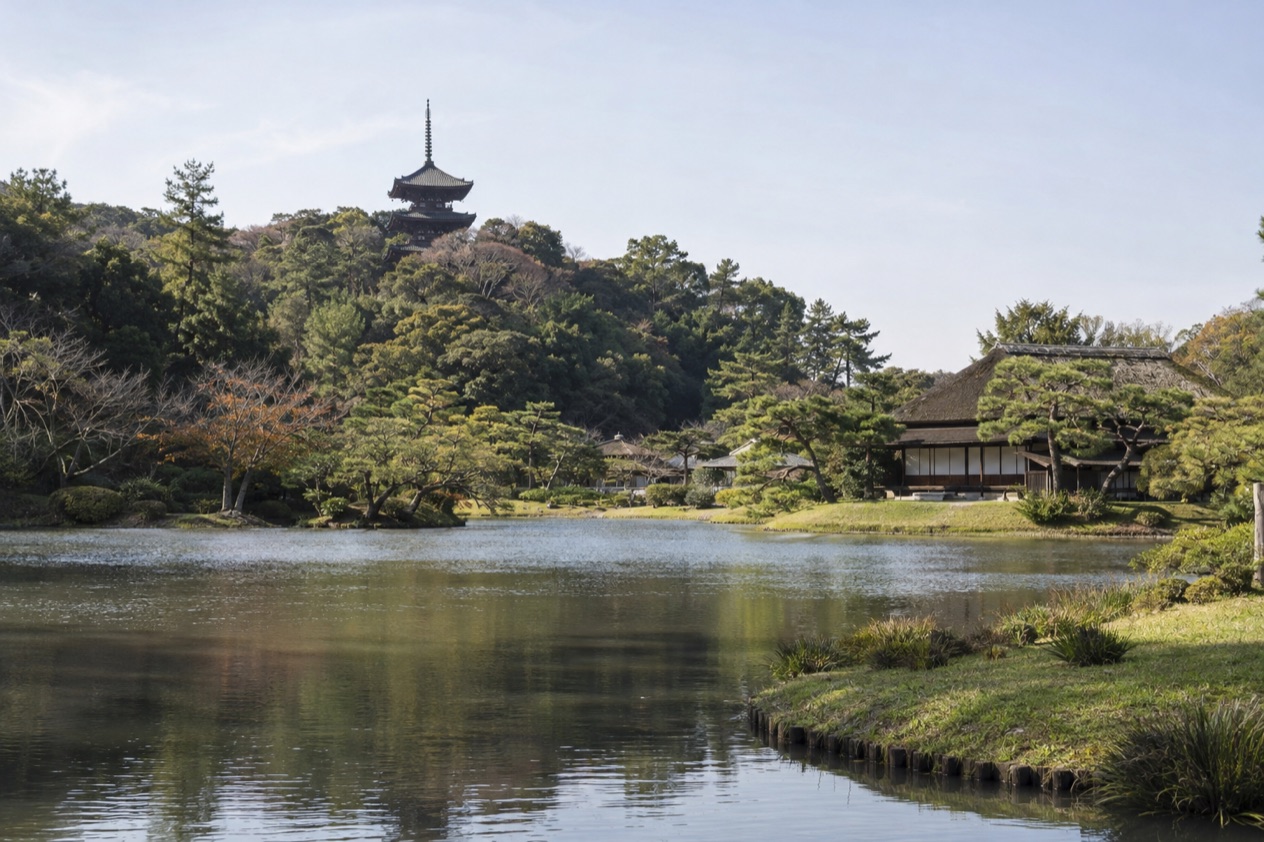
Around the Main Pond at Sankeien, the water holds the reflection of a three-story pagoda, and the path bends past thatched roofs and old gates before opening onto another view across the water. It is a garden built by a silk trader in Yokohama, and it feels more like a walk through a collection of old Japanese houses set in landscaped hills than a stroll through flowerbeds. The visit suits anyone who likes gardens, architecture and the changing seasons.
Is visiting Sankeien Garden worth it?
Yes, if you enjoy historic buildings set in a landscape and want a green, unhurried afternoon in Yokohama. It suits garden lovers, photographers, people interested in traditional Japanese architecture and anyone who wants a counterweight to the harbor and the skyscrapers of the city center.
What sets Sankeien apart from other gardens around Tokyo and Yokohama is that it is as much an open-air architecture collection as a garden. Ten of its buildings are designated Important Cultural Properties, and three more are Tangible Cultural Properties designated by the City of Yokohama.
Many were brought from other parts of Japan, including a former three-story pagoda that began its life in Kyoto. The garden covers a large area, so the walk unfolds in stages, with ponds, hills, teahouses and farmhouses appearing one after another.
It was designed and built by Tomitaro Hara, a silk trader who wrote under the name Sankei Hara. His family gave the garden to the City of Yokohama in 1953, and a foundation was created to repair and maintain it. That private-collector origin helps explain the garden’s distinctive combination of landscape and historic architecture.
What to see at Sankeien Garden
The Outer Garden and the Main Pond
The Outer Garden, the area next to the Main Pond, was the first part of Sankeien to open to the public, in 1906.
Look for the way the buildings sit in the landscape rather than dominating it. Roof lines appear between branches, and in spring and autumn the reflections on the water double the color. Walk the full loop of the shore before climbing anywhere, since the angles change with every bend.
Tomyo-ji Pagoda
The former three-story pagoda of Tomyo-ji was originally built in Kyoto in 1457 and moved to Sankeien in 1914. It is the garden’s most recognizable structure, and it was once part of a temple rather than a garden, which gives it a presence quite different from the decorative buildings around it.
Notice the layered, slightly curved eaves, the weathered wood and the hillside setting that lets you see it from above as well as from below. It photographs especially well when cherry blossoms or maple leaves frame it, and it rewards a pause from a few different vantage points.
The Former Yanohara House
The Former Yanohara House began as the private residence of the Yanohara family. It is the only building at Sankeien whose interior is open to the public all year, which makes it the place to understand how people actually lived in a house of this kind.
Inside, look at the structure of the timber frame, the open hearth areas typical of a farmhouse and the way the rooms flow toward the garden. It is a good counterpoint to the more refined pavilions elsewhere in the grounds, and a useful place to slow down.
Seasonal pavilions: Choshukaku, Kakushokaku, Rinshunkaku and Hakuun-tei
Several buildings open only at certain times of year. The Choshukaku pavilion opens in spring and in November, for the traditional viewing of the autumn colors. The Kakushokaku opens during the summer only, as do the Rinshunkaku and the Hakuun-tei.
If your visit overlaps with one of these openings, it adds a layer to the walk: you step inside rooms that were designed to frame the garden, with the view as the centerpiece. The Kakushokaku can also be rented for meetings and parties, a sign of how these buildings are still used rather than simply preserved.
Hours, tickets and rules
The garden is a large, landscaped property, and most of the experience happens outdoors along its paths. Only the Former Yanohara House can be entered all year, while a handful of other buildings open in particular seasons, so the interiors you can see depend on when you come.
| Site | Open |
|---|---|
| Former Yanohara House (interior) | All year |
The Choshukaku is open in spring and in November. The Kakushokaku, the Rinshunkaku and the Hakuun-tei are open during the summer only. The Kakushokaku can be rented for meetings and parties.
When to visit Sankeien Garden
Spring and autumn are the seasons the garden is known for, with cherry blossoms and ume blossoms in the cooler months of the year and changing leaves in autumn. Each season repaints the same paths, so the pagoda and the pond look different from one visit to the next.
Ume, the Japanese plum, blooms during the colder part of the year. Cherry blossoms follow in spring, and April brings highs near 66°F, with rain on about nine or ten days. Pack a light layer for cooler spring days.
In July the garden turns warm and humid, with highs in the mid-80s and humidity near 78 percent. It is the season when the Kakushokaku, the Rinshunkaku and the Hakuun-tei open their doors, so summer has its own reward for those who do not mind the heat.
October is mild, with highs around 72°F, but it is one of the wetter months, with rain on about eleven days. Leaves are still turning later in the season, and November is when the Choshukaku opens for the traditional viewing of the autumn colors. A rainy day suits the thatched buildings and the wet stones well, so bring a compact umbrella and go anyway.
Tips for your visit
Plan for a long, unhurried walk, because the grounds are broad and the paths rise and fall with the hills. Comfortable shoes matter more here than at a flat city park, and a layer for changing weather is worth carrying in most seasons. A camera is the obvious companion, especially around the pond and the pagoda.
From central Tokyo, JR and private railway lines reach Yokohama Station in about an hour. From central Tokyo, a JR train or one of several private railway lines reaches Yokohama Station in about an hour. Travelers coming from western Japan on the Nozomi Shinkansen arrive at Shin-Yokohama Station, with about 2 hours from Kyoto and Osaka. From Haneda Airport, the Keikyu line takes 20 minutes to Yokohama Station.
Combine Sankeien with the rest of Yokohama, a port city that has been open to the world since 1859 and sits on Tokyo Bay. A day that pairs the quiet of the garden with the harbor makes a good contrast between old merchant Japan and the modern waterfront. Match the visit to the season: summer for the pavilions, November for the autumn colors, spring for the blossoms.
Good to know before you go
Yokohama’s rainy stretches and warm, humid summers are worth planning around, so a light rain layer is useful for much of the year. Carry some yen for small purchases and . Because several buildings open only in particular seasons, check which ones you hope to enter before you choose your month.
Sources
- Wikipedia, Sankei-en (https://en.wikipedia.org/wiki/Sankei-en), checked October 11, 2026
- Japan National Tourism Organization, Yokohama (https://www.japan.travel/en/destinations/kanto/kanagawa/yokohama-and-around/), checked October 11, 2026
- Wikipedia, Yokohama (https://en.wikipedia.org/wiki/Yokohama), checked October 11, 2026
- Wikivoyage, Yokohama (https://en.wikivoyage.org/wiki/Yokohama), checked October 11, 2026
- Japan Meteorological Agency (JMA), Normal values 1991-2020, monthly (https://www.data.jma.go.jp/stats/etrn/view/nml_sfc_ym.php?prec_no=46&block_no=47670), station Yokohama, elevation 39 m, checked October 11, 2026
To plan your stay
- Best Time to Visit Japan: Cherry Blossoms, Autumn Colors, Weather and Festivals
- Where to Stay in Japan: Ryokan, Temple Stays, Capsule Hotels and the Best Cities to Base In
- Sending Luggage from the Airport in Japan: Hands-Free Travel, Hotel Delivery and Coin Lockers
- Know Before You Go to Japan: Entry, Money, Etiquette and Getting Around