
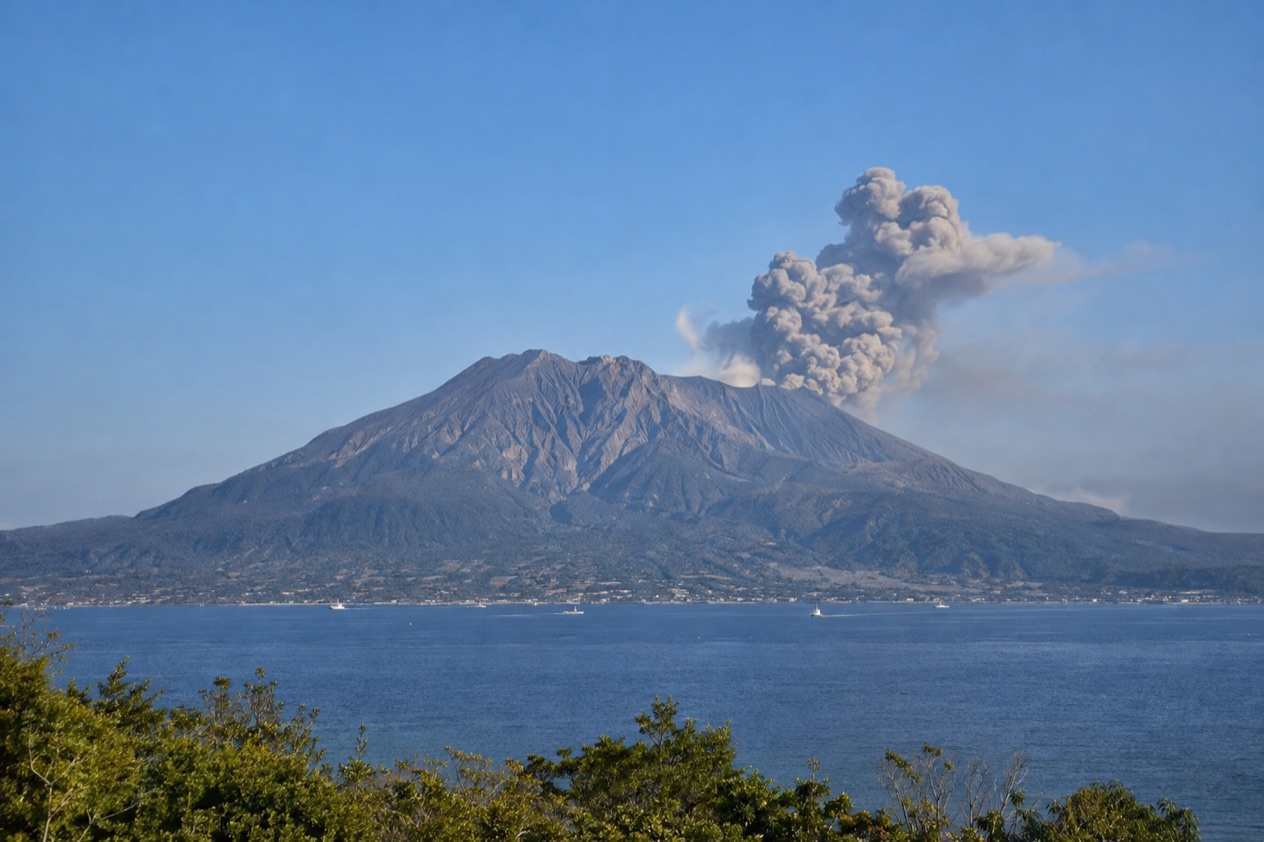
Sakurajima announces itself before you reach it: a dark, broad-shouldered cone rising from the bay, sometimes wearing a plume of gray ash that leans with the wind over the rooftops of Kagoshima. Step ashore and the volcano stops being a backdrop.
It becomes ground you stand on, with lava fields, steaming baths and fields of oversized radishes. A visit here is a half-wild, half-lived-in outing built around an active volcano that people also happen to call home.
Is visiting Sakurajima worth it?
Yes, for anyone who wants to see a volcano as a place where people live, farm, bathe and go to school, rather than as a distant silhouette. It suits curious travelers, food lovers, and anyone staying in Kagoshima who wants a day that feels different from the city streets.
What sets it apart from other volcanic destinations in Japan is how close it sits to a real city. Kagoshima lies only 2.5 miles away across the bay, and the mountain is part of daily life there.
Schoolchildren wear helmets against falling volcanic debris, the city holds regular evacuation drills, and shelters have been built for people to take refuge. Elsewhere you travel up to a crater lake or a resort town in the hills. Here the volcano rises from the water opposite a city’s waterfront, and the contrast between café terraces and a smoking summit is the whole point.
It is also a place of soft pleasures. The fertile ash soil grows produce found nowhere else in quite the same form, and the area around the mountain holds several hot spring resorts.
Sakurajima is part of Kirishima-Kinkowan National Park, so the lava flows are treated as scenery to be looked at and understood. Come for the landscape, stay for the baths and the table, and leave with a better sense of why Kagoshima has been nicknamed the Naples of the Eastern world, with its bay, its warm climate and its emblematic stratovolcano.
What to see at Sakurajima
The sights here are the mountain itself, the ground it has made, and the things that grow and flow from it. Each shows a different side of the same volcano.
The three peaks of the summit
Sakurajima is not a single point but a crown of three summits: Kita-dake to the north, Naka-dake in the middle and Minami-dake to the south. Kita-dake is the tallest, reaching 3,665 feet above sea level. From the bay and from the Kagoshima waterfront the peaks blend into one heavy silhouette, but up close the ridgeline separates, and the slopes show the layering of old ash, scoured gullies and patches of hardy green.
What you look for here is the volcano’s mood. Some days the summit sits clear and sharp, other days a column of ash drifts from it, and the light turns the cone from charcoal to violet. Treat the peaks as something to watch and photograph rather than to approach. The volcano is active, and its slopes are for looking at from the lower ground and the viewpoints the area provides.
The 1914 lava flows and the former island
Sakurajima was an island until the eruption of 1914. Its lava flows ran down to the water and joined the mountain to the Ōsumi Peninsula, so that the island became a peninsula. That single event explains the geography you see today: dark, rough ground running out to the shore where there was once open sea.
The lava flows are one of the main attractions of the national park, and they reward slow looking. The black rock is knotted, cracked and rust-streaked, and over the decades pines, grasses and shrubs have crept into the crevices.
It is a landscape that shows how recent and how violent the island’s reshaping was, yet it now reads as quiet and weathered. Look for the contrast between the raw stone and the green that has reclaimed parts of it.
Hot springs around the volcano
The area around Sakurajima holds several hot spring resorts, and an onsen (a bath fed by natural volcanic water) is the natural companion to a day of volcano gazing. The heat that powers the mountain is the same heat that warms the water, so a soak connects you to the landscape in a very direct way.
Bathing in Japan follows its own habits: you wash before you enter the shared water, and the bath is for soaking rather than scrubbing. Pair it with a simple local meal and the day settles into a gentle rhythm.
Daikon, oranges and ash pottery
Sakurajima is known for the produce its volcanic soil grows. The Sakurajima daikon is a huge white radish the size of a basketball, one of the main agricultural products of the area, and the Sakurajima komikan is a small orange that thrives in the same immensely fertile ground. Both are a pleasure to taste, the daikon tender and sweet when simmered, the komikan bright and easy to peel.
The ash itself has become a craft material. Local pottery is made from volcanic ash, and the pieces carry the dark, speckled look of the mountain. A cup or a small dish from Sakurajima is a more meaningful souvenir than most, since the clay is literally what the volcano has dropped on the island and on Kagoshima for generations.
How to get to Sakurajima
Sakurajima is reached by the Sakurajima Ferry, which serves the former island across the bay from Kagoshima. That water crossing is the way the island is served, and it is a pleasure in itself: you leave the city behind and watch the volcano grow larger as the shore falls away.
Kagoshima, the base for the visit, is the capital of Kagoshima Prefecture on the island of Kyushu. Sakurajima belongs to the city administratively, and Kagoshima City sits only four kilometers from the active volcano, so the mountain and the waterfront face each other in plain view.
Reaching Kagoshima first
Travelers arrive in Kagoshima by train or by air. The Kyushu Shinkansen connects Kagoshima to Kumamoto in 42 minutes, which makes the city a natural stop on a rail journey through Kyushu. Japan Rail Pass holders can use Kyushu Shinkansen services at no charge, except Mizuho trains.
By air, domestic flights to Kagoshima depart from Tokyo and take 2 hours. From the city, the ferry carries you across the bay to the volcano. The crossing puts you on the shore of the former island, where the lava flows, the hot springs and the farm country begin.
The ferry crossing
The ferry is the link between the city and the volcano, and it is worth treating as part of the experience rather than as a transfer. From the deck you see the whole bulk of the mountain, the three-peaked summit, the dark slopes and the line of the shore, with the Kagoshima skyline behind you.
On a day when ash is drifting, the plume is easy to follow from the water, and you get a sense of how the wind carries it toward the city. Once you land, you are on a former island that the 1914 lava flows tied to the peninsula, and the landscape around the terminal is already volcanic.
When to visit Sakurajima
The volcano does not follow the calendar, and ash can fall on Kagoshima whatever the month, since the mountain regularly dumps ash over the city.
That said, the seasons shape what you taste and how the day feels. Kagoshima has a warm climate, which is part of what earned it the Naples nickname, so the bay feels bright and open for much of the year. The cooler months suit the local produce, since daikon radishes and komikan oranges are often associated with the colder part of the year in this part of Kyushu, and a warm bath feels especially good then.
Reading the mountain on the day
The eruption alert level is the number that matters most. That episode shows how quickly conditions can change at an active volcano, and it is why the city keeps its drills and shelters ready.
Before you go, look at the current alert level and the local advice for the area. A day of drifting ash does not spoil a visit, and it is part of what makes the place real, but conditions on the mountain decide what the day looks like, so stay flexible about the plan.
Seasons on the table and in the bath
Think of the year in terms of flavors. The fertile soil keeps the island’s farms busy, and the oversized daikon and the small komikan orange are the stars of the local table. If you arrive when they are in season, you can taste them simmered, pickled or eaten fresh, and the markets and small shops in the area reflect that.
The hot springs are a pleasure in any season, but a soak after a day outdoors is especially welcome when the air is cool. If your trip falls in a warmer stretch, the baths still make a calm ending to the day, and the volcano is just as striking as the light turns toward evening.
Tips for your visit
Bring what suits a day outdoors on volcanic ground: comfortable shoes with a good grip for rough, uneven rock, and a layer you can add or remove as the weather shifts on the bay. Sunglasses help against bright light on dark stone, and a small cloth or mask can be welcome on a day when ash is in the air. Carry a small towel if you plan to visit an onsen.
Building the day
Treat Sakurajima as a day that begins and ends in Kagoshima. Cross on the ferry, spend your time looking at the lava flows and the mountain, add a hot spring soak, and taste the local produce. That gives the outing a natural arc: the water crossing, the landscape, the bath, the meal.
Back in the city, the volcano stays in view, so you can keep watching it from the waterfront as the day ends. Kagoshima is a historical city, and its streets and its bay give the trip a second half that feels quite different from the rough, dark ground you have just left.
Families and the pace of the day
Children often find a volcano fascinating, and Sakurajima has something to hold their attention: a smoking mountain, a ferry ride, and a radish as big as a ball. The helmets that Kagoshima schoolchildren wear against volcanic debris are a striking detail that sparks conversation about how people live beside an active mountain.
Keep the pace relaxed and let the day follow what interests the group. Rough lava ground can be uneven underfoot, so travelers with limited mobility may prefer to enjoy the mountain from the ferry deck and the Kagoshima waterfront, then pick a bath or a meal for the island portion of the day.
What to combine nearby
The natural partner for Sakurajima is Kagoshima itself, a historical city watched over by the volcano. Spend time on its waterfront, where the mountain fills the view across the bay, and let the evening settle there. The area also forms part of Kirishima-Kinkowan National Park, so the landscape around the bay has a wider frame of protected scenery.
If you are traveling through Kyushu by rail, Kagoshima makes a fitting end to a line of stops, with the Shinkansen linking it to Kumamoto. A pottery piece made from volcanic ash, or a daikon dish at the table, will carry the memory of the island home.
Good to know before you go
Sakurajima is an active volcano, and the habit that serves visitors best is to follow the current eruption alert level and local guidance on the day. The mountain was designated a Decade Volcano in 1991, marking it as worthy of particular study, and it is watched closely. Kagoshima carries on around it with drills and shelters in place, and a visit fits easily into that routine when you stay alert and flexible.
Sources
- Wikipedia, Sakurajima (https://en.wikipedia.org/wiki/Sakurajima), checked October 11, 2026
- Japan National Tourism Organization, Kagoshima (https://www.japan.travel/en/destinations/kyushu/kagoshima/kagoshima-and-around/), checked October 11, 2026
- Wikipedia, Kagoshima (https://en.wikipedia.org/wiki/Kagoshima), checked October 11, 2026
- Wikivoyage, Kagoshima (https://en.wikivoyage.org/wiki/Kagoshima), checked October 11, 2026
To plan your stay
- Best Time to Visit Japan: Cherry Blossoms, Autumn Colors, Weather and Festivals
- Where to Stay in Japan: Ryokan, Temple Stays, Capsule Hotels and the Best Cities to Base In
- Sending Luggage from the Airport in Japan: Hands-Free Travel, Hotel Delivery and Coin Lockers
- Know Before You Go to Japan: Entry, Money, Etiquette and Getting Around