
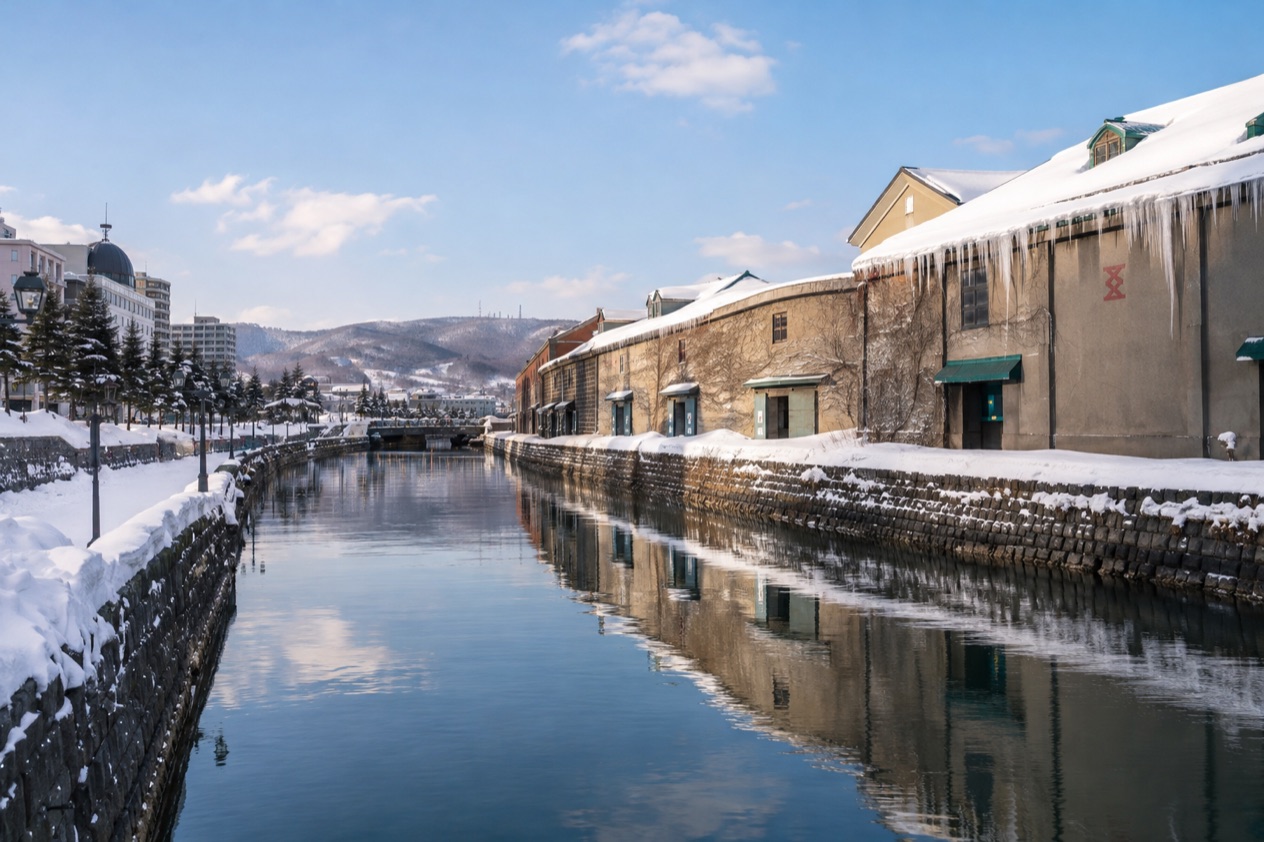
You come down toward the water in Otaru and the canal appears as a curve of still, dark surface with a row of Victorian-style street lamps leaning over it. Old warehouses line the edge, and the building facades and the lamps reflect in the water. It is a visit built around looking and wandering, with a beer, a meal or an ice cream somewhere along the way, in a port town on the Sea of Japan that makes an easy companion to Sapporo.
Is visiting the Otaru Canal worth it?
Yes, if you like cities where the past is still part of the street scene, and it suits couples, friends and families who are happy to wander and snack more than tick off sights. The canal is not a monument with a long program inside. It is a stretch of waterfront where the lamps, the old commercial buildings and the town around them make the whole atmosphere, and where a slow hour feels like a full outing.
What sets it apart from the other places people visit around Hokkaido is the port history behind it. Otaru faces Ishikari Bay and the Sea of Japan and has long served as the main port of the bay, and the canal is a leftover of that working life. Instead of a mountain, a hot spring or a national park, you get a harbor town that kept its warehouses, its wooden mansions and its habit of eating well, with a historic feel that Sapporo’s grid of modern avenues does not offer.
It also works as a day trip. Otaru is a popular tourist destination because of its many historical buildings, and the canal is the point where those buildings, the lamps and the water come together.
What to see at the Otaru Canal
The canal and its lamps
The canal itself is the heart of the visit, and what you notice first is the line of Victorian-style street lamps that runs along it. The water is calm in a way that makes the reflections as much of the picture as the buildings. Brick and stone warehouses stand along the banks, and many of them now house restaurants, shops and cafés, so the old trading street has become a place to browse and eat.
The canal grew out of the port’s business. Goods came in from ships and were carried to the warehouses along the water, which is why the buildings stand so close to the edge.
Look at the heavy doors, the thick walls and the rows of windows to see how they were meant to store cargo. Walk the length of the water, cross the bridges and look back along the line of lamps, because the view changes with each angle.
Otaru Beer beside the water
Otaru Beer stands next to the canal and is a German restaurant with a medieval theme. Inside, the mood is closer to a hall in Bavaria than to a Hokkaido harbor, with heavy furnishings, a rustic look and a menu of German-style dishes and beer. It is a lively contrast to the quiet canal outside.
It suits anyone who wants to sit down after walking the waterfront and turn the visit into a meal. Think sausages, hearty plates and a pour of beer, in a place that treats the table as part of the show. For a group with different tastes, it gives you an easy anchor point at the canal itself.
Nishin Goten, the herring mansion
Nishin Goten, the herring mansion, stands on the west side of Otaru. It is a large wooden building from 1897 that was once the house of the fishing magnate Fukumatsu Tanaka, and it was moved from Tomari village in 1958. The scale of the timber structure speaks for the wealth that herring brought to the coast of Hokkaido.
It adds a second layer to the canal visit. The canal tells the story of cargo and warehouses, and the mansion tells the story of the fishing fortunes that fed the port. Look for the heavy beams, the long rooms and the way a working family’s home was built to impress. It is a good stop for anyone curious about how the town got its history.
Otaru Aquarium
Otaru Aquarium is the oldest existing aquarium in Hokkaido, a reason to go for families and for anyone who likes sea life as much as architecture. It gives the harbor town a different kind of attraction, one built around the water rather than around the buildings beside it.
It pairs well with the canal for a day that mixes old streets and something lighter. Children who may tire of warehouses and lamps usually enjoy having an animal stop in the plan, and adults get a break from the walking.
Hours, tickets and rules
The canal is a public stretch of town, a waterfront of lamps, bridges and old warehouses that you take in on foot. The shops, cafés and restaurants along it each run to their own schedule, so the experience changes from one doorway to the next. A restaurant like Otaru Beer is a place to sit and eat, while the water and the lamps are simply there to look at.
What you see is the main thing to plan around. The lamps are Victorian in style and line the water, the warehouses stand shoulder to shoulder along the banks, and the surface of the canal gives the whole scene its mirror. You can lean on the bridges to look along the water, step into a shop in an old building or stop at a café with a view of the lamps.
Nearby attractions are a different matter. Nishin Goten, with its wooden halls from the age of the herring trade, and Otaru Aquarium, the oldest existing aquarium in Hokkaido, are separate places on their own terms. Treat each as its own stop, with its own pace, rather than as part of the canal stroll.
How to get to the Otaru Canal
The usual starting point is Sapporo, and the train is how you reach Otaru from there. Otaru is a port city on the coast of the Sea of Japan, about 19 miles west of Sapporo. Trains from Sapporo to Otaru run approximately every 20 minutes throughout the day, and the fastest service, the Airport Rapid, takes 30 minutes from Sapporo.
The line has a history of its own. In 1880 the first railway line in Hokkaido opened with daily service between Otaru and Sapporo, so you travel along a route that helped make the port important. Within Otaru, the JR Hokkaido stations on the Hakodate Main Line are Ranshima, Shioya, Otaru, Minami-Otaru, Otaru-Chikkō, Asari and Zenibako.
If you arrive by air, the nearest airports to Otaru are New Chitose Airport, 54 miles to the south, and Okadama Airport, 23 miles to the southeast. From either one, the way into the city is through Sapporo and then along the Hakodate Main Line toward Otaru.
When to visit the Otaru Canal
The canal is a place for every season, and each one changes how the lamps, the water and the old warehouses feel. In summer the weather in Otaru is very warm and balmy, with a maximum temperature of around 77°F and high humidity. That makes it a good season for strolling the waterfront, dropping into a café and eating ice cream on the way.
Winter is the other side of the town. Otaru is very snowy, receiving as much as 260 in of snow from November to March, and the average maximum snow cover is 48 in.
Snow on the banks and rooftops changes the look of the canal, and the lamps become the focus of the scene. Winters are less severe than in most other cities in Hokkaido, though, so the cold is part of the trip rather than a barrier to it.
Spring and autumn sit between those two moods, with the town and the water keeping their character whatever the weather brings. For a visit built on the canal, pick the season whose mood appeals to you, and dress for it. Summer asks for light clothes and a bit of patience with humidity, and winter asks for boots and layers.
Tips for your visit
Plan the canal as a wandering visit rather than a checklist. Walk the length of the water, cross a bridge or two, and give yourself time to step into a shop or a café housed in an old warehouse. The scene rewards a slow pace, and the lamps and reflections look different from each side of the canal.
Combine it with other things in town. Otaru Beer next to the canal is the obvious place for a meal, and rainbow tower ice cream is a food attraction unique to Otaru and a fun treat for children and adults alike. Nishin Goten on the west side of the city adds the story of herring and fishing fortunes, and Otaru Aquarium gives you a lighter stop with sea life.
For families, the mix of water, lamps, ice cream and an aquarium gives a day with several kinds of pleasure. For winter visits, bring waterproof footwear and warm layers because of the snow. For summer, bring something light and a way to cope with the humidity. Whatever the season, leave room in the day for a long lunch, since eating is half the reason to come to this port town.
Good to know before you go
The weather decides what you wear more than anything else in Otaru, from humid summer afternoons to deep winter snow. Bring shoes that handle wet or snowy pavement in the cold months, and light clothes in summer. The canal, the lamps and the waterfront cafés are the heart of the visit, and a pair of comfortable shoes will serve you well along the banks and over the bridges.
Sources
- Wikipedia, Otaru (https://en.wikipedia.org/wiki/Otaru), checked October 11, 2026
- Wikivoyage, Otaru (https://en.wikivoyage.org/wiki/Otaru), checked October 11, 2026
To plan your stay
- Best Time to Visit Japan: Cherry Blossoms, Autumn Colors, Weather and Festivals
- Where to Stay in Japan: Ryokan, Temple Stays, Capsule Hotels and the Best Cities to Base In
- Sending Luggage from the Airport in Japan: Hands-Free Travel, Hotel Delivery and Coin Lockers
- Know Before You Go to Japan: Entry, Money, Etiquette and Getting Around