
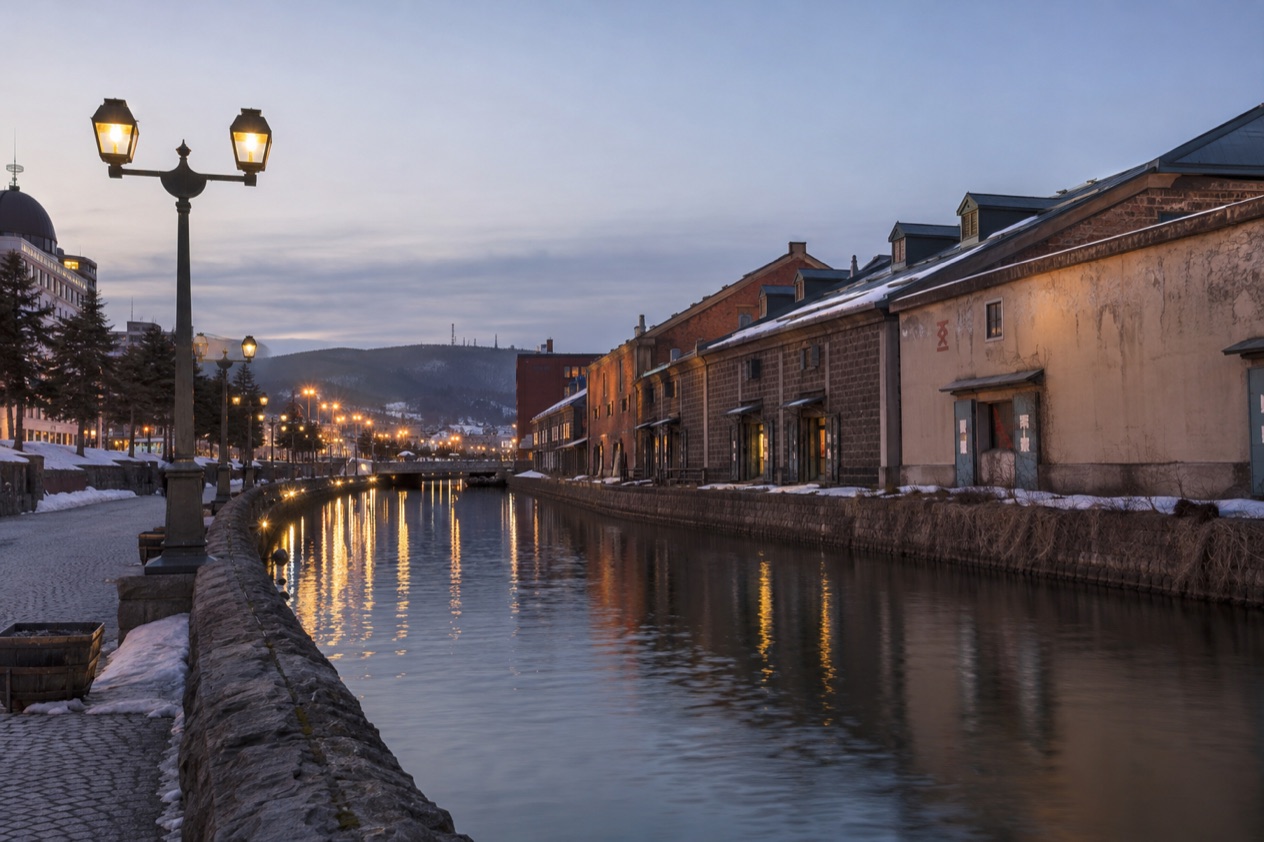
At dusk in Otaru, the gas lamps come on along the canal and the old warehouse walls turn amber, while the smell of grilled fish drifts out of the side streets. Boats once tied up here to unload cargo, and the brick and stone buildings still stand along the water. This is a harbor town on Hokkaido’s Sea of Japan coast, made for travelers who like to wander, eat seafood and browse small shops.
Where is Otaru and what is it like?
Otaru is a port city in Hokkaido, on the Sea of Japan coast, west of Sapporo. It faces Ishikari Bay and has long served as the main port of that bay. The town is a harbor first, and that history shapes everything you see: the canal, the warehouses, the streets that slope down toward the water.
The character is that of an old trading town that now welcomes visitors. Many historical buildings survive, and that is a large part of why Otaru is a popular tourist destination.
Banks, merchant houses and storehouses from the days when goods moved through the harbor now hold shops, cafés, restaurants and galleries. You tend to spend a day here the way you would in a small seaside town, drifting from one street to the next, stopping for a bowl of rice topped with raw fish, then for something sweet.
Otaru also has a place in Hokkaido’s story. In 1880 the first railway line on the island opened with daily service between Otaru and Sapporo. That link tied the harbor to the inland city, and it explains why the two towns still feel like a pair, with Otaru as the seaside half.
The climate adds to the mood. The yearly average temperature is modest, and winters here are less severe than in most other cities in Hokkaido, though they are still winters, with snow on the old rooftops and lamps glowing in it. Summers are warm and humid, with a light, seaside feel.
Otaru suits people who enjoy walking through a town, reading old facades and eating well. It suits couples, friends and anyone who wants a change of pace from a big city. Travelers who come for dramatic mountains, long hikes or nightlife on the scale of a major city will find a smaller, gentler place, one best taken slowly.
What is there to do in Otaru?
Otaru’s pleasures are a canal, historic buildings, seafood and the shops that fill the old streets. What sets it apart from its neighbors is the harbor-town setting: Sapporo is a large inland city, and Niseko is a mountain resort, while Otaru is a place of water, brick and stone.
The Otaru Canal and its gas lamps
The canal, completed in 1923, is the image people carry away from Otaru. A walkway follows the water, and gas lamps light it after dark, so evening is when the old warehouses take on their glow.
You stroll along the edge, look at the stone buildings across the water and stop wherever a café or a small shop catches your eye. Reflections of the lamps on the surface make the canal a favorite subject for photographs.
It is a place to wander rather than a sight to tick off. The warehouses along the water have been given new lives, and some hold restaurants and shops. Start from Otaru Station and the canal comes into view on foot, with no ticket to buy.
| Site | Admission | From Otaru Station |
|---|---|---|
| Otaru Canal | Free | 10-minute walk |
Historic buildings and the old streets
Beyond the canal, the town is full of buildings from its trading past. Look for heavy stonework, tall windows and the sturdy shapes of former banks and warehouses. Many are now shops, galleries or cafés, so you can step inside and see the old rooms as well as the facades.
The streets that lead away from the water reward slow browsing. Glassware and music boxes are among the things Otaru is known for in its shops, along with local sweets and baked goods. It is a good town for gifts, and for people who like to go in and out of small stores without a plan.
Seafood and the port
A port town eats from the sea, and Otaru is no exception. Sushi counters, rice bowls piled with raw seafood and grilled fish are the dishes to look for, usually in small restaurants near the harbor and along the streets around the station. Hokkaido’s seafood has a reputation across Japan, and here you eat it close to the water it came from.
Finish with something sweet. Otaru’s bakeries and confectioners sell cream-filled pastries, cheesecakes and soft ice cream, and travelers eat their way down a single street. The harbor, with Ishikari Bay beyond it, is a pleasant place to sit with a snack and watch the light change.
Winter lights and snow
In winter Otaru turns into a snow town. Usually in February the Snow Light Path festival sets small candle lanterns along the canal and the old railway line, so the water, the snow and the lamps glow together. Even outside the festival, snow on the warehouse roofs and the gas lamps along the canal give the town a storybook look.
How many days do you need in Otaru?
One full day covers the essentials, and two days give the town room to breathe. Because trains link Otaru and Sapporo throughout the day, travelers visit from Sapporo, but staying overnight changes the experience.
With a single day, you can walk the canal, wander the old streets, have a seafood lunch and browse the glass and music box shops. You see the harbor in daylight, then wait for the gas lamps if you stay into the evening. That is a satisfying sample of the town, though it moves quickly.
With a second day, the pace relaxes. You can return to the buildings you only glanced at, step inside the galleries and cafés, sit by the water and try a second or third restaurant. Staying overnight also means you see the canal after the day visitors have gone, when the lamps do their work and the town feels like itself.
Adding Sapporo
Sapporo is the obvious companion, since the two towns have been joined by rail since 1880. Pairing them gives you a big city with its shopping and restaurants and a harbor town with its old stone buildings. The contrast is the appeal: one is large and modern, the other smaller and rooted in its trading past.
Adding Niseko
Niseko, the mountain resort, can be reached from Otaru by local train, with only 8 services a day, all stopping at every station in between. The trip takes approximately 2 hours. If you plan to link the two, build the schedule around those few departures, and treat the ride itself as part of the day.
Where to stay in Otaru
The most convenient base is around Otaru Station, which puts the rail link to Sapporo and the start of the walk to the canal close together. From there you reach the water on foot, and you can head back to your room after dinner without worrying about the last train out of town.
Staying near the canal itself suits people who want the lamplit evenings on their doorstep. Couples and travelers who care more about atmosphere than convenience tend to favor this side of town.
A different option is to stay in Sapporo and visit Otaru by train. Trains run approximately every 20 minutes throughout the day, so the town works as an outing from the larger city. You give up the evening scene at the canal, but you gain Sapporo’s range of restaurants and lodging.
If your plans include Niseko, think about where the train runs. Services between Niseko and Otaru are limited, so choosing where to sleep is partly a question of which end of that line you want to wake up on. Otaru is the one that comes with a harbor, a canal and seafood for breakfast.
How do you get to Otaru and get around?
The way in is by train from Sapporo, on a line that has linked the two towns since 1880. Trains run approximately every 20 minutes throughout the day, and the fastest service, the Airport Rapid, takes 30 minutes from Sapporo.
From Niseko the connection is slower and less frequent. Only 8 local services run each day, stopping at all intermediate stations, and the journey takes approximately 2 hours. That makes the ride a matter of planning around a handful of departures rather than turning up at the platform.
Once you arrive at Otaru Station, the canal is a 10-minute walk away, and the walkway along the water is where most of the sightseeing happens. Much of what draws people here, the canal, the old buildings and the shops, is a matter of strolling from one spot to the next, and the town rewards going on foot with an open schedule.
Beyond the canal area, the old streets and the harbor give you plenty to see without needing anything more than comfortable shoes. In winter, with snow on the ground, walking takes longer and calls for good footwear, though the lamps and the snow make the time feel well spent.
When is the best time to visit Otaru?
Summer, from June through August, and February, for the winter lights, are the two moments to aim for. Summer brings warm, humid weather, with highs around 77°F, and the town feels light and open, ideal for walking along the water and eating outdoors when the weather suits.
February is the other draw. Snow settles on the old buildings, and the Snow Light Path festival, usually held that month, places small lanterns along the canal and the old railway line. Winters in Otaru are less severe than in most other cities in Hokkaido, but they are still winters, so expect snow underfoot and dress for it.
The seasons in between each have their own look, with the harbor and the old stone buildings as a constant backdrop. If your priority is the canal at night, any time works, since the gas lamps burn after dark whatever the weather.
Good to know before you go
Prices in Otaru are in yen, and the canal walkway is free, so a first walk along the water costs nothing. Summer is humid, which is worth remembering when you plan a day of walking. In winter, snow and cold make good shoes and warm layers the sensible choice. The town is small enough that a few unhurried hours reveal its character, and a longer stay lets you see it by both daylight and lamplight.
Sources
- Wikipedia, Otaru (https://en.wikipedia.org/wiki/Otaru), checked October 11, 2026
- Wikivoyage, Otaru (https://en.wikivoyage.org/wiki/Otaru), checked October 11, 2026
To plan your stay
- Best Time to Visit Japan: Cherry Blossoms, Autumn Colors, Weather and Festivals
- Where to Stay in Japan: Ryokan, Temple Stays, Capsule Hotels and the Best Cities to Base In
- Sending Luggage from the Airport in Japan: Hands-Free Travel, Hotel Delivery and Coin Lockers
- Know Before You Go to Japan: Entry, Money, Etiquette and Getting Around