
The ferry slides toward Miyajima, and behind the shrine’s floating gate the forested mass of Mount Misen fills the skyline, dark green against the sky. Deer wander the waterfront below it, and woodsmoke and the smell of grilled oysters drift from the lanes.
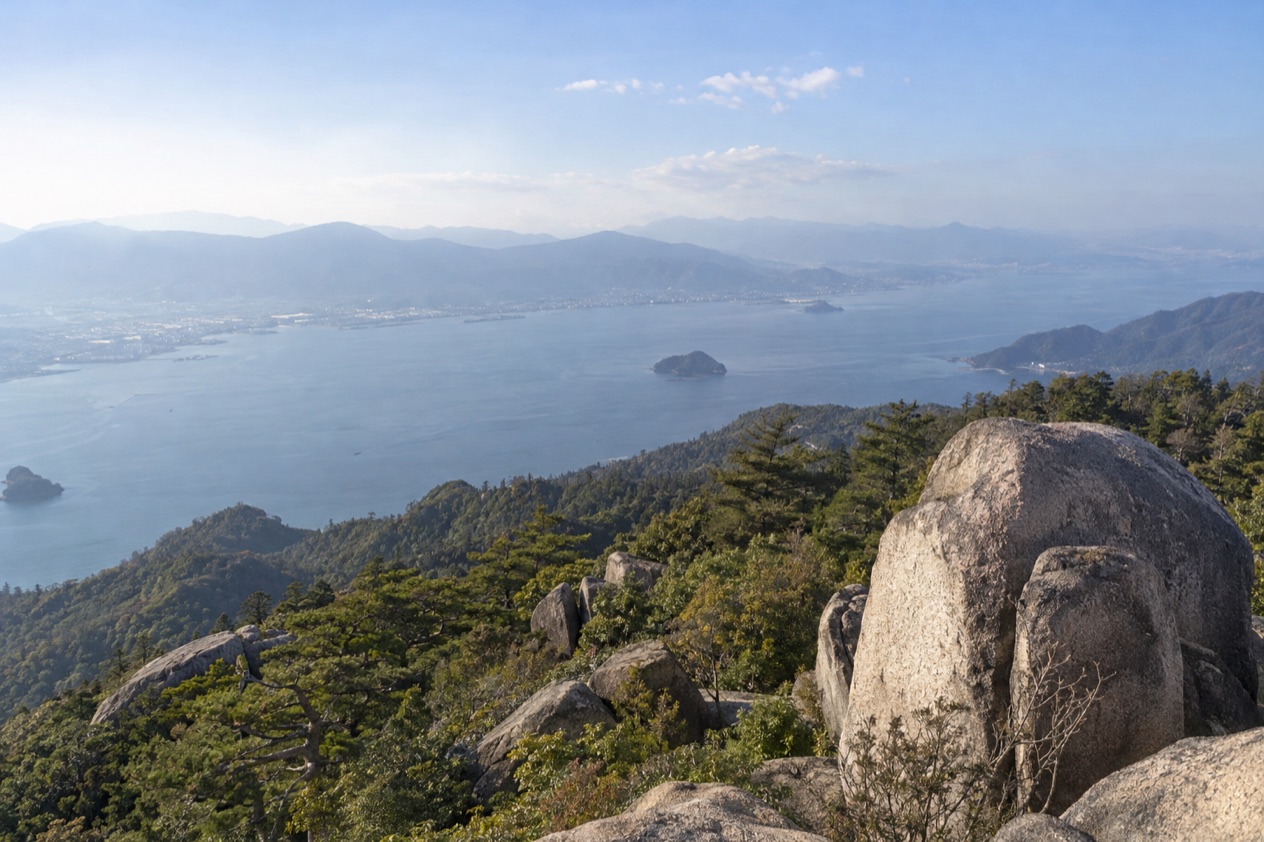
Is visiting Mount Misen worth it?
Yes, for travelers who want more from Miyajima than the shrine and the waterfront, and especially for anyone drawn to sacred mountains, old forest and a story that links the island to Hiroshima. Misen reaches 1,755 feet, so it is the island’s high point, and it gives the shrine below a setting you cannot grasp from the shore.
What sets it apart from the other sights nearby is that it is a living religious site rather than a single monument. The summit area holds a flame said to have been lit by Kobo Daishi, the monk Kukai, and the north side of the mountain is covered by primeval forest protected by Hiroshima prefecture.
The whole island lies within Setonaikai National Park, and the shrine at the base sits in a World Heritage area. Few places in the region combine a pilgrimage story, protected woodland and a view over an inland sea in one outing.
It suits travelers who like to spend half a day on one place rather than ticking off a list. If your time on Miyajima is only a stroll along the shore, you will still enjoy the island, but you will see the mountain only as a backdrop. Those who give it time come away with a sense of why the island has been called sacred for so long.
Miyajima is the popular nickname, meaning Shrine Island, while the island’s real name is Itsukushima. Misen is the mountain at the heart of that name, and the island’s religious life has long looked up toward it as much as out toward the gate in the water.
What to see at Mount Misen
The eternal flame, Kiezu-no-hi
Kiezu-no-hi means the fire that does not go out. Tradition holds that Kobo Daishi started it when he trained on the mountain in 806, and it still burns today, tended in a hall where a large iron kettle sits over the fire. The water boiled there is considered holy and is used to treat diseases, so pilgrims and visitors alike come to see the kettle and the glow beneath it.
The flame also carries a modern meaning. It was used as the pilot light for the Flame of Peace in Hiroshima Peace Memorial Park, which ties this quiet mountain hall to the city across the water. If you plan to visit the park later, the connection gives both places more weight.
The primeval forest on the north side
The north side of Mount Misen is covered by primeval forest, protected by Hiroshima prefecture, and it is the reason the mountain looks so dark and dense from the ferry. Old trees, moss and deep shade give the slopes a feel quite unlike the manicured gardens of the island’s shrines. You may hear birds and the rustle of wildlife long before you see anything.
Shigure-zakura, a cherry on the mountain, has been cut down and can no longer be seen, and Ryuoto No Sugi, a great cedar, is dead and only the stump remains. They still turn up in local stories, so it helps to know that what you find now is the stump and the memory rather than a living giant.
Kukai’s mountain and its temple hall
According to the Miyajima Tourist Association, Kukai visited Mount Misen in 806. He is the monk later known as Kobo Daishi, founder of the Shingon school of Buddhism, and the mountain has been tied to his name ever since. Halls, small statues and stone markers on the slopes reflect that Buddhist history, which sits alongside the Shinto shrine at the foot of the island.
That mix is typical of old Japanese holy places, where Buddhist and Shinto traditions have shared a mountain for centuries. Look for incense, offerings and weathered stone, and notice how the atmosphere changes as you leave the shoreline behind.
Momijidani-Koen, Maple Valley Park
At the foot of Mount Misen lies Momijidani-Koen, Maple Valley Park, a wooded valley whose name points to its maples. In autumn the leaves turn red and orange and light up the slope, while in other seasons the park is a green, shaded stretch beside a stream at the edge of the forest.
Pair it with the mountain as a before or after, since it sits where the island’s built-up streets meet the wilder slopes. It gives you a sense of the mountain’s character even if you do not go much higher.
When to visit Mount Misen
Mount Misen can be visited in any month, and each season gives it a different mood. The island’s shrine keeps hours that shift through the year, which is a useful guide to how long daylight lasts, since the mountain is a place for daytime. Itsukushima Shrine, at the base, opens as follows.
| Period | Itsukushima Shrine hours |
|---|---|
| March to October | 06:30 to 18:00 |
| November | 06:30 to 17:30 |
| December | 06:30 to 17:00 |
| January to February | 06:30 to 17:30 |
Autumn is the season most linked to Miyajima in the minds of travelers, because of the maples at Momijidani-Koen below the mountain. The leaves turn on their own schedule from one autumn to the next, so treat the color as a seasonal pleasure rather than a fixed date. Cooler air also suits a climb or a walk on the slopes better than the heat of midsummer.
Spring brings fresh green to the forest, and the woods feel soft and bright. Summer is leafy and humid, with thick shade under the trees, which is welcome on the slopes though the air can be heavy.
A clear day gives the best view over the water and the islands of the inland sea, while mist or cloud turns the forest into something closer to an ink painting. Neither is a disappointment, they are simply different visits. If the weather turns wet, the forest looks richer and the stone and moss deepen in color.
There is no festival or equinox date tied to Mount Misen in what we can say for certain, so plan around the season and the light rather than a single day. Shorter winter days are the one scheduling point worth keeping in mind, because the shrine’s closing time moves earlier as the year ends.
Tips for your visit
Getting to Miyajima is part of the experience. Frequent ferries, run by JR West (the JR Miyajima ferry) and by Miyajima Matsudai Tourist Ship, connect the island to the mainland at Miyajimaguchi, and the crossing takes about ten minutes. From the landing you head toward Momijidani-Koen and the foot of the mountain.
Another way to arrive is the express passenger ferry between Itsukushima and Hiroshima harbour, which runs hourly. It links the island with the city directly by water, a pleasant alternative if you are staying in Hiroshima and want to see the island from the sea on the way in.
Plan Misen as the main part of your Miyajima day rather than something squeezed in at the end. The mountain rewards unhurried time, and you will want room for the flame, the forest and the views. Leave the shoreline, the shrine and the shopping lanes for before or after.
Combining Misen with the rest of the island
Itsukushima Shrine lies within the World Heritage area at the water’s edge and fits naturally into the same day. Walking the shrine’s corridors and then looking up at the mountain behind it helps the geography make sense, and you see how the sacred peak and the shrine belong to one landscape.
Momijidani-Koen sits at the foot of the mountain, so it works as a lead-in or a cool-down. The lanes of the waterfront have grilled oysters, maple leaf shaped manju cakes and rice paddle souvenirs, and deer often wander among the stalls, so it is worth keeping food in a bag.
Linking the mountain to Hiroshima
Because the eternal flame served as the pilot light for the Flame of Peace in Hiroshima Peace Memorial Park, a day that includes both places has a thread running through it. Seeing the flame on the mountain and then the memorial park in the city gives the island a role in the region’s modern story as well as its ancient one.
Families and travelers with limited mobility should think about how much of the mountain they want to take on, since it is a real mountain rather than a garden. Momijidani-Koen and the shrine area at the base give a taste of the landscape for anyone who stays low, and you can still look up at the summit from the shore.
Good to know before you go
Bring yen for ferry tickets, snacks and small purchases on the island, and take any rubbish with you or dispose of it properly, since Misen is a sacred site and part of a national park. Deer roam freely near the waterfront and may nibble at paper and bags. Keep your voice low around the flame hall and the stone markers, as this is a place of worship as well as a viewpoint.
The island and its surrounding sea lie within Setonaikai National Park, and the north side of the mountain is protected forest, so staying on marked paths is the habit that suits the place. Rain and wind can arrive with the seasons, so a look at the sky before heading up costs nothing.
Sources
- Wikipedia, Mount Misen (https://en.wikipedia.org/wiki/Mount_Misen), checked October 11, 2026
- Wikipedia, Itsukushima (https://en.wikipedia.org/wiki/Itsukushima), checked October 11, 2026
- Wikivoyage, Miyajima (https://en.wikivoyage.org/wiki/Miyajima), checked October 11, 2026
To plan your stay
- Best Time to Visit Japan: Cherry Blossoms, Autumn Colors, Weather and Festivals
- Where to Stay in Japan: Ryokan, Temple Stays, Capsule Hotels and the Best Cities to Base In
- Sending Luggage from the Airport in Japan: Hands-Free Travel, Hotel Delivery and Coin Lockers
- Know Before You Go to Japan: Entry, Money, Etiquette and Getting Around