
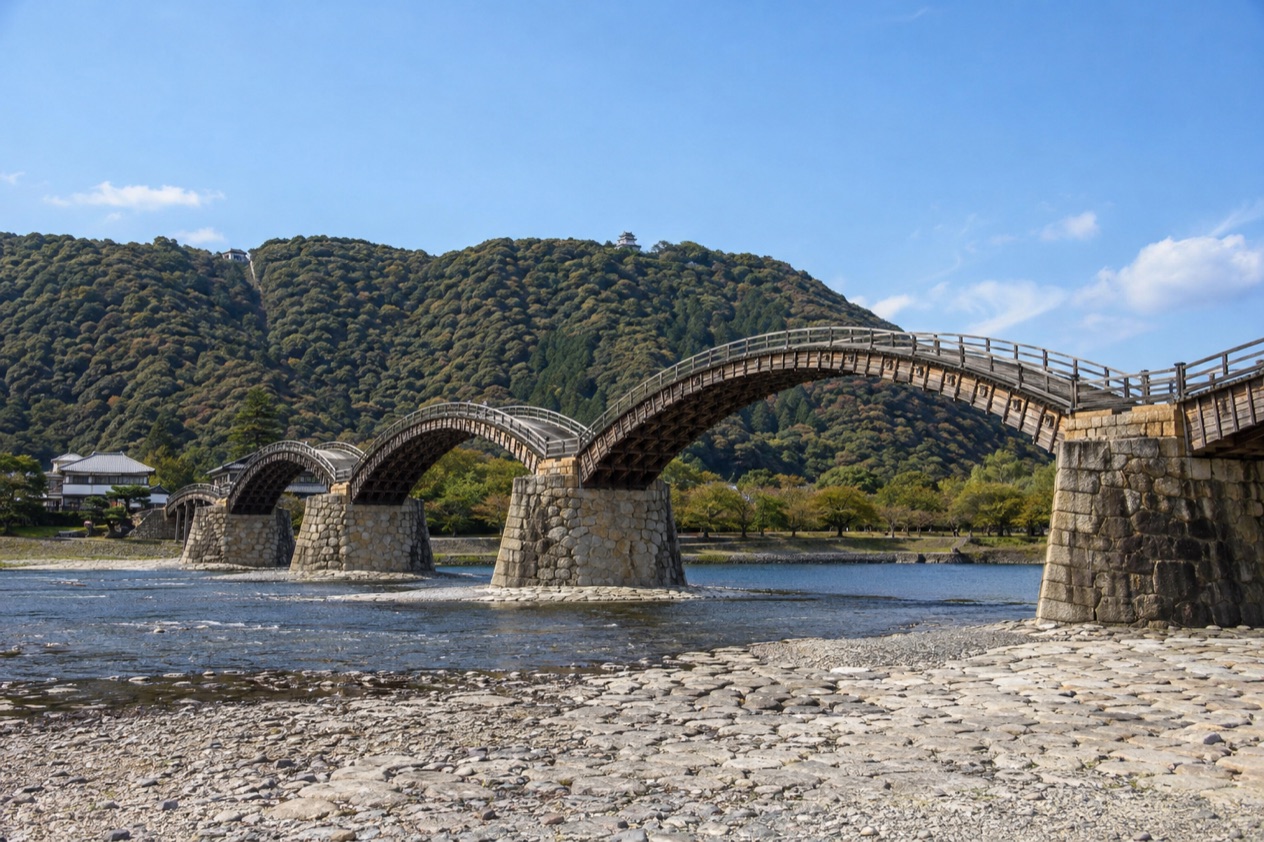
Footsteps sound different on Kintai Bridge, a dry knock of feet on wooden planks, while the Nishiki River slides by under five humped arches. Behind the far bank the green slope of Mt. Yokoyama rises toward a castle on its summit. This is a walk across one of Japan’s best-loved wooden bridges, set inside Kikkou Park in Iwakuni, and it suits anyone who likes a place with a story told in timber.
Is visiting Kintai Bridge worth it?
Yes, if you enjoy old structures with a clear idea behind them, and especially if you like to see how people in Japan solved a practical problem with wood and patience. The bridge is a National Treasure, it is a bridge you can cross on foot, and it sits at the base of a hill crowned by a castle, so a single stop gives you architecture, a river, a park and a view up to the keep.
What sets it apart from other historic sites in the area is the way it was built. Its five arches span the Nishiki River, and the whole design answers one question: how do you put a bridge across a river that floods?
The builders did not try to out-muscle the water. They made the walkway a removable layer that can float free, so that the structure underneath survives. Few bridges tell their engineering so plainly just by looking at them.
It also differs from the temples and castles that fill most Japan itineraries because the main attraction is something you use rather than only look at. You climb one arch, descend into the dip, climb the next, and feel the curve in your legs. That rhythm, plus the sight of the arches from the riverbank, is the heart of the visit.
The setting adds to the case. Kikkou Park gathers the bridge and Iwakuni Castle into one outing, and the park is a popular destination in the spring during the cherry blossom festival and in the fall when the Japanese maples change color.
If your trip passes through Yamaguchi Prefecture or along the Seto Inland Sea, this is a place that rewards a stop.
What to see at Kintai Bridge
The five arches and the walkway
The first thing you notice is the shape. Five wooden arches carry a pedestrian bridge across the Nishiki River, with a total length of about 175 meters, so the span feels long when you see it from the bank. The deck itself is narrow, only 5 meters wide, which gives the crossing an intimate scale despite the length of the whole.
Look at the underside from the riverbank if you can. The arches are built up from timber members that curve as a single sweeping line, and the reflection in the water often completes the circle.
On the bridge, notice how the planks rise and fall with each arch, and how the handrails follow the same curve. Cross it slowly and then turn back, because the view up the river changes when you face the other way.
Built without metal nails
For nearly three hundred years, Kintai Bridge stood without a single metal nail. Instead the carpenters relied on joinery, cutting wood so that the pieces lock into one another. This is the same family of skills that raises temple halls and old farmhouses in Japan, here applied to a structure that must flex and endure moving water.
The flood design is the clever part. The wooden pathway floats on top of its frame using mortise and tenon joints, which means that rising floodwater can lift the walkway away and spare the main structure. When you stand on the bridge you are standing on the sacrificial layer, and the real backbone is below. It is a good thing to keep in mind as you look at the underside of the arches.
A bridge with a long, interrupted history
The third lord of Iwakuni Domain, Kikkawa Hiroyoshi, had the bridge built in 1673. It did not last long: a flood destroyed it the following year. The lesson of that loss shaped the version that came next, and the design you see is the result of rethinking the problem rather than simply repeating it.
After that, the bridge was kept alive by regular rebuilding. The three middle spans were renewed on a shorter cycle than the two spans that meet the banks, a rhythm that kept the timber sound.
The bridge then stood for 276 years before the flood from typhoon Kijia washed it away in 1950. It was reconstructed in 1953 to resemble the original, and between 2001 and 2004 all five girders were restored for the first time in 50 years. In 1922 it had been declared a National Treasure of Japan.
Mt. Yokoyama and Iwakuni Castle
The bridge stands at the foot of Mt. Yokoyama, and at the top of the hill lies Iwakuni Castle. From the bridge you can look up at the wooded slope and the castle above it, which turns the bridge into the foreground of a larger picture. The castle and the bridge belong to the same story of the Iwakuni lords, so seeing them in one visit makes the place easier to understand.
Kikkou Park, which includes both the bridge and the castle, is where you can wander between the river and the hillside. It is the setting for the two seasons the park is known for: the cherry blossom festival in spring and the color change of the Japanese maples in the fall. Even outside those moments, the green of the slope and the line of the arches give the area a clear character.
When to visit Kintai Bridge
Spring and fall are the two seasons to aim for. Kikkou Park is a popular destination during the cherry blossom festival, when the park around the bridge and castle is dressed in pink, and again when the Japanese maples change color in the fall. In both, the wooden arches gain a frame of color that the bridge alone cannot offer.
Spring is the time for those who want the festival atmosphere, with blossoms over the riverbanks and the slope of Mt. Yokoyama. The exact timing of the bloom shifts from one spring to the next, so it is wise to follow the blossom reports as your dates approach rather than fix a day months ahead. The same is true of the maples in the fall, when the color moves across the hillside over a period of weeks rather than on a set day.
Summer and winter have their own appeal, especially for visitors who want the structure without the seasonal rush of color. In the warmer months the river is a fixture of local life, and cormorant fishing is a tradition associated with the Nishiki River. In winter the bare timber of the arches stands out clearly against the hillside. These are quieter seasons for the park’s foliage, but the bridge itself does not change.
Weather matters here more than at most sites, because the whole story of the bridge is about the river. A flood destroyed the first bridge, and a typhoon washed away the second after centuries of service.
Heavy rain is a reminder of why the design looks the way it does. If a rainy day is the one you have, the wet planks and the swollen river make the bridge’s purpose easy to grasp, and the castle hillside takes on a deeper green.
Opening hours and any admission for the bridge are not something to guess at, so confirm them locally when you arrive in Iwakuni. What can be said is that the bridge works as a stop for one part of a day, with the castle and the park filling the rest of the time you choose to spend there.
Tips for your visit
Think of the bridge as one stop inside Kikkou Park rather than a stand-alone sight. Bring comfortable shoes for crossing the planks and for wandering the park, and leave room in your plans for the castle on top of Mt. Yokoyama. The bridge, the riverbank and the hillside are best treated as a single visit so you can see the structure from several angles.
Getting to Iwakuni
Iwakuni sits in Yamaguchi Prefecture, bordering Hiroshima Prefecture to the east and the Seto Inland Sea to the south. The city is served by the JR West San’yo Shinkansen at Shin-Iwakuni Station, and by the JR West San’yo Main Line at Iwakuni Station, Minami-Iwakuni Station and other stations. Shin-Iwakuni is served only by the all-stops Kodama train, which is worth knowing when you plan your day.
From the stations, the bridge is reached by bus. It takes about 20 minutes from Iwakuni Station. From Shin-Iwakuni Station the ride is about 15 minutes.
Air travelers have another option, since ANA operates flights from Tokyo Haneda and Naha to Iwakuni Kintaikyo Airport. Elsewhere in the prefecture, flights from Haneda to Ube Airport take approximately two hours, and the Shin-Yamaguchi and Shin-Shimonoseki stations are served by the Sanyo Shinkansen line between Osaka and Fukuoka.
What to pair it with
The obvious companion is Iwakuni Castle, which stands at the top of Mt. Yokoyama above the bridge, and the rest of Kikkou Park. Together they make a coherent outing around the history of the Iwakuni lords. Combine them in a single visit so that the bridge you crossed becomes the foreground of the hill you look up at.
If your route continues through the prefecture, Yamaguchi is home to Akiyoshido, the largest limestone cave in Japan, which makes a very different kind of stop from a wooden bridge. Iwakuni is also known for a local style of pressed sushi, a good thing to look for at mealtime. Pairing a structure made of timber with a cave carved by water gives a trip through the region an unexpected symmetry.
Families and mobility
The deck is a narrow walkway, and its arches mean the surface rises and falls as you cross. Travelers with strollers, wheelchairs or difficulty with steps should keep that shape in mind when planning, and look at the bridge from the riverbank if crossing does not suit. Children often enjoy the up-and-down rhythm, and a short story about the floods and the floating deck can turn the crossing into a small lesson in engineering.
Good to know before you go
Kintai Bridge is a place to take at a walking pace, with a camera and an interest in how things are built. Spring and fall bring the festival and the maple color, and the river that shaped the bridge’s story is never far from your mind.
Since heavy rain and typhoons are part of its history, it makes sense to watch the forecast if your dates fall in a stormy period. Carry some yen for small purchases around the park, and keep in mind that the planks are wood, so wet weather changes how the crossing feels.
Sources
- Wikipedia, Kintai Bridge (https://en.wikipedia.org/wiki/Kintai_Bridge), checked October 11, 2026
- Japan National Tourism Organization, Iwakuni (https://www.japan.travel/en/destinations/chugoku/yamaguchi/), checked October 11, 2026
- Wikipedia, Iwakuni (https://en.wikipedia.org/wiki/Iwakuni), checked October 11, 2026
- Wikivoyage, Iwakuni (https://en.wikivoyage.org/wiki/Iwakuni), checked October 11, 2026
To plan your stay
- Best Time to Visit Japan: Cherry Blossoms, Autumn Colors, Weather and Festivals
- Where to Stay in Japan: Ryokan, Temple Stays, Capsule Hotels and the Best Cities to Base In
- Sending Luggage from the Airport in Japan: Hands-Free Travel, Hotel Delivery and Coin Lockers
- Know Before You Go to Japan: Entry, Money, Etiquette and Getting Around