
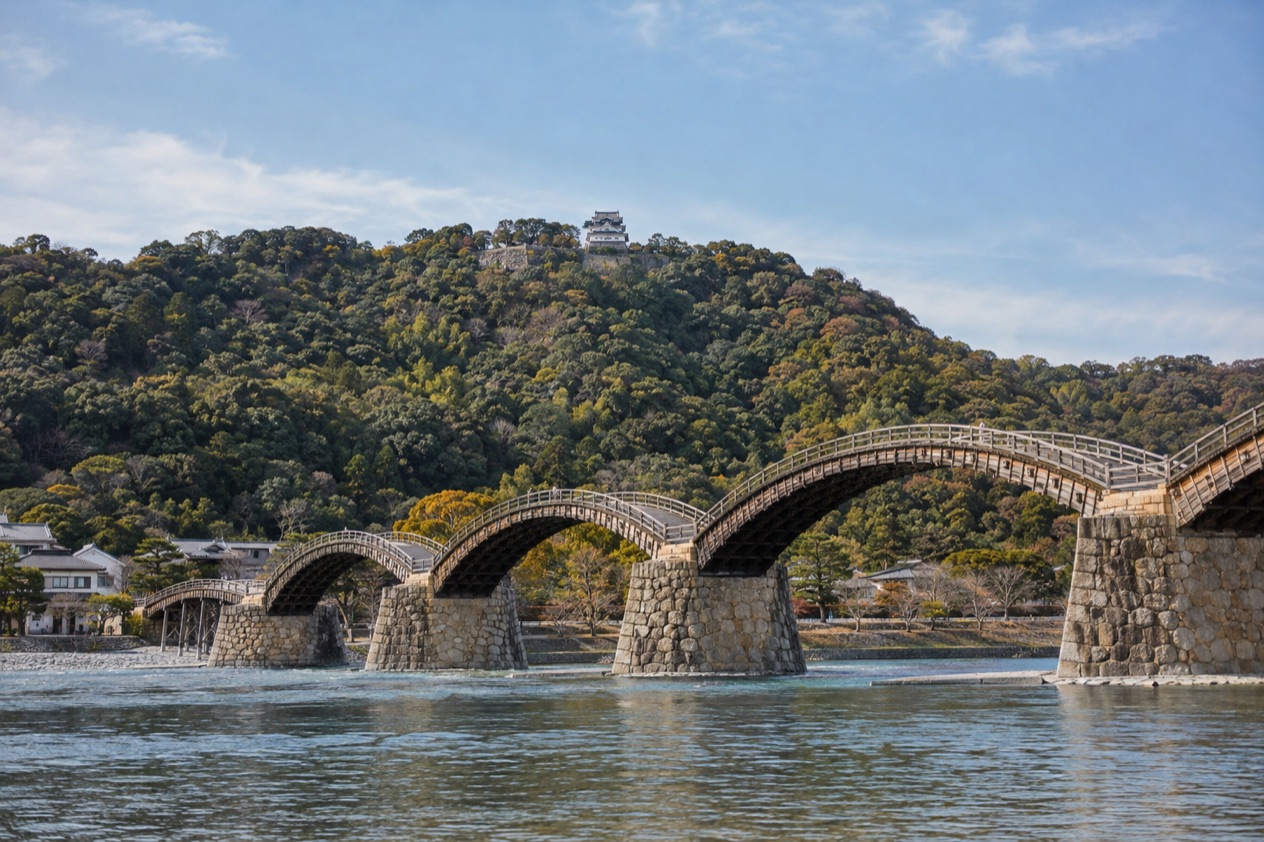
A wooden bridge rises in five arches over a wide, shallow river, and the reflection of each arch closes the circle in the water below. Beyond the far bank, a green hill carries the white castle keep above the roofs of the old samurai quarter.
It rewards those who stop on the way between Hiroshima and the western tip of Honshu, and those who enjoy a town that can be taken slowly, on foot, with a snack in hand.
Where is Iwakuni and what is it like?
Iwakuni sits in Yamaguchi Prefecture, in the Chugoku region at the western end of Honshu, with Hiroshima Prefecture on its eastern border and the Seto Inland Sea along its southern edge. It is a river-and-castle town rather than a resort or a big metropolis, and its identity is tied to the Nishiki River and the bridge that crosses it.
Shopping streets, train stations and neighborhoods spread across the flat ground, while the old part of town gathers near the river, where the bridge, a park, the former residences of the castle’s retainers and the hill with its keep all sit within reach of one another. You come here to look at craftsmanship, to stroll, and to eat local specialties, not to tick off a long list of attractions.
The Kintai Bridge is the sight that defines the place. It is a historical wooden arch bridge, and the original, according to the record, was built in 1673 using only wood and no metal nails. What you cross today is a reconstruction from 1953, and the most recent renovation was completed in 2004.
That layering matters, because the bridge is something the community has rebuilt and cared for over generations rather than a relic left alone. Seen from the riverbank, the arches echo the curve of the hills behind them, and on the water the reflection makes the shape feel complete.
Iwakuni suits travelers who enjoy history, photography, gardens and food, and who are happy to build a day around one landmark and its surroundings. It may disappoint anyone looking for a dense nightlife scene or a long list of museums and shows. Think of it as a place to slow down for a day or two, with a river on one side and the inland sea in the distance.
Iwakuni also works as a counterweight to the busier cities on a Japan itinerary. After the crowds and neon of the large metropolises, a town where the main event is a walk across a wooden bridge and a stroll through a cherry-lined park feels like a change of key.
What is there to do in Iwakuni?
The big reasons to come are the bridge, the park beside it, the white snakes and the town’s food. What separates Iwakuni from its neighbors is that these things cluster in one compact-feeling riverside district, so the day has a natural shape: cross, wander, look, eat.
Kintai Bridge
The bridge is the reason people arrive. Five wooden arches carry a walkway over the Nishiki River, and the structure is built with the kind of joinery that makes carpentry fans linger. Walking across it, you feel the timber underfoot and see the river bending away on both sides.
From the stations, a bus runs to the bridge. It takes about 20 minutes from Iwakuni Station and about 15 minutes from Shin-Iwakuni Station. Spend time looking at the bridge from the banks as well as walking over it, because the full curve of the arches shows best from a distance, and the reflection in the water adds a second set of arches.
Kikko Park and the white snakes
Kikko Park lies by the bridge and is a popular cherry blossom viewing spot in April. Even outside the bloom it works as a green pause, with paths, trees and the feel of a former castle-town estate. Locals use it for strolls, and visitors fold it into the walk to and from the bridge.
The park also holds a sanctuary for white snakes, which are found only in Iwakuni and are designated by the Japanese government as special national treasures. Seeing them is a curious, slightly unexpected stop, and children and animal lovers tend to remember it. The snakes are living creatures, so treat the visit as a chance to look rather than a guarantee of a particular view.
| Site | Open |
|---|---|
| Kikko Park | 24 hours a day |
The old town, the castle hill and the table
Around the river, the streets of the former castle town invite a slow wander. Look for old wooden facades, small shops selling local sweets and crafts, and the hill that carries the castle keep. A ropeway and a footpath are the usual ways of reaching the top, and the view over the river, the bridge and the roofs makes the effort worthwhile.
Iwakuni has its own food traditions, with pressed sushi in a wooden box and dishes made with lotus root among the local specialties you will see on menus. Pair a lunch of these with a walk along the river, and you have the core of a satisfying day. Sweet shops near the bridge sell treats to eat as you go.
How many days do you need in Iwakuni?
The bridge, the park with its snake sanctuary, the castle hill and a local lunch fit comfortably into a single day if you start from a base in town.
With a second day, you can take things at the pace the town invites. Walk the riverbanks twice, once to look at the bridge from the side and once to cross it. Spend longer in the old quarter, stop in cafés, and return to the park when you are ready for another look. If you visit in April, the cherry blossoms in Kikko Park give you a reason to linger.
With more time, the rest of Yamaguchi Prefecture opens up. Hagi, an old castle town, has five UNESCO World Heritage sites within it. Akiyoshido, the largest limestone cave in Japan, is another draw, and Karato Ichiba Market in Shimonoseki offers some of Japan’s best seafood. These are separate outings, each deserving its own day, and they work as extensions of a trip rather than additions to a short stay.
To the east, Hiroshima Prefecture borders Iwakuni, so the city fits naturally into a route that links the two. Many itineraries use Iwakuni as a stop between larger destinations, which makes a single night a sensible minimum if you want to see the bridge without rushing for a train.
Where to stay in Iwakuni
The choice comes down to three areas: near Iwakuni Station, near Shin-Iwakuni Station, and around the bridge and park. Each puts you in a different relation to the trains and the sights, so decide what matters most for your plans.
Staying near Iwakuni Station puts you in the part of the city served by the JR West San’yo Main Line. It suits travelers who want to use the local rail line and reach the bridge by bus. Minami-Iwakuni Station and other stops on the same line serve further neighborhoods, so there is some choice along the line.
Shin-Iwakuni Station is the Shinkansen stop. It is served only by the all-stops Kodama train, and it is a long ride from the old station, so it is best thought of as its own base. Choose it if you arrive or leave by Shinkansen and want to be near your train. From there, the bridge is about 15 minutes by bus.
Staying near the Kintai Bridge and Kikko Park places you where the old town begins. This is the choice for anyone who wants to wake up near the river and walk to the sights without planning around a bus. A ryokan, the traditional Japanese inn with tatami rooms and set meals, fits the setting well when one is available, though availability varies by property and you should confirm details with the place you choose.
Visitors treat Iwakuni as a one-night stop, so a place near whichever station you use for arrival or departure often makes the most practical base. If the riverside atmosphere is the point of your trip, the old town is the better pick.
How do you get to Iwakuni and get around?
You reach Iwakuni by train or by air. By rail, Shin-Iwakuni Station is on the San’yo Shinkansen operated by JR West, and the JR West San’yo Main Line serves Iwakuni Station, Minami-Iwakuni Station and other stations in the city.
Shin-Iwakuni Station is served only by the all-stops Kodama train, so not every Shinkansen service stops there, and it is a long ride from the old station. That fact shapes your arrival: look at which station your train uses, and think about which station is closer to where you plan to stay.
By air, ANA operates flights from Tokyo Haneda and Naha to Iwakuni Kintaikyo Airport. The airport’s name nods to the bridge, which tells you what the city wants you to see first.
Once in town, the bus connects the stations with the Kintai Bridge. The ride takes about 20 minutes from Iwakuni Station and about 15 minutes from Shin-Iwakuni Station. Around the bridge, the park and the old quarter, the sights sit together by the river, so on arrival you can move between them on foot.
Beyond Iwakuni, the same rail network leads to the rest of the region. The Sanyo Shinkansen runs between Osaka and Fukuoka and stops in Yamaguchi Prefecture at Shin-Yamaguchi and Shin-Shimonoseki, which helps if you plan to extend your trip to places such as Hagi or Shimonoseki. Flights from Tokyo’s Haneda Airport to Yamaguchi’s Ube Airport take approximately two hours, a separate option for the wider prefecture.
When is the best time to visit Iwakuni?
April is the month the town offers its most memorable picture, because Kikko Park is a popular cherry blossom viewing spot then. Pale pink branches over the paths and the river, with the bridge nearby, make for the kind of walk that people plan trips around. Bloom dates shift from one spring to the next, so treat April as the general window and not as a fixed week.
Outside the cherry blossom season, Iwakuni still works as a destination, because its main sights are a bridge, a river, a castle hill and a park, all of which are there in any month. Autumn and spring suit a walking day by the river, and the sights keep their character under different light and color across the year. Kikko Park is open 24 hours a day, so you can fit it around your own schedule.
Summer brings the heat and humidity typical of western Honshu, and the rainy season can turn a riverside walk into a short dash between shelters. In winter the town is calm and the sights remain accessible, though cold days call for warm layers. Whatever the month, plan for rain gear, since the weather can change the shape of a day outdoors.
Good to know before you go
Iwakuni is a town where the sights are outdoors, so a day here depends on the weather: bring comfortable shoes for the riverbanks, the park and the old streets, and rain gear for showery days. The bridge, the park and the white snake sanctuary are the heart of a visit, and a local lunch of regional specialties rounds it out.
If your plans include the cherry blossom season, think of April as the time to aim for, and keep a day of flexibility for the weather. In the rainy and typhoon seasons, keep an eye on forecasts and local announcements before heading out, and keep your schedule loose enough to adjust. As in other Japanese towns, simple courtesy goes a long way: take off your shoes where asked, keep your voice low in temples and ryokan, and carry your trash with you until you find a bin.
Sources
- Japan National Tourism Organization, Iwakuni (https://www.japan.travel/en/destinations/chugoku/yamaguchi/), checked October 11, 2026
- Wikipedia, Iwakuni (https://en.wikipedia.org/wiki/Iwakuni), checked October 11, 2026
- Wikivoyage, Iwakuni (https://en.wikivoyage.org/wiki/Iwakuni), checked October 11, 2026
- Wikipedia, Kintai Bridge (https://en.wikipedia.org/wiki/Kintai_Bridge), checked October 11, 2026
To plan your stay
- Best Time to Visit Japan: Cherry Blossoms, Autumn Colors, Weather and Festivals
- Where to Stay in Japan: Ryokan, Temple Stays, Capsule Hotels and the Best Cities to Base In
- Sending Luggage from the Airport in Japan: Hands-Free Travel, Hotel Delivery and Coin Lockers
- Know Before You Go to Japan: Entry, Money, Etiquette and Getting Around