
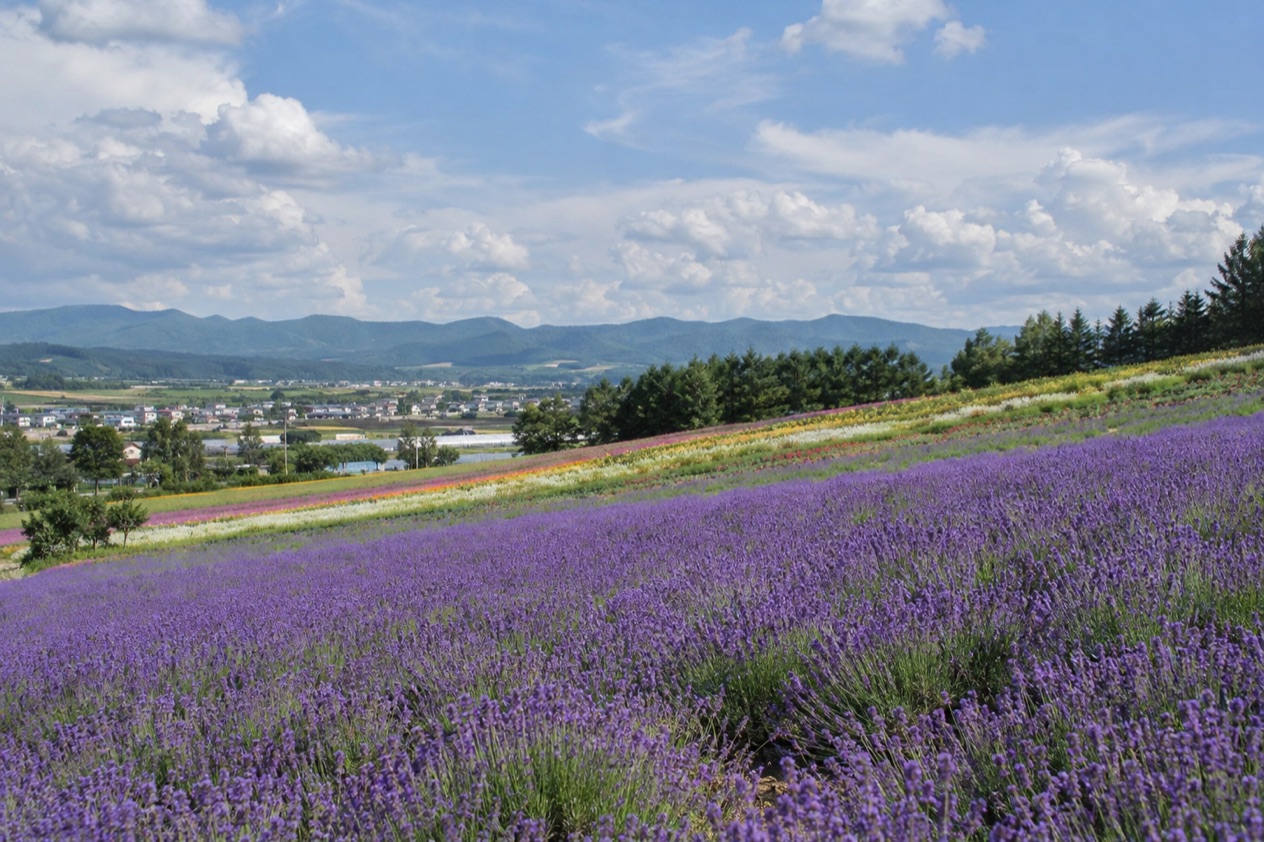
Rows of purple run straight toward the horizon in Nakafurano, broken by stripes of other flowers in orange, yellow and red, and the scent of lavender drifts across the farm paths. At Farm Tomita the colors are laid out like a painted hillside, and nearby farms add their own fields and lavender sweets. This is a visit built around flowers, slow walking and small treats made from the harvest.
Is visiting the Furano lavender fields worth it?
Yes, if you like gardens, color and a country setting, and especially if you are building a Hokkaido trip around summer flowers. The fields suit couples, families, photographers and anyone who enjoys a day outdoors that ends with ice cream or a bag of soap to carry home.
What sets Furano apart from other flower destinations is how much grows beyond the lavender itself. Farm Tomita is known for its wide lavender fields and for colorful seasonal blooms planted in bands alongside them, so the view is a patchwork instead of a single purple field. The farm also turns its harvest into essential oils, perfumes, soaps and food items, so what you smell in the field you can find again in the shop.
Furano has other draws too: a cheese factory and an ice milk factory that welcome visitors, the television drama Kita no Kuni kara that made the town familiar to many in Japan, and a ski resort for winter. The town sits at the geographic center of Hokkaido, which earned it the nickname Navel Town. In the flower season it feels like a place built for wandering from farm to farm, with a dairy stop in between.
Farm Tomita is one of Hokkaido’s most visited tourist destinations, so you will be sharing the view with other travelers. If you would rather see lavender after the main rush has passed, a second farm in town has an answer, described below.
What to see at the Furano lavender fields
Farm Tomita in Nakafurano
Farm Tomita is the name most travelers have in mind when they say Furano lavender. It lies in Nakafurano, in the Furano area of central Hokkaido, and it is known for expansive lavender fields along with colorful seasonal blooms. The flowers are planted in broad bands, so as you walk the paths the color changes from purple to warm orange and yellow shades.
Look for the way the rows follow the slope, and take time to smell the lavender up close, since the scent changes from one patch to the next. The farm also grows lavender for products, which is why you will find oils, perfumes and soaps in its shops, along with food items made with the flower. Lavender ice cream and sweets are the usual way to taste the crop.
Late-blooming lavender at Popuri Village
Furano Music Box Popuri Village specializes in cultivating late-blooming lavender. That matters if your dates are tight, because visitors can see the flowers even if they missed the main season. It is a useful second stop or a fallback if you arrive after the peak at other farms.
As the name suggests, the village also leans toward music boxes and gifts, so it mixes a flower walk with browsing. Pair it with Farm Tomita to compare how two farms present the same crop, one with its patchwork of bands and one with its extended season.
The cheese and ice milk factories
Furano has a Cheese Factory and an Ice Milk Factory listed among its tourist destinations, and they make a natural break between flower fields. Hokkaido is known across Japan for its dairy, and tasting fresh ice milk after a morning among the lavender is a pleasant counterpoint to the floral scent.
Go for the tasting and the look at local dairy products rather than for a long visit. These stops round out the day so that it is about food and the countryside as much as flowers.
Town festivals around the flowers
Furano keeps a calendar of local festivals. The Shoukon Festival takes place on June 15 and 16, the Hokkaido Belly Button Festival on July 28 and 29, and Furano Shrine’s Annual Festival on August 25 and 26. The belly button festival draws on the town’s nickname as the center of the island.
If one of those dates overlaps with your trip, it adds a street-level, local layer to a visit otherwise spent in the fields. Only the belly button festival falls in the same stretch as the flowers.
How to get to the Furano lavender fields
Furano is reached by rail, by bus or by car from the nearest bases, and the fields lie in the Furano area around Nakafurano. Rail is the most direct way to put the town on a map: Furano is served by JR Hokkaido’s Nemuro Line and Furano Line, and Furano Station is a stop on both.
From Asahikawa, Furano Bus operates a line called the Lavender Express between Asahikawa and Furano. Asahikawa Airport is approximately one hour from Furano by bus or car, which makes the airport a practical gateway if you are flying in to reach the flowers.
| From | Mode | Time |
|---|---|---|
| Asahikawa Airport | Bus or car | Approximately one hour |
Farm Tomita is in Nakafurano, within the Furano area, and Popuri Village is also in town. Once in Furano, you can plan the cheese factory and ice milk factory stops around the same visit. For schedules, stops and fares on the Lavender Express and the JR lines, rely on the operators themselves, since a flower trip depends on a timetable that shifts with the season.
Because Furano sits at the geographic center of Hokkaido, it works as a base for those traveling across the island. Furano Station is the rail point for the town, and the two JR lines that serve it make it a stop you can build a route around.
When to visit the Furano lavender fields
The best time to see the flower gardens in the Furano area is around July. That is when the lavender and the neighboring blooms form the bands of color the farms are known for, and it is the month most travelers aim for.
If July does not fit, remember that Popuri Village grows late-blooming lavender, so you can still see flowers after the main season has passed. That gives the trip some flexibility without forcing you to plan around a single week.
July also brings the Hokkaido Belly Button Festival on July 28 and 29, a good reason to stay in town in the last days of the month. Earlier in summer, the Shoukon Festival on June 15 and 16 falls before the main flower season, and Furano Shrine’s Annual Festival on August 25 and 26 comes after it.
Outside summer, Furano is better known for skiing. The Furano Ski Resort is owned and operated by Prince Hotels and has two skiing areas, Furano Zone and Kitanomine Zone, with one lift ticket valid for both. A winter visit is a different trip, but it shows that the town has a reason to be visited in more than one season.
Tips for your visit
Plan the day around more than lavender. Farm Tomita alone offers fields, seasonal flowers and a range of lavender products, so give yourself time to wander the paths and then browse the oils, perfumes, soaps and food items. Bring something to carry your purchases, and comfortable shoes for walking between flower beds.
A good combination for the area is Farm Tomita, a stop at the cheese factory or the ice milk factory, and then Popuri Village for its late lavender and its shops. This turns one flower farm into a full tour of Furano, with a mix of scenery and food.
Travelers who love photography will find the colored bands of seasonal flowers a rewarding subject beside the purple rows. Families can pair the fields with an ice milk stop, which gives children something to look forward to.
Because Farm Tomita is one of Hokkaido’s most visited tourist destinations, expect company on the paths. If you are traveling from Asahikawa Airport, build the transfer into your plan, since the trip takes approximately one hour by bus or car.
Good to know before you go
Furano is a town as well as a flower destination, so it is easy to fold the lavender into a broader Hokkaido itinerary that includes Asahikawa and the central part of the island. The farms sell lavender products, from essential oils to food items, which makes them a place to pick up gifts. Keep an eye on the weather through the summer, and treat the festival dates as fixed points when you build the rest of your plans.
Sources
- Wikipedia, Farm Tomita (https://en.wikipedia.org/wiki/Farm_Tomita), checked October 11, 2026
- Wikipedia, Furano, Hokkaido (https://en.wikipedia.org/wiki/Furano,_Hokkaido), checked October 11, 2026
- Wikivoyage, Furano (https://en.wikivoyage.org/wiki/Furano), checked October 11, 2026
To plan your stay
- Best Time to Visit Japan: Cherry Blossoms, Autumn Colors, Weather and Festivals
- Where to Stay in Japan: Ryokan, Temple Stays, Capsule Hotels and the Best Cities to Base In
- Sending Luggage from the Airport in Japan: Hands-Free Travel, Hotel Delivery and Coin Lockers
- Know Before You Go to Japan: Entry, Money, Etiquette and Getting Around