
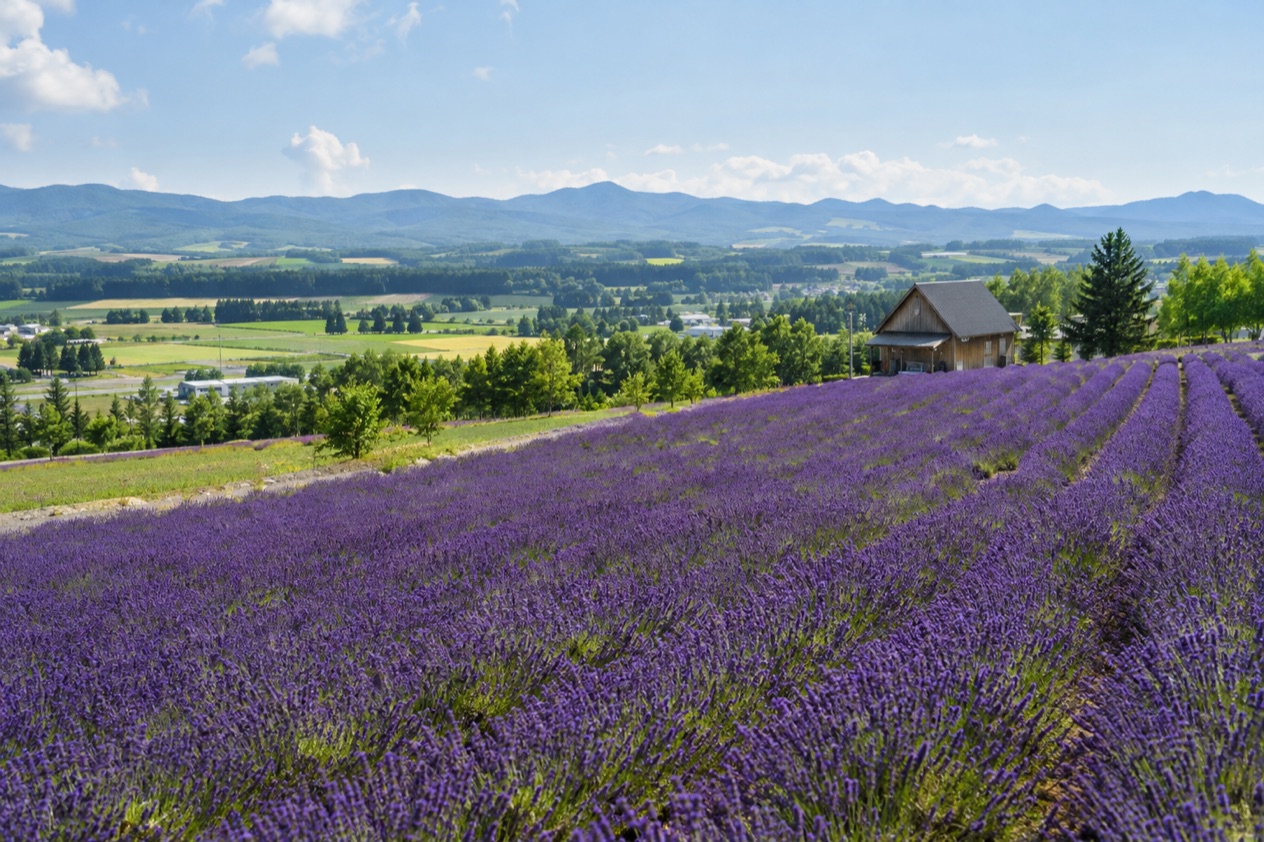
In July the hills around Furano turn purple, and the air over the farms smells of lavender while people drift between the rows with ice cream in hand. Come winter, the same slopes are white and the talk moves to lift lines and hot soup. Furano and Biei sit in the middle of Hokkaido, and they suit travelers who like open country, flower gardens and a slow drive between viewpoints.
Where is Furano and Biei and what is it like?
Furano and Biei lie in central Hokkaido, Japan’s northern island, in the southern part of Kamikawa Subprefecture. Furano is the larger name on the map, a city that bills itself as the Navel Town because it sits at the exact geographic center of the island. Biei is the neighboring town known for its pond with strikingly blue water, and Nakafurano, home of Farm Tomita, fills the space between them.
The character here is rural and open. Furano is famous for its lavender fields, for the television drama Kita no Kuni kara, which made its landscapes familiar to a Japanese audience, and for a ski resort that has hosted a Snowboarding World Cup. That mix gives the place two very different faces: a summer of flower gardens and farm stands, and a winter of snow and skiing.
The pace is unhurried. You come for fields, hills and viewpoints rather than for a long list of museums or nightlife, and the days tend to be built around where you stop and look.
Travelers who love landscape, photography and a countryside feel will be at home. Those who want a dense city of temples, shopping streets and late-night bars will find Sapporo a better match for that mood, and Furano is better as a counterweight to it. Two rail lines call at Furano Station, JR Hokkaido’s Nemuro Line and the Furano Line, which makes the town the natural anchor for the area in your mind, even if you spend most of your time out among the farms and hills.
What is there to do in Furano and Biei?
The reasons to come fall into a few clear groups: flowers in summer, a famous blue pond, skiing in winter and a local festival with a name nobody forgets. Each one gives the area a different feel, and together they explain why people return in more than one season.
Lavender and flower gardens
The flower gardens of the Furano area are the image most people carry in their heads, rows of color rolling over the hills under a big Hokkaido sky. Farm Tomita in Nakafurano is the name that comes up first when lavender is mentioned, and it is a place to wander slowly, camera in hand, stopping wherever a stripe of purple or another bloom catches your eye.
Around July is the best time to see the gardens. The season also brings the scent, which drifts across the fields and into the small shops selling lavender sweets, soaps and soft-serve ice cream. It suits couples, families and photographers equally well, and a leisurely afternoon is enough to sample more than one garden.
The Shirogane Blue Pond in Biei
The Shirogane Blue Pond in Biei is known for the color of its water and for the Japanese larch trees that stand around it. The pond looks almost unreal in photographs, and in person the pale blue against the dark trunks of the larches explains why it has become one of the images tied to Biei.
It is a place to look rather than to do, so it pairs well with the rest of a day in the hills. Combine it with a garden or a drive through the countryside and let the shape of the afternoon follow the light.
Skiing at Furano
Furano Ski Resort has hosted the Snowboarding World Cup, which tells you the slopes are taken seriously. The resort is made up of two skiing areas, Furano Zone and Kitanomine Zone, and a single lift ticket is valid for both, so you can move between them in a day without buying twice.
It suits skiers and snowboarders who want a mountain with a defined character and a town nearby for dinner. The same hills that hold flowers in July become the centerpiece of the winter trip, which is what sets Furano apart from places that are strong in only one season.
The Belly Button Festival
The Hokkaido Belly Button Festival is held in Furano on July 28 and 29. It plays on the town’s nickname as the center of the island, and it falls in the heart of the summer season, so it can be built into a trip that already includes the flower gardens.
Expect a lively street mood, with locals and visitors out together. It is a good fit for travelers who like to see a town at play rather than only its landscapes.
How many days do you need in Furano and Biei?
A long weekend is enough to see the essentials, and a few extra days let the area unfold at a gentler pace. The sights here are spread across hills and farmland, so the time goes to moving between them and stopping, not to ticking off a dense list.
With two or three days in summer, you can give one day to the flower gardens around Furano and Nakafurano, including Farm Tomita, and another to Biei and its blue pond. If your dates reach the end of July, the Belly Button Festival is an easy addition and gives the trip a clear highlight. In winter, the same short stay fits best around the slopes, with the two ski zones and a single lift ticket covering both.
A longer stay lets you repeat favorite spots at different times of day, linger at a garden without watching the clock and let a weather change decide the plan. It also leaves room for a ride on the rails, since Furano Station is a stop on two JR Hokkaido lines, and for a base from which to reach places farther afield in central Hokkaido.
If you are coming from Sapporo for a single day in summer, the seasonal lavender train described below makes that kind of outing possible, though the area rewards a night or two more. Asahikawa, with the nearest airport, also fits naturally at the start or end of a longer trip.
Where to stay in Furano and Biei
Furano town is the practical base, the place where the rail lines meet at Furano Station and where a visitor can pair a bed with the ski resort or the flower gardens. It suits travelers who like to have the town’s rail connections close, and it works in both summer and winter, since the ski zones and the farms are part of the same area.
Staying near the ski resort makes sense in winter, when the days revolve around the Furano Zone and the Kitanomine Zone and a single lift ticket covers both. Skiers and snowboarders will want to be close to the lifts, while those who come for the scenery may prefer the calmer feel of the town.
Biei offers a different rhythm, a small town in the hills that suits visitors whose main interest is the pond and the countryside. Nakafurano, home of Farm Tomita, is a natural pick for anyone building a trip around the lavender season, since it puts the gardens within reach.
A reasonable approach is to choose by season: Furano for winter skiing and for rail access, Nakafurano or Biei for a summer built around flowers and views. Whichever you pick, the distances between these places are part of the pleasure of the region, so the base matters less than the time you give to the surrounding hills.
How do you get to Furano and Biei and get around?
Asahikawa Airport is the nearest air gateway, roughly one hour from Furano by bus or car. From there you can reach the town and begin the trip without a long transfer, which suits travelers flying into Hokkaido specifically for the area.
By rail, Furano is served by JR Hokkaido’s Nemuro Line and Furano Line, and Furano Station is a stop on both. The train is tied to the flower season, so it is a summer option rather than a year-round one.
Once you are in the area, the rail stations tie the main towns together, while the gardens, the pond and the ski zones are spread across the hills. Bus and car are the other ways to cover the ground, and the one-hour link from Asahikawa Airport is described by the same two modes. How you combine them depends on whether you are basing yourself in Furano town or moving between Furano, Nakafurano and Biei.
Plan the day around where you want to stop, since the highlights are not clustered in a single walkable center. Furano Station is the fixed point for rail travelers, and the rest of the area unfolds from there.
When is the best time to visit Furano and Biei?
July is the month for flowers. Around that time the gardens of the Furano area are best, and the Hokkaido Belly Button Festival on July 28 and 29 adds a celebration to the calendar. The Furano Lavender Express runs from June to September, so the wider summer window is also open for visitors who prefer to arrive by train from Sapporo.
Winter is the other season, built around skiing at the Furano Ski Resort, with its two zones, Furano and Kitanomine, and a single lift ticket valid for both. The area hosted the Snowboarding World Cup, and that reputation is part of the draw for those who come when the hills are white.
The two seasons give the place two different trips, so the right month depends on whether you want color in the fields or snow on the slopes. For the Blue Pond and the surrounding larch trees, any season that fits your wider plans can work, since the pond is known for its blue water and the trees around it as a defining feature.
Good to know before you go
Furano and Biei are best treated as a countryside trip, so plan around the places you want to see and the transport that connects them. The summer lavender train and the link from Asahikawa Airport are the two arrival options the area offers most clearly, and the flower season around July and the winter ski season are the two periods that give the region its identity. Take your time between stops, and let the landscape set the pace.
Sources
- Wikipedia, Furano, Hokkaido (https://en.wikipedia.org/wiki/Furano,_Hokkaido), checked October 11, 2026
- Wikivoyage, Furano (https://en.wikivoyage.org/wiki/Furano), checked October 11, 2026
- Wikipedia, Farm Tomita (https://en.wikipedia.org/wiki/Farm_Tomita), checked October 11, 2026
- Wikipedia, Biei (https://en.wikipedia.org/wiki/Biei), checked October 11, 2026
To plan your stay
- Best Time to Visit Japan: Cherry Blossoms, Autumn Colors, Weather and Festivals
- Where to Stay in Japan: Ryokan, Temple Stays, Capsule Hotels and the Best Cities to Base In
- Sending Luggage from the Airport in Japan: Hands-Free Travel, Hotel Delivery and Coin Lockers
- Know Before You Go to Japan: Entry, Money, Etiquette and Getting Around