
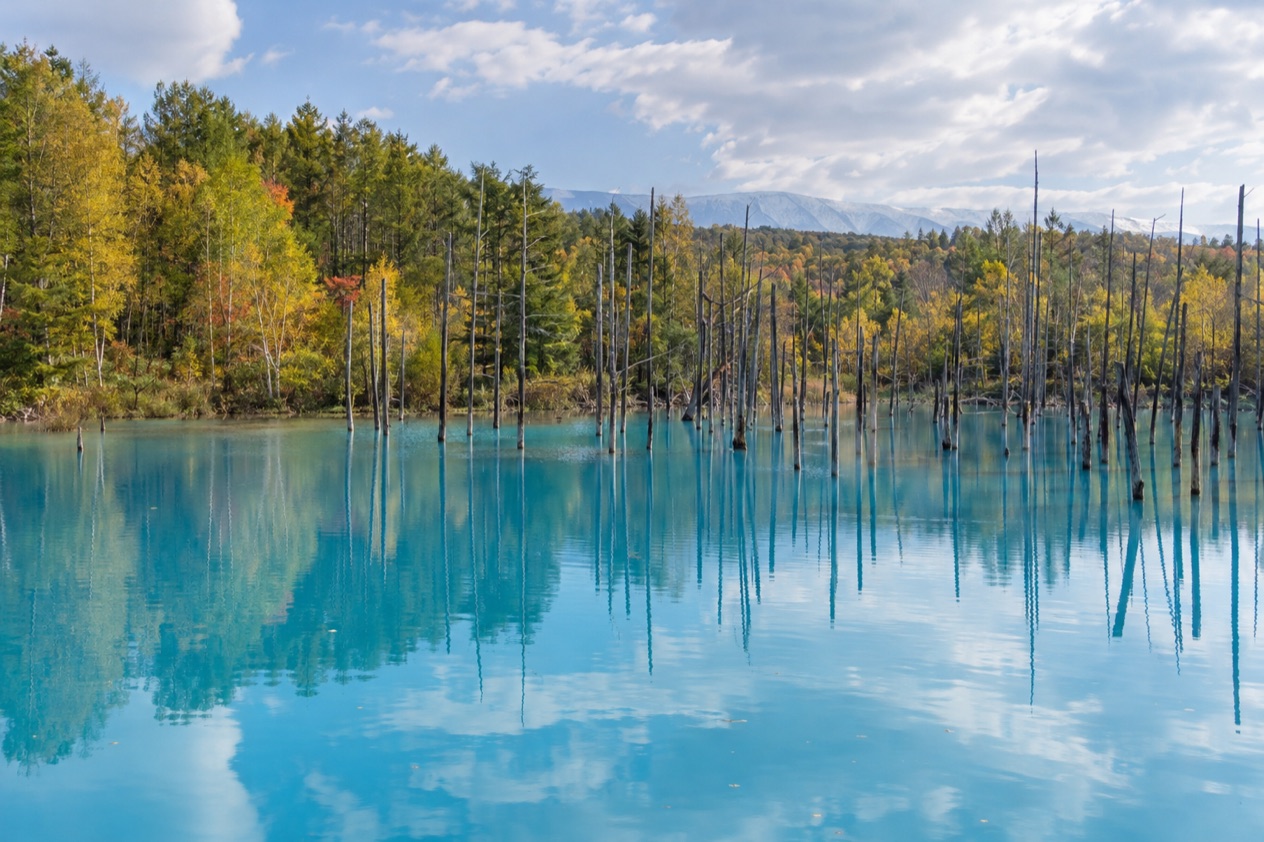
The first thing that stops people at the Shirogane Blue Pond is the color. The water is a milky, mineral blue that looks almost unreal against the green or gold of the Japanese larch trees around it.
Is visiting the Blue Pond in Biei worth it?
Yes, if you enjoy landscapes and photography, and if you are already planning to spend time in central Hokkaido. The pond rewards people who like to stand still and watch the color of the water shift with the sky. It is less satisfying for anyone who expects a long list of activities, because the pleasure here is looking.
What sets it apart from the other sights around Biei is how it came to be. The famous flower fields of the area are planted and tended by farmers. The blue of this pond is the opposite story, a color that resulted from aluminum added to the water to control mudslides. A piece of engineering turned into a view that people travel to see.
The setting adds to the effect. The pond is known for its blue water and for the Japanese larch trees that surround it, and the combination of a pale blue surface and slim trunks gives every photograph a calm, graphic look. Nothing else near Biei looks quite like it.
Most of the other attractions in the area are about color on a grand scale, rolling fields in summer and white hills in winter. The Blue Pond is a single, small, concentrated scene. That makes it a good counterpoint to a day spent driving or riding past farmland, and a reason to slow down between the bigger views. Pair it with the fields and you get both the wide landscape and the close one.
What to see at the Blue Pond in Biei
The blue water and how it came about
The water is the reason for the visit. Its blue color resulted from aluminum added to the water to control mudslides, so the pond belongs to the story of how this volcanic region protects itself from mud and debris. In the general telling, it began as a practical structure and only later became something people came to admire.
Look at how the shade of blue changes as you move around the edge. Water of this kind often reads as pale turquoise in one direction and a deeper, cloudier blue in another, depending on the sky and the angle of the light. Cloud cover tends to soften it, and clear skies tend to sharpen it, so a grayer day still gives you a pond worth seeing, only a different one.
The Japanese larch trees
The pond is surrounded by Japanese larch trees, and they are as much a part of the picture as the water. Larches are unusual among conifers because they change color and drop their needles, so the frame around the pond is not the same twice in a year. In green months the trees give the pond a soft border, and later in the year their needles turn golden.
Some trunks rise straight out of the water, thin and dark, and these are the shapes most photographers go looking for. Study how they reflect on the surface, because on a still day the trees seem to continue downward into the blue. It is a simple scene, and that simplicity is what makes it linger in the mind.
The pond in autumn
Autumn is when the Shirogane Blue Pond is especially scenic. The warm color of the larches sits against the cool blue of the water, a pairing of opposites that makes the pond look even more vivid than it does in summer.
If autumn light is what you are after, bring patience as well as a camera. The scene changes with every cloud that passes, and waiting for a bright interval is part of the experience. Walk the viewing points slowly and compare the same trees from different spots, since the shape of the shoreline changes the composition more than you might expect.
Shirogane Onsen nearby
The pond shares its name with the hot springs of Shirogane Onsen in Biei, which were discovered in 1950. The water there comes out at a temperature of 48°C, which is why the springs have become a place to warm up and rest after time outdoors.
An onsen is a Japanese hot spring bath, and visiting one after a day of walking and photographing is a long-standing way to round off an outing in Hokkaido. The bathing customs vary from one facility to another, so follow the signs at the entrance when you arrive.
How to get to the Blue Pond in Biei
Biei is the base for the Blue Pond, and the town sits in Kamikawa Subprefecture, Hokkaido, between Asahikawa and Furano. Those two names matter, because they are the places from which you reach Biei. You can come by train from Asahikawa Station or from Furano Station, or arrive by plane from Asahikawa.
If you are starting from Sapporo, the route runs first by train from Sapporo Station to Asahikawa Station, and from there on toward Biei. That makes Asahikawa the hinge of the journey, the place where the trains from the big city meet the line into the farming country.
Furano gives you a second way in. It is a city in Hokkaido Prefecture, in the southern part of Kamikawa Subprefecture, and it is described as lying at the geographic center of Hokkaido, which earned it the nickname Navel Town. Travelers who have been staying around Furano for its lavender fields or its ski resort can use the train from Furano Station to reach Biei.
The step between Biei itself and the pond is not something to improvise from memory, so settle it once you are in town. Ask at the station or at your lodging how people usually make that last leg. What matters for planning is the first part of the trip, which is Asahikawa or Furano on one side, Biei in the middle, and the pond within the town’s area.
Arriving by plane means landing at Asahikawa and continuing from there. For a trip that combines the Blue Pond with other parts of Hokkaido, the two stations of Asahikawa and Furano are useful anchors, since both link directly to Biei and each opens a different set of sights on either side of it.
When to visit the Blue Pond in Biei
Autumn is the season the pond is known for, since the Shirogane Blue Pond is especially scenic then, with golden larches around the blue water. If your trip is flexible, this is the time to build around.
Summer has its own pull, but it comes from the surrounding area rather than the pond alone. The bright colors of Biei’s fields attract thousands of visitors in July and August, and the Furano area’s flower gardens are best around July. A summer trip therefore puts the pond inside a much larger day of flowers, fields and lavender, and the town will be busier because of it.
Winter changes the whole landscape of Biei. Patchwork Road is known for its green color in summer and its white snow in winter, so the same hills that glow in July turn into a white, quiet expanse. If you come in the cold months, treat the Blue Pond as part of a snowy Hokkaido trip, and look to Furano’s two ski areas for the other highlight of the season.
There is no single hour that decides a good visit, since the color of the water depends on the sky above it. Build your day around the weather you actually have. A bright sky brings out the blue, and an overcast one gives a softer, more muted version, and both are worth the stop.
Tips for your visit
Plan the Blue Pond as one stop in a longer day rather than a full outing by itself. The pond is a single scene, and the area around Biei is built for combining views.
Combine it with Patchwork Road and Panorama Road
Patchwork Road is the most natural companion to the pond for a landscape day. It is known for its green color in summer and white snow in winter, and it is dotted with individually named trees, among them Mild Seven Hill, Ken and Mary Tree, Seven Star Tree, and Parents and Child Tree. Seeking them out turns the drive or ride into a small treasure hunt.
Panorama Road includes Shikisai Hill, a flower park known for its lavender and other flowers. It is the stop to add if your visit falls in the warm months, when the rows of color are the point. Together, the two roads and the pond give you three very different kinds of beauty in the same area, cultivated fields, named trees and a pond that is blue for reasons of engineering.
Stars, a museum and a hot spring
If you are staying into the evening, the Misora Hillside Local History Museum in Biei has an observatory with a 400mm reflecting telescope and a 150mm refracting telescope. It adds a different kind of looking to a day that has been about color, and it is a pleasant thought for those who like the night sky as much as the landscape.
After a day outdoors, Shirogane Onsen offers the other classic ending, a soak in the hot springs. Between the museum and the baths you can make an evening in Biei that has nothing to do with driving, and lets the pond stay in memory as a quiet morning or afternoon.
Behaving well in a farming town
Biei lives from its fields, and the town has taken visitor behavior seriously, with a Tourism Master Plan established in 2020 that aims to improve it. In practice, treat the countryside as someone’s workplace. Keep to the places meant for visitors, take your trash with you, and be thoughtful where you stop to photograph.
What you can plan for is the variety of the area, with parks, roads and hot springs that give each member of the group something to enjoy.
Good to know before you go
Rural Hokkaido rewards a little planning around the weather, because the scene and the season change what you will see, from golden larches in autumn to snow-covered hills in winter. Dress for the conditions of the month you choose and keep your plans loose enough to follow the sky.
Bring a way to pay that you are comfortable with, since small towns can feel different from the big cities. The Blue Pond is a place for looking, and a calm, unhurried visit suits it best.
Sources
- Wikipedia, Biei (https://en.wikipedia.org/wiki/Biei), checked October 11, 2026
- Wikipedia, Furano, Hokkaido (https://en.wikipedia.org/wiki/Furano,_Hokkaido), checked October 11, 2026
- Wikivoyage, Furano (https://en.wikivoyage.org/wiki/Furano), checked October 11, 2026
To plan your stay
- Best Time to Visit Japan: Cherry Blossoms, Autumn Colors, Weather and Festivals
- Where to Stay in Japan: Ryokan, Temple Stays, Capsule Hotels and the Best Cities to Base In
- Sending Luggage from the Airport in Japan: Hands-Free Travel, Hotel Delivery and Coin Lockers
- Know Before You Go to Japan: Entry, Money, Etiquette and Getting Around