
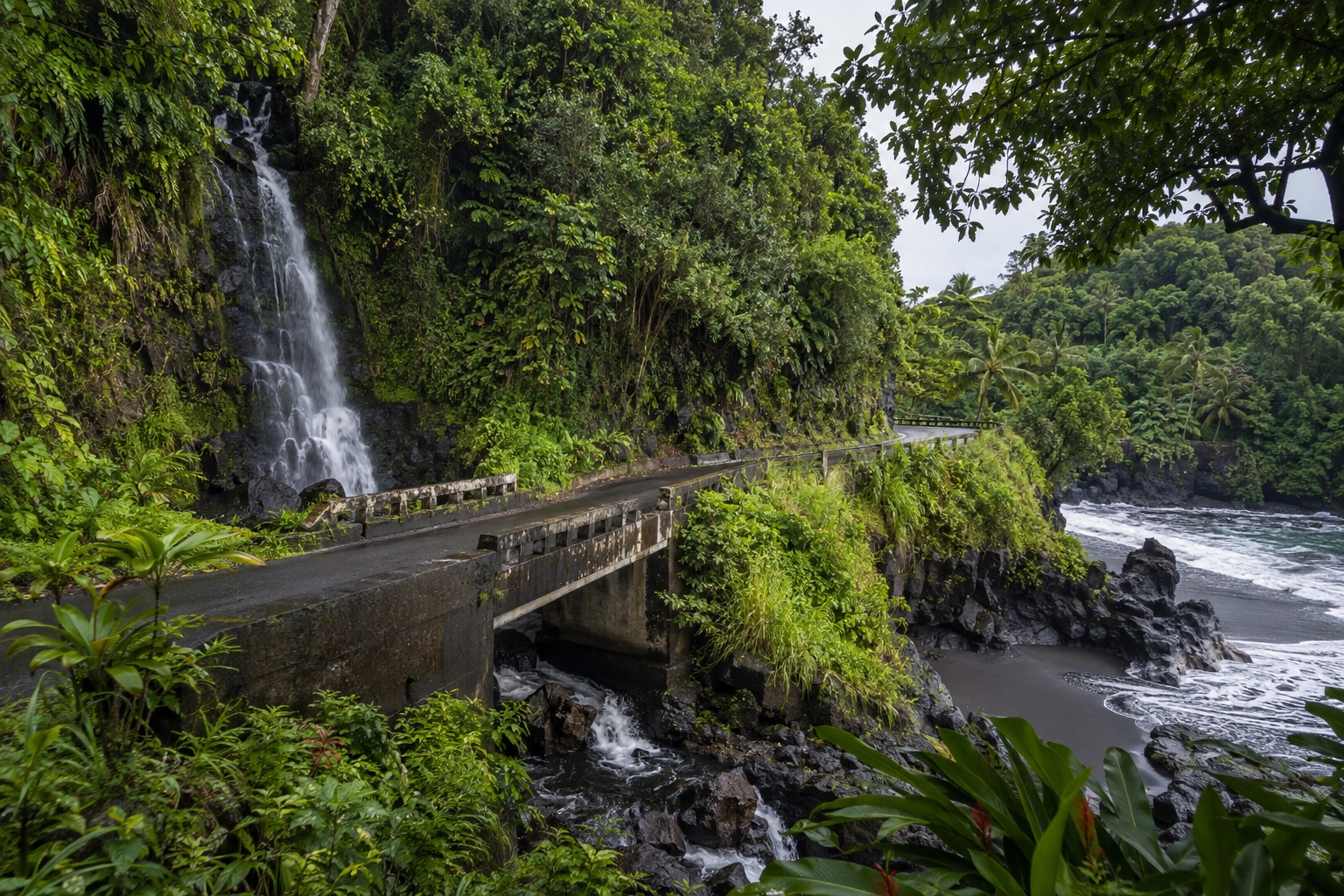
On the Road to Hana, the day starts with the smell of wet earth and ginger, and the curves tighten into a tunnel of rainforest where every bend hides another waterfall. Roadside stands sell banana bread and cold coconut, and the light changes by the minute between sun and passing showers. The drive is a lush, green day trip along Maui’s windward coast, and it feels different in the quiet, hot summer months than in the wetter winter, when the streams run full and the north shores roar.
When is the best time to visit the Road to Hana?
The easiest stretch runs from late spring through early fall, roughly May to September, when the air is warm, the days are long and the rain is a little less frequent, with June the driest of the year. Nothing here is truly dry, though. This is Maui’s wet side, and a shower can cross the road in any month.
For beaches and the sea, summer and early fall are the best bet. The ocean is at its warmest, the north-facing shores lose their winter swell, and a stop at the black sand of Waianapanapa feels like a real pause instead of a quick look from the edge. Winter turns the same coast rough and moody, which makes for dramatic photos but fewer reasons to get in the water.
For sightseeing, winter has its own pull. Streams and waterfalls run strong, the jungle is at its greenest, and the Pipiwai Trail at Kipahulu feels especially lush under the bamboo. The trade-off is slick pavement, muddy trails and a day that can turn gray. Summer gives you longer daylight to take the road slowly, which matters on a route of hundreds of curves and one-lane bridges.
For a quiet road, aim for the shoulder weeks between the holiday rushes, especially late April to May and September to early November. For families, spring break in March is loud: the road fills with rental cars, the pullouts overflow and patience on the one-lane bridges wears thin. Summer school vacation is busy too, but it spreads out more evenly, and warm water makes the stops easier for children.
The Road to Hana weather by month
The climate is warm and steady all year, with small swings in temperature and a steady supply of rain.
| Month | Average high (°F) | Average low (°F) | Rainfall (inches) | Sea (°F) |
|---|---|---|---|---|
| January | 77.8 | 64.8 | 5.64 | 77.5 |
| February | 77.3 | 65.0 | 5.45 | 76.4 |
| March | 77.5 | 65.7 | 8.46 | 75.8 |
| April | 78.2 | 67.4 | 5.00 | 76.2 |
| May | 79.7 | 68.4 | 5.43 | 76.9 |
| June | 81.1 | 69.8 | 4.45 | 78.3 |
| July | 81.7 | 71.2 | 5.49 | 79.2 |
| August | 82.9 | 71.7 | 5.99 | 79.5 |
| September | 82.5 | 70.3 | 6.12 | 80.2 |
| October | 81.9 | 70.5 | 6.88 | 80.1 |
| November | 80.2 | 69.8 | 6.65 | 79.5 |
| December | 78.8 | 68.0 | 6.59 | 78.4 |
The year has two moods. From May to October it is hotter and a little sunnier, with warm nights and afternoons that suit swimming and long stops. From November to April it is cooler and wetter, though the temperature barely drops, so a light rain jacket matters more than a sweater.
Rain is not only a winter story: late fall brings some of the heaviest months, and spring can turn soggy with a stalled system. The days are shortest in December, which leaves less margin for a slow drive back before dark.
When is the Road to Hana cheapest and least crowded?
The road is quietest in the weeks between the big travel rushes, mainly late April through May and again from September to early November. Rooms in Hana and the nearby towns are easier to find then, the pullouts have space, and the beaches feel like a few people instead of a crowd.
The busy stretches are easy to name. Spring break brings families from the mainland in March and early April, summer fills the island with school vacation travelers, and the winter holidays from Christmas through New Year are the busiest of all. Easter week adds another surge. In those weeks the road moves slowly, popular stops fill early and peak-season rates apply to rooms.
Crowds matter more here than on most drives because the road is narrow and the bridges are one lane. A busy day means waiting your turn at every crossing and finding fewer places to pull over. At Waianapanapa, a reservation is needed for every visitor, so the black sand beach is rarely a spur-of-the-moment stop, and the quiet months make planning a little more relaxed.
Which months should you avoid in the Road to Hana?
No month is a bad idea, but the late fall and the heart of the hurricane season deserve a little thought. The Central Pacific hurricane season runs from June 1 to November 30, and it overlaps with the warmest weeks of the year. Hawaii is rarely hit, yet a storm system or its remnants can bring heavy rain to a coast that is already wet.
The wettest months on this side of Maui are the stretch from autumn into early winter, plus March, which can be unexpectedly soggy. Heavy rain makes the road slick, swells the streams and can make trails muddy. It is a good reason to keep plans flexible and to leave generous time for the drive.
Winter has another face: big surf along the north shores. It is spectacular from a safe distance, but it makes many coastal stops less inviting for swimming. If you want to get in the water, the warmer months usually offer better odds, though locals read the posted warnings and the day’s surf and currents before going in, and they swim near a lifeguard only where one is on duty.
When can you swim in the Road to Hana?
The water is comfortable for most of the year, and warmest from late summer into early fall. In those months the sea feels pleasantly warm, and even in the cooler early spring it is mild enough that a quick dip is not a shock.
What changes more than the temperature is the surf. Summer is usually gentler along the north shore, while winter swell can make beaches rough, with strong currents. At Waianapanapa and the small coves along the coast, you should read the posted warnings and check the day’s surf and currents before you go in the water, and swim near a lifeguard only where one is on duty, never by the season alone.
Not every pool is open to bathers either. The Pools of Oheo at Kipahulu are closed to entry for safety, so you view them from the Kuloa Point Trail. Elsewhere, streams and waterfall basins can rise quickly after rain, so for most visitors the Road to Hana is a day for looking, walking and short beach stops rather than long swims.
Festivals and events in the Road to Hana through the year
Winter holidays and humpback whales
Christmas and New Year bring the biggest crowds to Maui, and the Hana side feels it too. The road is busy, rooms fill early, and small stands run out of banana bread by midday. It is a festive time, with lights in town and a warm, slightly wet air that makes holiday cheer feel very un-mainland.
Winter is also humpback whale season in Hawaii. From the high points along the coast you can sometimes spot spouts and tail slaps offshore, especially on calm mornings. It is worth stopping at a safe pullout and scanning the horizon, since the whales do not keep a schedule and the sightings are never guaranteed.
If you come for the winter, plan for big surf on exposed shores and for rain that can arrive fast. Waterfalls look their best, so it is a rewarding time for photography, provided you leave room in the day for a slower drive.
Spring and summer: Lei Day, Kamehameha Day and fruit stands
May 1 is Lei Day across Hawaii, a celebration of the flower garland and of aloha itself. On Maui it shows up in schools, shops and community gatherings, and the roadside stands near Hana often have fresh flowers and leis for sale. It is a gentle, local moment that fits the slow rhythm of the road.
June 11 is Kamehameha Day, a state holiday honoring the king who united the islands. Expect parades, floral leis draped over statues and a lively mood in towns around the island. Hana is small, so the day is felt more in the atmosphere than in big events, and the road may be busier with locals out for the holiday.
Through the summer the stands along the road are the real attraction: banana bread, fresh fruit, coconut and shave ice. They are small, often run by neighbors, and they give the drive its easy, unhurried feel. Stop where it is legal and friendly to do so, and remember that many parcels along the road are private land.
Sources
- Hawaii DOT, Final Environmental Assessment « Hana Highway Bridge Improvements Project » (Sept. 2024), files.hawaii.gov/dbedt/erp, checked September 25, 2026
- Hawaii DOT, Final EA Hana Highway Bridge Improvements (Sept. 2024), checked September 25, 2026
- Hawaii DLNR Division of State Parks, dlnr.hawaii.gov/dsp/parks/maui/waianapanapa-state-park, checked September 25, 2026
- gostateparks.hawaii.gov/waianapanapa/about, checked September 25, 2026
- Hawaii DLNR Division of State Parks, waianapanapa-state-park, checked September 25, 2026
- National Park Service, nps.gov/hale/planyourvisit/kipahulu.htm, checked September 25, 2026
- National Park Service, nps.gov/hale/planyourvisit/fees.htm, checked September 25, 2026
- NOAA NCEI, monthly normals 1991-2020, station USC00511125, checked September 8, 2026
- Open-Meteo Marine API, average 2015-2024, checked September 8, 2026
- sunrise-sunset.org, sunrise and sunset calculated for the 15th of the month, checked September 8, 2026
- NWS Honolulu / Central Pacific Hurricane Center, « 2026 Central Pacific Hurricane Season Outlook », weather.gov/hfo/hurricaneOutlook2026, checked September 24, 2026