
Mykonos suits travelers who want beaches, nightlife, a walkable town and slightly thinner crowds. Santorini is the island for the view, and for honeymoons, photography and sunsets over a flooded volcano. If you have just two days for one island, Santorini tends to make the bigger impression quickly, because the caldera needs no warm-up. For a longer stay, Mykonos holds up better, with more beaches to rotate through and crowds that are easier to escape.
What are Santorini and Mykonos like?
Mykonos Town is a maze of narrow, twisting lanes between white buildings with shutters painted pink, royal blue and turquoise. Bougainvillea frames the doorways, and tiny cafés serve frothy iced coffee. The island is fairly flat, so the town spreads out, and a few streets from the busiest lane the crowds thin within minutes. Go in the morning, before the day-trippers arrive, and drift until the lanes open onto Little Venice, with its houses hanging over the water and the windmills behind.
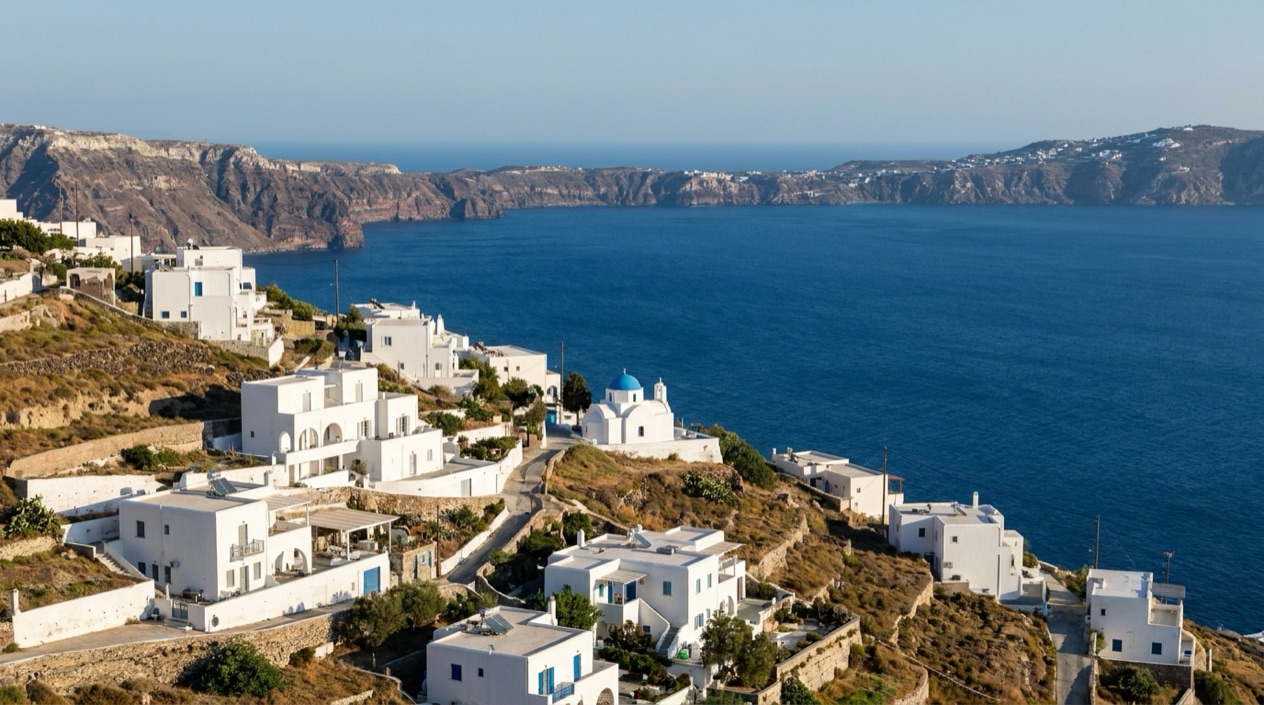
Santorini is a flooded volcano crater, and Oia and Fira sit on its rim, more than 1,000 feet (300 meters) above the sea. The drop is sheer, and the water below is a deep jewel blue. White villages are stacked into the cliff, and the main towns are mostly two or three parallel streets squeezed along the edge. Outside early morning and after sunset, those lanes can be shoulder to shoulder.
Both islands are packed in July and August, largely because cruise ships call almost daily. When several cruise ships are docked, the main towns tend to get very busy, so you may want to spend that day elsewhere.
Which island has better beaches?
Mykonos, and it isn't close. Each beach on the island has its own mood, and Mykonos is known as Greece's beach club island. Many beaches come with big bars where the bass is pumping, open sand can be scarce, and you'll usually pay for a lounger.
Santorini's beaches are for looking at. The black volcanic sand and the famous Red Beach make striking photos, but the Red Beach means a crammed parking lot, a rocky, narrow path and big rocks with little room to sit. Some of the rocky beaches can often be reached only by boat. For an actual beach day, head to the black sand at Perissa and Perivolos, on the side of the island away from the caldera. It is roomier and calmer, with hotel loungers and beer stops along the shore. Kamari, a little farther north, has a similar feel. On either island, the sea is not Caribbean-warm and cools quickly in spring and fall.
Which island has better nightlife?
Mykonos is the party island, often called the Ibiza of Greece. Scorpios beach club hosts a sunset ritual that draws far more than the party crowd, and because the town faces west, the bars of Little Venice and the 180 Sunset Bar watch the sun drop straight ahead. To skip the cocktail scene, drive up to the Armenistis lighthouse in the northwest corner, with views of the surrounding islands. Drinks are expensive, and in summer the popular spots fill fast, so reserve tables well ahead.
Santorini keeps it low-key and romantic. Oia has little in the way of bars or clubs, so the livelier spots are in Fira. A glass of wine at the cliff edge as the sun sets is a beloved evening habit, and the cafés, restaurants and wine bars along the rim each promote their own view. Reserve a table with a view in advance, which also keeps you out of the crush that fills the lanes at sunset.
Which island has more to see and do?
Give Oia and Fira a day of their own, since these caldera villages appear in so many Santorini photos and tend to be among the most crowded spots on the island. At Akrotiri, an ancient Minoan city lies preserved under volcanic ash, much like Pompeii, a window into daily life before the eruption that shaped the island. A boat ride from Oia takes you to Nea Kameni, where you can hike the volcano, and some cruises add the nearby hot springs. Catamaran tours sail around the island, and an evening cruise lets you watch the sunset from the water, away from the crowds on shore. For a calmer sunset, settle in at a winery: Santo Wines is the best known, so reserve a couple of days ahead, and Venetsanos nearby also needs a booking.
Mykonos has less sightseeing overall, which suits a slow trip. Wander the whitewashed lanes and designer shops of Mykonos Town, look out at the windmills above the Aegean, and set aside a day for Delos, a UNESCO World Heritage Site said to be where Apollo and Artemis were born, with ancient temples, mosaics and an amphitheater. Mykonos is also a handy base for island hopping: Tinos is about 15 minutes away by ferry, Naxos about 40 minutes, and Paros under an hour.
Is Santorini or Mykonos more expensive?
Both are expensive by European standards, and from June to August expect to pay about 50% more than on nearby islands like Naxos or Sifnos. Mykonos gives you more range. You can sleep in a luxury hotel or a simple room a short walk from the old town, and eat at a glamorous restaurant or grab a cheap gyro, a café sandwich or a slice from one of the bakeries.
Santorini skews higher, with restaurant markups and its famous budget-busting hotels. Oia is the priciest town, and hotels outside it can keep the caldera view for less. Many of the 5-star rooms are stacked close together, with less privacy than the rate suggests. On either island, eating outside the main towns brings the bill down, and the shoulder months of May and September are easier on both budget and crowds.
How do you get to Santorini and Mykonos and get around?
Both islands have international airports with flights from Athens and other European cities. By ferry from Athens, Mykonos is closer: under three hours on a fast ferry such as Seajets, four to six on a larger Blue Star boat. Santorini lies farther south, and the trip takes at least five hours on the fast boats and up to eight on slower routes. Fast boats can get pricey and fill up in summer, so book ahead, and double check your stop, since some ferries are not direct.
On Mykonos, the Old Port is within walking distance of most hotels in town. Most ferries and cruise ships use the New Port, linked to the Old Port by the Sea Bus, and many hotels offer a free transfer. Santorini's ferries dock at Athinios, a notoriously crowded, chaotic port. Buses meet arrivals for the roughly 20-minute ride to Fira, but arranging a hotel transfer in advance saves a scramble.
On the ground, Mykonos is the easier island. Much of the action is in the main town, and the buses need fewer transfers, though they get crowded. Renting a car is doable, if a little nerve-racking on sharp turns and steep inclines, and it opens up the lesser-known beaches and spots like Kikis Tavern, a hidden-gem restaurant with no electricity. Santorini's cliffs, hairpin turns and narrow roads are tougher, and buses have the right of way, so cars often back into tiny spaces to let them pass. The buses themselves are slow and infrequent, and many routes need a transfer. Some visitors skip driving there, while careful drivers find a car a quick way to cover the island. Rental offers greet you at the port, but booking ahead is safer, and paying with a travel credit card adds insurance protection. ATVs cost about the same as a car and are slower and less safe.
If you drive, Greek law requires a valid U.S. driver's license, and insurance companies may require an international driver’s permit. Talking or texting on a phone while driving is illegal. Greece has one of the highest traffic fatality rates in the European Union, and thieves break into rental cars looking for passports, valuables and luggage, so it is wise to take your belongings with you.
Which island is better for couples, families or groups?
- Honeymooners: Santorini, especially Oia, for cave and boutique hotels with private pools, hot tubs and terraces over the caldera.
- Photographers: Santorini, where the white buildings stacked down the cliff make a backdrop almost any shot toward the sea can use.
- Beach lovers and nightlife fans: Mykonos.
- Families: both work, but Mykonos is easier to walk, and the calm water at Platis Gialos has family-friendly resorts close by.
- Friend groups, solo travelers and mixed budgets: Mykonos, which suits many kinds of trips.
- Hikers: Santorini, for the Fira to Oia trail and its sweeping scenery.
- Wine lovers: Santorini, where volcanic soil produces distinctive wines like Assyrtiko, and Sigalas, in the north, offers serious tastings away from the crowds.
- Food lovers: roughly even. Santorini has caldera-view tavernas and volcanic-grown cherry tomatoes, fava beans and white eggplant. Mykonos leans international, with stylish restaurants and upscale seafood spots.
Can you visit both Santorini and Mykonos on one trip?
Easily. Ferries run between the two several times a day in season, and the crossing takes about two to three hours. Two nights on each island is the bare minimum for a quick trip, and about a week across both lets you settle in. Either order works. Fly into one island and out of the other to avoid backtracking.
Is Greece safe, and what do U.S. travelers need to enter?
The U.S. State Department calls Greece a generally safe destination, though petty crime is common in popular tourist spots. Pickpocketing and purse-snatching happen at popular tourist sites and on public transportation, so stay alert in the crowds of Oia. In Mykonos, don't leave drinks unattended or carry valuables when you go out. Tremors and earthquakes occur regularly in Greece. Forest fires are common in the dry summer months and occasionally close roads. Strikes and demonstrations are common, can come with little notice, and may shut down seaports, airports and taxis, so build some slack into ferry and flight connections.
U.S. citizens can enter without a visa for up to 90 days, and a passport should have at least three months of validity beyond your planned departure date. A passport you have reported lost or stolen will not get you in, even if you find it again. Carry a passport or other photo ID at all times, and be ready to show proof of sufficient funds and a return ticket if asked.
Sources
- abroadwithash.com (https://www.abroadwithash.com/mykonos-vs-santorini/), checked October 18, 2026
- destinationdreamerdiaries.com (https://www.destinationdreamerdiaries.com/blog/mykonos-vs-santorini-which-greek-island-is-better), checked October 18, 2026
- rtwin30days.com (https://rtwin30days.com/mykonos-vs-santorini-greece/), checked October 18, 2026
- johnnyafrica.com (https://johnnyafrica.com/mykonos-or-santorini/), checked October 18, 2026
- perfectdaysomewhere.com (https://www.perfectdaysomewhere.com/mykonos-santorini/), checked October 18, 2026
- U.S. Department of State (https://travel.state.gov/content/travel/en/international-travel/International-Travel-Country-Information-Pages/Greece.html), checked October 15, 2026
- U.S. Department of State (https://travel.state.gov/content/tsg_aem/us/en/home/international-travel/travel-advisories/destination.grc.html), checked October 15, 2026