
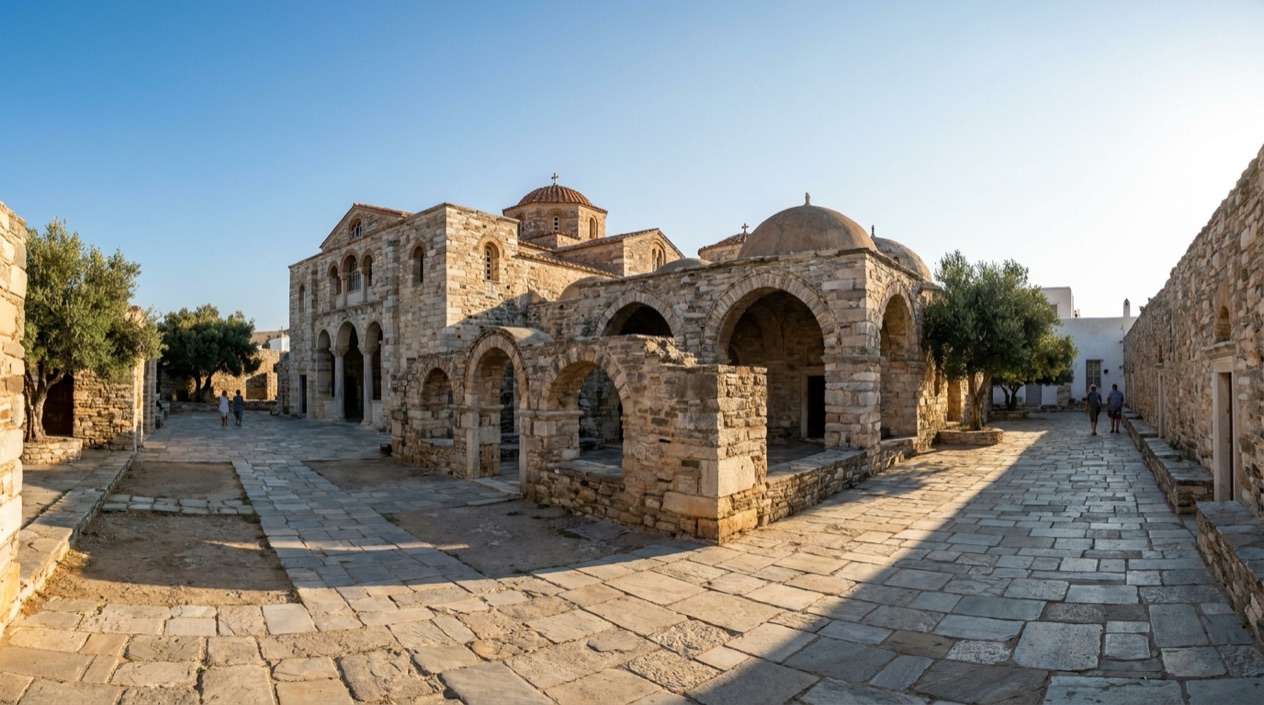
You come into Parikia from the harbor and the church is there among the town’s houses, a low cluster of domes and walls with a bell tower, set around a quiet courtyard. Step through the gate and the noise of the waterfront drops away. Ekatontapyliani is the great Byzantine church of Paros, and a visit here is about stone, icons and a very old story told inside a town you are already walking through.
Is visiting Ekatontapyliani worth it?
Yes, for anyone who wants Paros to be more than beaches and whitewashed lanes, and especially for travelers drawn to history, early Christian architecture and pilgrimage places. It sits in Parikia, the island’s port town, so it fits into a day when you arrive by ferry or stroll out from a café on the waterfront.
What sets it apart from the other churches of the Cyclades is its scale and its layers. This is not a single chapel but a church complex: a main church with two more chapels around it and a baptistery with a cruciform font.
The tradition that Saint Helen, the mother of Emperor Constantine, founded it on her way to the Holy Land gives the place the air of a very old pilgrimage stop, and the credit later given to Emperor Justinian for starting the construction adds another chapter. It is described as a renowned Marian pilgrimage church of the Aegean, second only to the Megalochare church on Tinos. That ranking tells you something about how people have treated this place for centuries: not as a monument to look at, but as a church that still receives the faithful.
Ekatontapyliani gives you a different Paros, one built around belief, memory and a long chain of builders. If your trip has room for only one cultural stop in town, this is the one that explains the island’s past.
What to see at Ekatontapyliani
The complex is best taken as a sequence of parts, each with its own character. Start in the courtyard, let your eyes adjust, then move inward from the main church to the chapels and finally the baptistery.
The main church
The main church is the heart of the complex and the part that gives the place its standing as a Marian sanctuary. The tradition says it was founded by Saint Helen during her pilgrimage, when she stopped to worship at a chapel already on the island. The date given for the church is 326, and its oldest features are thought to predate the moment Christianity became the state religion of the Roman Empire in 391.
Inside, look at how the building holds together the work of different periods. Later construction is credited to Justinian, and the church was badly damaged by an earthquake in the 18th century before being gradually restored.
When you stand under the dome, you are standing in a building that has been broken and rebuilt, and the patchwork is part of its interest. Notice the icons and the way light enters, and watch how worshippers behave, since this remains a living church.
The two side chapels
Around the main church stand two more chapels, which is what turns a single church into a complex. They are smaller and more intimate, and moving between them gives you a sense of how the sanctuary grew over time rather than being planned in one stroke.
Each chapel invites a slower look than the main space. Take in the icons, the proportions of the walls and the way the rooms connect to one another. The old chapel on Paros that the Saint Helen story mentions is part of the tradition that surrounds this ground, and the chapels are where that sense of layered history is easiest to feel.
The baptistery and its cruciform font
The baptistery is the detail visitors remember. Its font is cruciform, shaped like a cross, a form that speaks of the early centuries of the church when baptism was a central moment in a believer’s life. The font gives you something very concrete to look at, a piece of ritual furniture whose shape alone tells a story.
Spend a moment here after the larger spaces. The baptistery is where the age of the complex feels most direct, since the oldest features of the site are thought to go back before the late fourth century. Look at the outline of the font, then at the room around it, and imagine the long line of people who have passed through.
When to visit Ekatontapyliani
Parikia is a port, and the church sits among its streets, so the best moment is the one that suits your own day and your own season. Spring and autumn give the gentlest weather for walking through town and lingering in a courtyard, while summer brings the strongest sun and winter brings rain.
Air temperatures are those of Mykonos, the closest measurement point to Paros, and the rain figures are those of Paros itself. October is warmer still, with highs around 71°F, and about four days of measurable rain on Paros, so a late-season trip still gives you mostly dry streets.
| Month | Average high (°F) | Average low (°F) | Rain (inches) | Days with rain |
|---|---|---|---|---|
| January | 55.2 | 47.7 | 2.93 | 10.5 |
| April | 64.0 | 54.7 | 0.76 | 3.5 |
| July | 83.3 | 72.7 | 0.01 | 0.1 |
| October | 71.2 | 63.0 | 1.11 | 3.9 |
July is hot and almost without rain, so the courtyard and the stone interior are a welcome change from the sun, though the town outside is at its busiest holiday pace on an island described as one of the country’s most popular destinations. January is the other extreme, with more than ten days of rain on Paros, so a rain jacket belongs in the bag. A rainy winter day can suit this church well, since the visit takes place largely under a roof.
As for special dates, a Marian pilgrimage church naturally draws its largest gatherings around feasts of the Virgin. The Dormition of the Virgin is celebrated every year on August 15, and the details of any celebration are best left to the day itself, but if your trip lines up with a feast you may find the church and its courtyard far fuller and more devout than on an ordinary day.
Tips for your visit
Treat the church as a place of worship first and a sight second. Walk in quietly, keep your voice low and watch what others around you do. The complex is a working church, and its standing as a pilgrimage site means you may share the space with people who have come to pray.
Bring sun protection in summer, given the high averages in July, and a rain jacket in winter, given the rainy days of January. Comfortable shoes suit the stone surfaces of a courtyard and an old church. A camera is natural here, but let the moment of prayer or a service decide whether you raise it.
Getting to Parikia
The church is in Parikia town, so visitors reach it as soon as they reach Paros. Ferries and high-speed catamarans run daily from Athens (Piraeus), the Cyclades and Heraklion, Crete to Paros. Paros lies about 93 miles south-east of Piraeus, the port of Athens.
Olympic Air operates a daily air service from Athens to Paros, with a flight time of 30 to 45 minutes. However you arrive, the church is one of the sights of the town where you land, which makes it a natural first or last stop on the island.
Combining it with the rest of Paros
Paros is one of the largest islands of the Cyclades, and the rest of it rewards exploring. Naoussa and Lefkes are villages known for their traditional Cycladic charm, and they pair well with a visit to the church as a contrast between a Byzantine sanctuary and island village life.
The island is also tied to its marble. Parian marble was used in architecture and sculpture during the classical period, including for Praxiteles’ Hermes and the Venus de Milo. Keep that in mind as you look at the stonework in town, and you will see the church as part of a place that has long worked with stone.
Good to know before you go
Paros is in the center of the Cyclades, and the church stands in the middle of Parikia, so the practical side of a visit is simple: you are already in town. Carry some euros for coffee and small purchases around the harbor, and take the usual habits of any busy port. In summer, plan for strong sun and heat around the town, and in winter for rain.
Sources
- Wikipedia, Panagia Ekatontapiliani (https://en.wikipedia.org/wiki/Panagia_Ekatontapiliani), checked October 12, 2026
- Visit Greece (GNTO), Paros (https://www.visitgreece.gr/islands/cyclades/paros/), checked October 12, 2026
- Wikipedia, Paros (https://en.wikipedia.org/wiki/Paros), checked October 12, 2026
- Wikivoyage, Paros (https://en.wikivoyage.org/wiki/Paros), checked October 12, 2026
- Hellenic National Meteorological Service (HNMS), climatological normals 1991-2020 for Mykonos station (https://www.emy.gr/climatic-data), monthly mean daily maximum and minimum; rain from the ECMWF ERA5 reanalysis, 1991-2020, grid cell of Paros (Open-Meteo), checked October 12, 2026
- ECMWF ERA5 reanalysis 1991-2020, grid cell of Paros (Open-Meteo), checked October 12, 2026
To plan your stay
- Best Time to Visit Greece: September and Late May to Early June
- Arachova: Parnassus Mountain Town, Formaela Cheese, Ski Season and Saint George's Day
- American Airlines Flights to Greece: U.S. Cities, Athens Arrivals and Onward Island Flights
- Greece on a Budget: Cash Machines, Cards, Beaches and Ferries