
Monemvasia is a medieval castle town on a huge rock off the southeast Peloponnese, joined to the mainland by a single narrow causeway. Couples, history lovers and slow wanderers fall hard for it. A night inside the walls is worth planning the whole trip around. Spring and autumn are the best seasons to go, and winter brings near solitude among the locals. July and, above all, August bring heat and crowds.
Where should you stay in Monemvasia?
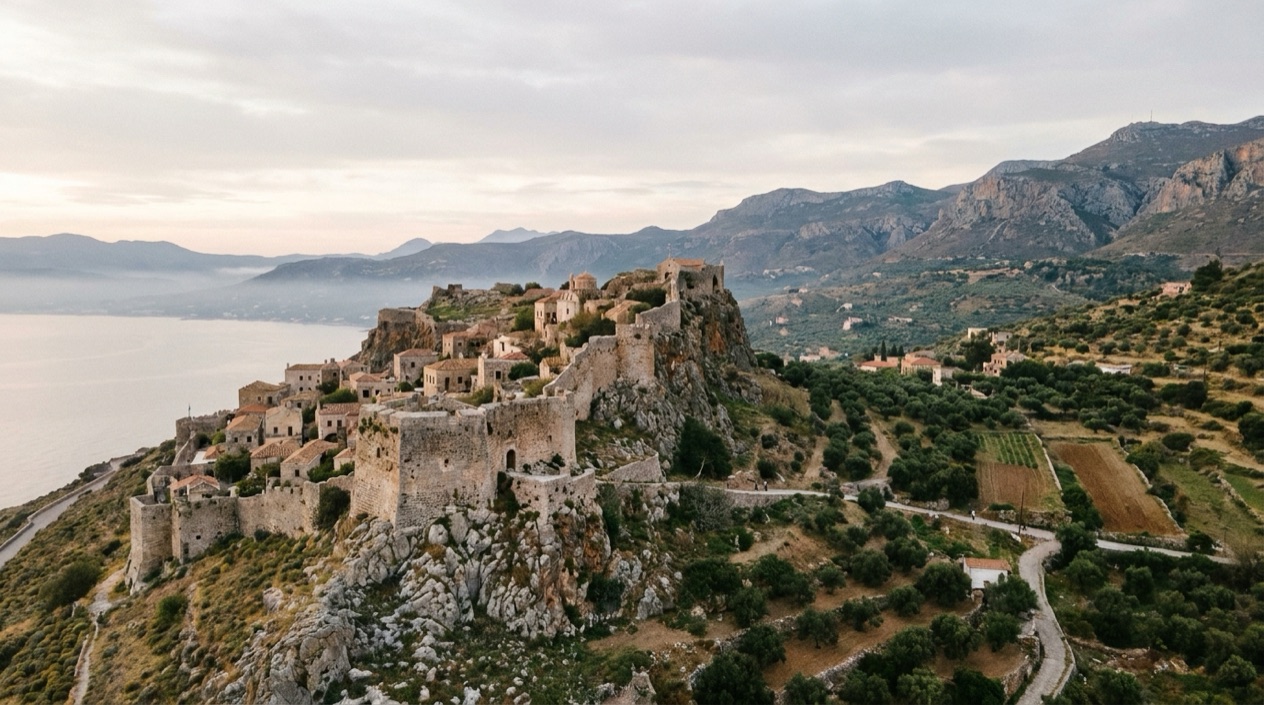
The town has two halves, and each makes for a different trip. The Lower Town sits inside the castle walls and is still lived in, a living museum of stone houses and arches. The modern town, called Gefyra, stretches along the coast across the causeway.
Inside the castle walls (Lower Town)
This is the dream version. Ask for the vaulted ceiling if you can. At dawn the lanes are empty, and you can watch the sunrise before the day-trippers arrive. At night the town is dimly lit and very quiet. It suits couples and anyone who wants the full time-travel effect.
Rates run higher than in the modern town, and the restaurants lean a little upscale. Staying inside is a once-in-a-lifetime experience, and it's worth giving up a night elsewhere or trimming other expenses to do it. The Lower Town has no vehicle traffic inside the walls, and the cobblestone streets are uneven, which is worth remembering if you're hauling a roller suitcase. Pack light, or plan to carry your bag from the gate.
The modern town (Gefyra)
Across the bridge you'll find cheaper hotels, apartments and guesthouses, along with more restaurants, livelier evenings and a full view of the rock. Some places sit right by the sea near the bridge. Others are on a hill facing the castle, about a ten-minute walk from the center. A few family-friendly apartment complexes sit several kilometers north of town.
Gefyra suits families, beach people and anyone on a tighter budget. Expect a walk of 15 to 20 minutes, slightly uphill, from the bridge to the castle gate, and closer to 30 minutes from farther into town. In July and August, book a room with air conditioning.
What are the best things to do in Monemvasia?
Start with the Lower Town. It's so compact you could walk all of it in minutes, and you'll still spend hours there. One main cobbled street, called Kalderimi by locals and officially named Yiannis Ritsos Street, runs from the main gate to Malvasia Café. It's lined with shops, cafés and restaurants, and a maze of narrow alleys branches off it. You won't need a map. Follow the stone paving and let yourself get a little lost. In summer the cobbles get slippery in the sun, the shiny black ones most of all, so wear shoes with good grip.
The main square holds the Christ Elkomenos church and an old mosque that now houses the Monemvasia Archaeological Collection. Get up early at least once to watch the sunrise from here. Near the gate, the terrace outside the house of poet Yiannis Ritsos has a lovely view. The house itself isn't open to visitors. The second square, Chrysafitissa, sits above the crashing waves beside the southern walls, with the Church of Panagia at its center. Past it, the restored Eastern Wall leads to a small gate and the lighthouse.
The Upper Town is the highlight for many visitors. It's a hillside of ruined mansions, Ottoman baths, Byzantine churches and old walls, with open views of the sea. The walk up Voltes, a winding fortified path, is quite steep, but the views at the top make it well worth the effort. It's steep in places, but the zigzags make it gradual enough for most people. The way down is harder because the stones can be slippery, so take extra care if rain is in the forecast. Go in the afternoon to avoid the strongest sun, and stay for sunset. Agia Sophia, nearly intact at the top, is the most impressive building up there. Walk a bit farther uphill to the Acropolis for the widest views.
For something more physical, walk the full perimeter of the rock in hiking shoes or sneakers. Start at the lighthouse just outside the walls and follow the red arrows. You'll reach the bridge in about an hour. The trickiest stretch is right at the start, where you pick your way over slippery stones along the edge. If it looks too scary, skip it. Go early in the morning, before the heat builds.
Portello is the place to sit and watch the sea. It was the sea entrance in medieval times. To get there from the main gate, turn right down any alley toward the outer walls and follow the wooden sign. You can sit on the black rocks and watch the waves, which feel especially dramatic when the wind picks up, as it often does. Strong swimmers dive in here too, but the water is deep and the waves hit the rocks hard.
Other add-ons:
- A tasting at the Monemvasia Winery in nearby Velies. Contact the winery first to check that tours are running.
- Signposted footpaths around Monemvasia. Pick up *Laconia's Traveler*, a free regional newspaper with trail maps.
- Day trips by car to Mystras, Gytheio, the Diros Caves and the Mani. Kastania Cave is about an hour south.
What are the best beaches in Monemvasia?
Pori beach, a couple of miles north of town, is the pick. It's long, sandy and clean, with shade trees, open sea and a view of the rock.
South of town are four smaller, very pleasant beaches, all reachable by car or bicycle: Xifias, Ampelakia, Livadia and Agios Fokas.
Near the castle, the swimming is simpler. Close to the bridge you'll find a long stretch of beach, and a small jetty sits at the roadside on the way to the main gate. A flat-stone area about a five-minute walk from the fortress toward the modern town works well for guests staying inside the walls. A small gate at the foot of the Lower Town opens onto a ladder that drops into the sea, and since the shore is rocky, calm days are the best time to swim there. Within walking distance of the modern town are several beaches, mostly stony but pleasant enough for a dip.
With a car and a free day, go farther. Elafonisos, to the south, has the kind of beaches people dream about. Farther north along the coast, the small town of Kyparissi has two stone beaches and is said to be one of the prettiest towns in Greece.
What should you eat in Monemvasia?
Eat inside the castle at least once. Restaurants and cafés line the Lower Town's main street, and some have rooftop seating that looks out over the sea wall.
- Voltes serves Greek food with a twist and has plenty of meatless dishes. Ask for the vaulted room and try the rosé house wine.
- Matoula has served traditional Greek dishes since 1950. Sit on the terrace when the weather allows, and save room for the orange pie.
- To Kanoni has a lovely terrace and good house wine, and it's your best bet for pizza or pasta when you want a break from Greek food.
- Chrisovoulo is one of the most popular places on the main street, known for traditional dishes and seafood.
- Oinomelo is another good choice for meze.
- Peinakothiki makes sweet and savory crepes, and cats lounge out front.
For drinks, Malvasia Café has some of the prettiest views in town, over the Lower Town and the sea. It's good for tea in the sun or a drink after dark. Café Byzantino overlooks the main square and is known for its breakfast buffet. Byron's Wine Tasting Bar looks like a movie set and pours a long list of wines. The terrace at Emvasis Café and Cocktail Bar and the tables at Enetiko Café and Cocktail Bar are good for an afternoon or evening drink.
The local wine is sweet Malvasia, made here since the Middle Ages. You can order a glass at almost any bar or restaurant in the castle. Bottles are hard to find outside the area, so buy one to take home.
Gerakas, a little harbor lying beside a salt water marsh and lake, is reached through a narrow channel, and it is thought to be a very sheltered spot. People from around the region drive long distances on rural roads for a fish lunch at Remezzos, the taverna there.
How many days do you need in Monemvasia?
Three full days give a first-time visitor plenty of time to enjoy the special feel of Monemvasia.
Day 1: The Lower Town and an evening stroll
Arrive, park by the bridge, walk or ride the minibus up to the gate, and settle into your room. Spend the afternoon on the main street and in the alleys, with stops in the main square and Chrysafitissa Square. Have a drink at Malvasia Café as the light softens, then head to dinner nearby and walk back through the near-empty lanes.
Day 2: The Upper Town and Portello
Rise early for the sunrise and a coffee in the main square. Spend the late morning at Portello on the black rocks. In the afternoon, climb to the Upper Town, visit the Agia Sophia Church and wander among the ruins, then enjoy the panoramic views from up there. Finish with dinner at Chrisovoulo.
Day 3: A beach day and a glass of wine
Drive to Pori for a long swim and shade under the trees, or head south to one of the smaller beaches. Come back for a late lunch, then a tasting at Byron's. With a fourth day, you could hike the perimeter of the castle in the morning, starting from the lighthouse just outside the walls, or drive south to Elafonisos for its beaches.
How do you get to Monemvasia and around?
Driving is the easiest way to get here. The trip takes about four to four and a half hours from Athens and roughly two and a half from Kalamata. A car also lets you reach beaches and villages around the area, including Elafonisos to the south and several beaches on the western coast. If you don't have a car, KTEL intercity buses run to Monemvasia from Athens, Kalamata, Sparta and other towns nearby. Daily buses take about 4.5 to 5 hours from the capital and 3 to 3.5 hours from Kalamata, so check the timetable before you go. The Flying Dolphin and ferry services no longer run.
There's ample free parking by the bridge. From there, walk up to the main gate or take the minibus, which runs often in summer. The rules change often, so ask your hotel first.
What do Americans need to know before visiting Monemvasia?
U.S. citizens can visit Greece without a visa for up to 90 days of tourism. Your passport should have at least three months of validity beyond your planned departure date. A passport that has been reported lost or stolen will be refused at the border. You may also be asked for proof of funds and a return or onward ticket.
Greek law requires visitors who drive to carry a valid U.S. driver's license, and insurance companies may require an international driver’s permit. Thieves in Greece break into rental cars to steal passports, valuables and luggage, so it's wise to keep valuables with you, including when you park at the bridge. Greece is generally safe, but petty crime is common at popular tourist spots.
Strikes and demonstrations are common and can disrupt buses and other transportation, so build some slack into travel days. Forest fires are common in the dry summer months and occasionally close roads. Before a long summer drive, check road conditions with your hotel.
Sources
- Visit Greece (GNTO) (https://www.visitgreece.gr/mainland/peloponnese/monemvasia), checked October 18, 2026
- greecetravel.com (https://www.greecetravel.com/monemvasia/), checked October 18, 2026
- kastra.eu (https://www.kastra.eu/castleen.php?kastro=monemvasia), checked October 18, 2026
- itsalltriptome.com (https://www.itsalltriptome.com/monemvasia/), checked October 18, 2026
- nothingfamiliar.com (https://www.nothingfamiliar.com/monemvasia-greece/), checked October 18, 2026
- U.S. Department of State (https://travel.state.gov/content/travel/en/international-travel/International-Travel-Country-Information-Pages/Greece.html), checked October 15, 2026
- U.S. Department of State (https://travel.state.gov/content/tsg_aem/us/en/home/international-travel/travel-advisories/destination.grc.html), checked October 15, 2026