
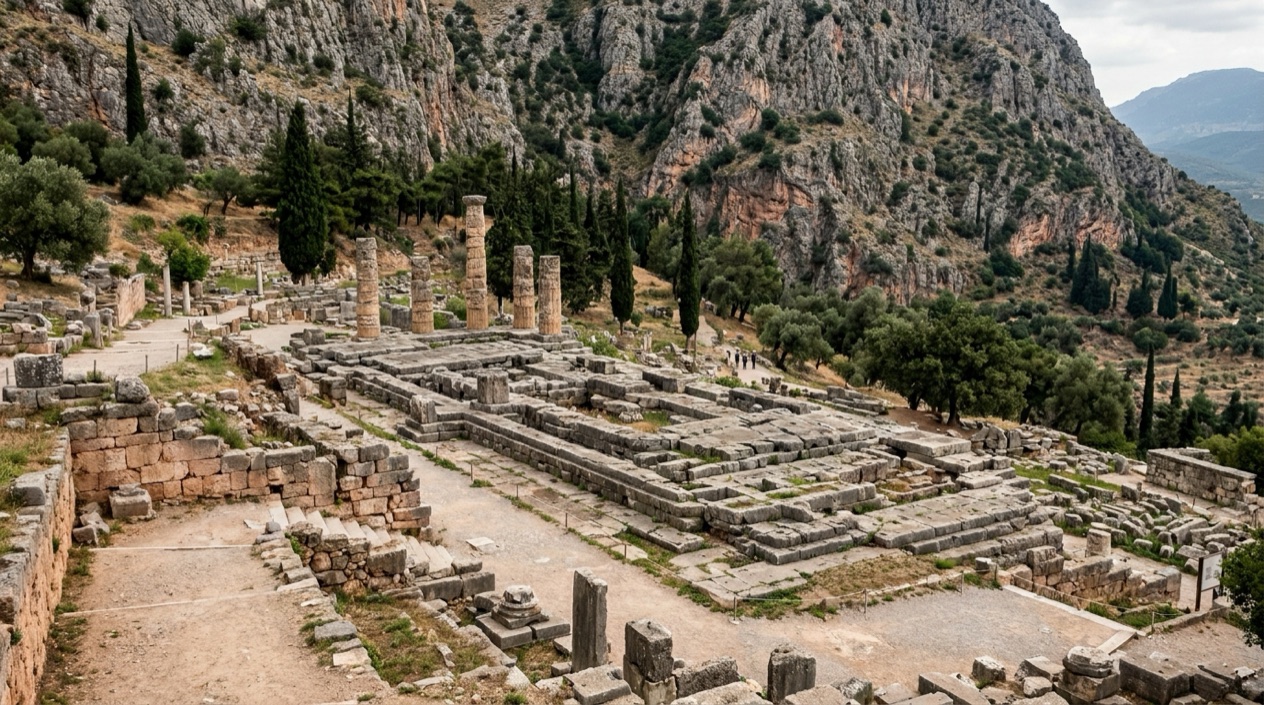
Cypress and olive trees crowd the lower slope, the valley drops away behind you, and the stone path turns upward between broken columns and the bases of vanished statues. Delphi sits on the southwestern flank of Mount Parnassus, and from the first bend you feel how the ancient Greeks chose the spot: high, hushed and facing a great sweep of land. The visit is an open-air walk up a sacred hillside, with a museum of extraordinary bronze and marble close by.
Is visiting Delphi worth it?
Yes, for anyone who wants to stand where the Greeks went to ask the gods about war, marriage, colonies and harvests, and who is happy to climb a hillside to do it. The reward is as much the setting as the stones. Delphi was considered the navel of the Earth in antiquity, a spiritual meeting place that held the most important oracle of ancient Greece, and the ground still carries that weight.
What separates Delphi from other ancient sites is that it was never a city or a palace. It was a sanctuary, a precinct where cities competed to leave the finest offerings and where people from every corner of the Greek world gathered.
You read it differently from a town ruin: the monuments are gifts, thank-offerings and boasts, set along a winding path that rises toward the temple of Apollo. The site stands on a scarp 1,600 feet above the valley floor, so the views are part of the experience from beginning to end.
It also gives you more than ruins. The museum holds the Charioteer of Delphi, the Sphinx of Naxos and the earliest known notation of a melody, which means you can follow a visit among the stones with a look at what those stones once held. The theatre and the stadium add the entertainment side of the sanctuary, since this was a place of song, drama and athletic contests as well as prophecy.
It suits history lovers, anyone drawn to Greek myth, photographers and travelers who like to pair a landscape with a story. Those who want a beach day or a lively resort will find the pace here quite different. The modern town next door has hotels and tavernas for lingering over a meal once the walking is done, and that mix of old stones and a welcoming village is much of the charm.
The ancient precinct is open to the public for a fee, and the road that brings you, Greek National Road 48 between Amfissa and Livadeia, runs right past the modern town. UNESCO designated the site a World Heritage Site in 1987, a recognition of how much of the sanctuary still survives on its mountainside.
What to see at Delphi
The sanctuary climbs in stages, and each stage had a purpose for the pilgrims who made the walk: purification, offering, consultation, then celebration. Following that order gives the ruins a story rather than leaving them a scatter of stone.
The Sacred Way and the Temple of Apollo
The main path zigzags up the slope past the foundations of treasuries, small buildings that cities raised to hold their offerings to the god. Statues once lined the route, and the stone bases still show where they stood. Look for the Athenian Treasury, rebuilt in marble beside the path, as a sense of what these little monuments looked like.
At the top stands the terrace of the Temple of Apollo, where the oracle once sat. Visitors came to put questions to the god, and the priestess known as the Pythia answered in a voice that priests then interpreted. Only the foundations and a few columns remain, but the terrace gives you the wide view over the valley that the ancients also had.
The theatre and the stadium
Above the temple, the ancient theatre could hold approximately 4,500 spectators. The curved rows of seats look out over the sanctuary and the valley, so the audience watched drama and heard music with the whole landscape as a backdrop. Stand on the upper rows and you can trace the path you climbed, with the temple terrace beneath you.
Higher still lies the stadium, which could seat 6,500 spectators. It was here that athletes competed in the games held at the sanctuary, and the long, narrow track and the stone seating along its sides remain clear on the hillside. It is the highest point of the main walk, and the view back over the ruins makes the climb feel earned.
The Castalian Spring and the Phaedriades
The Castalian Spring rises in the ravine of the Phaedriades, the great rock walls that rise above the sanctuary. Pilgrims came to wash here before approaching the god, and the remains of two monumental fountains still stand.
The Tholos and the sanctuary of Athena Pronaia
The circular plan is what sets it apart from the rectangular temples around it. Its position away from the main precinct gives it a calmer feel, and it makes a good contrast to the busier climb.
The ancient gymnasium lies at a similar distance from the main sanctuary. It had a palaestra, a pool and baths, and the water was believed to give the ability to communicate directly with Apollo. It is a reminder that athletes and visitors prepared body and spirit before approaching the god.
The Delphi Archaeological Museum
The museum houses the pieces that make the ruins come alive. The Charioteer of Delphi, a bronze figure with inlaid eyes, is the centerpiece, and the Sphinx of Naxos recalls the offerings that cities raised on tall columns. The collection also includes the earliest known notation of a melody, a reminder that music was part of worship here.
Visiting the museum after the ruins lets you place each object in the landscape you have just walked. Visiting it before helps you picture what once stood on the empty bases along the path. Either way, it turns the sanctuary from a set of foundations into a place full of dedications, faces and voices.
When to visit Delphi
Summer is when Delphi is at its busiest: the modern town teems with visitors who spend a few hours before or after their visit to the archaeological site. That energy gives the town streets a lively feel, with the tavernas and hotels along them in full use. If you like company and a lively evening meal after a day among ruins, summer matches that mood.
The precinct is an open-air hillside, which shapes every season. The path climbs from the lower sanctuary to the stadium, and you are outdoors for the whole walk, with the sun, wind or rain of the day above you. In the warm months, sun protection and water are sensible, and in the cooler or wetter months a rain jacket and warm layers make more sense. Sturdy shoes suit the stone paths in any weather.
Because the site stands high above the valley on the slope of Mount Parnassus, the view is a large part of the experience, and clear skies reward the climb. Neither is a wrong choice, and it is worth deciding what you want from the place before you fix your dates.
Since the town fills with visitors in summer, travelers who prefer a calmer setting may want to look at other times of year, when the streets of the modern village and the paths of the sanctuary feel less like a gathering point. Whichever month you choose, the museum gives you a roof for a part of the visit if the weather turns.
Think of the sanctuary the way the ancient pilgrims did: a destination reached by a long road, where the effort of arriving is part of the meaning. Decide how much of your day you want to give to the climb and to the museum, and let the season shape the rest. A long lunch in the town afterward fits any month.
Tips for your visit
Wear shoes with a solid grip, because the sanctuary path is made of old stone and climbs the slope the whole way up to the stadium. The site stands on a scarp 1,600 feet above the valley floor, so a day here is a hillside walk, and your legs will feel the ascent. Bring water and sun protection for warm months, and a rain jacket if the weather looks unsettled.
Planning the day around the ruins and the museum
The ancient precinct and the museum are separate stops, so plan to visit both rather than choosing one. The ruins give you the layout and the views, while the museum gives you the objects, including the Charioteer and the Sphinx of Naxos. Travelers like to walk the sanctuary first, then see the finds with the setting fresh in mind.
The Tholos at the sanctuary of Athena Pronaia and the ancient gymnasium lie apart from the main ruins, so they reward a separate stop. Treat them as a second chapter of the visit, with a different mood from the climb through the main precinct. Both bring you closer to the ritual side of Delphi, the purification and preparation that came before the consultation.
Combining Delphi with the modern town
The modern town lies very close to the archaeological site and spreads across two streets lined with traditional small houses, hotels and tavernas. It was created after buildings were removed from the sacred precinct to allow excavation, so the village and the ruins have a shared history. After the climb, a table at a taverna is the natural way to finish the day, with plates of grilled meat, local cheese, salads and bread.
Staying in the town lets you spend an evening there once the day visitors have gone, with the valley and the mountain slope as scenery. The town sits on Greek National Road 48 between Amfissa and Livadeia, which places it along a through route and makes it a convenient base for a stop in central Greece.
Families and mobility
Children who like stories tend to enjoy Delphi, because the myths are vivid: the god Apollo, the priestess on her seat, the pilgrims bringing questions. The theatre and the stadium give them room to picture performances and races. The paths are old stone on a slope, so those with limited mobility should think carefully about how much of the ascent they want to take on.
A good approach is to choose the parts that matter most to your group, such as the temple terrace, the theatre or the museum, and treat the stadium as an optional last climb. The museum offers a rest from the slope and a way to see the highlights of the sanctuary without the walk.
Good to know before you go
The ancient site is open to visitors for a fee, and the modern town around it has hotels and tavernas where you can settle the bill for meals and rooms. Take sun protection and water into the open-air precinct in warm weather, and expect the paths to be uneven stone.
Summer brings crowds to the town, so the streets feel lively then. When you plan the day, leave room for the museum, the Tholos and the walk back down to the village.
Sources
- Wikipedia, Delphi (https://en.wikipedia.org/wiki/Delphi), checked October 12, 2026
- Visit Greece (GNTO), Delphi (https://www.visitgreece.gr/mainland/central-greece/delphi/), checked October 12, 2026
- Wikivoyage, Delphi (https://en.wikivoyage.org/wiki/Delphi), checked October 12, 2026