
Evening in Corfu Town means strolling stone-paved alleys between Venetian palaces and church bell towers, then settling at a café table on the edge of the Spianada. On Kefalonia, boats knock gently against the quay at Fiskardo while the smell of grilled fish drifts across the waterfront. Both islands sit in the Ionian Sea, and the choice between them comes down to whether you want a UNESCO-listed old town or a larger, wilder island of caves, mountains and wine.
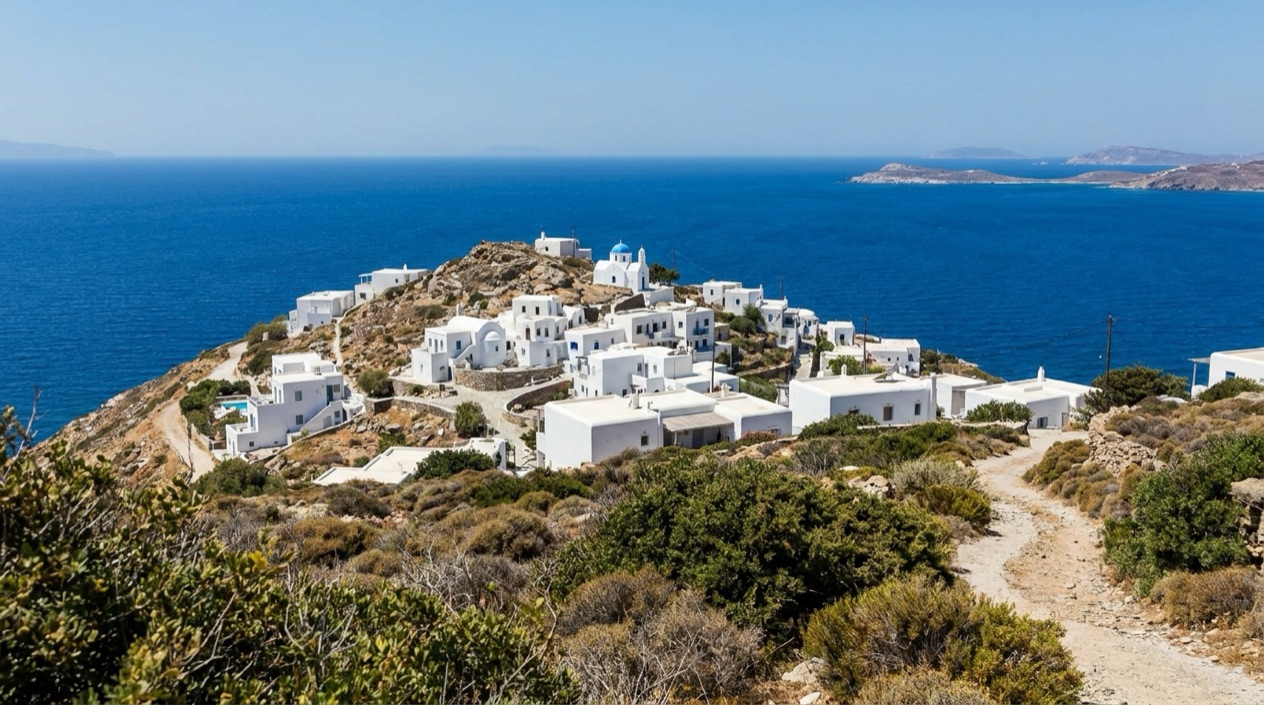
Which is better, Corfu or Kefalonia?
Corfu is better for travelers who want a town to wander, with palaces, fortresses and a layered history, while Kefalonia is better for those who want an island to explore, with caves, a mountain, a wine slope and ferry ports to hop onward from. Neither wins outright. They are two different kinds of Ionian island, and the table lays out the contrast.
| Category | Corfu | Kefalonia |
|---|---|---|
| Beaches | Golden sand or white pebbles along the coastline | Waters that give refuge to loggerhead sea turtles and Mediterranean monk seals |
| Vibe | A museum city of Greek and Western architecture, with a UNESCO-listed old town | Rebuilt towns of functional concrete, with Fiskardo the one village that stayed intact |
| Things to do | Old Fortress, Achilleion, Mon Repos and ancient Korkyra | Melissani lake, Drogarati cave, Assos Castle, amphorae off Agia Efimia and Skala |
| Food | Island kitchen of the Ionian, from the old town tavernas | Robola white wine from the slopes of Mount Ainos, plus the island’s meat pies |
| Weather | Wet in January, nearly dry in July (see the climate table) | Mountain peaks with the endemic Cephalonian fir, sea around the coast |
| Getting there | Flights from Athens and Thessaloniki, ferries and cruise ships into Corfu Town | Ferry harbors at Sami, Poros, Argostoli and Fiscardo |
| Best for | Architecture, history and town evenings | Nature, caves, wine and island-hopping |
Read the table as a sorting tool. If your ideal day ends in a plaza with a drink in hand, lean toward Corfu. If it ends after a cave, a mountain drive and a harbor lunch, lean toward Kefalonia.
One more difference shapes the feel of each island. Corfu is the northernmost of the Ionian Islands, lying off the far northwest coast of Greece in the Adriatic, with Italy to the west and Albania to the northeast. Kefalonia is the largest island in the Ionian Sea, and its size means a stay there is spread over several bases rather than gathered around one town.
Sights, beaches and food
Corfu’s great sight is its capital. The old town of Corfu city is a UNESCO World Heritage Site, inscribed in 2007, and it reads like a museum city where Greek and Western architecture blend.
Palaces, squares, churches and stone-paved alleys fill the historic center, and the Palace of St. Michael and St. George, built in 1815 of white Maltese stone, is a reminder of the British years. The Old Fortress, a Venetian fortress, anchors the city’s edge.
Corfu’s coastline carries beaches of golden sand or white pebbles, so you can pick a stretch by the color underfoot. Beyond the town, the Achilleion looks out over the city of Corfu and the southern part of the island, framed by the Ionian Sea. Corfu’s table draws on the same mix of Ionian and Venetian influences: slow-cooked dishes such as pastitsada and sofrito, spicy fish stew called bourdeto, and kumquat in liqueurs and sweets.
Kefalonia’s sights are less about streets and more about the land itself. Melissani, an underground lake, and Drogarati cave are the natural attractions most often named, and Assos Castle, built by the Venetians in 1596, stands among the island’s main tourist attractions. The seabed at Agia Efimia and Skala hides ancient amphorae, and loggerhead sea turtles and monk seals find refuge in the waters around the island.
The island’s towns were leveled in the 1953 earthquake, apart from Fiskardo, so most of what you see is functional concrete construction. Fiskardo, the one place that survived intact, is where the older look of the island remains. At the table, Kefalonia offers Robola, the white wine grown on the slopes of Mount Ainos, and the island’s meat pie, the kind of dish that goes well with a glass of that wine on a taverna terrace.
On sights alone, Corfu wins for a traveler who wants a city built to be walked and admired. Kefalonia wins for one who prefers natural features, a wine slope and a harbor village. On food, the two are matched: Corfu leans on its old-town kitchens, Kefalonia on its wine and pies. Choose by what you want to look at while you eat.
Things to do
Corfu: a town, a fortress and ancient Korkyra
The core of a Corfu stay is the old town, where the Old Fortress, the palaces and the squares and churches reward unhurried wandering. The Ionian Parliament and the Spianada Park are the subject of a restoration the municipality has announced progress on, so the green heart of the city is in the middle of renewal. Cafés on the edge of the park suit a long coffee break between sights.
Corfu also carries an ancient layer. The ruins of ancient Korkyra, called Palaiopolis, lie at the site of the palace of Mon Repos, which was built on top of them. Two Archaic temples add to the picture.
The Temple of Artemis, built around 580 BC in what is now the suburb of Garitsa, is known as the first Doric temple built exclusively of stone. Kardaki Temple, built around 500 BC on Analipsi Hill, is considered the only Doric Greek temple without a frieze.
For a view, the Achilleion offers a panorama of the city of Corfu to the north and the southern part of the island. Together with a beach day on golden sand or white pebbles, that is a full Corfu week without leaving the area around the capital.
Kefalonia: caves, castles and the sea
Kefalonia rewards a driver’s curiosity. Melissani Cave and its underground lake lie northwest of the town of Sami, and Drogarati cave is another natural attraction on the island. The Geopark Kefalonia Ithaka designates 50 sites as Geosites, which gives a hiker or a curious driver a long list of stops across the landscape.
History here is physical too. Assos Castle, built by the Venetians in 1596, stands as a main attraction. Near Poros in the southeast, at the outskirts of Tzanata, a Mycenaean Tholos tomb sits among olive trees, cypresses and oaks. It was erected around 1300 BC, and it is the largest tholos tomb yet found in northwestern Greece. In Fiskardo, a Roman grave complex was uncovered in late 2006 during excavation for a new hotel foundation.
Water adds another layer. The seabed at Agia Efimia and Skala hides ancient amphorae to explore, and the waters around the island shelter loggerhead turtles and monk seals, which you may glimpse if luck is with you. The ferry harbors also make day trips possible: Sami links to Ithaca, Fiscardo to Lefkas and Ithaca, and Argostoli to Zante.
Weather and the best time to go
Corfu has two clear seasons in the figures: a wet winter and a nearly dry summer. At Aktion, on the mainland coast south-east of Corfu, highs average in the mid-80s in July and in the mid-50s in January. The rain figures are those of Corfu itself, and they say it all: January is a month of heavy rain on many days, July a month of sunshine with only a couple of showery days.
| Month | Average high (°F) | Average low (°F) | Precipitation (inches) | Days with rain (1 mm or more) |
|---|---|---|---|---|
| January | 55.8 | 44.1 | 5.06 | 11.3 |
| July | 85.8 | 69.6 | 0.58 | 2.4 |
In practice, a January visit to Corfu means a rain jacket and a plan for indoor sights, which the old town provides in its churches and palaces. July, with high averages, calls for sun protection and a day that revolves around the beach. The hot months suit the golden-sand and white-pebble coast, and the old town can be explored with a sunhat in the long light.
On Kefalonia, the seasons show in the landscape and the sea. The endemic Cephalonian fir grows on the peaks of Mount Ainos, and Robola grapes ripen on its slopes, so the mountain is a place to look at in any month. The sea around the island is where loggerhead turtles and monk seals find refuge, and a boat trip or a swim from a harbor village puts you in their waters.
The ferry between Argostoli and Lixouri runs at a higher rhythm in the season, which hints at when the island is at its busiest. Plan Kefalonia around its outdoor draws, the caves, the mountain, the coast and the harbors, and you will find a reason to go in any month. Plan Corfu around the rain table: pick July for beaches, or accept a wetter January for the old town in a quieter frame.
Getting there and getting around
Corfu is reached by air or sea at the same spot. Corfu International Airport, Ioannis Kapodistrias, sits in Corfu Town, where most cruise ships and long-distance ferries dock. Flights from Athens International Airport take 1 hour 15 minutes, and from Thessaloniki Airport Macedonia they take 55 minutes.
That concentration means the capital is the natural gateway, and everything else on the island fans out from the town. The Achilleion and the beaches are reached from there, and the old town itself is the place where the island’s arrivals begin and end.
Kefalonia works differently, built around four main ferry harbors. Sami, on the eastern part of the island, links to Patras and to Ithaca, and it is where the ferry from Patra on the mainland arrives. Poros has routes to Kyllini. Argostoli, the largest harbor, connects to Zante and Lixouri. Fiscardo links to Lefkas and Ithaca.
Within the island, Argostoli is the administrative seat and the main town, and the island is divided into three municipalities: Argostoli, Lixouri and Sami. The ferry between Argostoli and Lixouri runs every hour, and every half-hour in the season. A Kefalonia trip therefore tends to be organized around its harbors, with the caves, Assos, Tzanata and Fiskardo as stops between them.
Which route joins them is a question for the ferry timetables rather than this comparison, but both islands are well placed to plug into a wider Ionian itinerary.
Who should choose which
Choose Corfu if your idea of a vacation is a historic town. The old town is UNESCO-listed, with palaces, squares and churches, and the Old Fortress, Mon Repos and the Achilleion give you days of sightseeing without leaving the capital’s orbit.
Choose Kefalonia if you want a bigger island to explore by its landscape. Caves, an underground lake, a Venetian castle, a mountain with its own fir, a wine slope and the waters of turtles and monk seals fill a week, and the ferry harbors open day trips to neighboring islands. Fiskardo gives you the older village feel that the rest of the island lost in 1953.
Combining the two is possible for a longer trip, because both belong to the Ionian chain, with Corfu the northernmost and Kefalonia the largest. Split the time so that Corfu gives you town evenings and Kefalonia gives you cave, mountain and harbor days. If you only have time for one, let the first question decide it: a town to wander, or an island to roam.
Good to know before you go
Both islands reward a little planning around place rather than around rules of thumb. In Corfu, the historic center is where the sights gather, and the Spianada Park and the Ionian Parliament are being restored, so parts of the city may look like a work in progress. In Kefalonia, remember that the rebuilt towns are mostly concrete, and that Fiskardo, the intact village, is the exception.
Pack for the table rather than for the postcard: a rain jacket for a wet Corfu winter, sun protection for a hot summer, and shoes that suit cave floors and castle stones on Kefalonia.
Sources
- Corfu official tourism site (https://www.corfu.gr/), checked October 12, 2026
- Visit Greece (GNTO), Corfu (https://www.visitgreece.gr/islands/ionian-islands/corfu/), checked October 12, 2026
- Wikipedia, Corfu (city) (https://en.wikipedia.org/wiki/Corfu_(city)), checked October 12, 2026
- Wikivoyage, Corfu (https://en.wikivoyage.org/wiki/Corfu), checked October 12, 2026
- Wikipedia, Corfu, section Archaeology (https://en.wikipedia.org/wiki/Corfu#Archaeology), checked October 12, 2026
- Hellenic National Meteorological Service (HNMS), climatological normals 1991-2020 for Aktion station (https://www.emy.gr/climatic-data), monthly mean daily maximum and minimum; rain from the ECMWF ERA5 reanalysis, 1991-2020, grid cell of Corfu (Open-Meteo), checked October 12, 2026
- ECMWF ERA5 reanalysis 1991-2020, grid cell of Corfu (Open-Meteo), checked October 12, 2026
- Wikipedia, Old Fortress of Corfu (https://en.wikipedia.org/wiki/Old_Fortress_of_Corfu), checked October 12, 2026
- Wikipedia, Achilleion (Corfu) (https://en.wikipedia.org/wiki/Achilleion_(Corfu)), checked October 12, 2026
- Visit Greece (GNTO), Kefalonia (https://www.visitgreece.gr/islands/ionian-islands/kefalonia/), checked October 12, 2026
- Wikipedia, Kefalonia (https://en.wikipedia.org/wiki/Kefalonia), checked October 12, 2026
- Wikivoyage, Kefalonia (https://en.wikivoyage.org/wiki/Kefalonia), checked October 12, 2026
- Wikipedia, Fiskardo (https://en.wikipedia.org/wiki/Fiskardo), checked October 12, 2026
- Wikipedia, Melissani Cave (https://en.wikipedia.org/wiki/Melissani_Cave), checked October 12, 2026
- Wikipedia, Cephalonia (https://en.wikipedia.org/wiki/Cephalonia), checked October 12, 2026